
CodingSoftware & developer tools
Simon Willison says Claude Opus 5.5 can now vibe code browser games that are fun to play
Simon Willison argues October 2026 marks the point where AI models moved from building game-like prototypes to playable, enjoyable games, citing four browser games he vibe coded mostly with Claude Opus 5.5, each taking no more than four hours of his own time.
From the Simon Willison article of October 28, 2026 and cited sources: Willison presents this as a follow-up to his November 2025 argument about coding agents. [1] [3]
SOURCES[1] The October inflection point for vibe game development simonwillison.net[3] november-2025-inflection tag — Simon Willison simonwillison.net
 AT Pulse research deskPublished · Updated · 5 min read · AI-assisted analysis
AI-assisted, not human-edited. Methodology Corrections Who owns this site
- What happened
- Willison presents this as a follow-up to his November 2025 argument about coding agents. [1] [3]
- Original source
- Simon Willison article, independent perspective
- Brief by
- AT Pulse research desk AI-assisted; publisher and contact on the desk page
- When
- October 28, 2026 article published
- Covered
- Oct 28 edition
- Evidence
- 9 sources across 7 sites
- 1The October inflection point for vibe game developmentsimonwillison.net
- 2I think October represents another inflection point in…x.com
- 3november-2025-inflection tag — Simon Willisonsimonwillison.net
- 4Battle Drones — Simon Willisonsimonwillison.net
- 5Anthropic releases Opus 5.5 — TechCrunchtechcrunch.com
- 6Steam Next Fest under fire — Time Extensiontimeextension.com
RisingHow it’s measured
Hacker News · 4 likes · 4 comments
Reach blends public engagement (views, likes, comments, shares, stars) from the platforms where the story or its original source lives: YouTube, Hacker News, GitHub, Substack and similar. A video and the article written from its transcript share one score, taken from the video. Platforms with no data are left out rather than counted as zero, and the age of a story never lowers its score.
Willison presents this as a follow-up to his November 2025 argument about coding agents. His new claim is that Opus 5.5 grasps game design and what makes a game fun. In his informal side-by-side builds, GPT-6 Astra could make working games, but they were less enjoyable to play. [1] [3]
Battle Drones started as a Claude Fable 5 prototype that ran but was not great to play. Asking the agent to make it much more fun started an overnight session with more than 1,000 simulated playtests. The released game took 12 major iterations and 321 agent commits, Willison barely reviewed the code, and it is open source under Apache 2.0. [1] [4]
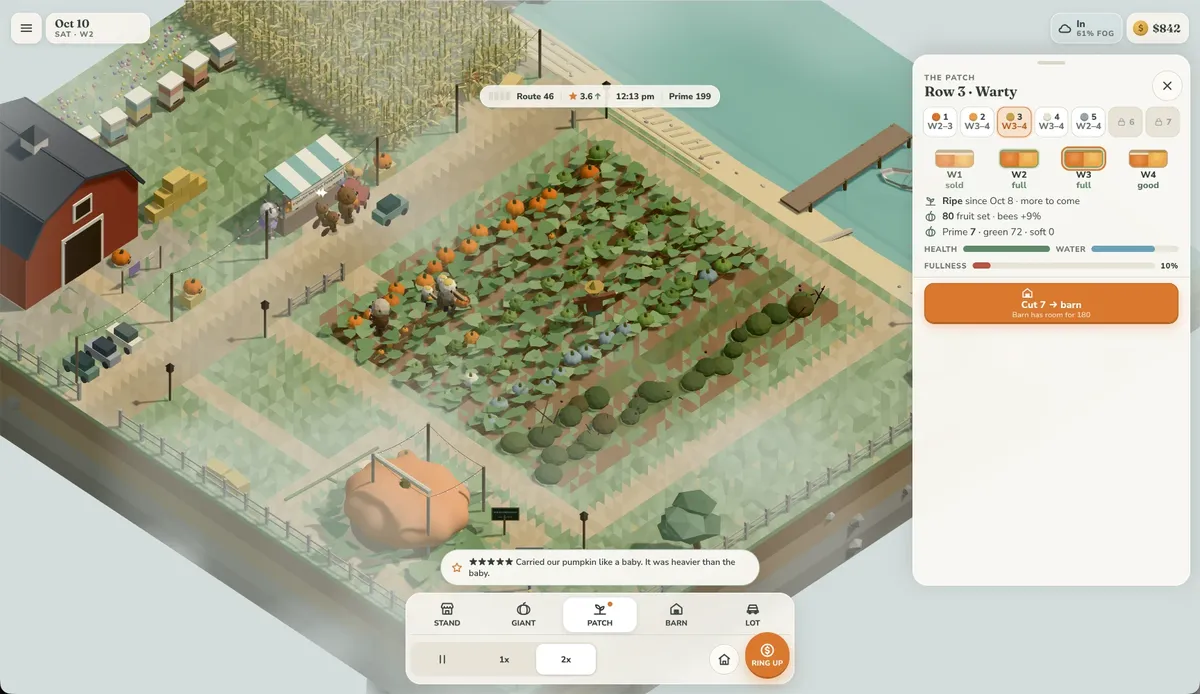
The amount of steering varied by game. Tree Appreciator came from one prompt. Emberwick was built in stages and needed extra rounds to fix quest-state bugs. The farming game Quarter Sun Cove grew from a brainstormed spec file into a Claude Code Ultracode run of nearly two days. His suggested workflow is to start with a three.js prompt in chat and move to an agent once the idea works. [1]
The claim arrives as Steam's October Next Fest drew about 8,200 demos, nearly double June's count, and players complained that AI-generated filler made good games hard to find. An Aftermath analysis from 2025 argued that Steam's algorithm already buries low-effort releases, and that the real problem is too many good games competing for attention. [6] [9]
one developer's four games and agent self-play, not human playtests. Implication: if the pattern holds, playable prototypes cost hours of human time plus compute, changing how studios test concepts.
Read the full assessment
Meanwhile, storefronts like Steam already strain under rising, partly AI-generated demo volume.
Executive brief
Simon Willison argues that October 2026 is the point where AI models went from building things that look like games to building games that are fun to play. His evidence is personal: four browser games he vibe coded without reading the code, mostly with Claude Opus 5.5. In his telling, the prompt "Make it a LOT more fun" turned a dull strategy prototype into a game he enjoyed. He says he spent no more than four hours on any one project, and an agent did much of the rest. Nobody has independently checked the "fun" claim. It is landing at the same time as a backlash against AI-generated demos flooding Steam Next Fest (Willison).
What changed and event timeline
Opus 4.5 sets the earlier benchmark
Willison later described November 2025 as the month coding agents went from "mostly works" to "almost always does what you want." That earlier shift is what he is comparing October 2026 against ().
Battle Drones prototype
The first versions of his Command & Conquer-style game were built with Claude Fable 5. They worked as a 2D game but, in his words, were not great to play ().
Steam Next Fest backlash
Roughly 8,200 demos took part, close to double June's count. Players complained that low-effort, AI-generated titles made it hard to find good games ().
Opus 5.5 ships
Anthropic released Opus 5.5, cut output pricing from $25 to $20 per million tokens, and said the model outperforms the larger Fable on many benchmarks ().
Battle Drones released
The game took 12 major iterations and 321 agent commits, and Willison says he reviewed almost none of the code. It is open source under Apache 2.0 ().
The "inflection point" post
Willison argues that Opus 5.5 understands game design and fun. In his informal testing, GPT-6 Astra builds games but plays less well ().
Capabilities and access
- Main model: Claude Opus 5.5. Willison used the standard Claude chat interface, Claude Code with the Ultracode mode, and an "Opus 5.5 Extra" setting.
- Where to get it: Opus 5.5 is available through Anthropic's API (TechCrunch).
- OpenAI models he compared: GPT-6 Pro, GPT-6 Astra and GPT-6 Extra High, plus GPT-6 Luna as an AI opponent in Battle Drones.
Read the full section
- Main model: Claude Opus 5.5. Willison used the standard Claude chat interface, Claude Code with the Ultracode mode, and an "Opus 5.5 Extra" setting. He credits it with gains in 3D modelling, music generation and game design (Willison).
- Where to get it: Opus 5.5 is available through Anthropic's API (TechCrunch).
- OpenAI models he compared: GPT-6 Pro, GPT-6 Astra and GPT-6 Extra High, plus GPT-6 Luna as an AI opponent in Battle Drones.
- Stack: HTML/JavaScript with three.js or Phaser, hosted as static pages on GitHub Pages or Cloudflare Pages.
Technical analysis for researchers and developers
- How the games were built:
- Tree Appreciator: one prompt, no follow-ups.
- Emberwick: a fantasy RPG grown in stages, from engine demo to added terrain to a full game.
Read the full section
- How the games were built:
- Tree Appreciator: one prompt, no follow-ups.
- Emberwick: a fantasy RPG grown in stages, from engine demo to added terrain to a full game. It needed extra rounds of playtesting and prompting to fix quest-state bugs, such as a character being in the wrong place to complete a quest.
- Quarter Sun Cove (pumpkin farming): a brainstorming session produced a spec file, then Ultracode ran for nearly two days (Willison).
- How "fun" was evaluated: The Battle Drones "more fun" pass ran an overnight session that included more than 1,000 simulated playtests (Battle Drones write-up). That is self-play by the agent, not a study with human players.
- Models playing each other: Battle Drones has a mode where the game advances five seconds, then pauses so each model can read the state and issue commands. This could be reused as an informal test bed for comparing models.
- Reproducibility: The chat transcripts and repository are public, so others can rerun the prompts. Outputs will vary from run to run.
Claims and evidence
- "Opus 5.5 knows what fun is." This is one author's subjective judgement across four games (Willison). No independent playtest or benchmark backs it up.
- "GPT-6 Astra isn't quite there." Willison himself says this comes from a non-exhaustive comparison, including side-by-side Emberwick builds.
- Others are seeing the same thing. He says he met several people with similar experiences at Foo Camp. This is anecdotal.
Read the full section
- "Opus 5.5 knows what fun is." This is one author's subjective judgement across four games (Willison). No independent playtest or benchmark backs it up.
- "GPT-6 Astra isn't quite there." Willison himself says this comes from a non-exhaustive comparison, including side-by-side Emberwick builds.
- Others are seeing the same thing. He says he met several people with similar experiences at Foo Camp. This is anecdotal.
- Opus 5.5 beats Fable on many benchmarks. This is Anthropic's claim, as reported by TechCrunch, and none of those benchmarks measure game quality.
- The open-source license gets used. Gabriel Turpin's fork, Panache, appeared one day after the Apache 2.0 release.
Context and prior work
- The November 2025 framing: Willison's earlier inflection-point argument about coding agents, which Martin Fowler also picked up as the "November Inflection" (Willison).
- Earlier vibe-coded games: Pieter Levels' fly.pieter.com flight simulator was an earlier commercial vibe-coded game.
- Earlier AI disclosure rules: Steam already required developers to disclose AI use before this Next Fest (Aftermath).
Read the full section
- The November 2025 framing: Willison's earlier inflection-point argument about coding agents, which Martin Fowler also picked up as the "November Inflection" (Willison).
- Earlier vibe-coded games: Pieter Levels' fly.pieter.com flight simulator was an earlier commercial vibe-coded game. He reports reaching $1M in annual recurring revenue in 17 days; that figure is his own claim (levels.io).
- Earlier AI disclosure rules: Steam already required developers to disclose AI use before this Next Fest (Aftermath).
Limitations, safety and contested findings
- Sample: four games from one experienced developer, judged by that developer.
- Bugs and side effects: Emberwick had quest-state bugs.
- Community backlash: players called October's Next Fest flooded with AI "slop" (Time Extension).
Read the full section
- Sample: four games from one experienced developer, judged by that developer.
- Bugs and side effects: Emberwick had quest-state bugs. The original audio-based multiplayer in Battle Drones gave Willison's wife a headache, and that approach was replaced with a WebSockets relay (Battle Drones write-up).
- Community backlash: players called October's Next Fest flooded with AI "slop" (Time Extension).
- A dissenting view on that backlash: Aftermath's earlier analysis, from 2025, argued that Steam's algorithm already buries low-effort releases. On that view, the real problem is too many good games competing for attention, not AI shovelware (Aftermath).
- Willison's own line: he says he will not enter vibe-coded games in traditional game jams or competitions.
Business and practitioner implications
- Prototyping gets much cheaper. Playable browser prototypes now take hours of a person's time plus agent compute.
- Discovery and trust become the hard part. Next Fest shows that a larger supply of games is already straining storefronts and player goodwill.
- A practical workflow: start in chat with a "mobile-friendly three.js game" prompt, then move to Codex or Claude Code once the project is past proof of concept (Willison).
Read the full section
- Prototyping gets much cheaper. Playable browser prototypes now take hours of a person's time plus agent compute. That changes how studios can test concepts and pitch ideas.
- Discovery and trust become the hard part. Next Fest shows that a larger supply of games is already straining storefronts and player goodwill. Disclosure, curation and visible human creative input may decide which games get noticed.
- A practical workflow: start in chat with a "mobile-friendly three.js game" prompt, then move to Codex or Claude Code once the project is past proof of concept (Willison).
- Measuring fun: letting models play each other could become a lightweight in-house way to evaluate games.
The source trail.
Sources (9)
The October inflection point for vibe game development
Article text retrieved; extracted text may omit tables or interactive elements.
simonwillison.netI think October represents another inflection point in capabilities for coding agents and the models that drive them: Claude Opus 5.5 can now build video games that are a
Related coverage; assess separately
x.com