
CodingSoftware & developer tools
Simon Willison's Battle Drones v14 adds Compass Rose map for four-player online matches
Battle Drones, Simon Willison's browser strategy game built almost entirely by coding agents, now supports four-player online matches on a new map called Compass Rose. He says one prompt to Claude Opus 5.5 produced both the map and the networking changes.
From the Simon Willison article of October 24, 2026 and cited sources: Version 14 adds Compass Rose, a 72×72 arctic map with one player in each corner and frozen streams between territories. [1] [5]
SOURCES[1] Release: battledrones v14: Compass Rose — Simon Willison simonwillison.net[5] GitHub release v14 github.com
 AT Pulse research deskPublished · Updated · 4 min read · AI-assisted analysis
AI-assisted, not human-edited. Methodology Corrections Who owns this site
- What happened
- Version 14 adds Compass Rose, a 72×72 arctic map with one player in each corner and frozen streams between territories. [1] [5]
- Original source
- Simon Willison article, independent perspective
- Brief by
- AT Pulse research desk AI-assisted; publisher and contact on the desk page
- When
- October 24, 2026 article published
- Covered
- Oct 25 edition
- Evidence
- 6 sources across 4 sites
- 1Release: battledrones v14: Compass Rose — Simon Willisonsimonwillison.net
- 2Battle Drones—a vibe coded RTS with audio-based…simonwillison.net
- 3TechCrunch: Anthropic releases Opus 5.5techcrunch.com
- 4explainx.ai: Battle Drones analysisexplainx.ai
- 5GitHub release v14github.com
- 6GitHub: simonw/battledronesgithub.com
Reach: not measured yet
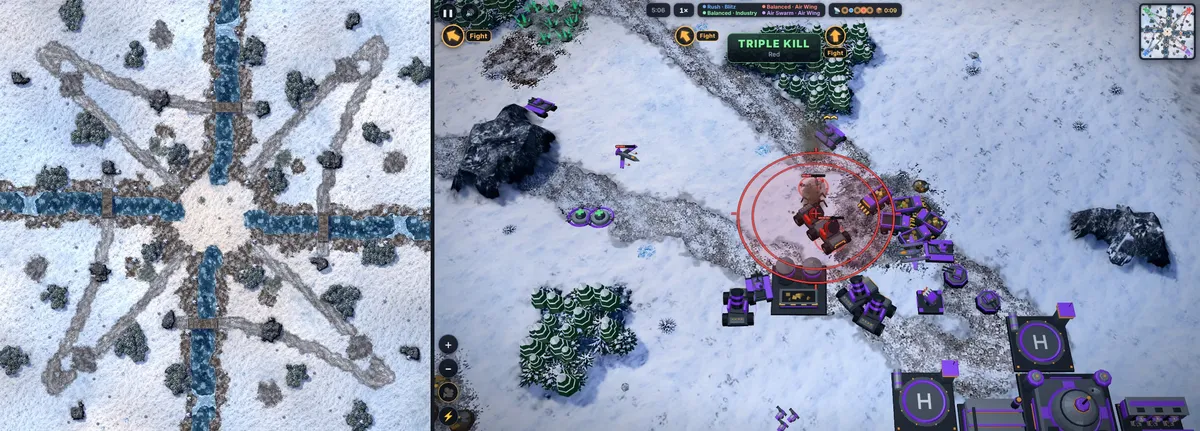
Version 14 adds Compass Rose, a 72×72 arctic map with one player in each corner and frozen streams between territories. Up to four people can play online, and AI players fill empty slots or take over when someone disconnects. Two-player matches and saved records work as before. [1] [5]
Willison says a single plain-English prompt led Claude Opus 5.5 to build the new map and extend the WebSocket networking code from two players to four. He published the prompt but not the full agent session. [1]
The design helps agents make changes safely. The simulation is deterministic and runs in lockstep: the host keeps the turn log and the other players stay in sync with it. A stateless relay only forwards orders. Unit tests, smoke tests, a balance harness that runs AI round-robins, and replays check the code in place of line-by-line human review. [2] [5] [6]
Willison and a third-party analysis from explainx.ai both say this way of working suits low-stakes projects like games, not code that handles money or credentials. The analysis adds that automated tests do not replace code review and that the token costs of reproducing the work are unknown. [2] [4]
the release notes and a public replay with four AI players show four-player play working.
Read the full assessment
Implication: a deterministic lockstep design with a stateless relay and automated tests may let agents extend multiplayer code with little human review, at least for low-stakes software.
Executive brief
Simon Willison's Battle Drones, a browser real-time strategy game built almost entirely by coding agents, now supports four-player online battles. He reports that one plain-English prompt led Claude Opus 5.5 to add a new symmetric map called "Compass Rose" and extend the WebSocket networking code from two players to four (Willison). The game's code is in TypeScript, a language he has barely used, and he says he reviewed almost none of it (Willison, Oct 20). That makes the project a public, inspectable record of agent-directed development. No independent testing of the v14 multiplayer code was found.
What changed and event timeline
Battle Drones v1
Willison started the game on Phaser, then moved it to Three.js for 3D from v5 on. He says agents did almost all of the coding across later versions ().
Opus 5.5 launches
Anthropic released Opus 5.5 with output priced at $20 per million tokens, down from $25. It says the model matches the larger Fable model on many benchmarks; those are Anthropic's own figures ().
Full write-up
Willison described 12 major versions and 321 agent commits, an audio-modem multiplayer mode, a WebSocket relay, and matches where AI agents play each other ().
Third-party analysis
Explainx.ai called the project a process case study rather than a breakthrough. It warned that the agent-versus-agent results are "a capability, not a ranking" ().
v14 Compass Rose
v14 adds a four-player free-for-all map, online play for up to four humans, and AI players that fill empty slots or take over for players who disconnect (;).
Capabilities and access
- Map: a 72×72 arctic map with one player per corner. Frozen streams divide the territories, and bridges and fords connect them (release notes).
- Elimination: a side is out when its headquarters and all its Goliath mechs are destroyed, or when it resigns.
- Joining: players join through share links or QR codes. Two new team colours, purple and green, join blue and red (Willison).
Read the full section
- Map: a 72×72 arctic map with one player per corner. Frozen streams divide the territories, and bridges and fords connect them (release notes).
- Elimination: a side is out when its headquarters and all its Goliath mechs are destroyed, or when it resigns. Eliminated players can keep watching with fog of war removed, and the end screen charts all four players (release notes).
- Joining: players join through share links or QR codes. Two new team colours, purple and green, join blue and red (Willison).
- Not on this map: Robot Love mode and Last Stand (release notes).
- Access: the game is free to play at simonw.github.io, and the code is Apache-2.0 licensed (repo).
Technical analysis for researchers and developers
- Lockstep networking: the host keeps the turn log and the other clients stay in sync with it (release notes).
- Deterministic simulation: custom math functions (
fmath.ts) keep replays reproducible (Willison, Oct 20). v14 fixes rewinding so it restores in-game state and the on-screen display correctly (release notes). - Testing: Vitest unit tests, Playwright smoke tests, and a balance harness that runs AI round-robins (repo). Willison cites more than 1,200 simulated playtests (Willison, Oct 20).
Read the full section
- Lockstep networking: the host keeps the turn log and the other clients stay in sync with it (release notes). The relay server on Fly pairs players by room code, forwards only orders at roughly 100–200ms intervals, and stores nothing (repo).
- Deterministic simulation: custom math functions (
fmath.ts) keep replays reproducible (Willison, Oct 20). v14 fixes rewinding so it restores in-game state and the on-screen display correctly (release notes). - Testing: Vitest unit tests, Playwright smoke tests, and a balance harness that runs AI round-robins (repo). Willison cites more than 1,200 simulated playtests (Willison, Oct 20).
- Compatibility: two-player matches and saved records are unchanged (release notes).
Claims and evidence
- One prompt produced the map and the network changes. This is Willison's own account.
- The release notes and a public four-way AI replay support this (release; replay).
- Opus 5.5 is near Fable-level. This comes from Anthropic's own benchmarks (TechCrunch).
Read the full section
- One prompt produced the map and the network changes. This is Willison's own account. The prompt is published, but the full agent session is not (Willison).
- Four-player online play works. The release notes and a public four-way AI replay support this (release; replay). The replay shows AI players, not a match between four human players.
- Opus 5.5 is near Fable-level. This comes from Anthropic's own benchmarks (TechCrunch).
Context and prior work
Battle Drones grew from 321 commits on Oct 20 to 346 on its main branch (Willison, Oct 20; repo). Willison estimates the relay costs about $2.19 a month to run (Willison, Oct 20). Opus 5.5 was the first model in Anthropic's 5.5 family, and Sonnet 5.5 and Haiku 5.5 followed later (TechCrunch).
Read the full section
Battle Drones grew from 321 commits on Oct 20 to 346 on its main branch (Willison, Oct 20; repo). The project came with a working reference design: the WebSocket relay was built after the audio-modem mode proved unpleasant ("high pitched modem sounds" that caused headaches). Willison estimates the relay costs about $2.19 a month to run (Willison, Oct 20). Opus 5.5 was the first model in Anthropic's 5.5 family, and Sonnet 5.5 and Haiku 5.5 followed later (TechCrunch).
Limitations, safety and contested findings
- Willison says he knows "almost nothing about game development."
- explainx.ai says the code-review gap matters here only because a game is low-stakes, and that deterministic tests "do not replace code review."
- No independent reports on the reliability of four-player networking were found.
Read the full section
- Willison says he knows "almost nothing about game development." He has also said he is uneasy about low-effort vibe coding being passed off as real game design (Willison, Oct 20).
- explainx.ai says the code-review gap matters here only because a game is low-stakes, and that deterministic tests "do not replace code review." It also says the token costs of reproducing the work are unknown (explainx.ai).
- No independent reports on the reliability of four-player networking were found.
Business and practitioner implications
- A deterministic lockstep simulation plus a stateless relay is a pattern that agents can extend without breaking.
- Feedback loops matter more than reviewing every line. Tests, balance harnesses and replays gave measurable checks where line-by-line review was skipped (repo).
- Know where the limit is.
Read the full section
- Constrained architecture helps. A deterministic lockstep simulation plus a stateless relay is a pattern that agents can extend without breaking. Here, going from two to four players took a single prompt.
- Feedback loops matter more than reviewing every line. Tests, balance harnesses and replays gave measurable checks where line-by-line review was skipped (repo).
- Know where the limit is. Willison's own framing, and the third-party analysis, put a clear line around this way of working: it suits prototypes and low-stakes products, not code that handles money or credentials (explainx.ai).