
BusinessMarkets, money & strategy
CoreWeave credit stress tests Nvidia's guarantees for neoclouds and OpenAI's Ohio campus
Nvidia has become a financier of its own customers, guaranteeing chip values and neocloud obligations. October's selloff in CoreWeave debt and neocloud shares is the first real test of whether used GPUs hold enough value to back those commitments.
From the CNBC · Technology article of October 24, 2026 and cited sources: Nvidia now carries large contingent liabilities tied to its customers. [1] [4] [5] [6]
SOURCES[1] CNBC: Nvidia's role as AI financier faces first big test cnbc.com[4] The Decoder: Nvidia guarantees its own chips' value the-decoder.com[5] MonitorDaily: $500B of private credit for GPU financing monitordaily.com
 AT Pulse research deskPublished · Updated · 5 min read · AI-assisted analysis
AI-assisted, not human-edited. Methodology Corrections Who owns this site
- What happened
- Nvidia now carries large contingent liabilities tied to its customers. [1] [4] [5] [6] [7]
- Original source
- CNBC · Technology article, independent perspective
- Brief by
- AT Pulse research desk AI-assisted; publisher and contact on the desk page
- When
- October 24, 2026 article published
- Covered
- Oct 25 edition
- Evidence
- 10 sources across 9 sites
- 1CNBC: Nvidia's role as AI financier faces first big testcnbc.com
- 2Linked video: Nvidia's role as AI financier faces first…youtube.com
- 3The Next Web: Huang says CoreWeave needs no backstopthenextweb.com
- 4The Decoder: Nvidia guarantees its own chips' valuethe-decoder.com
- 5MonitorDaily: $500B of private credit for GPU financingmonitordaily.com
- 6NVIDIA Form 8-K, Aug 17, 2026sec.gov
RisingHow it’s measured
YouTube video · 296.6K views · 3.3K likes
Reach blends public engagement (views, likes, comments, shares, stars) from the platforms where the story or its original source lives: YouTube, Hacker News, GitHub, Substack and similar. A video and the article written from its transcript share one score, taken from the video. Platforms with no data are left out rather than counted as zero, and the age of a story never lowers its score.
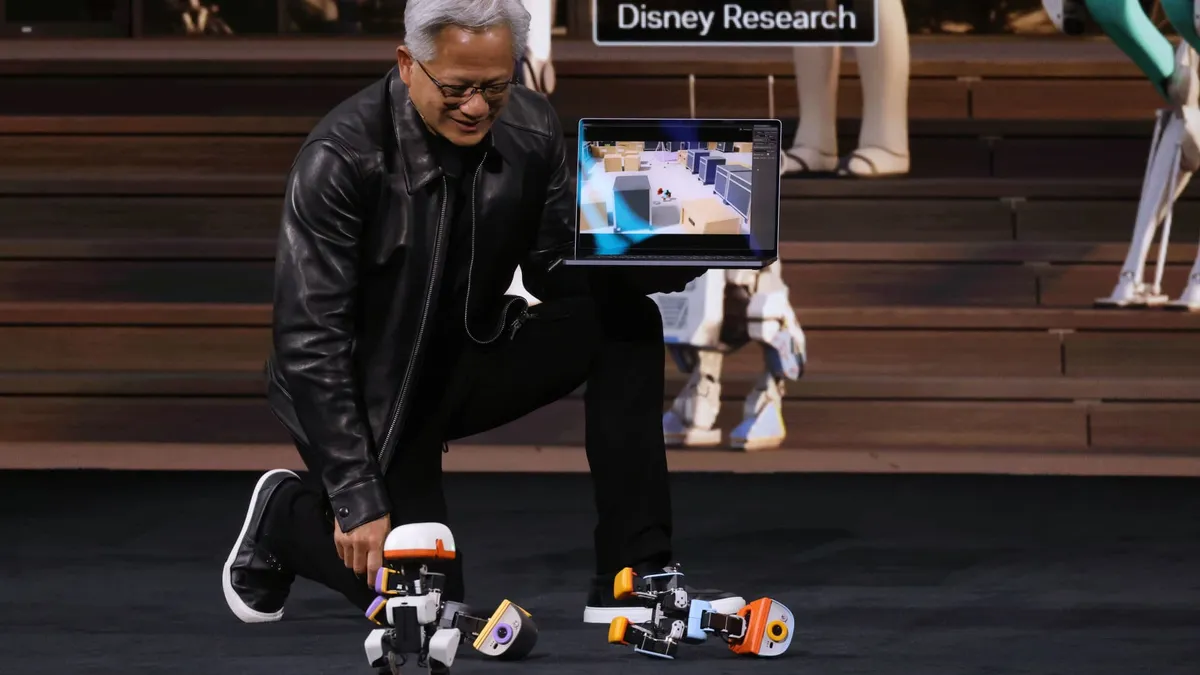
Nvidia now carries large contingent liabilities tied to its customers. CNBC counts $36 billion in off-balance-sheet backstops for neoclouds as of July. Nvidia's August 8-K caps residual value guarantees on OpenAI's roughly 4.25 GW Pike County, Ohio campus at $105 billion, payable only if OpenAI defaults. A $500 billion private-credit framework with Apollo, BlackRock, Blackstone, Brookfield, Goldman Sachs and KKR has Nvidia guarantee up to 25% of financed chips' residual value. [1] [4] [5] [6] [7]
Markets are testing these commitments. CoreWeave's five-year credit default swaps reached a record 1,194.5 basis points on Oct. 15, which implies a better-than-60% chance of default within five years. Yields on its 2031 and 2032 bonds rose above 15%. CoreWeave, Nebius and IREN each fell at least 30% in October. Nvidia-backed Firmus shelved a planned US$5 billion IPO, and Nvidia's own stock is down 7.6% for the month. [1] [3] [8] [9]
The guarantees amount to a bet that GPUs keep their resale and rental value. Huang argues that general-purpose hardware stays fungible and durable, helped by years of CUDA software updates. He points to H100 rental rates rising from $1.70 to $2.35 per GPU-hour between October 2025 and March 2026, though that evidence comes from an interested party. Moody's expects chip values to stay above the contractual residual amounts in the near term. Michael Burry, the Bank of England and the broker Howden have each raised concerns about depreciation or the pace of financing. [1] [2] [4]
Payback depends on demand growing faster than ever. In the linked video interview, the host estimates frontier and inference lab revenue at about $200 billion this year and says it would need to roughly double each year to repay trillions in capex. Huang replies that lab revenue is only one part of total infrastructure demand. [2]
the guarantees and backstops appear in filings and press reporting, and credit markets are pricing high CoreWeave default risk.
Read the full assessment
Implication: Nvidia's earnings and balance sheet now depend more on customer credit health and used-GPU prices, which matters to compute buyers, lenders and investors.
Executive brief
Nvidia now carries large contingent exposure to its customers' finances. CNBC reports $36 billion in off-balance-sheet backstops for neoclouds as of July, plus a guarantee of up to $105 billion on OpenAI's Ohio campus (CNBC). Those guarantees are being tested. In October, CoreWeave's credit default swaps priced a better-than-60% chance of default within five years (The Next Web). CoreWeave, Nebius and IREN each fell at least 30% this month, and Nvidia's own stock is down 7.6% for October. Jensen Huang says demand is "off the charts" and that the missing piece is working capital.
What changed and event timeline
$500B financing framework
Nvidia signed agreements with Apollo, BlackRock, Blackstone, Brookfield, Goldman Sachs and KKR. Under them it will guarantee up to 25% of the residual value of its chips in financed projects (;).
Firmus pulls its IPO
The Nvidia-backed Australian operator shelved a US$5 billion listing that targeted a roughly US$30.6 billion valuation, citing market volatility. It will raise money privately instead ().
CDS record vs. CEO reassurance
In Stockholm, Huang said CoreWeave's cost of capital is falling and it needs no backstop. The same day, its five-year CDS hit a record 1,194.5 basis points ().
Nvidia's third straight down week
The stock is down 7.6% in October and on pace for its worst month since November 2025. Moody's says guarantees are the fastest-growing type of off-balance-sheet financing ().
Capabilities and access
- Hardware: The Vera Rubin rack holds 72 GPUs and costs more than $7 million, per a Morgan Stanley estimate.
- How customers get financing:
- equity stakes (a portfolio worth $99 billion);
Read the full section
- Hardware: The Vera Rubin rack holds 72 GPUs and costs more than $7 million, per a Morgan Stanley estimate. Competitors include Google's TPUs and AMD's Helios rack, launched in July (CNBC).
- How customers get financing:
- equity stakes (a portfolio worth $99 billion);
- offtake commitments, such as up to $6.3 billion of CoreWeave compute;
- minimum resale or hourly-price guarantees;
- revenue sharing (e.g., Sharon AI);
- limited-partner stakes in private funds, including $2 billion in Brookfield's AI infrastructure fund (CNBC).
Technical analysis for researchers and developers
- What the guarantees bet on: The structures are bets that used GPUs keep their value.
- Evidence on depreciation: Huang points to A100s with useful lives close to a decade.
- Huang's argument: General-purpose hardware can be "fungible" and "durable," which makes it financeable. On the podcast he says specialization works against both 01:25:30.
Read the full section
- What the guarantees bet on: The structures are bets that used GPUs keep their value. Moody's David Gonzales expects chips to stay worth more than the contractual residual amounts in the near term (CNBC).
- Evidence on depreciation: Huang points to A100s with useful lives close to a decade. He also cites H100 rental rates rising from $1.70 to $2.35 per GPU-hour between October 2025 and March 2026 (The Decoder).
- Huang's argument: General-purpose hardware can be "fungible" and "durable," which makes it financeable. On the podcast he says specialization works against both 01:25:30. He adds that years of CUDA software updates help hardware hold its value 01:00:07.
- Power as a bottleneck: In the same conversation, the interviewer cites roughly 50 GW of announced chips against 35–40 GW of land, power and shell capacity 00:51:47.
Claims and evidence
- Ohio guarantee terms: The $105 billion cap and the default-only trigger come from Nvidia's own 8-K (SEC).
- "Demand is off the charts": This is Huang's claim, and he has a direct interest in it.
- Total exposure: Estimates differ.
Read the full section
- Ohio guarantee terms: The $105 billion cap and the default-only trigger come from Nvidia's own 8-K (SEC).
- "Demand is off the charts": This is Huang's claim, and he has a direct interest in it. Market prices show the opposite, with record CDS spreads (The Next Web).
- Total exposure: Estimates differ.
- New Constructs puts the net present value of Nvidia's off-balance-sheet liabilities above $153 billion (CNBC).
- An aggregator puts exposure to AI cloud providers at $171.5 billion: $7 billion invested directly plus $164.5 billion in guarantees and commitments (AI Weekly).
- CoreWeave's debt: CNBC reports about $51.6 billion of total debt. The Next Web reports about $30 billion, which likely uses a different definition.
Context and prior work
- How new this is: Nvidia's February annual report does not mention AI cloud agreements. Most backstops began in the past 6–12 months (CNBC).
- Earlier warnings:
- Michael Burry had already argued that GPUs depreciate faster than buyers assume.
Read the full section
- How new this is: Nvidia's February annual report does not mention AI cloud agreements. Most backstops began in the past 6–12 months (CNBC).
- Earlier warnings:
- Michael Burry had already argued that GPUs depreciate faster than buyers assume.
- The Bank of England called the pace of AI financing "historically unprecedented" (The Decoder).
Limitations, safety and contested findings
- Payback math: On the podcast, the host says lab revenue of about $200 billion this year would need to roughly double each year to pay back the capex 01:01:13.
- Rating treatment: Moody's does not count guarantees as debt, but says it monitors them constantly.
- Insurance: Howden says insurers are "not yet a complete panacea" for the risk that GPUs lose value (CNBC).
Read the full section
- Payback math: On the podcast, the host says lab revenue of about $200 billion this year would need to roughly double each year to pay back the capex 01:01:13. Huang replies that frontier-lab revenue is only one part of total infrastructure demand 01:08:29.
- Rating treatment: Moody's does not count guarantees as debt, but says it monitors them constantly.
- Insurance: Howden says insurers are "not yet a complete panacea" for the risk that GPUs lose value (CNBC).
- Firmus valuation: Its valuation nearly tripled in two months, and that drew skepticism (NST).
Business and practitioner implications
- Compute buyers: Prices from neoclouds may now include counterparty risk.
- Lenders and investors: The 25% residual value guarantee has become the benchmark for GPU-backed loans (MonitorDaily).
- Nvidia's position: Its cash makes it hard for rivals to compete.
Read the full section
- Compute buyers: Prices from neoclouds may now include counterparty risk. Check which capacity is backed by Nvidia offtake or guarantees, and how stable each provider's contracts are.
- Lenders and investors: The 25% residual value guarantee has become the benchmark for GPU-backed loans (MonitorDaily). Whether it holds up depends on resale prices for used GPUs.
- Nvidia's position: Its cash makes it hard for rivals to compete. It generated $70 billion of free cash flow in the first half, against AMD's roughly $4 billion. The other side is that Nvidia's earnings now depend more on the credit health of its weakest customers.
The source trail.
Sources (10)
CNBC: Nvidia's role as AI financier faces first big test
cnbc.comLinked video: Nvidia's role as AI financier faces first big test as neoclouds take market hit
linked video auto captions
www.youtube.com