
InfrastructureCompute, chips & cloud
Nvidia unveils DSX POD container data center and OpenShell agent runtime at GTC Berlin as neocloud stocks fall
At GTC Berlin, Nvidia unveiled DSX POD, a shipping-container data center of seven Vera Rubin racks, and OpenShell, an open-source sandbox for AI agents. Meanwhile, neocloud stocks fell on debt worries, and Huang described capital, not chips, as the constraint.
From the CNBC · Technology article of October 23, 2026 and cited sources: DSX POD packs seven Vera Rubin NVL72 racks (504 GPUs) into one container of about 28 tonnes. [1] [3] [4] [7]
SOURCES[1] On the ground at Nvidia GTC Berlin: Jensen Huang, robot… cnbc.com[3] Linked video: On the ground at Nvidia GTC Berlin: Jensen… youtube.com[4] ServeTheHome: GTC Berlin 2026 DSX PODs servethehome.com
 AT Pulse research deskPublished · Updated · 5 min read · AI-assisted analysis
AI-assisted, not human-edited. Methodology Corrections Who owns this site
- What happened
- DSX POD packs seven Vera Rubin NVL72 racks (504 GPUs) into one container of about 28 tonnes. [1] [3] [4] [7]
- Original source
- CNBC · Technology article, independent perspective
- Brief by
- AT Pulse research desk AI-assisted; publisher and contact on the desk page
- When
- October 23, 2026 article published
- Covered
- Oct 25 edition
- Evidence
- 11 sources across 11 sites
- 1On the ground at Nvidia GTC Berlin: Jensen Huang, robot…cnbc.com
- 2TechCrunch: Microduck robotstechcrunch.com
- 3Linked video: On the ground at Nvidia GTC Berlin: Jensen…youtube.com
- 4ServeTheHome: GTC Berlin 2026 DSX PODsservethehome.com
- 5Motley Fool: CoreWeave and Nebius crashingfool.com
- 6Opening Bell Daily: CoreWeave and IREN 2026 lowsopeningbelldailynews.com
RisingHow it’s measured
YouTube video · 11.1M views · 4K likes
Reach blends public engagement (views, likes, comments, shares, stars) from the platforms where the story or its original source lives: YouTube, Hacker News, GitHub, Substack and similar. A video and the article written from its transcript share one score, taken from the video. Platforms with no data are left out rather than counted as zero, and the age of a story never lowers its score.
DSX POD packs seven Vera Rubin NVL72 racks (504 GPUs) into one container of about 28 tonnes. Partners build it from Nvidia's reference design, and deliveries start in early 2027. Huang's case for it is speed: he values a 1-gigawatt site at about $50 billion and says a three-month delay costs roughly $10 billion in revenue. Moving assembly and burn-in into the supply chain is meant to shorten the time from equipment arrival to production. The keynote put this at four to five months cut to about one. [1] [3] [4] [7]
OpenShell is an Apache 2.0 runtime that sandboxes AI agents. It enforces per-agent policies on system calls, file access and network connections. Nvidia says formal verification checks every policy change against a permission ceiling. Separate Sentry software on BlueField-4 monitors agents from outside the host. One review describes the current release as v0.1.x. [3] [8] [9]
On October 22, CoreWeave fell 10.1% to $55.60 and Nebius fell 7%. The drop followed reports that CoreWeave's debt was yielding about 15% on the secondary market. Huang told CNBC that neocloud demand far exceeds the capital available and that the gap will be closed. Nvidia holds sizeable stakes in neoclouds, which is relevant when reading his view. [1] [5] [6]
neocloud shares and debt prices moved sharply the day after the keynote, and Huang said capital is scarce. Implication: financing and deployment speed, not GPU supply, may decide returns. No independent benchmarks of DSX POD or OpenShell exist yet.
Executive brief
Nvidia's own deployment pitch is a reminder that money, not chips, is now the constraint. At GTC Berlin on October 21, 2026, Jensen Huang put a 1-gigawatt AI data center at about $50 billion. He argued that a three-month delay costs roughly $10 billion in revenue. His answer is the DSX POD: seven Vera Rubin racks built inside a shipping container. The next day, CoreWeave fell 10% and Nebius fell 7% on worries about debt. Huang told CNBC that demand for capital "is much greater than the availability." Separately, Nvidia released OpenShell, an open-source runtime that sandboxes AI agents and limits what they can access (CNBC).
What changed and event timeline
Keynote launches DSX POD and OpenShell
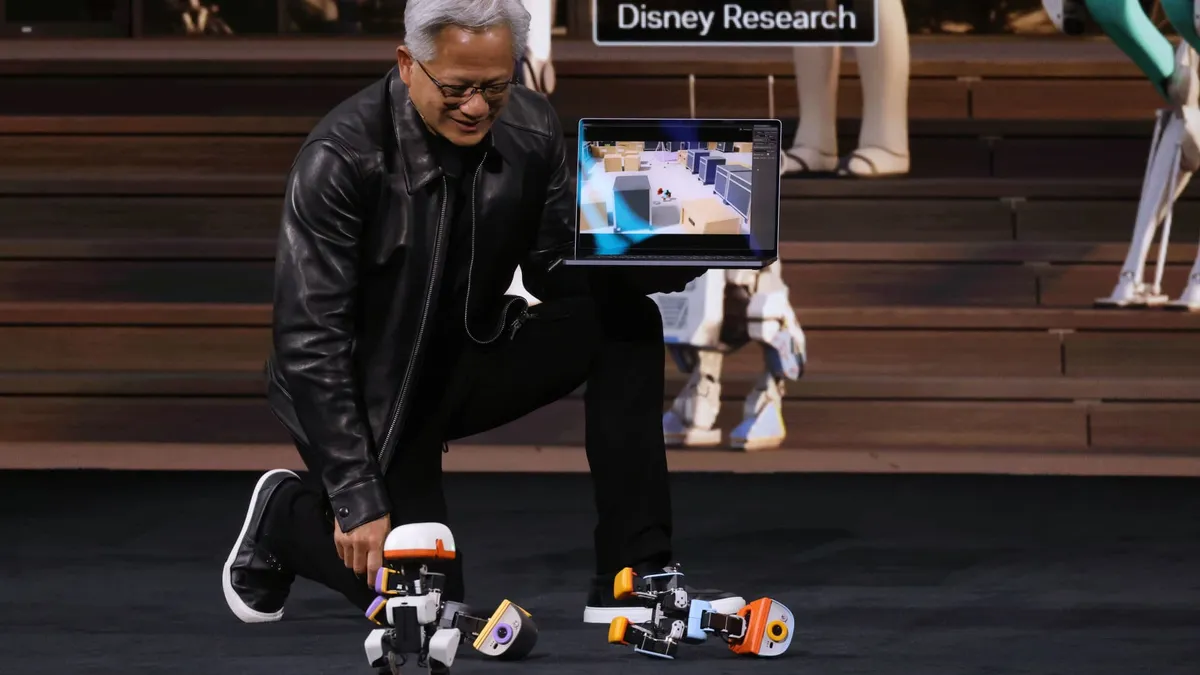
Huang presented a containerized Vera Rubin "AI factory" and a secure runtime for agents. He also brought Pollen Robotics' Microduck robots on stage (;).
OpenShell reference architecture published
Full reference documentation for running agents safely on Vera Rubin, Vera CPUs and BlueField-4 was released the same day ().
Neocloud selloff
CoreWeave fell 10.1% to $55.60 and Nebius fell 7%. The selloff followed reports that the secondary-market yield on CoreWeave's debt had reached about 15% (;).
Huang calls capital scarce
He told CNBC that demand for neoclouds is "off the charts," that working capital is "missing in the middle," and that the problem is "going to get solved" ().
Microduck preorders pass 20,000
Preorders for the open-source toy robot exceeded 20,000 within a day of the demo. Delivery is targeted for Christmas ().
Capabilities and access
- DSX POD: seven Vera Rubin NVL72 racks (504 GPUs) in one container weighing about 28 tonnes. Nvidia rates it at 25 exaFLOPs of inference.
- OpenShell: released under the Apache 2.0 licence and available now. It runs on Linux, Kubernetes, Windows and the major clouds (The Next Web).
- Other announcements: the RTX Spark PC (1 petaflop, 128 GB of memory) and a Windows version of DGX Station (20 petaflops, 754 GB) expected by year-end.
Read the full section
- DSX POD: seven Vera Rubin NVL72 racks (504 GPUs) in one container weighing about 28 tonnes. Nvidia rates it at 25 exaFLOPs of inference. It is a reference design that partners build, not a product Nvidia sells, with deliveries from early 2027 (ServeTheHome; Yahoo Finance).
- OpenShell: released under the Apache 2.0 licence and available now. It runs on Linux, Kubernetes, Windows and the major clouds (The Next Web). One review describes it as a v0.1.x release (BERI).
- Other announcements: the RTX Spark PC (1 petaflop, 128 GB of memory) and a Windows version of DGX Station (20 petaflops, 754 GB) expected by year-end. Also announced: the Agile One reference humanoid robot for Q1 2027, and four more vehicle lines joining Nvidia's Hyperion robotaxi platform (keynote).
Technical analysis for researchers and developers
- How Nvidia frames an agent: five parts — model, harness (the software that orchestrates the model), sandbox, knowledge and tools.
- How OpenShell enforces limits: policies are enforced at the level of system calls, file access and network connections.
- Open models: Huang said Nemotron and Nvidia's other open models ship with their training data and the scripts needed to reproduce them (keynote).
Read the full section
- How Nvidia frames an agent: five parts — model, harness (the software that orchestrates the model), sandbox, knowledge and tools. Vera Rubin systems are split by role: GPUs run the model, Vera CPUs run the harness, and BlueField-4 handles data and storage (keynote).
- How OpenShell enforces limits: policies are enforced at the level of system calls, file access and network connections. Nvidia says formal verification checks each policy change against a permission ceiling (keynote). Separately, Sentry software running on BlueField-4 monitors agents from outside the host machine (The Next Web).
- Open models: Huang said Nemotron and Nvidia's other open models ship with their training data and the scripts needed to reproduce them (keynote).
- Evaluation: none of the reviewed sources includes an independent benchmark of DSX POD or OpenShell.
Claims and evidence
- Speed-up per generation: Huang said Blackwell is about 30x faster than Hopper and Vera Rubin another 30x over Blackwell (keynote).
- Deployment time — the figures conflict: in the keynote, Huang said turn-on falls from 4–5 months to about one month (keynote).
- Power and water: Nvidia claims DSX uses 30% less power for the same output and saves 54 million litres of water a day at 2 GW (keynote).
Read the full section
- Speed-up per generation: Huang said Blackwell is about 30x faster than Hopper and Vera Rubin another 30x over Blackwell (keynote). Nvidia has not published the methodology.
- Deployment time — the figures conflict: in the keynote, Huang said turn-on falls from 4–5 months to about one month (keynote). Other coverage reports six months cut to 14 days (Yahoo Finance).
- Power and water: Nvidia claims DSX uses 30% less power for the same output and saves 54 million litres of water a day at 2 GW (keynote). None of the reviewed sources independently confirms these figures.
- Sentry: Nvidia says Sentry can stop a misbehaving agent within milliseconds and raises agent capacity by up to 20% (The Next Web).
Context and prior work
- Huang described a lineage from the DGX-1 he delivered to OpenAI in 2016 (1 petaflop) to Blackwell's rack-scale design.
- He said Nvidia invested nearly $10 billion in Europe over the past year (keynote).
- Earlier CNBC reporting (September) said OpenAI and Anthropic were looking for smaller data-center deals (CNBC).
Read the full section
- Huang described a lineage from the DGX-1 he delivered to OpenAI in 2016 (1 petaflop) to Blackwell's rack-scale design. DSX POD extends that idea to a whole container (keynote).
- He said Nvidia invested nearly $10 billion in Europe over the past year (keynote).
- Earlier CNBC reporting (September) said OpenAI and Anthropic were looking for smaller data-center deals (CNBC).
- Nvidia's agent-runtime partners include Anthropic, OpenAI, Google and Meta (FourWeekMBA).
Limitations, safety and contested findings
- Power still has to be in place: the 14-day figure assumes power, cooling and networking already exist.
- Cost and load: no price has been published.
- Cooling caveat: hot climates may still need chillers, which weakens the dry-cooling water savings (Memeburn).
Read the full section
- Power still has to be in place: the 14-day figure assumes power, cooling and networking already exist. Grid connections in the US average about four years (Memeburn).
- Cost and load: no price has been published. One analyst estimate puts the compute alone at $55–64 million per POD, which needs 1.3–1.6 MW (BERI).
- Cooling caveat: hot climates may still need chillers, which weakens the dry-cooling water savings (Memeburn).
- Conflict of interest: Nvidia holds sizeable stakes in neoclouds, and Huang's bullish view should be read with that in mind (CNBC).
Business and practitioner implications
- Finance teams: working capital and credit quality (high bond yields, operators without credit ratings) now look like bigger bottlenecks than GPU supply (Motley Fool).
- Infrastructure buyers: DSX POD is a 2027 purchasing decision. It needs a prepared site and should be bid against colocation alternatives (BERI).
- Developers: OpenShell can be piloted now as a least-privilege sandbox for agents. Its security claims should be tested in-house before relying on them.
Read the full section
- Finance teams: working capital and credit quality (high bond yields, operators without credit ratings) now look like bigger bottlenecks than GPU supply (Motley Fool).
- Infrastructure buyers: DSX POD is a 2027 purchasing decision. It needs a prepared site and should be bid against colocation alternatives (BERI).
- Developers: OpenShell can be piloted now as a least-privilege sandbox for agents. Its security claims should be tested in-house before relying on them.
The source trail.
Sources (11)
On the ground at Nvidia GTC Berlin: Jensen Huang, robot ducks and neocloud distress
Article text retrieved; extracted text may omit tables or interactive elements. A transcript of the video linked from this page is supplied (linked video auto captions; https://www.youtube.com/watch?v=v-NGxyPjcrE); automatic text may contain errors.
cnbc.comTechCrunch: Microduck robots
techcrunch.comLinked video: On the ground at Nvidia GTC Berlin: Jensen Huang, robot ducks and neocloud distress
linked video auto captions
www.youtube.com