
SafetyRisk, alignment & guardrails
Trump's photo of a restored White House column has an OpenAI watermark, according to Google's SynthID Detector
The Verge used Google's newly public SynthID Detector to find an OpenAI watermark in a column photo Trump posted to tout White House restoration. The work itself is real, but the image was AI-edited, and anyone can now run such checks.
From the The Verge · AI article of October 15, 2026 and cited sources: The Verge ran the Truth Social image through SynthID Detector, which reported it as made or edited with OpenAI. [1]
SOURCES[1] Trump posts AI-edited photo to brag about White House… theverge.com
 AT Pulse research deskPublished · Updated · 5 min read · AI-assisted analysis
AI-assisted, not human-edited. Methodology Corrections Who owns this site
- What happened
- The Verge ran the Truth Social image through SynthID Detector, which reported it as made or edited with OpenAI. [1]
- Original source
- The Verge · AI article, independent perspective
- Brief by
- AT Pulse research desk AI-assisted; publisher and contact on the desk page
- When
- October 15, 2026 article published
- Covered
- Oct 16 edition
- Evidence
- 9 sources across 8 sites
- 1Trump posts AI-edited photo to brag about White House…theverge.com
- 2The Next Web: OpenAI adopts C2PA standard and Google's…thenextweb.com
- 3Straight Arrow News: Workers drape off iconic White House…san.com
- 4arXiv: MarkNull: Model-Agnostic Watermark Removal in…arxiv.org
- 5Google blog: Google expands SynthID Detector for AI contentblog.google
- 6arXiv: SynthID-Image: Image watermarking at internet scalearxiv.org
Reach: not measured yet
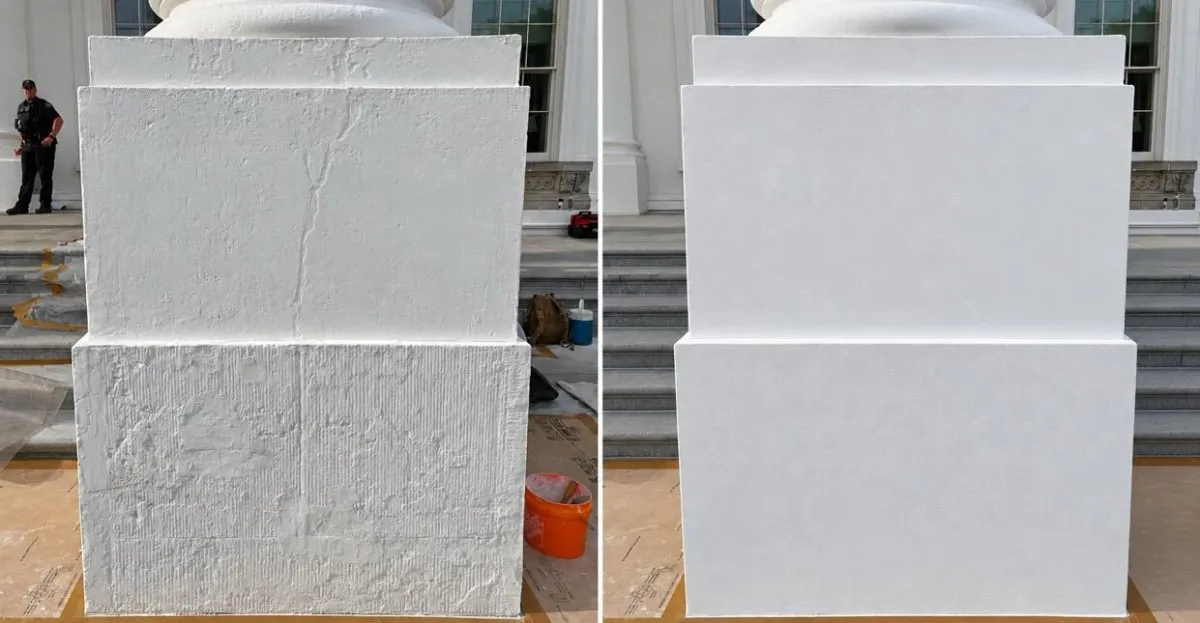
The Verge ran the Truth Social image through SynthID Detector, which reported it as made or edited with OpenAI. Trump's other renovation photos tested clean. Reddit users had already spotted visual problems, including steps that don't match the 'before' shot and near-identical reflections and cardboard in both frames. The White House did not immediately respond. [1]
The edited photo doesn't mean the restoration was made up. Workers began stripping paint from the North Portico columns in June, and the White House described the job as standard stone repair. [1] [3]
Two recent changes made it possible to name a vendor. In May, OpenAI committed to adding SynthID watermarks to images from ChatGPT, Codex and its API. On October 7, Google opened the detector to everyone. Because the watermark is embedded in the pixels, it can survive the screenshots and re-encoding that strip C2PA metadata. [2] [5] [6]
a free public tool linked a presidential image to a specific AI vendor, and visible flaws in the image back that up.
Read the full assessment
Implication: anyone can now catch AI touch-ups to documentary-style photos, so organizations need disclosure policies that cover edited images, not just fully generated ones.
Executive brief
A photo President Trump posted on Truth Social to show off restoration of a White House column carries an invisible OpenAI watermark. The Verge ran the image through Google's SynthID Detector, and the tool reported it as "made or edited with OpenAI." The column work itself is real; workers began stripping paint in June. So the photo doesn't prove the restoration was invented.
Read the full section
A photo President Trump posted on Truth Social to show off restoration of a White House column carries an invisible OpenAI watermark. The Verge ran the image through Google's SynthID Detector, and the tool reported it as "made or edited with OpenAI." Google had opened that detector to the general public only eight days earlier. Visual problems in the image back up the result: the steps don't match the "before" shot, and the window reflections and cardboard look almost identical in both frames. The column work itself is real; workers began stripping paint in June. So the photo doesn't prove the restoration was invented. It shows that a sitting president posted AI-edited evidence of it, and that ordinary users can now catch this kind of edit.
What changed and event timeline
OpenAI adopts SynthID
OpenAI joined the C2PA steering committee (C2PA is an industry standard for signed provenance metadata). It also committed to adding Google DeepMind's SynthID watermark to images from ChatGPT, Codex and its API ().
Column paint stripping begins
Workers started stripping paint from the North Portico columns. The White House described the job as standard stone-repair restoration ().
Removal attack posted
Researchers posted MarkNull, a watermark-removal method they say compromises SynthID-Image without visible quality loss. The paper is listed as accepted to USENIX Security 2026 ().
Detector opens to everyone
Google released SynthID Detector globally, in English. It checks watermarks from Google, OpenAI, NVIDIA and Kakao, with Apple listed as coming soon ().
Column photo flagged
The Verge reported that Trump's "restored" column image tested positive for an OpenAI SynthID watermark. His other renovation photos did not. The White House did not immediately respond ().
Capabilities and access
- Detector: SynthID Detector at synthid.com checks uploaded images, video and audio for SynthID watermarks.
- Attribution depth: The detector's result names the vendor (OpenAI), not a product or model.
- OpenAI's own checker: OpenAI also previewed a public verification tool, which covers only images made with OpenAI products (The Next Web).
Read the full section
- Detector: SynthID Detector at synthid.com checks uploaded images, video and audio for SynthID watermarks. Before October 7 it was limited to waitlisted journalists and researchers (Google blog).
- Attribution depth: The detector's result names the vendor (OpenAI), not a product or model. The reviewed sources don't say whether ChatGPT, Codex or the API was used, or which model version.
- OpenAI's own checker: OpenAI also previewed a public verification tool, which covers only images made with OpenAI products (The Next Web).
Technical analysis for researchers and developers
- How SynthID works: SynthID-Image is a post-hoc, model-agnostic system. Google's paper reports robustness to common perturbations (arXiv 2510.09263).
- Why it caught this image: C2PA metadata is stripped by screenshots and re-encoding.
- What "edited" means here: A positive result covers images that were edited, not just generated.
Read the full section
- How SynthID works: SynthID-Image is a post-hoc, model-agnostic system. A learned encoder embeds an imperceptible watermark, and a paired detector reads it. Google's paper reports robustness to common perturbations (arXiv 2510.09263).
- Why it caught this image: C2PA metadata is stripped by screenshots and re-encoding. A pixel-level watermark is meant to survive both, which is why it could be found in a social-media repost (The Next Web).
- What "edited" means here: A positive result covers images that were edited, not just generated. It can't show how much of the image was changed. The Verge's image analysis is visual inspection, not pixel forensics.
- Reproducibility: Anyone can upload the posted image and re-run the check.
Claims and evidence
- Claim: the column photo carries an OpenAI SynthID watermark. Only The Verge's own test supports this (The Verge).
- Claim: the image shows visual inconsistencies. Reddit users first pointed these out, and The Verge described them (same source).
- Claim: the restoration work is real. Contemporaneous reporting supports this, including the June paint stripping and the White House's statements (SAN).
Read the full section
- Claim: the column photo carries an OpenAI SynthID watermark. Only The Verge's own test supports this (The Verge). Later write-ups, such as Time News, repeat that reporting rather than citing a separate test.
- Claim: the image shows visual inconsistencies. Reddit users first pointed these out, and The Verge described them (same source).
- Claim: the restoration work is real. Contemporaneous reporting supports this, including the June paint stripping and the White House's statements (SAN).
- Claim: SynthID's scale (180 billion+ images and videos watermarked). This figure is reported by Google itself (Google blog).
Context and prior work
- Trump's AI posting: An NBC News review published October 4, 2025 counted dozens of synthetic posts on Trump's Truth Social account since January 2025, with about half in August and September of that year (NBC News).
- Earlier White House cases: France 24 documented an AI-altered White House image used to promote "Trump TV" (France 24).
- What's new: This case is a vendor-specific attribution from a public tool, rather than a judgment based only on visual cues.
Read the full section
- Trump's AI posting: An NBC News review published October 4, 2025 counted dozens of synthetic posts on Trump's Truth Social account since January 2025, with about half in August and September of that year (NBC News).
- Earlier White House cases: France 24 documented an AI-altered White House image used to promote "Trump TV" (France 24). Snopes examined claims that the White House edited a Getty photo (Snopes).
- What's new: This case is a vendor-specific attribution from a public tool, rather than a judgment based only on visual cues.
Limitations, safety and contested findings
- Google says a missing watermark doesn't mean content isn't AI-made. The detector only recognizes watermarks from participating providers (Google blog).
- Watermarks can be removed. Skilled actors can strip the signal; this case was caught because nobody tried.
- Coverage is narrow. OpenAI's measures do nothing about images from tools that don't participate (The Next Web).
Read the full section
- A clean result proves little. Google says a missing watermark doesn't mean content isn't AI-made. The detector only recognizes watermarks from participating providers (Google blog).
- Watermarks can be removed. MarkNull reports cutting SynthID-Image's watermark bit accuracy to 53.14%, close to the 50% expected from chance (arXiv). Skilled actors can strip the signal; this case was caught because nobody tried.
- Coverage is narrow. OpenAI's measures do nothing about images from tools that don't participate (The Next Web).
- Purpose is unknown. The White House has given no explanation for the edit.
Business and practitioner implications
- Communications teams: AI touch-ups to "documentary" photos can now be detected by anyone in seconds.
- Newsrooms and trust-and-safety teams: A SynthID result is useful evidence of AI involvement.
- Platform builders: Watermark ecosystems are consolidating around SynthID plus C2PA.
Read the full section
- Communications teams: AI touch-ups to "documentary" photos can now be detected by anyone in seconds. Organizations need disclosure policies for edited images, not just fully generated ones.
- Newsrooms and trust-and-safety teams: A SynthID result is useful evidence of AI involvement. Pair it with C2PA checks, visual forensics and comment requests, and never treat a negative result as clearance.
- Platform builders: Watermark ecosystems are consolidating around SynthID plus C2PA. Building detection hooks into upload pipelines is now practical, but plan for adversaries who remove watermarks (arXiv).
The source trail.
Sources (9)
Trump posts AI-edited photo to brag about White House restoration work
Article text retrieved; extracted text may omit tables or interactive elements.
theverge.com