
ExitsIPOs, listings & liquidity
Cerebras CEO Andrew Feldman says IPO made more than 1,000 employees millionaires and tells staff to diversify
Cerebras CEO Andrew Feldman says the company's $5.55 billion May IPO made more than 1,000 employees millionaires. He credits demand for fast inference for wins at AWS, Oracle and Microsoft, and advises newly wealthy staff to sell some shares and move slowly.
From the Sourcery video of November 21, 2026 and cited sources: Cerebras sold 30 million shares at $185 in May 2026 and raised $5.55 billion, the largest US tech IPO since Uber. [1] [2] [7] [8]
SOURCES[1] Cerebras CEO: The Truth About IPO Wealth, AI… youtube.com[2] CNBC: IPO pricing cnbc.com[7] Yahoo Finance: Nasdaq debut finance.yahoo.com
 AT Pulse research deskPublished · Updated · 5 min read · AI-assisted analysis
AI-assisted, not human-edited. Methodology Corrections Who owns this site
- What happened
- Cerebras sold 30 million shares at $185 in May 2026 and raised $5.55 billion, the largest US tech IPO since Uber. [1] [2] [7] [8]
- Original source
- Sourcery video, independent perspective
- Brief by
- AT Pulse research desk AI-assisted; publisher and contact on the desk page
- When
- November 21, 2026 video published
- Covered
- Nov 22 edition
- Evidence
- 16 sources across 13 sites; transcript sourced
RisingHow it’s measured
YouTube video · 2.4K views · 27 likes
Reach blends public engagement (views, likes, comments, shares, stars) from the platforms where the story or its original source lives: YouTube, Hacker News, GitHub, Substack and similar. A video and the article written from its transcript share one score, taken from the video. Platforms with no data are left out rather than counted as zero, and the age of a story never lowers its score.
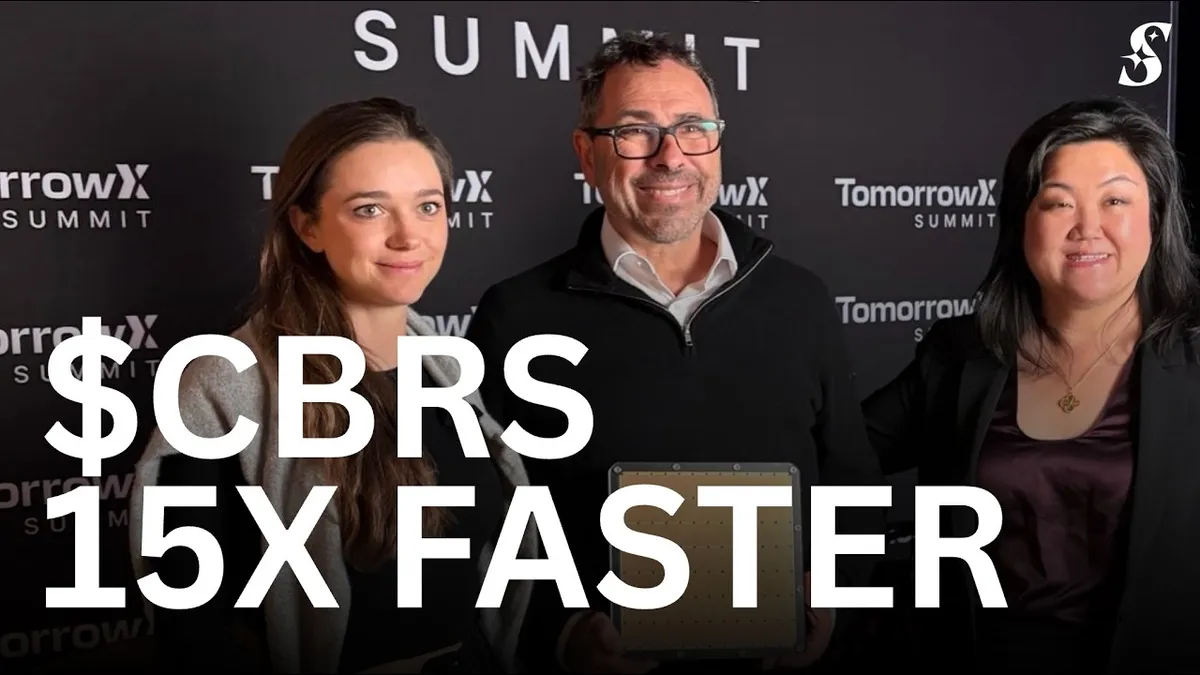
Cerebras sold 30 million shares at $185 in May 2026 and raised $5.55 billion, the largest US tech IPO since Uber. The stock closed its first Nasdaq day at $311.07. Feldman says the listing made more than 1,000 employees millionaires, a figure no other source confirms. [1] [2] [7] [8]
Feldman's advice to employees with equity: don't keep 95–99% of your wealth in one stock, and selling some is not a vote against the company. Big cash proceeds can sit untouched while you think about your values. Staff should judge the company by sales growth and product delivery, not by daily share-price swings. [1]
Feldman says buyers now prize inference speed, and that this explains why AWS, Microsoft and Oracle signed on within six months, on top of OpenAI's 750 MW commitment. He claims Cerebras is 10–15x faster than rivals. That is the company's own figure. A Cerebras page citing Artificial Analysis shows about 2.4x over the next-fastest provider on gpt-oss-120b. [1] [5] [6] [9] [14]
The IPO terms, backlog and Q3 results come from filings and market data. They suggest, but don't yet prove, that fast inference is becoming a mainstream cloud product. Revenue still depends heavily on a few customers.
Executive brief
Cerebras CEO Andrew Feldman says the company's IPO created "more than a thousand millionaires" among its staff (video, 10:58). That figure is his own and no other source confirms it. The financial record is firmer. Cerebras raised $5.55 billion in May 2026, the largest US tech IPO since Uber (CNBC). By September 30 it reported $26.1 billion in contracted future revenue (remaining performance obligations) (8-K). In the interview Feldman argues that buyers now care most about inference speed, and that this is why AWS, Oracle and Microsoft signed on. He also tells newly wealthy employees to sell some stock and diversify.
What changed and event timeline
OpenAI commits to 750 MW
OpenAI signed a multiyear deal for up to 750 MW of Cerebras inference capacity through 2028. Unnamed-source reports put its value above $10 billion (;).
AWS collaboration announced
AWS will pair its Trainium servers with Cerebras CS-3 systems and sell the combination only through Amazon Bedrock ().
Upsized IPO
Cerebras sold 30 million shares at $185, above a range that had already been raised. The stock closed its first Nasdaq day at $311.07 (;).
Microsoft signs
Microsoft became the third hyperscale cloud customer in six months. Feldman expects revenue from the deal to begin in Q1 2027 ().
Q3 results
GAAP revenue was $210.8 million, up 55% year on year. The GAAP net loss was $161.2 million. Full-year guidance was raised ().
Feldman interview published
He covers the importance of speed, the hyperscaler wins, how employees should handle IPO wealth, and his view on open versus closed models ().
Capabilities and access
- CS-3: the system behind the AWS offering. Trainium handles prompt processing and CS-3 handles output generation, over AWS's EFA networking (Amazon).
- CS-4: marketed as up to 30x faster for inference (8-K).
- CS-5: targets up to 10,000 tokens per second per user and is due to ship in early summer 2027 (same 8-K).
Read the full section
- CS-3: the system behind the AWS offering. Trainium handles prompt processing and CS-3 handles output generation, over AWS's EFA networking (Amazon).
- CS-4: marketed as up to 30x faster for inference (8-K).
- CS-5: targets up to 10,000 tokens per second per user and is due to ship in early summer 2027 (same 8-K).
- Where to get it: Cerebras's own cloud and Amazon Bedrock now. Oracle Cloud Infrastructure in 2027. Microsoft's service starts only after contract milestones are met (10-Q).
Technical analysis for researchers and developers
- Wafer-scale design: Cerebras puts compute, memory and bandwidth on one very large chip.
- Split inference on AWS: Trainium handles prefill (processing the prompt) and CS-3 handles decode (generating tokens).
- Measurement: Artificial Analysis re-runs each endpoint every six hours and averages the past five days.
Read the full section
- Wafer-scale design: Cerebras puts compute, memory and bandwidth on one very large chip. This removes the off-chip bottlenecks that slow GPUs when generating output (OpenAI).
- Split inference on AWS: Trainium handles prefill (processing the prompt) and CS-3 handles decode (generating tokens). Developers should benchmark end-to-end latency, including the time spent passing state between the two systems over EFA, rather than decode speed alone (Amazon).
- Measurement: Artificial Analysis re-runs each endpoint every six hours and averages the past five days. Its Cerebras page shows latency figures, for example 0.70 seconds to the first answer token on gpt-oss-120b (low) (Artificial Analysis).
Claims and evidence
- IPO terms: $185 per share and $5.55 billion raised. Announced by the company and reported by Reuters via Investing.com.
- Speed: Feldman says Cerebras is the fastest AI compute by 10–15x (8:56). Company materials say "up to 30x."
- Growth and backlog: the 70% "core" revenue growth and the plan to triple revenue in 2027 are company-reported.
Read the full section
- IPO terms: $185 per share and $5.55 billion raised. Announced by the company and reported by Reuters via Investing.com. The final prospectus is filed as a 424B4.
- Speed: Feldman says Cerebras is the fastest AI compute by 10–15x (8:56). Company materials say "up to 30x." A Cerebras page citing Artificial Analysis gives 1,671 tokens per second on gpt-oss-120b against 704 for the next-fastest provider, a gap of about 2.4x (Cerebras). The size of the lead depends on which baseline is used.
- Growth and backlog: the 70% "core" revenue growth and the plan to triple revenue in 2027 are company-reported. Core revenue is the company's own adjusted measure, not GAAP (8-K).
- "More than 1,000 millionaires": Feldman's statement only.
Context and prior work
Feldman points to past companies he sold, people who have worked with him across four or five companies, and mentors Mark Leslie (former Veritas CEO) and venture capitalist Pierre Lamond (15:56). In the reviewed coverage, Cerebras's IPO opens a wave of large AI listings.
Read the full section
Feldman points to past companies he sold, people who have worked with him across four or five companies, and mentors Mark Leslie (former Veritas CEO) and venture capitalist Pierre Lamond (15:56). In the reviewed coverage, Cerebras's IPO opens a wave of large AI listings. The interviewer expects SpaceX and Anthropic soon and possibly OpenAI next year (9:44). Feldman also expects competition between open- and closed-source models to intensify, and says both are needed (22:44).
Limitations, safety and contested findings
- Concentration: in Q3, one customer accounted for 38% of revenue and another for 34%. OpenAI-related revenue was $72.4 million (10-Q).
- Costs: stock-based compensation was $155.1 million in Q3. Capacity shortages limited how far OpenAI's Ultrafast tier could roll out (The Next Web).
- Outages: Feldman calls the recent outages a rare "confluence of unlucky things." He argues systems are most fragile while being upgraded (3:59; 21:57).
Read the full section
- Concentration: in Q3, one customer accounted for 38% of revenue and another for 34%. OpenAI-related revenue was $72.4 million (10-Q). MBZUAI, OpenAI and G42 together made up about 79% (FourWeekMBA).
- Costs: stock-based compensation was $155.1 million in Q3. Hardware revenue fell year on year. Capacity shortages limited how far OpenAI's Ultrafast tier could roll out (The Next Web).
- Outages: Feldman calls the recent outages a rare "confluence of unlucky things." He argues systems are most fragile while being upgraded (3:59; 21:57).
Business and practitioner implications
- Buyers: fast inference is now sold inside AWS Bedrock and is coming to OCI and Microsoft's cloud. Microsoft's terms are not public (Motley Fool).
- Investors: the $26.1 billion backlog sits alongside $7.8 billion in cash and heavy spending on data centers (The Next Web).
- Employees with equity: Feldman's advice is to avoid holding 95–99% of your wealth in one stock, to sell some, and not to rush big decisions (12:31).
Read the full section
- Buyers: fast inference is now sold inside AWS Bedrock and is coming to OCI and Microsoft's cloud. Teams building agents can try it without signing a new vendor. Microsoft's terms are not public (Motley Fool).
- Investors: the $26.1 billion backlog sits alongside $7.8 billion in cash and heavy spending on data centers (The Next Web).
- Employees with equity: Feldman's advice is to avoid holding 95–99% of your wealth in one stock, to sell some, and not to rush big decisions (12:31).
The source trail.
Sources (16)
Cerebras CEO: The Truth About IPO Wealth, AI Infrastructure & What Comes Next
Transcript retrieved via youtube_auto_captions; language en. Timestamped text, not direct audiovisual review. Source: https://www.youtube.com/watch?v=JvjxwbOz97s. Automatic captions/transcription may contain errors.
www.youtube.com