
FundingRounds, leads & terms
Contrary's Kyle Harrison argues against Noah Smith's 'China bear' turn, saying China's industrial capacity is a threat whether it is rising or has peaked
Kyle Harrison of Contrary argues that Noah Smith's new 'China bear' view underrates the risk. In his view, China's manufacturing scale is a threat whether its economy is rising or has peaked, and weak US industry is the problem in every scenario.
From the Investing 101 article of November 21, 2026 and cited sources: Smith now calls himself a China bear. [1] [8]
SOURCES[1] Paper Dragon Anxiety investing101.substack.com[8] Noahpinion: why im becoming a china bear noahpinion.blog
 AT Pulse research deskPublished · Updated · 5 min read · AI-assisted analysis
AI-assisted, not human-edited. Methodology Corrections Who owns this site
- Original source
- Investing 101 article, independent perspective
- Brief by
- AT Pulse research desk AI-assisted; publisher and contact on the desk page
- When
- November 21, 2026 article published
- Covered
- Nov 22 edition
- Evidence
- 11 sources across 10 sites
RisingHow it’s measured
YouTube video · 41.8K views · 919 likes
Reach blends public engagement (views, likes, comments, shares, stars) from the platforms where the story or its original source lives: YouTube, Hacker News, GitHub, Substack and similar. A video and the article written from its transcript share one score, taken from the video. Platforms with no data are left out rather than counted as zero, and the age of a story never lowers its score.
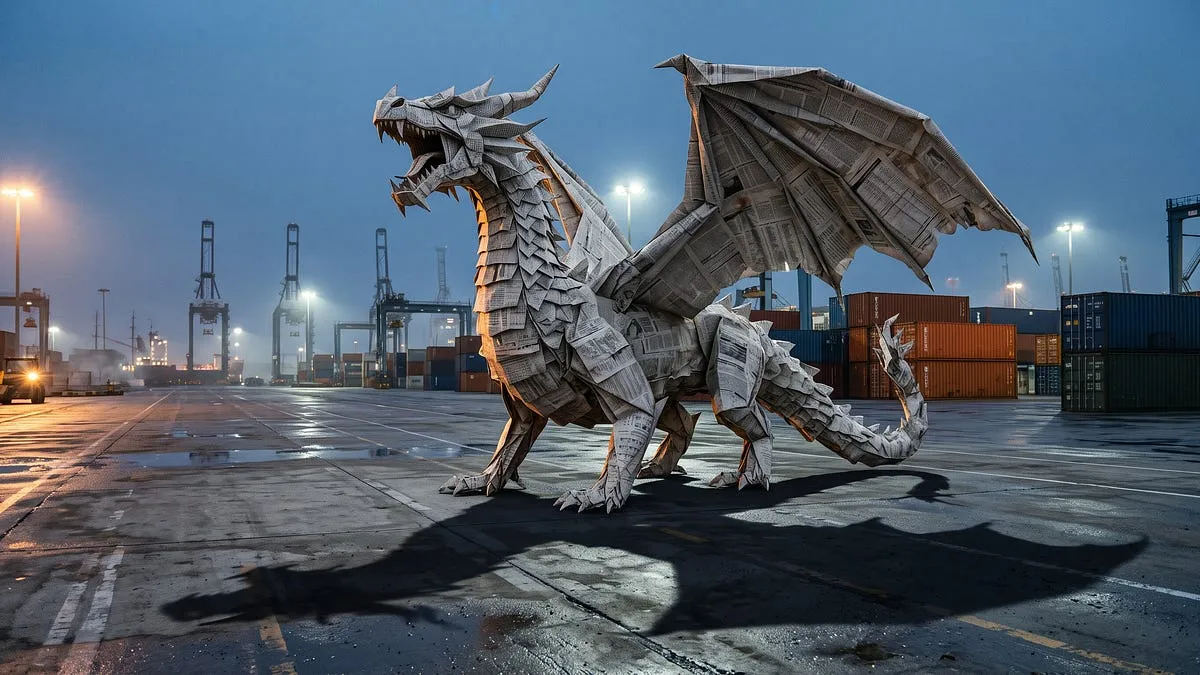
Smith now calls himself a China bear. His reasons are that AI agents weaken China's manufacturing-first model and that Xi is turning inward, so he treats containment as insurance rather than an urgent need. Harrison counters that a China whose growth has stalled may act more aggressively, not less. [1] [8]
Much of the disagreement depends on which measure is used. On profits, US firms are estimated to earn about 38% of global profits and Chinese firms about 16%. On capacity, China has about 31% of world manufacturing value added and installed 54% of the world's new industrial robots in 2024. [1] [4]
The wargame evidence cuts both ways. In the CSIS study, Taiwan held in most of 24 runs, but the US and its allies lost dozens of ships, hundreds of aircraft and tens of thousands of service members. The Pentagon's more pessimistic 'Overmatch' assessment is classified and known only through press accounts, so its method cannot be checked. [3] [5]
The firm facts are China's 54% share of 2024 robot installations and CSIS runs in which Taiwan held only at heavy cost.
Read the full assessment
The disputed implication is that capital and policy should move toward dual-use manufacturing and supply-chain visibility instead of counting on China's slowdown.
Executive brief
The CSIS wargame most often cited as evidence that the US can win over Taiwan is, read closely, a warning. Taiwan held in most of its 24 runs, but at the cost of dozens of allied ships, hundreds of aircraft and tens of thousands of service members (CSIS). Kyle Harrison of Contrary uses that result to argue against Noah Smith's recent turn to calling himself a "China bear." His main point: China's industrial capacity worries him whether China is rising or has peaked. His essay is commentary, and Contrary is an Anduril investor (video, 01:53).
What changed and event timeline
CSIS publishes its Taiwan wargame
The game modeled a Chinese invasion in 2026, run 24 times. In most runs China's amphibious invasion failed, but losses damaged the US global position "for many years" ().
IFR counts China's robot lead
China installed 295,000 industrial robots in 2024, 54% of the world total and a record for one year ().
Reports on the "Overmatch" brief
A New York Times account described a classified assessment by the Pentagon's Office of Net Assessment. In its wargames, US carriers were often destroyed and key munitions could run out within about a week ().
Anduril raises $5B at $61B
The company announced a Series H led by Thrive Capital and Andreessen Horowitz. That roughly doubled the $30.5B valuation it had about a year earlier (;).
Noah Smith turns "China bear."
His reasons are AI, the limits of China's manufacturing-first strategy, and Xi turning inward. He now treats containment as an "insurance policy" rather than an urgent need ().
Harrison's rebuttal
He argues that a China that has peaked may become more dangerous, not less, and that America's weak industrial base is the problem in every scenario ().
Capabilities and access
There is no AI model release here.
Read the full section
There is no AI model release here. The AI angle comes from two places:
- Smith's argument. He says AI agents erode China's technology edge, because China's system is tuned for an era of production that is ending (Noahpinion).
- Anduril's software. In the video interview, Harrison describes Anduril as "software-defined" hardware tied together by its Lattice software. He also says Anduril took over Microsoft's roughly $22B IVAS headset contract, now its EagleEye product (video, 35:45). That contract figure is his claim, and the reviewed sources do not corroborate it.
Technical analysis for researchers and developers
The disagreement comes down to which yardstick you use: Measurement is also a problem. Beijing reported 5% growth for 2025, while Rhodium Group estimates 2.5–3% (Investing 101). CSIS published its scenario variables and ran the game 24 times.
Read the full section
The disagreement comes down to which yardstick you use:
- Profits. Stephen Brooks and Ben Vagle estimate that US firms earn about 38% of global profits and Chinese firms about 16% (as cited by Harrison).
- Capacity. Kurt Campbell and Rush Doshi point to China's ~31% share of world manufacturing value added and over 53% of 2024 commercial shipbuilding (as cited by Harrison).
Measurement is also a problem. Beijing reported 5% growth for 2025, while Rhodium Group estimates 2.5–3% (Investing 101).
Wargame results depend on how each game is set up. CSIS published its scenario variables and ran the game 24 times. The Overmatch brief is classified and known only through press accounts (Taipei Times), so its method cannot be checked.
Claims and evidence
- China's 54% share of 2024 robot installations: confirmed by IFR data (IFR).
- High US losses even in winning CSIS runs: confirmed in the CSIS report (CSIS).
- Overmatch brief's "likely defeat" conclusion: reported from a leak and unverifiable (Asia Times).
Read the full section
- China's 54% share of 2024 robot installations: confirmed by IFR data (IFR).
- High US losses even in winning CSIS runs: confirmed in the CSIS report (CSIS).
- Overmatch brief's "likely defeat" conclusion: reported from a leak and unverifiable (Asia Times).
- Anduril's $5B round and $61B valuation: company-announced and reported independently by Reuters. Its $2.2B in 2025 revenue is self-reported (TechCrunch).
- China's shipbuilding capacity at "232x" the US, rare-earth figures, Operation Spiderweb ($1M of drones causing about $7B in damage, video, 18:39): Harrison's figures, not corroborated in the reviewed sources.
Context and prior work
- Harrison concedes the US has overrated rivals before: Japan in the 1980s, Soviet GDP, and the 1960 "missile gap."
- He points to Sputnik, after which overestimating the Soviets helped produce ARPA and NASA.
- He leans on Hal Brands and Michael Beckley, who argue that powers whose growth stalls tend to act aggressively.
Read the full section
- Past overestimates. Harrison concedes the US has overrated rivals before: Japan in the 1980s, Soviet GDP, and the 1960 "missile gap."
- Why he still prefers alarm. He points to Sputnik, after which overestimating the Soviets helped produce ARPA and NASA.
- "Peaking power trap." He leans on Hal Brands and Michael Beckley, who argue that powers whose growth stalls tend to act aggressively.
- Earlier hawk-versus-bear debate. Smith himself had already argued "china is quietly looking weaker" (Noahpinion).
Limitations, safety and contested findings
- Harrison co-authored a book on Anduril, and his firm holds a stake in the company (video, 01:53).
- The CSIS results show Taiwan held in most runs, which argues against "we always lose" framings.
- Harrison admits viral "China is lapping us" content sometimes comes from US footage: one widely shared automated-port clip was actually Long Beach.
Read the full section
- Investor bias. Harrison co-authored a book on Anduril, and his firm holds a stake in the company (video, 01:53). His argument for industrial urgency lines up with his portfolio.
- Contested evidence. The CSIS results show Taiwan held in most runs, which argues against "we always lose" framings. Harrison points instead to the cost of those wins.
- Overstated China narratives. Harrison admits viral "China is lapping us" content sometimes comes from US footage: one widely shared automated-port clip was actually Long Beach.
- Data limits. Chinese statistics are unreliable in both directions.
Business and practitioner implications
- Capital is flowing to defense tech. Anduril's round shows investors are backing the "industrial urgency" thesis (The Next Web).
- Supply chains are an opportunity. Many US manufacturers can't see their lower-tier suppliers, which are often Chinese (video, 01:09:24).
- For AI teams, the central point in dispute is Smith's claim that AI agents erode China's advantage in manufacturing scale.
Read the full section
- Capital is flowing to defense tech. Anduril's round shows investors are backing the "industrial urgency" thesis (The Next Web).
- Supply chains are an opportunity. Harrison sees openings in dual-use manufacturing and supply-chain visibility. Many US manufacturers can't see their lower-tier suppliers, which are often Chinese (video, 01:09:24).
- What to watch. For AI teams, the central point in dispute is Smith's claim that AI agents erode China's advantage in manufacturing scale.
The source trail.
Sources (11)
Paper Dragon Anxiety
Article text retrieved; extracted text may omit tables or interactive elements. A transcript of the video linked from this page is supplied (linked video auto captions; https://www.youtube.com/watch?v=HZiUlp9I1fc); automatic text may contain errors.
investing101.substack.comLinked video: Paper Dragon Anxiety
linked video auto captions
www.youtube.com