
ModelsArchitectures & capability
Gemini 4 Hydrogen's xhigh reasoning made one test response about six times costlier, now available in llm-gemini 0.38.1
Raising Gemini 4 Hydrogen's reasoning from high to xhigh made one SVG pelican test about six times longer and costlier, with output judged close to Neon's. llm-gemini 0.38.1 now exposes xhigh for Hydrogen and Neon; Carbon tops out at high.
From the Simon Willison article of November 20, 2026 and cited sources: Simon Willison ran the same SVG prompt on Hydrogen at two reasoning levels. [1]
SOURCES[1] Simon Willison: llm-gemini 0.38.1 simonwillison.net
 AT Pulse research deskPublished · Updated · 5 min read · AI-assisted analysis
AI-assisted, not human-edited. Methodology Corrections Who owns this site
- What happened
- Simon Willison ran the same SVG prompt on Hydrogen at two reasoning levels. [1]
- Original source
- Simon Willison article, independent perspective
- Brief by
- AT Pulse research desk AI-assisted; publisher and contact on the desk page
- When
- November 20, 2026 article published
- Covered
- Nov 22 edition
- Evidence
- 8 sources across 8 sites
- 1Simon Willison: llm-gemini 0.38.1simonwillison.net
- 2Crypto Briefing: Gemini 4 lineupcryptobriefing.com
- 3llm-gemini GitHub releasesgithub.com
- 4Google Cloud: Get started with Gemini 4docs.cloud.google.com
- 5Apidog: Gemini 4 Neon vs Carbon vs Hydrogenapidog.com
- 6Fello AI: Gemini 4 Models Comparedfelloai.com
Reach: not measured yet
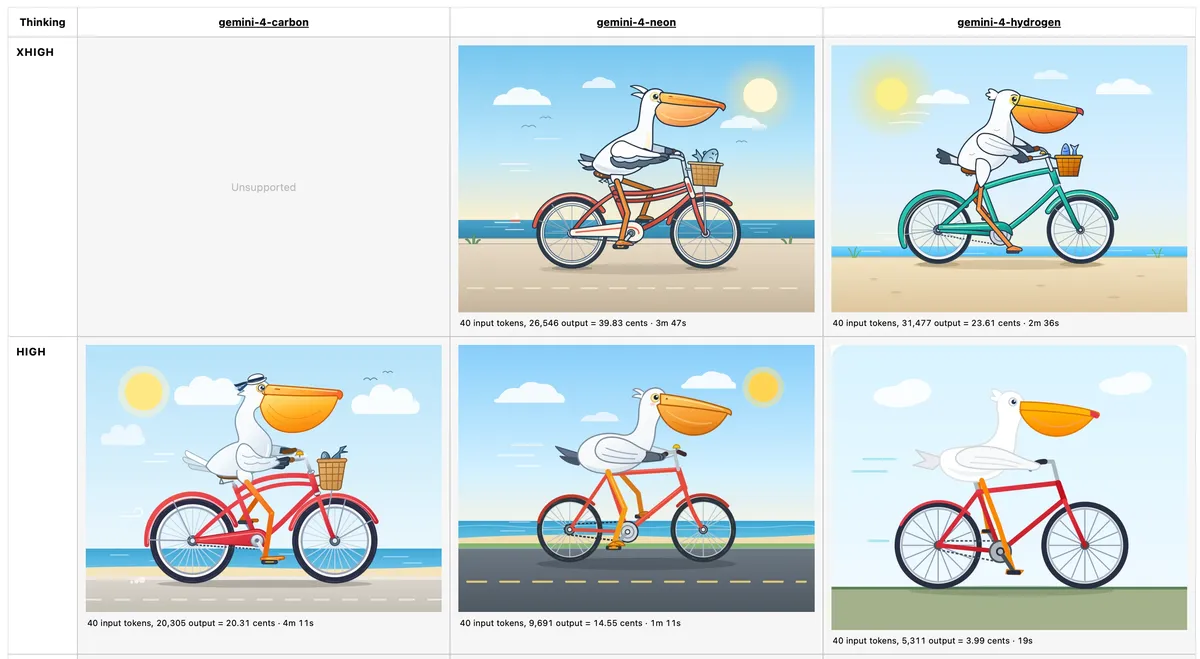
Simon Willison ran the same SVG prompt on Hydrogen at two reasoning levels. At high, it used 5,311 output tokens and cost 3.99 cents. At xhigh, it used 31,477 tokens and cost 23.61 cents. He judged the xhigh drawing competitive with the more expensive Neon. Almost all of the extra cost came from additional reasoning output. [1]
Reasoning levels don't mean the same thing across Gemini 4 models. Hydrogen and Neon offer low, medium, high and xhigh, with high as the default. Carbon and Argon stop at high and default to medium. Any cross-model comparison needs to state both the model and the level. [4] [5]
the reported token counts match Hydrogen's published price, so the sixfold jump holds for this prompt.
Read the full assessment
Implication: teams should budget by reasoning level, not model alone, and test whether Hydrogen at xhigh can replace pricier tiers on real workloads.
Executive brief
Turning Gemini 4 Hydrogen's reasoning setting from high up to xhigh made one test response about six times as long and six times as expensive. Simon Willison asked the model to draw an SVG pelican riding a bicycle. At high it used 5,311 output tokens and cost 3.99 cents. At xhigh it used 31,477 tokens and cost 23.61 cents, and he judged the drawing competitive with the more expensive Gemini 4 Neon (Simon Willison). He found this while fixing his llm-gemini 0.38.1 plugin, which had left out xhigh for Hydrogen and Neon. Carbon, Google's top reasoning model, doesn't offer xhigh at all. This is one prompt, not a benchmark.
What changed and event timeline
Gemini 4 Argon released
Argon is the first model in the four-model Gemini 4 lineup; the reporting says little about it beyond the date ().
Gemini 4 Carbon launches
Google pitches Carbon as its strongest reasoning model. It costs $2/$10 per million input/output tokens through Nov 30, then $4/$20 ().
Hydrogen arrives; llm-gemini 0.37 adds it
Hydrogen is the fast, cheap tier at $1.50/$7.50. Plugin 0.37 exposes it as
gemini-4-hydrogen(;).Neon released; plugin 0.38 follows
Neon is the middle tier at $3/$15, added to the plugin as
gemini-4-neon(;).Llm-gemini 0.38.1 adds
xhighThis dot release enables
xhighthinking for Hydrogen and Neon. Willison also updated his comparison grid ().
Capabilities and access
- Thinking levels: Hydrogen and Neon offer
low,medium,high(default) andxhigh. - Context window: 1,048,576 tokens, shared between input and output. A single request outputs up to 65,536 tokens by default (Google Cloud docs).
- Free tier: Hydrogen is the only Gemini 4 model on it (search summary of model guides).
Read the full section
- Thinking levels: Hydrogen and Neon offer
low,medium,high(default) andxhigh. Carbon and Argon offerlow,medium(default) andhigh(Google Cloud docs; Apidog). - Context window: 1,048,576 tokens, shared between input and output. A single request outputs up to 65,536 tokens by default (Google Cloud docs).
- Free tier: Hydrogen is the only Gemini 4 model on it (search summary of model guides).
- Caching: cached input is reported at 95% off (Apidog).
- Plugin:
llm install -U llm-geminigets version 0.38.1 (release).
Technical analysis for researchers and developers
- No common effort scale: "Reasoning level" means different things on different models.
- The costs check out: 31,477 output tokens × $7.50 per million ≈ $0.236, and 5,311 × $7.50 per million ≈ $0.040.
- Wrapper risk: Tools that keep a fixed list of allowed levels per model can quietly hide new options, as llm-gemini did until 0.38.1.
Read the full section
- No common effort scale: "Reasoning level" means different things on different models.
highis the top setting on Carbon but one step below the top on Hydrogen. Any comparison across models needs to state both the model and the level. - The costs check out: 31,477 output tokens × $7.50 per million ≈ $0.236, and 5,311 × $7.50 per million ≈ $0.040. Both match Willison's figures, given a 40-token prompt. So almost the entire cost difference comes from extra reasoning output.
- Wrapper risk: Tools that keep a fixed list of allowed levels per model can quietly hide new options, as llm-gemini did until 0.38.1. Developers should check level support against Google's docs.
- How the evidence was produced: Willison ran one creative prompt once per configuration and judged the results by eye. That shows cost scaling, not quality.
Claims and evidence
- Claim: At
xhigh, Hydrogen's output is competitive with Neon's. Evidence: Willison's own visual judgment of one SVG (Simon Willison). - Claim: Using
xhighmultiplies cost by about six on this prompt. Evidence: the token counts Willison reports, which also match published pricing (Simon Willison). - Claim: Carbon scores about 65% on Terminal-Bench 4.0, and Neon matches Carbon's coding results for less time and money. No independent replication turned up.
Read the full section
- Claim: At
xhigh, Hydrogen's output is competitive with Neon's. Evidence: Willison's own visual judgment of one SVG (Simon Willison). - Claim: Using
xhighmultiplies cost by about six on this prompt. Evidence: the token counts Willison reports, which also match published pricing (Simon Willison). - Claim: Carbon scores about 65% on Terminal-Bench 4.0, and Neon matches Carbon's coding results for less time and money. Evidence: reported by Crypto Briefing, with Google as the apparent source. No independent replication turned up.
- Claim: Hydrogen produces more than 5x fewer fabricated claims than Gemini 3.8 Flash. Evidence: a Google figure, relayed by Apidog.
Context and prior work
- The pelican test: Willison's "pelican riding a bicycle" SVG prompt is an informal, long-running way to compare models.
- Hydrogen's lineage: Guides place Hydrogen as the successor to Gemini 3.8 Flash (Apidog).
- Google's own usage advice: Hydrogen for everyday coding and agents, Neon when a developer is waiting on the answer, and Carbon for long-horizon work and deep verification (Gemini 4 guide).
Read the full section
- The pelican test: Willison's "pelican riding a bicycle" SVG prompt is an informal, long-running way to compare models. His blog has 162 posts under that tag (Simon Willison).
- Hydrogen's lineage: Guides place Hydrogen as the successor to Gemini 3.8 Flash (Apidog).
- Google's own usage advice: Hydrogen for everyday coding and agents, Neon when a developer is waiting on the answer, and Carbon for long-horizon work and deep verification (Gemini 4 guide).
Limitations, safety and contested findings
- Small sample: The
xhighquality claim rests on one prompt and one person's opinion. - Grid extraction conflicted with the docs: Machine extraction of Willison's comparison grid listed a Carbon
xhighrow and marked Neonxhighas unsupported (grid). - Restricted variants: "Cyber Permissive" versions of Carbon and Argon exist behind an allowlist and default to
high(Google Cloud docs).
Read the full section
- Small sample: The
xhighquality claim rests on one prompt and one person's opinion. - Grid extraction conflicted with the docs: Machine extraction of Willison's comparison grid listed a Carbon
xhighrow and marked Neonxhighas unsupported (grid). Both contradict Google's docs and Willison's post. Those rows were therefore not used here. - Restricted variants: "Cyber Permissive" versions of Carbon and Argon exist behind an allowlist and default to
high(Google Cloud docs). - No independent benchmarks: The benchmark numbers for the lineup come from Google, not outside testing.
Business and practitioner implications
- Price the setting, not just the model: Hydrogen at
xhighcosts about 6x Hydrogen athighon the same prompt. - Carbon's price doubles soon: It rises to $4/$20 on Dec 1 (Apidog). That makes testing Hydrogen and Neon at
xhigha timely alternative. - Cap and monitor output:
xhighcan produce tens of thousands of reasoning tokens per call. Set output limits and watch per-request spend.
Read the full section
- Price the setting, not just the model: Hydrogen at
xhighcosts about 6x Hydrogen athighon the same prompt. It could still undercut the higher tiers on some tasks, but only testing on real workloads will show that. - Carbon's price doubles soon: It rises to $4/$20 on Dec 1 (Apidog). That makes testing Hydrogen and Neon at
xhigha timely alternative. - Cap and monitor output:
xhighcan produce tens of thousands of reasoning tokens per call. Set output limits and watch per-request spend. - Update tooling: Anyone using the llm CLI should move to 0.38.1 to get
xhigh.