
EcosystemsRegions, accelerators & hubs
NSA classified network outage traced to PHP2Shell patching as Altimeter's Jamin Ball warns of rushed-patch failures
AI helped uncover decade-old PHP flaws, and the rush to patch them took down the NSA's classified network. Altimeter's Jamin Ball argues self-inflicted patch outages precede real AI-driven attacks, though most other November outages had unrelated, documented causes.
From the Clouded Judgement article of November 20, 2026 and cited sources: The Director of National Intelligence attributed the NSA's November 17 classified network outage to patching for PHP2Shell, not to an attack. [2]
SOURCES[2] SDxCentral: NSA outage after botched PHP update sdxcentral.com
 AT Pulse research deskPublished · Updated · 5 min read · AI-assisted analysis
AI-assisted, not human-edited. Methodology Corrections Who owns this site
- What happened
- The Director of National Intelligence attributed the NSA's November 17 classified network outage to patching for PHP2Shell, not to an attack. [2]
- Original source
- Clouded Judgement article, independent perspective
- Brief by
- AT Pulse research desk AI-assisted; publisher and contact on the desk page
- Studies
- arXiv 2610.36334 (Oct 2026) [10] date from arXiv ID
- When
- November 20, 2026 article published
- Covered
- Nov 22 edition
- Evidence
- 10 sources across 9 sites
- 1Clouded Judgement 11.19.26 - Security Armageddoncloudedjudgement.substack.com
- 2SDxCentral: NSA outage after botched PHP updatesdxcentral.com
- 3Wikipedia: PHP2Shellen.wikipedia.org
- 4Fortune: AI tools discovered the PHP vulnerabilityfortune.com
- 5Yahoo Finance: Major national disruptions in Novemberfinance.yahoo.com
- 6Wikipedia: 2026 FAA nationwide ground stopen.wikipedia.org
StrongHow it’s measured
Substack · 25 likes · 4 comments
Reach blends public engagement (views, likes, comments, shares, stars) from the platforms where the story or its original source lives: YouTube, Hacker News, GitHub, Substack and similar. A video and the article written from its transcript share one score, taken from the video. Platforms with no data are left out rather than counted as zero, and the age of a story never lowers its score.
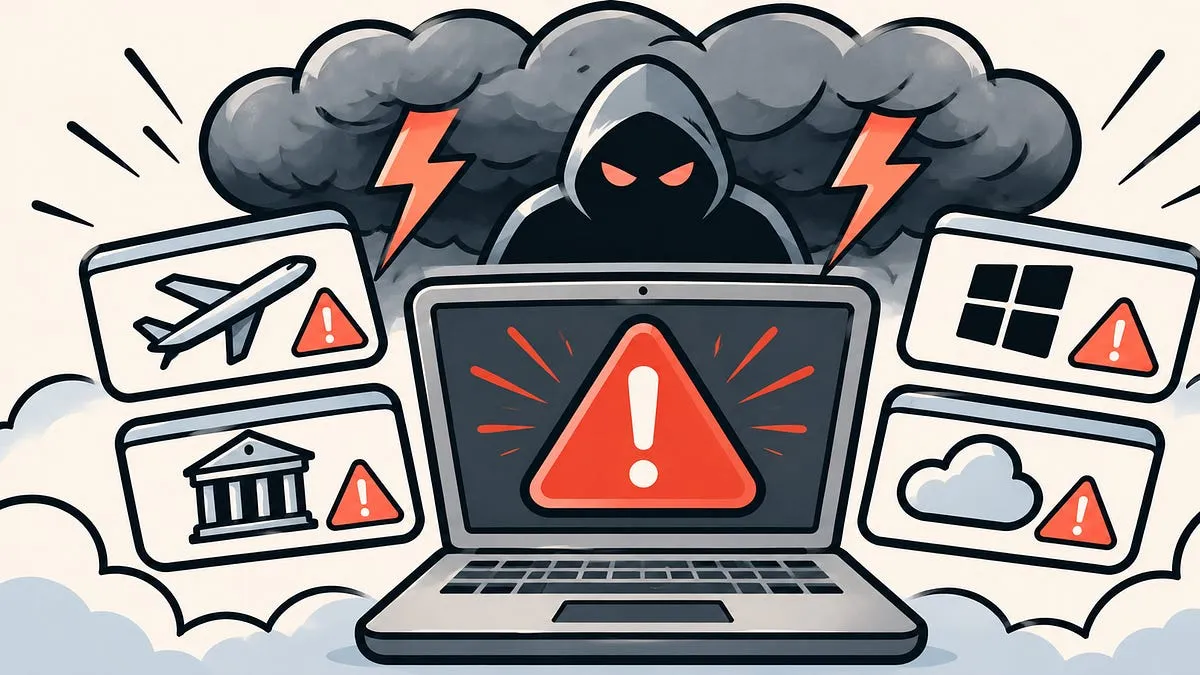
The Director of National Intelligence attributed the NSA's November 17 classified network outage to patching for PHP2Shell, not to an attack. The agency first called it routine maintenance, and some systems failed to come back up after the patches went in. [2]
PHP2Shell consists of two flaws in PHP's core, affecting versions 5.4 through 8.5, that went unnoticed for more than a decade. Researchers using frontier AI models found them, and each was rated 9.2 on CVSS v4.0. Exploitation attempts appeared days before the October disclosure. AI handled much of the tedious work of turning a known crash into code execution, but experts say it cannot yet do this unaided. [3] [4] [8]
Most of that week's high-profile disruptions had stated causes unrelated to PHP. Microsoft cited a capacity upgrade, the FAA ground stop followed new routers flooding its telecom network, and JPMorgan cited a hardware bug. The only confirmed cyberattack that week was injected code at Optimizely. [5] [6] [9]
Ball calls his thesis a hunch. It leans on a Bridgewater chart estimating that the time from disclosure to exploitation fell from about a month to 11 days and that zero-days roughly doubled. These figures are the investment firm's own estimates, built from non-public data that others cannot reproduce. [1] [7]
one confirmed case where emergency patching caused a major outage.
Read the full assessment
Implication: if AI keeps shortening exploit timelines, organizations need staged rollouts and rollback plans, because fast patching without them can disrupt operations as badly as an attack.
Executive brief
The clearest evidence for Jamin Ball's theory that companies are breaking their own systems by rushing patches comes from the U.S. government. On November 17, the NSA's classified network went down. Director of National Intelligence Jay Clayton said the cause was patching for PHP2Shell, a set of PHP flaws found with AI help, and not an attack (SDxCentral). Ball is a partner at Altimeter Capital, and his November 20 newsletter argues that AI shrinks the time from finding a flaw to exploiting it. In his view, the wave of outages is defenders' own doing and comes before the real attacks. Most other outages that week had different, documented causes.
What changed and event timeline
AI-assisted discovery
A researcher at Calif, working with OpenAI's GPT-5.6 Sol, found two flaws in PHP's core that had been there for more than a decade. Wiz found them separately ().
Disclosure and patches
Two CVEs went public, each rated 9.2 on CVSS v4.0. Patches followed the next day. Exploitation attempts had already been seen four days before disclosure (;).
Microsoft outage
Services failed in more than 70 countries. Microsoft blamed an earlier network capacity upgrade and said the incident was not related to cyber or AI ().
FAA ground stop; Bridgewater warning
Newly installed Juniper routers flooded the FAA's telecom network, halting U.S. flights for about 4.5 hours (). On the same day, Bridgewater put the odds of an economically destabilizing cyberattack within a year at one in three ().
NSA network down
The NSA first described the outage as routine maintenance. Clayton later tied it to PHP patching ().
"Security Armageddon" post
Ball argues that rushed patching is causing outages and that the patches themselves will create new weak spots ().
Capabilities and access
- Calif's discovery used GPT-5.6 Sol. Wiz used Gemini 4 Argon, GPT-5.6 Sol and its own Wiz Atlas tool (Wikipedia: PHP2Shell).
- Affected versions run from PHP 5.4 to 8.5. Fixes shipped as 8.2.35, 8.3.36, 8.4.27 and 8.5.12, with source-only patches for 7.4–8.1 (same source).
- According to IEEE Spectrum, the bug started as an out-of-memory crash reported in 2024.
Read the full section
- Calif's discovery used GPT-5.6 Sol. Wiz used Gemini 4 Argon, GPT-5.6 Sol and its own Wiz Atlas tool (Wikipedia: PHP2Shell).
- Affected versions run from PHP 5.4 to 8.5. Fixes shipped as 8.2.35, 8.3.36, 8.4.27 and 8.5.12, with source-only patches for 7.4–8.1 (same source).
- According to IEEE Spectrum, the bug started as an out-of-memory crash reported in 2024. An AI-assisted researcher turned it into code execution within two weeks (IEEE Spectrum).
Technical analysis for researchers and developers
- How the exploit was found: AI handled the tedious reasoning needed to turn a known crash into an exploit.
- How Bridgewater measured the trend: It built a time series of incidents from public disclosures, media reports and filings, tagged by root cause and adjusted for reporting lags.
- Where it breaks in practice: Swapping in a patched library can break systems downstream.
Read the full section
- How the exploit was found: AI handled the tedious reasoning needed to turn a known crash into an exploit. Columbia's Suman Jana says AI still cannot do this alone (IEEE Spectrum).
- How Bridgewater measured the trend: It built a time series of incidents from public disclosures, media reports and filings, tagged by root cause and adjusted for reporting lags. Its data is not public, so others cannot reproduce it (Bridgewater).
- Where it breaks in practice: Swapping in a patched library can break systems downstream. The NSA systems that did not come back up after patching are a documented case (SDxCentral).
- Proposed fixes: Experts suggest formal verification that can generate patches and prove them correct (IEEE Spectrum).
Claims and evidence
- Patching caused outages: confirmed for the NSA by the DNI (SDxCentral).
- Time from disclosure to exploitation fell from a month to 11 days, and zero-days roughly doubled: Bridgewater's own estimates, published by an investment firm that trades on this view (Bridgewater).
- Only one confirmed cyberattack that week: injected code at Optimizely (Yahoo Finance).
Read the full section
- Patching caused outages: confirmed for the NSA by the DNI (SDxCentral). The Microsoft, FAA and JPMorgan outages had stated causes unrelated to PHP: a capacity upgrade, routers and a hardware bug (CNBC).
- Time from disclosure to exploitation fell from a month to 11 days, and zero-days roughly doubled: Bridgewater's own estimates, published by an investment firm that trades on this view (Bridgewater).
- Only one confirmed cyberattack that week: injected code at Optimizely (Yahoo Finance).
- Ball's thesis: he calls it "just a hunch," and it rests on no independent data.
Context and prior work
- Bridgewater's report is the source of Ball's chart. It argues that defenders must fix every bug while attackers need only one (Bridgewater).
- An October 28 arXiv preprint looks at how to verify and disclose vulnerabilities found by AI, using PHP2Shell as its case study (arXiv 2610.36334).
- Johns Hopkins' Matthew Green expects little to change until something goes badly wrong (IEEE Spectrum).
Read the full section
- Bridgewater's report is the source of Ball's chart. It argues that defenders must fix every bug while attackers need only one (Bridgewater).
- An October 28 arXiv preprint looks at how to verify and disclose vulnerabilities found by AI, using PHP2Shell as its case study (arXiv 2610.36334).
- Johns Hopkins' Matthew Green expects little to change until something goes badly wrong (IEEE Spectrum).
Limitations, safety and contested findings
- Ball calls the FAA stop only the second since 9/11. Wikipedia counts it as the third in U.S. history, after 9/11 and 2023 (Wikipedia).
- Each organization says its own outage was not a cyberattack. That rules out attacks but not patching as a cause.
- Disclosures: Ball writes as an Altimeter partner, and his newsletter says Altimeter may trade securities of the companies it mentions.
Read the full section
- Ball calls the FAA stop only the second since 9/11. Wikipedia counts it as the third in U.S. history, after 9/11 and 2023 (Wikipedia).
- Each organization says its own outage was not a cyberattack. That rules out attacks but not patching as a cause. Apart from the NSA, no organization has linked its outage to PHP2Shell (CNBC).
- Disclosures: Ball writes as an Altimeter partner, and his newsletter says Altimeter may trade securities of the companies it mentions. Bridgewater manages money based on its own forecast.
Business and practitioner implications
- Plan for staged emergency patching. The NSA shows that patching fast without rollback plans causes outages of its own.
- Unit 42's Sam Rubin advises planning how to keep operating when a system goes down (CNBC).
- Ball's thesis supports more spending there, but it is an investor's view, not a measured trend.
Read the full section
- Plan for staged emergency patching. The NSA shows that patching fast without rollback plans causes outages of its own.
- Design for failure. Unit 42's Sam Rubin advises planning how to keep operating when a system goes down (CNBC).
- Watch security and observability vendors. Ball's thesis supports more spending there, but it is an investor's view, not a measured trend.
- Push frontier labs for researcher access. Experts propose donated AI access and formal verification as defenses (IEEE Spectrum).
The source trail.
Sources (10)
Clouded Judgement 11.19.26 - Security Armageddon
Article text retrieved; extracted text may omit tables or interactive elements.
cloudedjudgement.substack.com