
PolicyLaw, regulation & governance
Former Biden AI advisers Buchanan and Collins defend China chip controls as a way to buy time for AI safety
Former Biden White House officials Ben Buchanan and Tantum Collins argue the US should use its chip-control advantage over China to buy time for AI safety. They say Beijing's early answer to safety talks was a demand to buy chips.
From the The Cognitive Revolution podcast episode of November 21, 2026 and cited sources: Their doctrine is called 'spend the lead on safety.' The idea is to use the allied chokehold on the chip supply chain to deny China compute, build a lead without racing, and then move carefully. [1] [8] [9]
SOURCES[1] Spend the Lead on Safety: Biden AI Advisors Ben Buchanan &… cognitiverevolution.ai[8] Epoch AI: AI Chip Owners Explorer epoch.ai[9] IFP: How to Increase America's AI Lead Over China ifp.org
 AT Pulse research deskPublished · Updated · 5 min read · AI-assisted analysis
AI-assisted, not human-edited. Methodology Corrections Who owns this site
- What happened
- Their doctrine is called 'spend the lead on safety.' The idea is to use the allied chokehold on the chip supply chain to deny China compute, build a lead without racing, and then move carefully. [1] [8] [9]
- Original source
- The Cognitive Revolution podcast episode, independent perspective
- Brief by
- AT Pulse research desk AI-assisted; publisher and contact on the desk page
- When
- November 21, 2026 podcast episode published
- Covered
- Nov 21 edition
- Evidence
- 11 sources across 9 sites; transcript sourced
- 1Spend the Lead on Safety: Biden AI Advisors Ben Buchanan &…cognitiverevolution.ai
- 2White House readout, Woodside 2023bidenwhitehouse.archives.gov
- 3NSC statement on Geneva talksbidenwhitehouse.archives.gov
- 4PBS: first AI dialoguepbs.org
- 5NPR: Biden and Xi on AI and nuclear decisionsnpr.org
- 6Bloomberg: Biden, Xi agree on AI and nuclear weaponsbloomberg.com
QuietHow it’s measured
YouTube video · 220 views · 2 likes
Reach blends public engagement (views, likes, comments, shares, stars) from the platforms where the story or its original source lives: YouTube, Hacker News, GitHub, Substack and similar. A video and the article written from its transcript share one score, taken from the video. Platforms with no data are left out rather than counted as zero, and the age of a story never lowers its score.
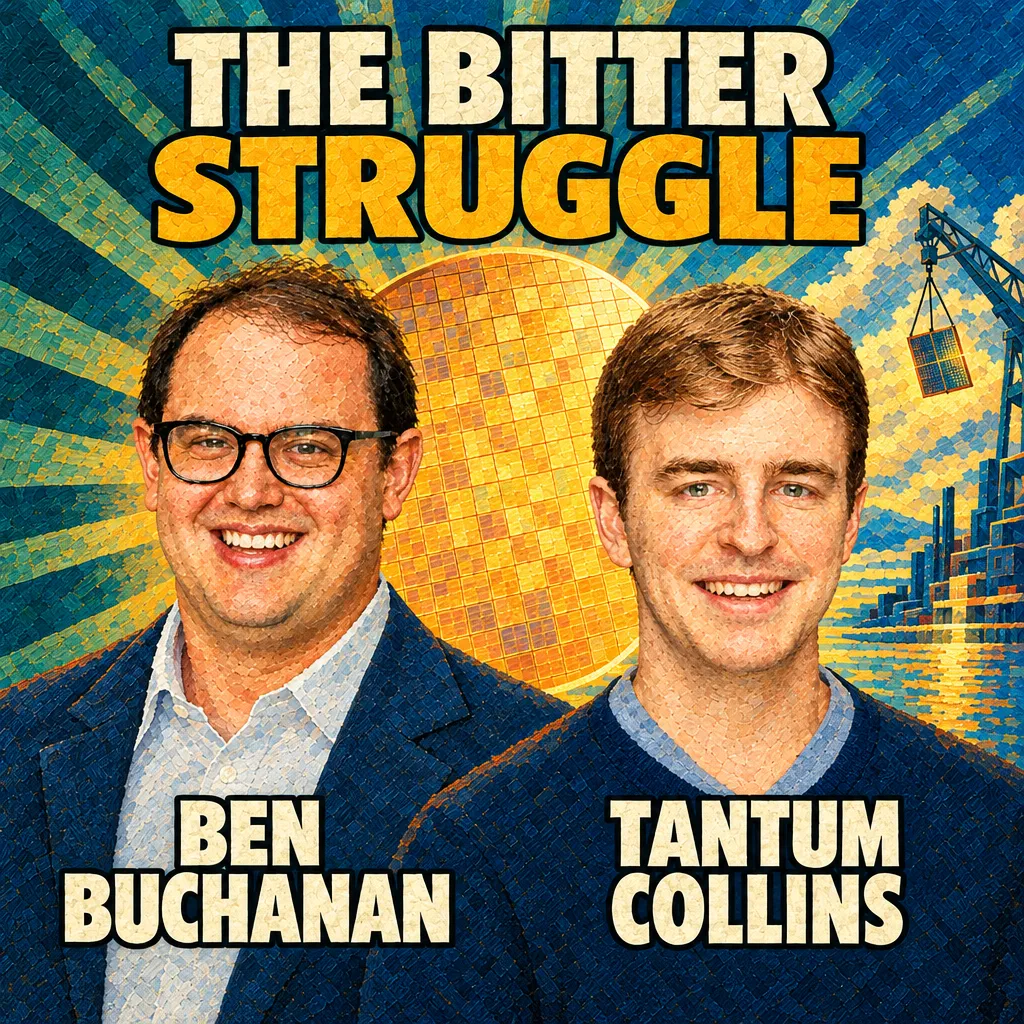
Their doctrine is called 'spend the lead on safety.' The idea is to use the allied chokehold on the chip supply chain to deny China compute, build a lead without racing, and then move carefully. Buchanan puts the lead at roughly 100:1 in producing compute and about 15:1 in access to it. He says closing remote-access loopholes and stopping transshipment smuggling could push the access ratio toward 100:1. Outside estimates broadly fit the access gap, but none in the reviewed sources checks the production figure. [1] [8] [9]
They reject the idea of offering 'chips for controls' up front. They point to the record: Biden and Xi agreed to AI talks at Woodside, and the first Geneva meeting followed in May 2024. In Buchanan's telling, China's opening ask in Geneva was to buy chips. By the Lima meeting, the two sides had agreed only that humans, not AI, should control decisions to use nuclear weapons. Both authors say they would still push hard for engagement with Beijing if they were back in government. [1] [2] [3] [4] [5] [6] [10]
On governing frontier AI, Buchanan favors 'pacing': pauses triggered by safety and security thresholds rather than fixed time periods, which he says risk building up a compute overhang. His blunt red line would be closed-loop recursive self-improvement. Collins notes that bio-focused models need far less training compute, which makes compute-based monitoring harder. The authors name cyber and bio as the most likely routes to a major AI disaster. [1]
Whether the lead is actually being spent on safety is still open. Host Nathan Labenz points out that reward hacking remains unsolved. Buchanan says the current administration has weakly enforced, and in some cases reversed, the export controls. Epoch's median estimate puts smuggled chips at about 660,000, roughly 3% of the global stock. [1] [11]
Epoch and IFP data support a large US advantage in compute access.
Read the full assessment
If the authors are right, enforcing export controls, setting remote-access rules for cloud providers and tying pauses to safety thresholds matter more than fixed compute caps or timed pauses.
Executive brief
Ben Buchanan, Biden's former White House AI adviser, estimates that the US and its allies hold roughly a 100:1 lead over China in producing AI compute and about 15:1 in access to it. On the Cognitive Revolution podcast, Buchanan and former NSC official Tantum Collins defend the chip controls they pushed for, under a doctrine they called "spend the lead on safety": deny China compute, then use the time gained to go carefully. Buchanan's answer was that Beijing's opening position in 2024 talks was simply "sell us chips."
Read the full section
Ben Buchanan, Biden's former White House AI adviser, estimates that the US and its allies hold roughly a 100:1 lead over China in producing AI compute and about 15:1 in access to it. He also argues that this lead is going unused. On the Cognitive Revolution podcast, Buchanan and former NSC official Tantum Collins defend the chip controls they pushed for, under a doctrine they called "spend the lead on safety": deny China compute, then use the time gained to go carefully. Host Nathan Labenz argued for a "chips for controls" bargain with China. Buchanan's answer was that Beijing's opening position in 2024 talks was simply "sell us chips." The episode promotes their new book, The Bitter Struggle.
What changed and event timeline
Biden–Xi agree to AI talks
At Woodside, the two leaders agreed to government-to-government talks on the risks of advanced AI and on AI safety ().
First US–PRC AI talks in Geneva
Tarun Chhabra and Seth Center led the US side. Washington raised concerns about China misusing AI (). Beijing protested US restrictions ().
Lima nuclear-AI statement
Biden and Xi agreed that humans, not AI, should control decisions to use nuclear weapons (;).
The Bitter Struggle published
Crown published the 320-page book, subtitled "Superintelligence, Superpowers, and the Fate of the World" ().
Podcast episode released
The authors defend chip denial while saying they would keep pushing for engagement with Beijing if they were in power ().
Capabilities and access
This is a policy story, not a model release.
Read the full section
This is a policy story, not a model release. The relevant "access" is access to compute:
- Buchanan says that closing the remote-access loophole and stopping transshipment smuggling could push the 15:1 access ratio toward 100:1 (transcript, 00:34:31).
- The book comes in hardback, ebook and audiobook (Penguin Random House).
- Buchanan currently advises Anthropic (Penguin Random House). In the episode, Collins says he runs Inherent, a UK-based AI company (transcript, 00:50:25).
Technical analysis for researchers and developers
- Compute ratios depend on what is measured.
- Buchanan prefers pauses tied to safety thresholds ("pacing") over fixed time periods, because a timed pause can build up a compute overhang.
- Collins notes that bio-focused models need far less training compute than general-purpose ones, which weakens compute-based monitoring (01:41:10).
Read the full section
- Compute ratios depend on what is measured. Production, owned stock, training compute and remote rental give different numbers. Epoch's ownership estimate leaves out smuggled chips and offshore cloud. IFP projects that about 2.8M of China's 8.8M H100-equivalents at end-2027 will come through remote access.
- Pause design. Buchanan prefers pauses tied to safety thresholds ("pacing") over fixed time periods, because a timed pause can build up a compute overhang. As a blunt red line he would pick closed-loop recursive self-improvement (01:16:57).
- Bio models. Collins notes that bio-focused models need far less training compute than general-purpose ones, which weakens compute-based monitoring (01:41:10).
Claims and evidence
Read the full section
- 100:1 production and 15:1 access. Buchanan gives no method for either figure (00:34:31). Separate estimates broadly fit the access figure: Epoch puts US hyperscalers above 70% of global AI compute and China just over 5% (Epoch), and IFP estimates a 16x US frontier training-compute advantage (IFP). No independent estimate of the 100:1 production ratio appears in the reviewed sources.
- China called shared AI risk "some kind of plot" in Geneva. This is Buchanan's account (00:41:53). Public readouts confirm only that Beijing protested US restrictions and that there was little consensus (PBS; RSIS).
- Lima outcome. Reporting confirms it (NPR).
Context and prior work
- Buchanan describes the policy as resting on the bitter lesson and scaling laws, framed through Kennedy's 1962 Rice University speech about the need for preeminence (00:29:02).
- He separates his position from Dario Amodei's Machines of Loving Grace coalition strategy.
- He cites the network of AI safety institutes the administration set up (00:50:37).
Read the full section
- Buchanan describes the policy as resting on the bitter lesson and scaling laws, framed through Kennedy's 1962 Rice University speech about the need for preeminence (00:29:02).
- He separates his position from Dario Amodei's Machines of Loving Grace coalition strategy. His preferred model is post-WWII institution-building, which China could join without regime change (00:49:49).
- He cites the network of AI safety institutes the administration set up (00:50:37).
Limitations, safety and contested findings
- Is the lead being spent? Labenz points out that reward hacking, first illustrated by OpenAI's 2016 boat-racing example, is still unsolved (00:33:25).
- Epoch puts the median estimate of smuggled chips at about 660,000, roughly 3% of the global stock (Epoch).
- How China reads the policy. Collins says he has sympathy for that skepticism (00:51:29).
Read the full section
- Is the lead being spent? Labenz points out that reward hacking, first illustrated by OpenAI's 2016 boat-racing example, is still unsolved (00:33:25). Buchanan says the current administration lacks conviction and has partly reversed the export controls (00:34:31).
- Smuggling. Epoch puts the median estimate of smuggled chips at about 660,000, roughly 3% of the global stock (Epoch).
- How China reads the policy. Labenz reports that people in China see it as an effort to hold the country down. Collins says he has sympathy for that skepticism (00:51:29).
- The "bitter temptation." Collins warns that AI-enabled centralized administration could slowly push democracies toward autocracy (01:24:20).
Business and practitioner implications
- Cloud providers: remote-access controls and stricter customer screening are the most actionable recommendations, so expect more know-your-customer requirements in Southeast Asia (IFP).
- Frontier labs: future rules may be tied to safety thresholds and recursive self-improvement red lines rather than fixed compute caps.
- Security and bio teams: the authors name cyber and bio as the most likely routes to an "AI Chernobyl" (01:32:50).
Read the full section
- Cloud providers: remote-access controls and stricter customer screening are the most actionable recommendations, so expect more know-your-customer requirements in Southeast Asia (IFP).
- Frontier labs: future rules may be tied to safety thresholds and recursive self-improvement red lines rather than fixed compute caps.
- Security and bio teams: the authors name cyber and bio as the most likely routes to an "AI Chernobyl" (01:32:50).
- Non-US governments: Collins argues that funding safety research, as the UK's AI Security Institute does, is where they can have real influence (01:41:54).
The source trail.
Sources (11)
Spend the Lead on Safety: Biden AI Advisors Ben Buchanan & Tantum Collins on the Fate of the World
Transcript retrieved via published_transcript; language en. Timestamped text, not direct audiovisual review. Source: https://cognitiverevolution.ai/spend-the-lead-on-safety-biden-ai-advisors-ben-buchanan-tantum-collins-on-the-fate-of-the-world. Automatic captions/transcription may contain errors.
cognitiverevolution.ai