
ExitsIPOs, listings & liquidity
Anthropic raises about $79 billion in Nasdaq IPO at $83 a share, closes first day up 17%
Anthropic sold 980 million Nasdaq shares at $83, above its marketed range, and closed its first trading day at $97.17. Its S-1 shows fast revenue growth alongside large, mostly non-cash losses and about $542 billion in compute commitments through 2031.
From the Newcomer article of November 19, 2026 and cited sources: Anthropic enlarged the offering from 825 million to 980 million shares and priced it at $83, above the $70–78 range. [2] [8] [3]
SOURCES[2] Anthropic: IPO pricing anthropic.com[8] Anthropic: Roadshow launch anthropic.com[3] Fortune: Anthropic stock pops 30% fortune.com
 AT Pulse research deskPublished · Updated · 4 min read · AI-assisted analysis
AI-assisted, not human-edited. Methodology Corrections Who owns this site
- What happened
- Anthropic enlarged the offering from 825 million to 980 million shares and priced it at $83, above the $70–78 range. [2] [8] [3]
- Original source
- Newcomer article, independent perspective
- Brief by
- AT Pulse research desk AI-assisted; publisher and contact on the desk page
- When
- November 19, 2026 article published
- Covered
- Nov 20 edition
- Evidence
- 10 sources across 8 sites
RisingHow it’s measured
Substack · 15 likes · 1 share
Reach blends public engagement (views, likes, comments, shares, stars) from the platforms where the story or its original source lives: YouTube, Hacker News, GitHub, Substack and similar. A video and the article written from its transcript share one score, taken from the video. Platforms with no data are left out rather than counted as zero, and the age of a story never lowers its score.
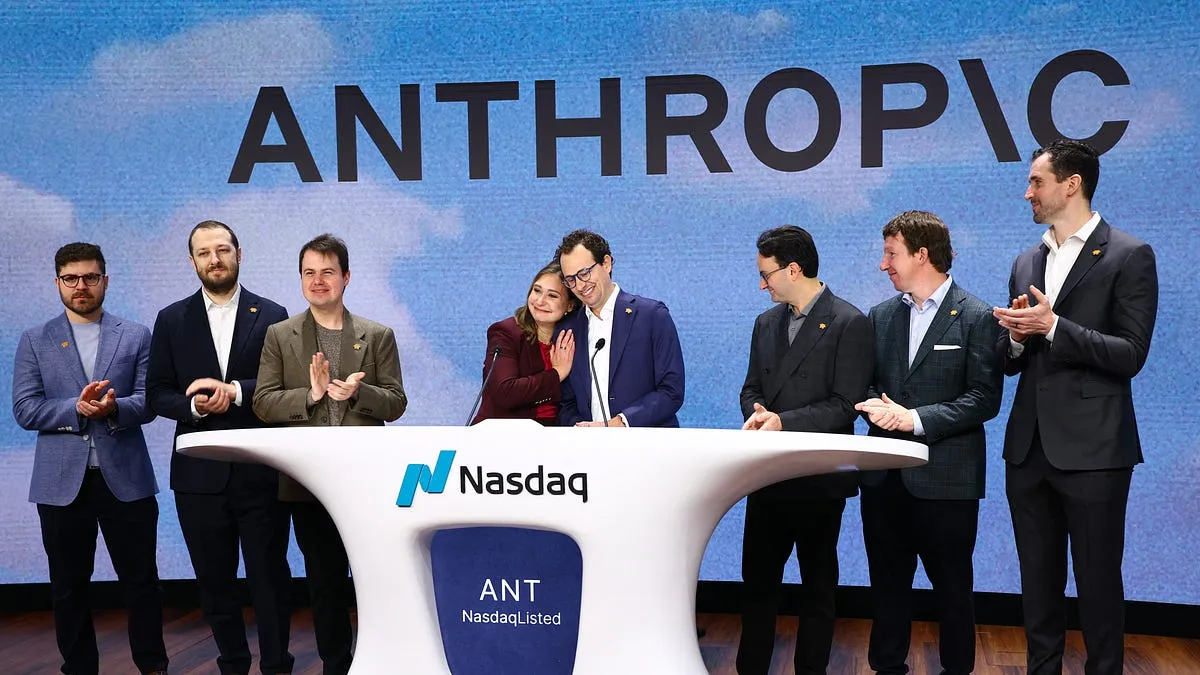
Anthropic enlarged the offering from 825 million to 980 million shares and priced it at $83, above the $70–78 range. Primary shares raised about $79 billion. Trading under the ticker ANT, the stock opened at $111.50 on November 19 and closed at $97.17. [2] [8] [3]
The S-1 reports $4.59 billion in 2025 revenue and $16.29 billion in the first half of 2026. It also shows an $80.7 billion first-half loss, about $72 billion of which came from non-cash convertible-note charges. About 80% of revenue is usage-based, and AWS accounts for 48% of it. [4]
Anthropic is committed to about $542 billion in compute spending through 2031 across Google TPUs, Amazon Trainium, SpaceX GPUs and Azure. The filing treats these chips as one interchangeable pool and says the company has underestimated its compute needs in the past. [4]
The valuation rose from $965 billion in the May Series H to a reported $1.3–1.8 trillion at the first-day close, depending on the share count used. The seven co-founders keep 50.1% of the voting power through a founder LLC, and the company remains a public benefit corporation. [5] [6] [9] [3] [10] [4]
The filing and first-day trading show the company's scale and strong investor demand. What follows is less certain: at an estimated 22–30x revenue, the price assumes enterprise AI profitability holds.
Read the full assessment
Quarterly reports will now make margins, pricing and cloud dependence public.
Executive brief
Anthropic is now the largest IPO ever by capital raised, ahead of SpaceX's June 2026 listing. It priced 980 million Nasdaq shares (ticker ANT) at $83 on November 18, 2026, above its $70–78 range (Anthropic). On November 19 the stock opened at $111.50, briefly valuing the company at about $2 trillion, then closed at $97.17, up 17% on the day (Fortune). Newcomer argues that the deal broke conventional startup rules in several ways (Newcomer). Big losses, made up mostly of non-cash charges, and about $542 billion in compute commitments did not put off buyers (CNBC).
What changed and event timeline
$965B Series H
Anthropic announced a $65B round led by Altimeter, Dragoneer, Greenoaks and Sequoia. In the same post it said run-rate revenue had passed $47B, a figure that is self-reported (;).
IPO paperwork filed
NPR reported that Anthropic had filed preliminary IPO paperwork with the SEC ().
Public S-1
The filing showed $16.29B in first-half revenue and an $80.7B loss, roughly $72B of it from non-cash convertible-note charges ().
Roadshow launches
The offering was set at 825M shares priced at $70–78, with Goldman Sachs and Morgan Stanley leading ().
Upsized pricing
The deal grew to 980M shares at $83, and the SEC declared the registration effective that day ().
Capabilities and access
The IPO is a financing event, not a model release, and the reviewed sources don't describe any new model version. Products named in coverage of the S-1 include Claude and Claude Code. Claude is sold through AWS, Google Cloud and Microsoft Azure, and AWS accounts for 48% of revenue (CNBC; Anthropic). About 20% of IPO shares were reserved for retail investors (Fortune).
Technical analysis for researchers and developers
The technically relevant disclosures are about infrastructure (CNBC):
Read the full section
The technically relevant disclosures are about infrastructure (CNBC):
- Compute obligations: about $542B through 2031. That includes Google TPUs ($114.5B), Amazon Trainium ($110B), SpaceX GPUs ($120.5B through 2029) and Azure ($44.9B).
- Mixed hardware: the S-1 treats Nvidia, AMD, Trainium and TPU capacity as one interchangeable pool. That implies Anthropic has invested heavily in running training and inference across different chip types.
- Revenue model: 80% of revenue is usage-based, so revenue rises and falls with tokens served.
- Forecasting risk: the S-1 says Anthropic has underestimated its compute needs in the past.
Claims and evidence
- Raise: Filing-confirmed: 956.35M primary shares at $83, about $79B (Anthropic). Earlier figures came from unnamed sources cited via Bloomberg and the FT (TNW).
- Valuation: About $1.49T fully diluted at $83, according to reports (TNW).
- Revenue: Filing figures are $4.59B for 2025 and $16.29B for the first half of 2026. Fortune cites $33.2B for nine months.
Read the full section
- Raise: Filing-confirmed: 956.35M primary shares at $83, about $79B (Anthropic). Reported, not filing-confirmed: a separate $26B nonvoting private placement from seven strategic partners, including Google and Nvidia (Fortune). Earlier figures came from unnamed sources cited via Bloomberg and the FT (TNW).
- Valuation: About $1.49T fully diluted at $83, according to reports (TNW). Reported closing values range from $1.75T fully diluted (Investing.com) to about $1.8T, or about $1.3T on basic shares (Fortune).
- Revenue: Filing figures are $4.59B for 2025 and $16.29B for the first half of 2026. The 900% net revenue retention figure is also company-reported (CNBC). Fortune cites $33.2B for nine months.
Context and prior work
SpaceX's June 2026 IPO raised $75B, or $86.2B after bankers sold extra shares, at a $1.77T valuation. The $965B Series H was the first time Anthropic was valued above OpenAI (Bloomberg Law). Among commenters on the S-1, Menlo Ventures' Matt Murphy and Bessemer's Byron Deeter both have their own firms' money in Anthropic.
Read the full section
SpaceX's June 2026 IPO raised $75B, or $86.2B after bankers sold extra shares, at a $1.77T valuation. Anthropic raised more but debuted at a lower valuation (TNW). The $965B Series H was the first time Anthropic was valued above OpenAI (Bloomberg Law). Among commenters on the S-1, Menlo Ventures' Matt Murphy and Bessemer's Byron Deeter both have their own firms' money in Anthropic. Murphy called it Menlo's biggest return, and Deeter called it Bessemer's largest investment (CNBC).
Limitations, safety and contested findings
- Governance: Anthropic is a public benefit corporation. A founder LLC held by the seven co-founders keeps 50.1% of the voting power (CNBC).
- Risk factors: the S-1 cites disputes over a Pentagon blacklist, moratoriums on data centers, concentration in TSMC and Taiwan, and the possibility of "catastrophic or existential" AI risk (Fortune).
- Market cap is contested: estimates range from $1.3T to $1.8T depending on the share count used.
Read the full section
- Governance: Anthropic is a public benefit corporation. A founder LLC held by the seven co-founders keeps 50.1% of the voting power (CNBC).
- Risk factors: the S-1 cites disputes over a Pentagon blacklist, moratoriums on data centers, concentration in TSMC and Taiwan, and the possibility of "catastrophic or existential" AI risk (Fortune).
- Market cap is contested: estimates range from $1.3T to $1.8T depending on the share count used.
- Lock-ups: they expire in phases between 27 and 76 days after the IPO, so selling pressure could rise in early 2027.
Business and practitioner implications
- Vendor visibility: quarterly reporting will publicly show Claude's pricing pressure, gross margin (implied at 85%) and cloud dependence.
- Cloud negotiations: enterprises buying through AWS, Google or Azure should expect hyperscaler incentives to stay closely tied to Anthropic.
- Valuation multiple: MIT Sloan's Sinan Aral estimates the price implies 22–30x revenue, a level that depends on enterprise profitability holding up (CNBC).
Read the full section
- Vendor visibility: quarterly reporting will publicly show Claude's pricing pressure, gross margin (implied at 85%) and cloud dependence.
- Cloud negotiations: enterprises buying through AWS, Google or Azure should expect hyperscaler incentives to stay closely tied to Anthropic.
- Valuation multiple: MIT Sloan's Sinan Aral estimates the price implies 22–30x revenue, a level that depends on enterprise profitability holding up (CNBC).
- Employee wealth: the average employee stake is worth more than $40M, which could affect hiring and retention (Fortune).