
BusinessMarkets, money & strategy
Anthropic's record $81.3bn IPO leaves its seven co-founders with majority voting control and stakes worth over $180bn
Anthropic's record $81.3bn Nasdaq listing left its seven co-founders with stakes worth more than $180bn at the opening price. A Founder LLC gives them 50.1% of votes, despite a non-binding pledge to give away 80% of their shares.
From the The Guardian · AI article of November 19, 2026 and cited sources: Anthropic priced its IPO at $83, above the $70–78 range. [6] [7] [8] [1]
SOURCES[6] Al Jazeera aljazeera.com[7] Deadline deadline.com[8] NPR npr.org
 AT Pulse research deskPublished · Updated · 5 min read · AI-assisted analysis
AI-assisted, not human-edited. Methodology Corrections Who owns this site
- Original source
- The Guardian · AI article, independent perspective
- Brief by
- AT Pulse research desk AI-assisted; publisher and contact on the desk page
- When
- November 19, 2026 article published
- Covered
- Nov 21 edition
- Evidence
- 14 sources across 14 sites
RisingHow it’s measured
YouTube video · 5.1K views · 8 likes
Reach blends public engagement (views, likes, comments, shares, stars) from the platforms where the story or its original source lives: YouTube, Hacker News, GitHub, Substack and similar. A video and the article written from its transcript share one score, taken from the video. Platforms with no data are left out rather than counted as zero, and the age of a story never lowers its score.
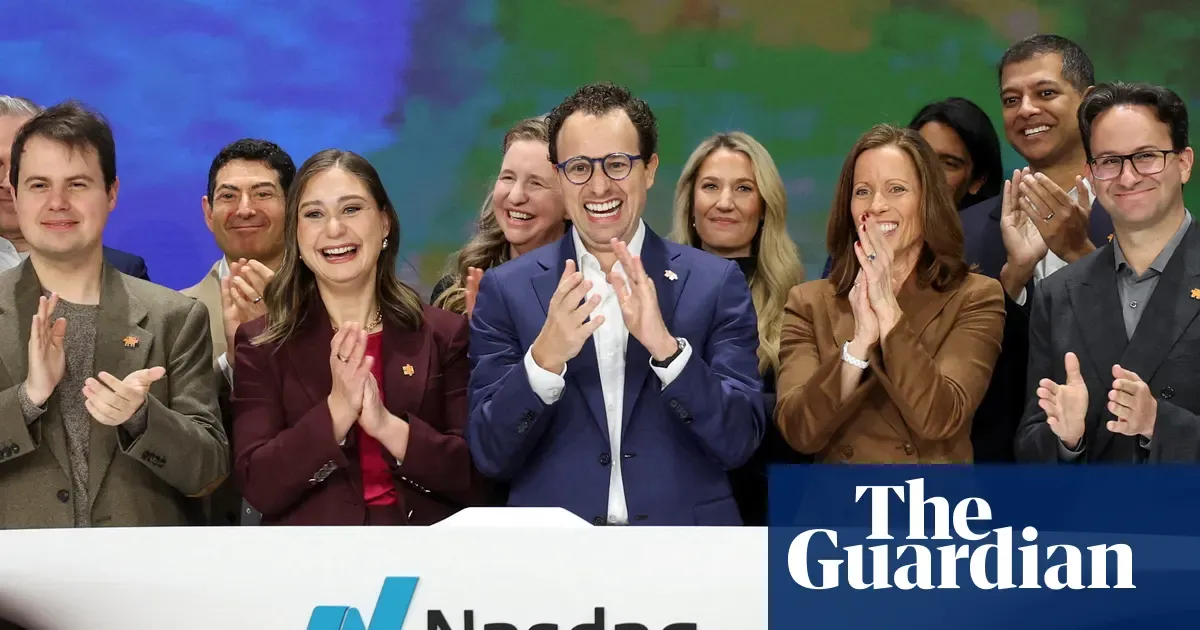
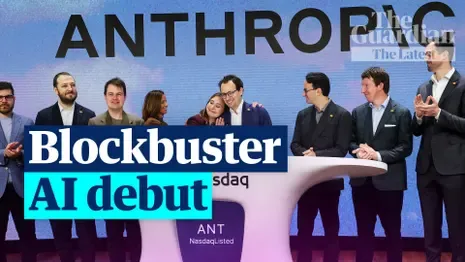
Anthropic priced its IPO at $83, above the $70–78 range. It sold 980m shares, more than the 825m planned, and raised $81.3bn, beating SpaceX's $75bn as the largest IPO on record. On 19 November, ANT opened at $111.50 and closed at $97.17. At the close, the founders' combined stake was worth about $160bn. [6] [7] [8] [1]
The founders keep majority control through a Founder LLC that holds 50.1% of votes. Their pledge to give away 80% of their shares is voluntary and revocable. The filing itself warns that founder control may conflict with shareholders' financial interests. The Long-Term Benefit Trust fills four board seats. [3] [5] [11] [1]
The company's own S-1 reports $16.29bn of revenue in the first half of 2026 and an $80.7bn net loss. About $72bn of that loss is a non-cash revaluation of convertible notes. The filing also shows roughly $417bn in compute commitments, with Amazon, Google, SpaceX and Microsoft. Two customers bring in about a fifth of revenue. Models released in the previous six months earned more than 80% of revenue, so older models are retired quickly. [4] [13] [10]
the filings show heavy losses, very large compute commitments and revenue concentrated among a few customers.
Read the full assessment
Implication: a lab that warns of catastrophic AI risk now faces quarterly shareholder scrutiny, and founder control could override investor priorities.
The dossier is below. It draws on IPO-day reporting, the public S-1 coverage and the original scaling-laws paper.
Executive brief
Anthropic's seven co-founders control 50.1% of the votes in a company worth more than $1.5 trillion. They keep that control even though they have pledged to give away 80% of their shares, and that pledge isn't legally binding. At the Nasdaq opening price of $111.50 on 19 November 2026, their stakes were worth more than $180bn combined, or about $27bn each. By the close they had fallen to roughly $160bn (Guardian). The listing raised $81.3bn, the largest IPO on record. The tension worth watching is a lab that warns of AI's catastrophic risks while now answering to public shareholders.
What changed and event timeline
Scaling-laws paper published
Kaplan, McCandlish, Brown and Dario Amodei, then at OpenAI, showed that model loss falls as a power law with model size, data and compute. That idea became central to Anthropic's strategy ().
Founder LLC control revealed
Reuters reported that the founders would keep majority control through a "Founder LLC", framed as a way to put the public good ahead of market pressure ().
S-1 made public
The filing showed $16.29bn of revenue in the first half of 2026, an $80.7bn net loss and about $417bn in compute obligations. It also restated the founders' 80% pledge (;).
IPO priced at $83
The price was above the $70–78 range. Anthropic sold 980m shares, up from 825m planned, for $81.3bn, beating SpaceX's $75bn initial raise ().
Volatile debut
Shares under the ticker ANT opened at $111.50, reached about $115 and closed at $97.17, 17% above the offer price (;).
Capabilities and access
- What's listed: Class A shares on the Nasdaq Global Select Market under ANT (Admiral Markets).
- What it sells: mainly access to Claude, aimed at businesses (video 03:39). Usage-based billing made up 80% of first-half revenue (BERI).
- Model versions: the reviewed sources tie the IPO to no specific model version.
Technical analysis for researchers and developers
- Model turnover is fast. Retiring old models is therefore routine, and developers should plan migrations accordingly (BERI).
- The research lineage is in the founders. Olah's background is neural-network research (Guardian).
- Compute is the binding constraint. Commitments include Amazon at $110bn, Google at $114.5bn, SpaceX at up to $120.5bn and Microsoft at $44.9bn (CNBC).
Read the full section
- Model turnover is fast. Models released in the six months to 30 September 2026 earned over 80% of revenue. Retiring old models is therefore routine, and developers should plan migrations accordingly (BERI).
- The research lineage is in the founders. Kaplan and McCandlish's scaling laws found that width and depth matter little across a wide range. They also found that compute-efficient training means very large models stopped before convergence (arXiv). Olah's background is neural-network research (Guardian).
- Compute is the binding constraint. Commitments include Amazon at $110bn, Google at $114.5bn, SpaceX at up to $120.5bn and Microsoft at $44.9bn (CNBC).
Claims and evidence
- Founder wealth: about 1.69bn shares in total (Fortune). At $111.50 that is roughly $188bn, which fits the Guardian's figure of more than $180bn.
- The pledge is "voluntary and revocable," with no timing or recipients set (Fortune).
- Revenue and losses come from the company's own S-1. No independent corroboration of that figure was found.
Read the full section
- Founder wealth: about 1.69bn shares in total (Fortune). At $111.50 that is roughly $188bn, which fits the Guardian's figure of more than $180bn.
- The pledge is "voluntary and revocable," with no timing or recipients set (Fortune).
- Revenue and losses come from the company's own S-1. About $72bn of the loss is a non-cash revaluation of convertible notes, not operating spending (CNBC). The Guardian's video gives about $33bn of revenue over nine months (04:25). No independent corroboration of that figure was found.
- Valuation: about $1.5tn at the offer price (Al Jazeera) and about $2tn at the open (NPR).
Context and prior work
All seven founders left OpenAI and started Anthropic in 2021 (video 02:50). Their backgrounds per the Guardian (Guardian): On governance, the Long-Term Benefit Trust fills four board seats, and its members include Ben Bernanke (TNW). Separately, 5% of shares, roughly $50bn, went to a Public Benefit Fund (NY1/AP).
Read the full section
All seven founders left OpenAI and started Anthropic in 2021 (video 02:50). Their backgrounds per the Guardian (Guardian):
- Dario Amodei: CEO; formerly OpenAI's VP of research.
- Daniela Amodei: president; previously worked in Congress and at Stripe.
- Jack Clark: former journalist; now leads the Anthropic Institute.
- Jared Kaplan: chief science officer; theoretical physics PhD.
- Tom Brown: chief compute officer.
- Chris Olah: neural-network researcher.
- Sam McCandlish: chief architect; physics PhD.
On governance, the Long-Term Benefit Trust fills four board seats, and its members include Ben Bernanke (TNW). Separately, 5% of shares, roughly $50bn, went to a Public Benefit Fund (NY1/AP).
Limitations, safety and contested findings
- Risks the company names itself: in the S-1, Anthropic lists catastrophic AI risk, models showing self-preservation behaviour, disputes with the Pentagon and dependence on Taiwanese chip supply (CNBC; Seeking Alpha).
- Control vs shareholders: the filing admits founder control "may conflict" with shareholders' financial interests (TNW).
- Profit pressure vs safety stance: the Guardian's business editor says Amodei urges an industry slowdown while now facing investors who want profits (06:58).
Read the full section
- Risks the company names itself: in the S-1, Anthropic lists catastrophic AI risk, models showing self-preservation behaviour, disputes with the Pentagon and dependence on Taiwanese chip supply (CNBC; Seeking Alpha).
- Control vs shareholders: the filing admits founder control "may conflict" with shareholders' financial interests (TNW).
- Profit pressure vs safety stance: the Guardian's business editor says Amodei urges an industry slowdown while now facing investors who want profits (06:58).
- Bubble concerns: other AI stocks fell on debut day, and Anthropic listed about 25% below an earlier reported valuation (09:28).
- Effective altruism: the founders are linked to the movement, but Dario Amodei now rejects the label (Guardian).
Business and practitioner implications
- Revenue concentration: two customers bring in about a fifth of revenue, and the top five about 25% (Seeking Alpha).
- Disclosure: as a public company, Anthropic will report every quarter, giving enterprise buyers regular visibility into its compute spending and margins.
- Philanthropy: the founders' pledges, the Public Benefit Fund and staff donations could steer large sums toward AI-safety and labour-transition causes.
Read the full section
- Revenue concentration: two customers bring in about a fifth of revenue, and the top five about 25% (Seeking Alpha). That makes pricing and contract terms sensitive to a few large buyers.
- Disclosure: as a public company, Anthropic will report every quarter, giving enterprise buyers regular visibility into its compute spending and margins.
- Philanthropy: the founders' pledges, the Public Benefit Fund and staff donations could steer large sums toward AI-safety and labour-transition causes. Nonprofits are already asking who decides how the money is spent (Chronicle of Philanthropy).
- Adoption: the Guardian's business editor says executives still struggle to name concrete productivity gains (10:29).
The source trail.
Sources (14)
Who are Anthropic’s seven co-founders, now worth $180bn?
Article text retrieved; extracted text may omit tables or interactive elements. A transcript of the video linked from this page is supplied (linked video auto captions; https://www.youtube.com/watch?v=prH0mqZzMF8); automatic text may contain errors.
theguardian.comLinked video: Who are Anthropic’s seven co-founders, now worth $180bn?
linked video auto captions
www.youtube.com