
Venture fundsFund closes, LPs & managers
NVIDIA board rules out Jensen Huang's return as VC panel weighs random-portfolio study and retail valuations
NVIDIA's board says it will not reinstate Jensen Huang despite political and investor pressure. A This Week in Startups panel set that against a study finding VC portfolio outcomes resemble random selection and an argument that defensive retail stocks, not AI, look overvalued.
According to arXiv 2605.03980 (May 2026) [4]: NVIDIA board rules out Jensen Huang's return as VC panel weighs random-portfolio study and retail valuations.
SOURCES[4] arXiv: Do Venture Capitalists Beat Random Allocation? arxiv.org
 AT Pulse research deskPublished · Updated · 5 min read · AI-assisted analysis
AI-assisted, not human-edited. Methodology Corrections Who owns this site
- What happened
- After Huang resigned in November 2026, NVIDIA named CFO Colette Kress interim CEO and Harvey Jones board chair, and gave no reason for the exit. [2] [3] [5] [6] [7] [13]
- Original source
- This Week in Startups video, independent perspective
- Brief by
- AT Pulse research desk AI-assisted; publisher and contact on the desk page
- Studies
- arXiv 2605.03980 (May 2026) [4] date from arXiv ID
- When
- November 18, 2026 video published
- Covered
- Nov 19 edition
- Evidence
- 13 sources across 12 sites; transcript sourced
- 1NVIDIA Ousts Jensen, AI Comes for Nerds & Walmart Is A…youtube.com
- 2PBS: Nvidia chair says no reinstatementpbs.org
- 3Al Jazeera: Nvidia dismisses calls to reinstate Huangaljazeera.com
- 4arXiv: Do Venture Capitalists Beat Random Allocation?arxiv.org
- 5NVIDIA Announces CEO Transitionnvidianews.nvidia.com
- 6NVIDIA Form 8-K (SEC)sec.gov
RisingHow it’s measured
YouTube video · 4.8K views · 38 likes
Reach blends public engagement (views, likes, comments, shares, stars) from the platforms where the story or its original source lives: YouTube, Hacker News, GitHub, Substack and similar. A video and the article written from its transcript share one score, taken from the video. Platforms with no data are left out rather than counted as zero, and the age of a story never lowers its score.
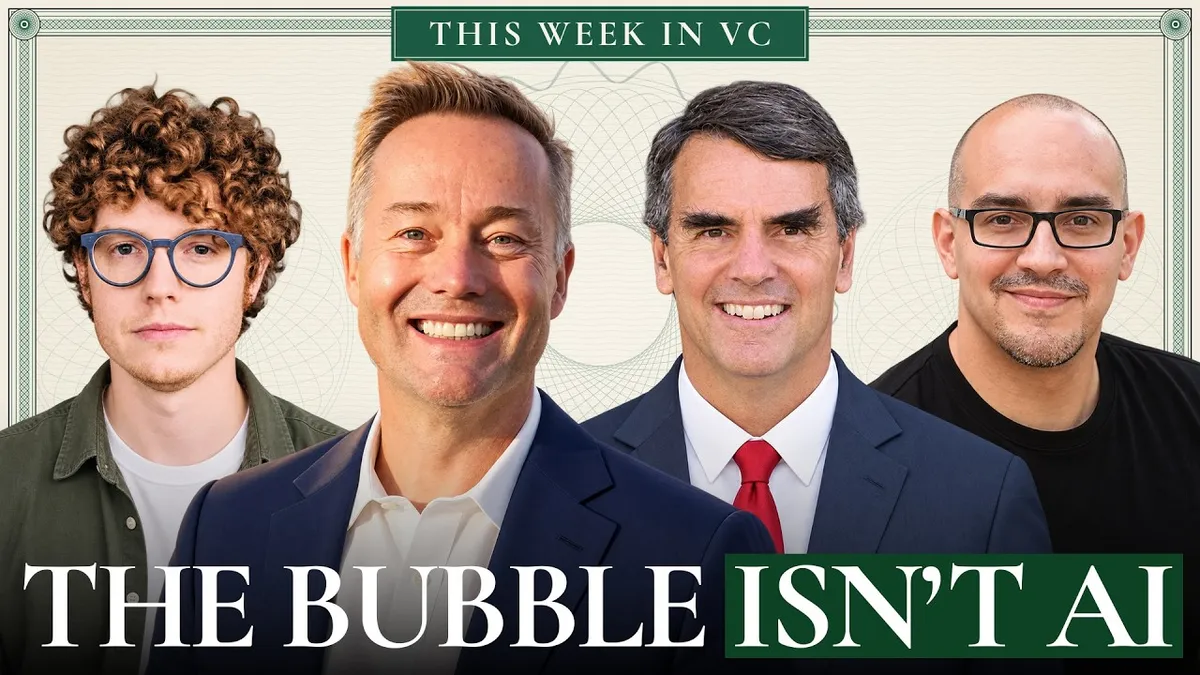
After Huang resigned in November 2026, NVIDIA named CFO Colette Kress interim CEO and Harvey Jones board chair, and gave no reason for the exit. Huang said he would return if asked. Jones said the board will not reinstate him, despite calls from Trump, Elon Musk and an open letter with nearly 200,000 signers. The same week NVIDIA reported Q3 revenue of $115.8B, up 103%. Reports link the exit to an affair with a woman US officials suspect is a Chinese spy. The board says it has no reason to believe security or company secrets were compromised, and Congress is investigating. [2] [3] [5] [6] [7] [13]
A May 2026 preprint compared VC portfolios with random portfolios that keep each fund's timing, geography, sector mix and size. Real funds' share of high-multiple wins could not be told apart from the random ones. Evidence that VCs avoid losses was weak at best and depended on how zero-value exits were coded. On the panel, DA Wallach pointed out that the company pool includes only startups that raised money. He also argued that top managers keep outperforming year after year, which pure chance would not produce. [4] [1]
Wallach said Walmart and Costco trade at roughly 40–50 times earnings, against about 16 for NVIDIA. Trefis figures roughly match: 44.5 for Walmart, 48.8 for Costco and 16.8 for NVIDIA. Dave McClure argued that AI agents lower customers' switching costs, which makes future cash flows less durable. In his view, that should pull P/E multiples down fastest at companies that don't innovate. [1] [11]
Panelists expect AI to replace metrics-driven later-stage investors before early-stage ones, where judging founders still matters. Tim Draper went further and predicted that large late-stage funds charging fees on multibillion-dollar pools will be pushed out. [1]
the board is holding firm despite record revenue and a share slide of more than 30% in a month; the random-portfolio result comes from one preprint. Implication, still untested: LPs may weigh access and entry price over claimed picking skill.
I've gathered the sources and am writing the dossier now.
Executive brief
Jensen Huang left NVIDIA on November 12, 2026, after 33 years as CEO. The board has said it will not bring him back, even with Trump, Elon Musk and nearly 200,000 open-letter signers calling for his return (PBS; Al Jazeera). This Week in Startups' Nov 18 venture roundtable put that fight next to three other stories: a paper finding VC portfolios match random picks, the "handoverism" debate about letting AI take control, and a claim that Walmart and Costco, not AI stocks, are the bubble. The episode is commentary, so its opinions are kept separate from what other sources confirm.
What changed and event timeline
Paper tests VCs against random picks
Knicker, Bouchaud and Benzaquen found that VC portfolios' best results look statistically the same as random selection under matched constraints ().
Huang resigns
NVIDIA named CFO Colette Kress interim CEO and Harvey Jones its first board chair, and gave no reason for the exit (;). Reports tie the exit to an affair with a woman US officials suspect is a Chinese spy ().
Gurley pushes "handoverism."
Benchmark's Bill Gurley said Anthropic's IPO filing should list handoverism (the belief that humans should or will hand control to AI) as a risk factor ().
Board rejects reinstatement as earnings jump
NVIDIA reported Q3 revenue of $115.8B, up 103%. Chair Jones said the board will not reinstate Huang, even though Huang said he would return if asked ().
Altman rejects AI handover; episode airs
At DealBook, Sam Altman and Greg Brockman called a gradual handover of control to AI "a terrible idea" (). The panel discussed it the same day ().
Capabilities and access
- No AI model or product was released here.
- The panel's AI claims are personal anecdotes. Jason Calacanis says one- or two-person teams now reach $20K a month in revenue (episode).
- None of these claims were benchmarked or tested independently.
Read the full section
- No AI model or product was released here.
- The panel's AI claims are personal anecdotes. Tim Draper says he now builds software himself and compares chatbot "personalities," mentioning a model he calls "GLM52" (episode). Jason Calacanis says one- or two-person teams now reach $20K a month in revenue (episode).
- None of these claims were benchmarked or tested independently.
Technical analysis for researchers and developers
- Method: The paper builds random portfolios that keep each fund's timing, geography, sector mix and portfolio size, but swap in randomly chosen companies.
- Findings: The share of high-multiple wins can't be told apart from random.
- Sample: Only funded companies are in the pool, so startups that never raised are excluded, as DA Wallach (Time BioVentures) noted on the show (episode).
Read the full section
- Method: The paper builds random portfolios that keep each fund's timing, geography, sector mix and portfolio size, but swap in randomly chosen companies. It adds a rank-based benchmark to compare funds against each other (arXiv).
- Findings: The share of high-multiple wins can't be told apart from random. There is at most weak evidence that VCs avoid losses, and that result depends on how zero-value exits are coded.
- Sample: Only funded companies are in the pool, so startups that never raised are excluded, as DA Wallach (Time BioVentures) noted on the show (episode).
- Reproducibility: The abstract does not give the dataset or sample size.
Claims and evidence
- Paper's conclusion: VC outcomes are "largely consistent" with random allocation (arXiv). Read that as the summary's interpretation, not the abstract's finding.
- Counterargument: Wallach says top managers keep outperforming year after year, which pure randomness would not produce (episode).
- Valuations: Wallach's claim that Walmart and Costco trade at 40–50x earnings versus NVIDIA's ~16x (episode) roughly matches Trefis: P/E of 16.8 for NVIDIA, 44.5 for Walmart and 48.8 for Costco (Trefis).
Read the full section
- Paper's conclusion: VC outcomes are "largely consistent" with random allocation (arXiv). A Substack summary goes further and says high entry prices drag returns below the random benchmark (Klement). Read that as the summary's interpretation, not the abstract's finding.
- Counterargument: Wallach says top managers keep outperforming year after year, which pure randomness would not produce (episode).
- Valuations: Wallach's claim that Walmart and Costco trade at 40–50x earnings versus NVIDIA's ~16x (episode) roughly matches Trefis: P/E of 16.8 for NVIDIA, 44.5 for Walmart and 48.8 for Costco (Trefis).
- Fund sizes: Draper's $200M fund and Time BioVentures' $100M fund were described on air. No independent reporting confirms them.
Context and prior work
- Earlier ML work: Lyonnet and Stern also used machine learning to study which deals VCs choose (paper).
- Correlation Ventures: Draper cited its data showing that startups burning more than $400K a month fail about 5x more often (episode).
- Export controls: Separately, DOJ and Commerce opened a criminal probe into Megaspeed, a Singapore company suspected of diverting chips to China (Al Jazeera).
Read the full section
- Earlier ML work: Lyonnet and Stern also used machine learning to study which deals VCs choose (paper).
- Correlation Ventures: Draper cited its data showing that startups burning more than $400K a month fail about 5x more often (episode). The figure comes only from his account.
- Export controls: Separately, DOJ and Commerce opened a criminal probe into Megaspeed, a Singapore company suspected of diverting chips to China (Al Jazeera).
Limitations, safety and contested findings
- Dates conflict: Fortune dates the resignation Nov 11 (Fortune), while NVIDIA says Nov 12.
- Security impact unproven: The board says it has no reason to believe national security or NVIDIA secrets were compromised. Congress is investigating (Al Jazeera).
- Panel split: Wallach said judgment should wait for more facts, and argued that one executive shouldn't effectively set chip-export policy (episode).
Read the full section
- Dates conflict: Fortune dates the resignation Nov 11 (Fortune), while NVIDIA says Nov 12. Reports also give different dates for when Huang admitted the affair.
- Security impact unproven: The board says it has no reason to believe national security or NVIDIA secrets were compromised. Congress is investigating (Al Jazeera).
- Panel split: Wallach said judgment should wait for more facts, and argued that one executive shouldn't effectively set chip-export policy (episode).
- Theories, not evidence: Wallach's "nerd singularity" (AI tools erode the edge software engineers have held) is a provocation, not data (episode).
Business and practitioner implications
- Governance: NVIDIA's board is enforcing its decision against the president, major investors and a public petition.
- VC: Dave McClure (Practical Venture Capital) expects AI to replace metrics-driven later-stage investors before early-stage ones (episode).
- Durability of earnings: McClure argues that AI agents lower customer switching costs, which should push P/E multiples down fastest for companies that don't innovate (episode).
Read the full section
- Governance: NVIDIA's board is enforcing its decision against the president, major investors and a public petition. The shares are down more than 30% over the month even with record results (Al Jazeera).
- VC: Dave McClure (Practical Venture Capital) expects AI to replace metrics-driven later-stage investors before early-stage ones (episode). Draper predicts large late-stage funds will be "eliminated by AI" (episode).
- Durability of earnings: McClure argues that AI agents lower customer switching costs, which should push P/E multiples down fastest for companies that don't innovate (episode).
- AI risk disclosure: Gurley's push means AI companies heading to IPO may face pressure to state where they stand on handing control to AI.
The source trail.
Sources (13)
NVIDIA Ousts Jensen, AI Comes for Nerds & Walmart Is A Bubble?!
Transcript retrieved via youtube_auto_captions; language en. Timestamped text, not direct audiovisual review. Source: https://www.youtube.com/watch?v=czmmj-6t9Ss. Automatic captions/transcription may contain errors.
www.youtube.com