
FundingRounds, leads & terms
Ramp CEO Eric Glyman sets out AI-first operating model after $1.85B raise at $60B valuation
After its $60B round, Ramp is reorganizing around AI agents. CEO Eric Glyman says its coding agent writes most pull requests. The company also paused hiring for a quarter and gave nearly all staff a shared AI workspace.
From the Y Combinator video of November 18, 2026 and cited sources: Ramp raised $1.85B at a $60B valuation in October 2026, up from $44B in June. [3] [8] [12]
SOURCES[3] TechCrunch techcrunch.com[8] PR Newswire: Ramp $60B announcement prnewswire.com[12] Axios axios.com
 AT Pulse research deskPublished · Updated · 5 min read · AI-assisted analysis
AI-assisted, not human-edited. Methodology Corrections Who owns this site
- What happened
- Ramp raised $1.85B at a $60B valuation in October 2026, up from $44B in June. [3] [8] [12]
- Original source
- Y Combinator video, independent perspective
- Brief by
- AT Pulse research desk AI-assisted; publisher and contact on the desk page
- When
- November 18, 2026 video published
- Covered
- Nov 19 edition
- Evidence
- 13 sources across 13 sites; transcript sourced
RisingHow it’s measured
YouTube video · 19.8K views · 201 likes
Reach blends public engagement (views, likes, comments, shares, stars) from the platforms where the story or its original source lives: YouTube, Hacker News, GitHub, Substack and similar. A video and the article written from its transcript share one score, taken from the video. Platforms with no data are left out rather than counted as zero, and the age of a story never lowers its score.
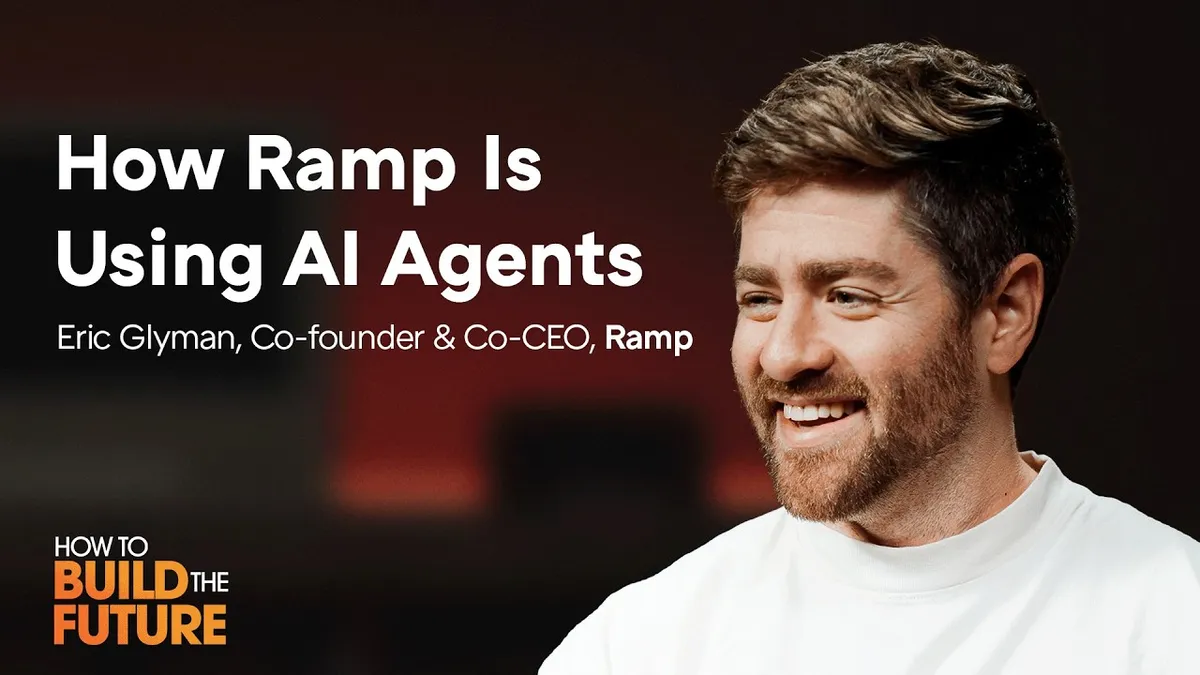
Ramp raised $1.85B at a $60B valuation in October 2026, up from $44B in June. Dragoneer led the round, with Thrive, Founders Fund, Sands and Avenir as co-leads. Annualized revenue is now above $2B. [3] [8] [12]
Inspect, Ramp's background coding agent, runs in remote sandboxes with the same systems access a human engineer has. It tests its own changes before opening a pull request. Glyman puts its share of pull requests at more than 85%. A mid-2026 Pragmatic Engineer report put it at 75% of merged pull requests. [1] [2]
By Ramp's own figures, AI gains were uneven: engineers became 10–100x more productive, but designers only about 2x. That broke the usual staffing ratios, and most headcount requests came from the teams using the least AI. Ramp responded by pausing hiring for a quarter. Its Glass workspace, built on Anthropic's Claude Agent SDK, was used by 1,925 of 1,930 staff in a single day. [1] [11]
Ramp's AI Index, built from the spending of more than 85,000 US businesses, shows 1% of firms account for 80% of spend with OpenAI and Anthropic. Token spend has been roughly flat for two months. Glyman says this means Jevons paradox has broken for AI. Ramp's own economist analysis points mainly to price cuts instead. [1] [6] [7]
Investors valued Ramp at $60B as its revenue passed $2B, and Ramp's data shows AI spend concentrated in very few firms. The implication Ramp draws is that redesigning the organization, not just buying tools, separates leaders from laggards.
Read the full assessment
Ramp sells products built on that thesis.
Executive brief
Ramp's CEO says the company's internal coding agent, Inspect, now writes more than 85% of its pull requests (interview, 24:55). A mid-2026 report put the share at 75% of merged PRs (Pragmatic Engineer). In a Y Combinator interview with Garry Tan, Eric Glyman describes a company built around "100x" employees. Ramp froze hiring for a quarter so staff would learn to work with AI. It also gave 1,930 employees a shared AI workspace called Glass. Ramp's own data shows that 1% of firms account for 80% of frontier-lab spend, and Glyman argues that Jevons paradox has "broken" for AI spending. These figures come from Ramp itself, which raised money at a $60B valuation in October.
What changed and event timeline
Raise at $44B
Ramp raised $750M at a $44B valuation, with annualized revenue then at about $1.5B ().
Talks at $60B reported
Bloomberg reported that Ramp was in talks to raise at a $60B valuation ().
Glass opens externally
Ramp's internal AI workspace entered early access for outside companies, with onboarding done personally ().
Spend concentration data
Ramp's analysis said 1% of firms drive 80% of OpenAI and Anthropic spend, and that token spend had been roughly flat for two months (;).
$1.85B at $60B
Dragoneer led the round, with Thrive, Founders Fund, Sands and Avenir as co-leads (;).
YC interview
Glyman sets out the "chapter two" thesis: redesign the organization around AI, not just adopt the tools ().
Capabilities and access
- Inspect: a background coding agent that runs in remote sandboxes, connects to internal systems, and checks its own changes (backend tests, frontend screenshots) (Pragmatic Engineer).
- Glass: built on Anthropic's Claude Agent SDK.
- Other launches: AI token spend management and Router.com, a model router (PR Newswire). The reviewed sources do not name the exact underlying model versions.
Read the full section
- Inspect: a background coding agent that runs in remote sandboxes, connects to internal systems, and checks its own changes (backend tests, frontend screenshots) (Pragmatic Engineer). Ramp sells it as a product (Ramp support) and has published a blueprint so others can build their own (ZenML).
- Glass: built on Anthropic's Claude Agent SDK. It connects to Slack, Notion, Linear, Google and Gong, supports both open and closed models, and is in early access only (BuildBetter).
- Other launches: AI token spend management and Router.com, a model router (PR Newswire). The reviewed sources do not name the exact underlying model versions.
Technical analysis for researchers and developers
- Closed-loop verification is the core design choice.
- Remote sandboxes remove the concurrency limit of running one or two local agent sessions.
- Glass stores reusable workflows as shared "skill files."
Read the full section
- Closed-loop verification is the core design choice. Inspect gets the same tools, data and VMs a human engineer has, and proves its own changes before a PR is opened (Pragmatic Engineer).
- Remote sandboxes remove the concurrency limit of running one or two local agent sessions. Inspect also serves as the base for 200+ downstream agents (code review, incident management, QA testing) (Pragmatic Engineer).
- Glass stores reusable workflows as shared "skill files." Glyman says this means teams stop paying to relearn the same lessons, and lets them choose cheaper settings, such as accepting 10% longer reasoning for a 50% price cut (interview, 31:20).
- No benchmark or controlled evaluation of either tool has been published.
Claims and evidence
- Round and valuation: $1.85B at $60B. These figures are company-announced and match TechCrunch and Axios reporting (Axios).
- Revenue: over $2B annualized, growing 25% faster than a year earlier (interview, 37:53). Self-reported.
- Median customer saves 7.5% of expenses: self-reported, with no published methodology (PR Newswire).
Read the full section
- Round and valuation: $1.85B at $60B. These figures are company-announced and match TechCrunch and Axios reporting (Axios). No filing confirmation appears in the reviewed sources.
- Revenue: over $2B annualized, growing 25% faster than a year earlier (interview, 37:53). Self-reported.
- Median customer saves 7.5% of expenses: self-reported, with no published methodology (PR Newswire).
- Policy agent decides expenses at 99% accuracy: Glyman's figure, with no evaluation published (interview, 33:41).
- 1,925 of 1,930 staff used Glass in a single day: internal figure (interview, 30:01).
- Share of PRs written by Inspect: "85%+" in the interview versus 75% of merged PRs in the Pragmatic Engineer report. The two figures differ.
Context and prior work
- Earlier company: Glyman and Karim Atiyeh previously built Paribus (YC Summer 2015), an email-scanning refund agent later sold to Capital One (interview, 1:06).
- Early-customer claims: Glyman says Ramp was the first customer of Cognition's Devin and an early alpha customer of Claude Code (interview, 26:44).
- Interviewer's affiliation: Garry Tan runs YC, which backed Paribus, and the episode includes a YC promotion.
Read the full section
- Earlier company: Glyman and Karim Atiyeh previously built Paribus (YC Summer 2015), an email-scanning refund agent later sold to Capital One (interview, 1:06).
- Early-customer claims: Glyman says Ramp was the first customer of Cognition's Devin and an early alpha customer of Claude Code (interview, 26:44).
- Interviewer's affiliation: Garry Tan runs YC, which backed Paribus, and the episode includes a YC promotion.
- Spend data source: Ramp's AI Index draws on card and bill-pay data from 85,000+ US businesses (Ramp AI Index).
Limitations, safety and contested findings
- Navier–Stokes claim: Glyman says AI "solved Navier–Stokes" (17:47).
- Jevons paradox claim: Glyman's "Jevons broke" point (42:14) refers to two flat months of spend. Two months is a short window for that conclusion.
- Unaudited figures: Implicator notes there is no external productivity audit, and that the Router savings and feature-request figures lack baselines (Implicator).
Read the full section
- Navier–Stokes claim: Glyman says AI "solved Navier–Stokes" (17:47). OpenAI's claimed result is disputed over credit and has not been accepted by the Clay Institute (NYU Shanghai RITS).
- Jevons paradox claim: Glyman's "Jevons broke" point (42:14) refers to two flat months of spend. Ramp's own economist analysis points mainly to price cuts, with Claude Opus 5.5 cutting cost per task by about 40% (SaaStr). Two months is a short window for that conclusion.
- Unaudited figures: Implicator notes there is no external productivity audit, and that the Router savings and feature-request figures lack baselines (Implicator).
Business and practitioner implications
- Budgeting AI spend: Glyman argues that flat per-seat AI budgets are the wrong control and that spend should be tied to outcomes (27:52).
- Uneven productivity gains: engineers getting 10–100x while designers get about 2x breaks the usual staffing ratios, and requests for more headcount came mostly from the teams using the least AI (22:30).
- Developers: the replicable pattern is a sandboxed agent that has real system access and checks its own work, which goes further than a chat interface.
Read the full section
- Budgeting AI spend: Glyman argues that flat per-seat AI budgets are the wrong control and that spend should be tied to outcomes (27:52). Ramp sells tools for this, which is a conflict of interest worth weighing.
- Uneven productivity gains: engineers getting 10–100x while designers get about 2x breaks the usual staffing ratios, and requests for more headcount came mostly from the teams using the least AI (22:30).
- Developers: the replicable pattern is a sandboxed agent that has real system access and checks its own work, which goes further than a chat interface.
The source trail.
Sources (13)
Ramp’s Bet on the 100x Employee
Transcript retrieved via youtube_auto_captions; language en. Timestamped text, not direct audiovisual review. Source: https://www.youtube.com/watch?v=0Hvs6-XODgU. Automatic captions/transcription may contain errors.
www.youtube.com