
StocksEquities, earnings & valuations
Anthropic prices IPO at $83 a share as Damodaran values the stock at about $77
Aswath Damodaran's updated valuation puts Anthropic's equity near $1.35 trillion and about $77 per share after netting out employee options, hours before the IPO priced at $83 in an upsized offering raising roughly $81.3 billion.
From the Musings on Markets article of November 19, 2026 and cited sources: The same $1.35 trillion of equity gives very different per-share values depending on the share count used. [1] [2]
SOURCES[1] Damodaran, "The Rocky Road from Aggregate to Per Share… aswathdamodaran.blogspot.com[2] Linked video: The Rocky Road from Aggregate to Per Share… youtube.com
 AT Pulse research deskPublished · Updated · 5 min read · AI-assisted analysis
AI-assisted, not human-edited. Methodology Corrections Who owns this site
- What happened
- The same $1.35 trillion of equity gives very different per-share values depending on the share count used. [1] [2]
- Original source
- Musings on Markets article, independent perspective
- Brief by
- AT Pulse research desk AI-assisted; publisher and contact on the desk page
- When
- November 19, 2026 article published
- Covered
- Nov 19 edition
- Evidence
- 9 sources across 7 sites
- 1Damodaran, "The Rocky Road from Aggregate to Per Share…aswathdamodaran.blogspot.com
- 2Linked video: The Rocky Road from Aggregate to Per Share…youtube.com
- 3TechCrunch: Anthropic prices IPO at $83techcrunch.com
- 4Anthropic S-1 (SEC)sec.gov
- 5BIT: Who steers Anthropic after its IPObit.com
- 6Damodaran, earlier Anthropic prospectus valuationaswathdamodaran.blogspot.com
RisingHow it’s measured
YouTube video · 22K views · 316 likes
Reach blends public engagement (views, likes, comments, shares, stars) from the platforms where the story or its original source lives: YouTube, Hacker News, GitHub, Substack and similar. A video and the article written from its transcript share one score, taken from the video. Platforms with no data are left out rather than counted as zero, and the age of a story never lowers its score.
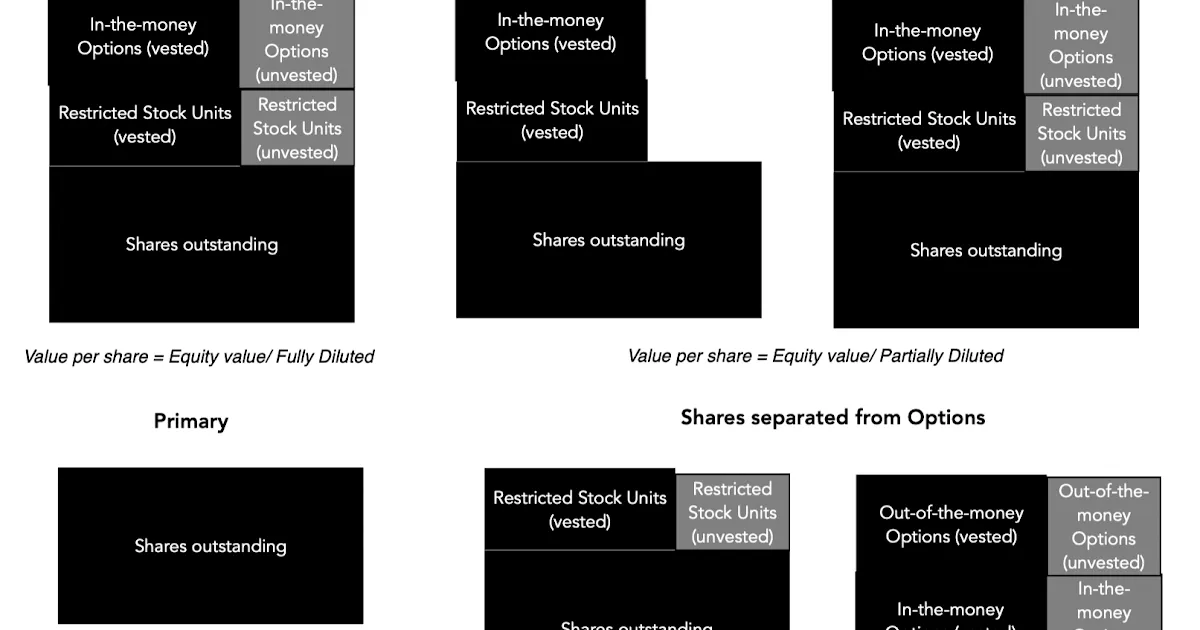
The same $1.35 trillion of equity gives very different per-share values depending on the share count used. Counting primary shares only gives about $91, which Damodaran rejects as too high. A fully diluted count gives about $76.46. His preferred method values the options at roughly $127 billion, subtracts that from equity, and divides by primary plus restricted shares, giving about $77. [1] [2]
Three small input changes cut about $125 billion from his earlier $1.475 trillion valuation. He lowered expected IPO cash from $100 billion to $60 billion, assumed $2.75 of revenue per dollar of capital instead of $3 because compute will cost more after the election, and raised the regulatory drag on margins from 5% to 6%. The model is highly sensitive to inputs. [1] [2] [6]
Reported market caps for ANT will depend on the share count each data service uses. At $83, reports put the company at about $1.5 trillion fully diluted and about $1.1 trillion non-diluted. Damodaran proposes a more consistent measure: price times primary and restricted shares, plus the value of the options. [2] [3] [8]
Several factors could weigh on the stock after listing. Non-founder insiders can sell up to 10% of their shares on day one. A single founder share carries 50.1% of the voting rights, which Damodaran argues could become a target for regulators after an AI accident. He plans to compare the first-day closing price, not the offer price, with his $77 estimate. [2] [5] [9]
with the same total equity value, per-share estimates range from about $76 to $91 depending only on the share count.
Read the full assessment
Implication: ANT's price, market cap and multiples may not compare cleanly across data services unless the share count and option treatment are disclosed.
I've finished checking sources and am writing the dossier now.
Executive brief
NYU finance professor Aswath Damodaran published an updated valuation on 18 November 2026. It puts Anthropic's equity at about $1.35 trillion, or $76.98 per share once employee options are valued and taken out. Hours later the IPO priced at $83, above the $70–78 range. The deal was also upsized to 980 million shares and raised about $81.3 billion. His model assumed about $60 billion. So the main input he cut, IPO cash, came in roughly $21 billion higher than he modelled. His per-share result also moves from $76 to $91 depending only on which share count is used.
What changed and event timeline
- Late Oct 2026
First Damodaran valuation
He valued the equity at $1.475 trillion and left the share count as a placeholder. The blog archives the post in October, but the update calls it the November 2 valuation ().
- Mid Nov 2026
Amended prospectus
The set 801,351,354 new Class A shares plus 23.6 million from selling holders. The assumed price was $74, the midpoint of the range.
Valuation update
Damodaran cut equity value to $1,351.6 billion and chose $76.98 per share. The changes covered IPO cash, the election's effect on compute costs, and regulation (;).
IPO priced at $83
The offering was upsized to 980 million shares raising $81.3 billion, valuing Anthropic at about $1.5 trillion fully diluted and about $1.1 trillion non-diluted ().
Nasdaq debut scheduled
Trading was set to begin under the ticker ANT (). No trading data is reflected in the reviewed sources.
Capabilities and access
This is a capital-markets event, not a model release, and no model version is involved.
Read the full section
This is a capital-markets event, not a model release, and no model version is involved.
- What is listed: Class A common stock of Anthropic, PBC, on Nasdaq under ANT. Goldman Sachs and Morgan Stanley lead a 22-bank syndicate (Reuters via Globe).
- Control: A single Class F founder share held by Founder LLC (the seven co-founders) carries 50.1% of general voting rights. Damodaran's text says 50.01%.
- Model: Damodaran's spreadsheet is public and includes an option-valuation worksheet.
Technical analysis for researchers and developers
Damodaran compares four ways to get from total equity value to a per-share value (video): The options are deep in the money (strike $2.91, about eight years left), so their value is close to fully diluted. Three small input changes removed about $125 billion of value, which shows how sensitive the model is (video).
Read the full section
Damodaran compares four ways to get from total equity value to a per-share value (video):
- Primary shares only (14,875 million): $90.86. He calls this too high and, in the video, "nonsense."
- Fully diluted (17,676 million): $76.46. This counts every option as exercised and ignores the exercise cash the company would receive.
- Treasury stock method: adds exercise proceeds back, but ignores the extra value of holding an option rather than exercising it, so it overstates per-share value.
- Option-adjusted (his choice): value the options with an option pricing model (about $127 billion, video), subtract them from equity, then divide by primary plus restricted shares. Result: $76.98.
The options are deep in the money (strike $2.91, about eight years left), so their value is close to fully diluted. Three small input changes removed about $125 billion of value, which shows how sensitive the model is (video).
Claims and evidence
- Share-count inputs: 801 million new shares, 1,026.66 million unvested restricted shares, 1,774 million options, 933.7 million shares earmarked for donation, and about 853 million shares from converting bonds (blog; video).
- Q3 results: revenue of $16.96 billion, net loss of $23.3 billion, and an $81 billion annualized run rate as of Oct. 31 (Reuters via Globe).
- Election effects: costlier data centers (each dollar of capital now assumed to produce $2.75 of sales, down from $3) and a heavier regulatory hit to margins (6% instead of 5%).
Read the full section
- Share-count inputs: 801 million new shares, 1,026.66 million unvested restricted shares, 1,774 million options, 933.7 million shares earmarked for donation, and about 853 million shares from converting bonds (blog; video). These are his reading of the filing; the 801 million figure matches the S-1/A.
- Q3 results: revenue of $16.96 billion, net loss of $23.3 billion, and an $81 billion annualized run rate as of Oct. 31 (Reuters via Globe).
- Election effects: costlier data centers (each dollar of capital now assumed to produce $2.75 of sales, down from $3) and a heavier regulatory hit to margins (6% instead of 5%). These are judgment calls, not reported facts.
Context and prior work
- The update completes a series of Damodaran posts on Anthropic.
- He traces Anthropic's one-time non-cash charge to re-valuing the conversion option in its convertible bonds as private prices rose.
- Anthropic's IPO now exceeds SpaceX's $75 billion IPO as the largest by proceeds (TechCrunch).
Read the full section
- The update completes a series of Damodaran posts on Anthropic. The earlier one assumed a 9.74% cost of capital, a 27.5% target margin and $100 billion of IPO cash (earlier post).
- He traces Anthropic's one-time non-cash charge to re-valuing the conversion option in its convertible bonds as private prices rose. The new post says $74 billion; the earlier one says $72 billion (video).
- Anthropic's IPO now exceeds SpaceX's $75 billion IPO as the largest by proceeds (TechCrunch).
Limitations, safety and contested findings
- Stale input: the $60 billion cash assumption (801 million shares at $74) is out of date given the actual 980 million shares at $83.
- Small discrepancies: vested options are 1,082 million in the blog and 1,062 million in the video.
- Governance risk: Damodaran argues the founder share is a "golden share on steroids." This is his speculation.
Read the full section
- Stale input: the $60 billion cash assumption (801 million shares at $74) is out of date given the actual 980 million shares at $83. Damodaran's update does not re-run the model with those terms.
- Small discrepancies: vested options are 1,082 million in the blog and 1,062 million in the video.
- Governance risk: Damodaran argues the founder share is a "golden share on steroids." He suggests an activist regulator could cite an AI accident to justify taking it over (video). This is his speculation.
- Lock-ups: non-founder insiders may sell up to 10% of their shares on day one (Crypto Briefing). Sources disagree on when the co-founders' shares unlock.
Business and practitioner implications
- Market cap will vary by source: Damodaran expects data services to report different market caps for ANT depending on the share count they use (video).
- His fix: an option-adjusted market cap, meaning price times primary plus restricted shares, plus the value of options (video).
- Day-one supply: the 10% early release adds selling pressure.
Read the full section
- Market cap will vary by source: Damodaran expects data services to report different market caps for ANT depending on the share count they use (video). The ~$400 billion gap between $1.5 trillion fully diluted and $1.1 trillion non-diluted shows the scale.
- His fix: an option-adjusted market cap, meaning price times primary plus restricted shares, plus the value of options (video).
- Day-one supply: the 10% early release adds selling pressure. Damodaran says he will compare the first day's closing price, not the offer price, with his $77 (video).
- For valuation work: check the footnotes on stock compensation and convertibles before using per-share figures.
The source trail.
Sources (9)
Damodaran, "The Rocky Road from Aggregate to Per Share Value"
aswathdamodaran.blogspot.comLinked video: The Rocky Road from Aggregate to Per Share Value: Anthropic's IPO update
linked video auto captions
www.youtube.com