
ModelsArchitectures & capability
DeepMind releases AlphaGenome 2, a DNA model that predicts genetic variant effects in specific cell types
DeepMind's AlphaGenome 2 predicts how single-letter DNA changes alter gene activity in specific cell types, not just tissues. It can also handle cell states that were absent from training. Academics get free API access, and companies can apply for a Google Cloud preview.
From the Two Minute Papers video of November 19, 2026 and cited sources: Version 1 predicted its output tracks in parallel, mostly at the tissue level. [3] [2]
SOURCES[3] DeepMind: AlphaGenome 2 blog deepmind.google[2] bioRxiv: AlphaGenome 2 preprint biorxiv.org
 AT Pulse research deskPublished · Updated · 5 min read · AI-assisted analysis
AI-assisted, not human-edited. Methodology Corrections Who owns this site
- Original source
- Two Minute Papers video, independent perspective
- Brief by
- AT Pulse research desk AI-assisted; publisher and contact on the desk page
- When
- November 19, 2026 video published
- Covered
- Nov 19 edition
- Evidence
- 12 sources across 11 sites; transcript sourced
RisingHow it’s measured
YouTube video · 44.6K views · 1.6K likes
Reach blends public engagement (views, likes, comments, shares, stars) from the platforms where the story or its original source lives: YouTube, Hacker News, GitHub, Substack and similar. A video and the article written from its transcript share one score, taken from the video. Platforms with no data are left out rather than counted as zero, and the age of a story never lowers its score.
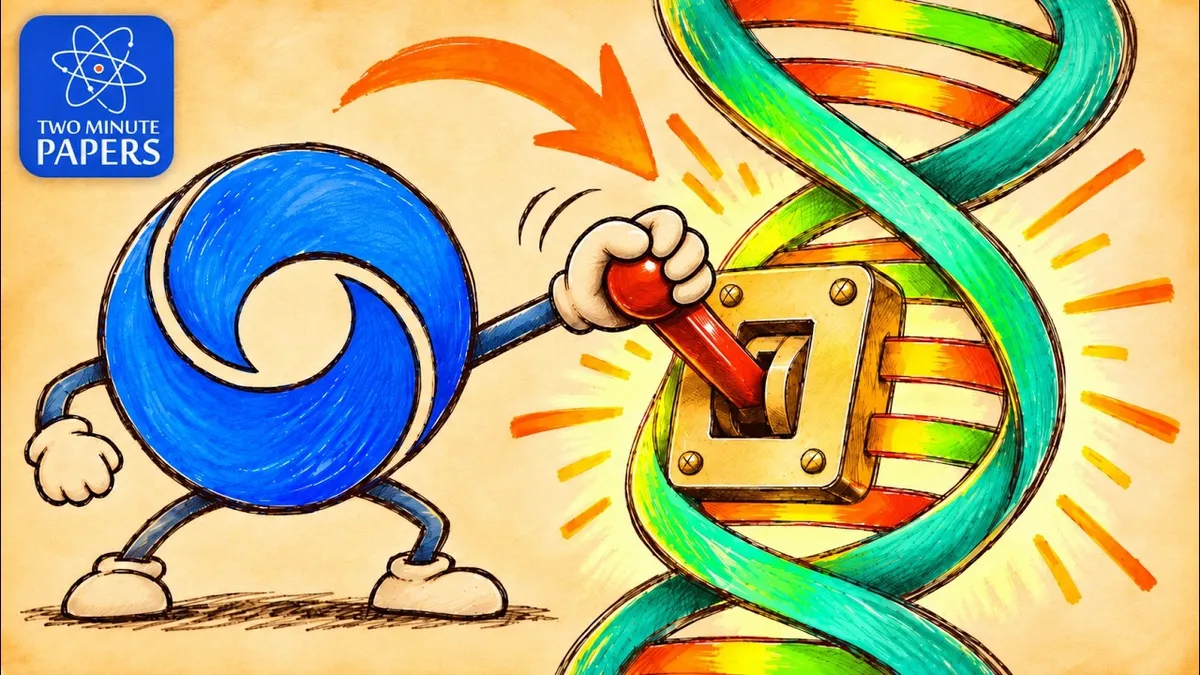
Version 1 predicted its output tracks in parallel, mostly at the tissue level. Version 2 replaces that with a conditional design that feeds a tissue, cell type or cell state into every stage of the network. A cell encoder lets a small RNA-seq profile represent a new or diseased cell state, so predictions for that state need no retraining. [3] [2]
DeepMind's preprint, which has not been peer reviewed, reports that the model finds about twice as many causal single-cell eQTLs as version 1 at 90% precision. On a 28-cell-type immune benchmark, it found causal variants 30% of the time, compared with 16% for version 1. It predicted the direction of the gene effect correctly 43% of the time, compared with 23%. [2] [11] [1]
Researchers doing non-commercial work can use a free API, and commercial users can apply for a private preview on Google Cloud. The model is not validated for clinical use. It is unclear whether the weights are available: the preprint lists a repository under a CC-BY-NC licence, but news coverage describes version 2 as API-only for now. [3] [9] [2] [10]
The reported gains suggest that labs with single-cell RNA-seq data could rank candidate disease variants by cell type before testing them in the lab. That is an implication, not a result: predictions remain hypotheses that need lab confirmation.
Executive brief
AlphaGenome 2 is DeepMind's new DNA model. At the same 90% precision as its predecessor, it finds roughly twice as many DNA variants that cause changes in gene activity inside specific cell types (bioRxiv preprint). AlphaGenome 1 predicted variant effects mostly at the tissue level. Version 2 is conditioned on cell type or cell state, and it can make predictions for cell states it never saw in training. Academics can use it free through an API, and companies can apply for a private preview (DeepMind blog). The headline numbers come from DeepMind's own preprint, which has not been peer reviewed (Chemistry World).
What changed and event timeline
AlphaGenome 1 announced
DeepMind introduced a model that reads 1 Mb of DNA and predicts many regulatory signals, mainly at tissue level ().
AlphaGenome 1 published in Nature
The paper reports matching or beating the strongest external models in 25 of 26 variant-effect evaluations ().
External critique of version 1
A Charité-led preprint found that when promoters were disrupted, AlphaGenome 1 often failed to carry the effect through to the rest of the gene's transcript ().
AlphaGenome 2 released
DeepMind released the model, posted the preprint and opened API access. The model was trained on more than 107 million cell profiles (;).
Outside researchers react
Scientists at the Francis Crick Institute and Cold Spring Harbor Laboratory were cautiously positive. One said the model is useful only if its predictions prove accurate ().
Two Minute Papers commentary
The video calls the work "science fiction level" but notes it still misses many disease mutations and struggles with rare cell types ().
Capabilities and access
- Model: AlphaGenome 2. Inputs are a 1 Mb DNA sequence plus a condition (tissue, cell type or cell state) (DeepMind blog).
- Outputs: gene expression, chromatin accessibility, histone modifications and DNA methylation.
- Training scope: 637 human and 311 mouse cell types (Wikipedia summary).
Read the full section
- Model: AlphaGenome 2. Inputs are a 1 Mb DNA sequence plus a condition (tissue, cell type or cell state) (DeepMind blog).
- Outputs: gene expression, chromatin accessibility, histone modifications and DNA methylation. It can also estimate measurements that were never taken, such as chromatin accessibility, from other available data.
- Training scope: 637 human and 311 mouse cell types (Wikipedia summary).
- Access: free API for non-commercial research; private preview on Google Cloud for commercial users. It is not validated for clinical or diagnostic use (TechRepublic).
- Weights: reports conflict. The preprint lists a GitHub repository and download page under a CC-BY-NC 4.0 licence (bioRxiv). News coverage describes version 2 as API-only for now, with weights to come later (search summary via i-scoop). The video says DeepMind plans to release code and weights (video, 5:30).
Technical analysis for researchers and developers
- Architecture: version 1 predicted each output track in parallel.
- Generalisation without retraining: a cell encoder infers the condition from gene-expression data.
- Evaluation: the main metric is recall of causal single-cell eQTLs at 90% precision. eQTLs are DNA variants linked to changes in a gene's activity.
Read the full section
- Architecture: version 1 predicted each output track in parallel. Version 2 replaces that with a conditional design: the cell condition is fed in at every stage of the network (DeepMind blog).
- Generalisation without retraining: a cell encoder infers the condition from gene-expression data. A small RNA-seq profile from a new or diseased cell state is enough to get variant predictions (bioRxiv).
- Evaluation: the main metric is recall of causal single-cell eQTLs at 90% precision. eQTLs are DNA variants linked to changes in a gene's activity. The preprint also reports enhancer-gene linking and comparisons with a fine-tuned AlphaGenome 1 and specialist models.
- Precomputed scores: the preprint includes predictions for 7 million common variants across hundreds of cell types.
- Compute cost: version 2 is more expensive to run, which makes a genome-wide atlas impractical with this model (Implicator).
Claims and evidence
- Twice the recall at 90% precision: reported in the preprint abstract (bioRxiv) and repeated in the video (3:24).
- TenK10K immune benchmark (28 cell types): causal variants found 30% of the time versus 16% for version 1.
- Parkinson's study: the video says version 2 got the direction right for 41% of known effects, versus 17% for a specialist model, without training on that study (3:53).
Read the full section
- Twice the recall at 90% precision: reported in the preprint abstract (bioRxiv) and repeated in the video (3:24).
- TenK10K immune benchmark (28 cell types): causal variants found 30% of the time versus 16% for version 1; correct direction of gene effect 43% versus 23% (Interesting Engineering).
- Parkinson's study: the video says version 2 got the direction right for 41% of known effects, versus 17% for a specialist model, without training on that study (3:53). None of the reviewed news sources reports this figure.
- HK1 in insulin-producing beta cells: a cell-specific prediction in the video (1:49). None of the reviewed news sources reports it.
- Verification status: every performance figure comes from DeepMind. No independent replication of version 2 has been reported (Implicator).
Context and prior work
- Models that predict DNA function from sequence have existed for about a decade, as Peter Koo of Cold Spring Harbor Laboratory notes (Chemistry World).
- Version 2 builds on AlphaGenome 1, published in Nature (PubMed).
- The main shift is from bulk tissue data to single-cell data: atlas-scale training covering more than 100 million cells across 68 tissues (Nature news).
Read the full section
- Models that predict DNA function from sequence have existed for about a decade, as Peter Koo of Cold Spring Harbor Laboratory notes (Chemistry World).
- Version 2 builds on AlphaGenome 1, published in Nature (PubMed).
- The main shift is from bulk tissue data to single-cell data: atlas-scale training covering more than 100 million cells across 68 tissues (Nature news).
Limitations, safety and contested findings
- Even on its own benchmark, about 7 in 10 causal variants go undetected, and data far from the training distribution may be handled less well (i-scoop).
- The model returns predictions of zero for many variants, which signals uncertainty.
- The Charité preprint's transcript-level critique of version 1 has not been tested against version 2 (Implicator).
Read the full section
- Even on its own benchmark, about 7 in 10 causal variants go undetected, and data far from the training distribution may be handled less well (i-scoop).
- The model returns predictions of zero for many variants, which signals uncertainty. James Lee of the Francis Crick Institute said its usefulness depends on accuracy, calling that "a big if" (Chemistry World).
- The Charité preprint's transcript-level critique of version 1 has not been tested against version 2 (Implicator).
- Rare cell types remain weak, according to the video (4:36).
Business and practitioner implications
- Research labs: any lab with single-cell RNA-seq data can get context-specific variant predictions for free, which may speed up prioritising which variants to test (Chemistry World).
- Pharma and biotech: commercial use depends on the Google Cloud preview and on the licence, so terms need checking.
- Validation: predictions should be treated as hypotheses that need lab confirmation, and should not be used for clinical decisions.
Read the full section
- Research labs: any lab with single-cell RNA-seq data can get context-specific variant predictions for free, which may speed up prioritising which variants to test (Chemistry World). Lee said the model reached in 30 minutes an answer that took his team 18 months of experiments (Implicator).
- Pharma and biotech: commercial use depends on the Google Cloud preview and on the licence, so terms need checking. Planned "AlphaGenome 2 Skills" in Google Antigravity point to agent-based workflows (DeepMind blog).
- Validation: predictions should be treated as hypotheses that need lab confirmation, and should not be used for clinical decisions.
The source trail.
Sources (12)
DeepMind Just Showed Us What AI Is Really For
Transcript retrieved via youtube_auto_captions; language en. Timestamped text, not direct audiovisual review. Source: https://www.youtube.com/watch?v=Cy7Wz6Z4TWU. Automatic captions/transcription may contain errors.
www.youtube.com