
ModelsArchitectures & capability
Google releases Gemini 4 Neon, and llm-gemini 0.38 adds support for it
Simon Willison's llm-gemini 0.38 plugin now supports Google's Gemini 4 Neon. Neon slightly outscores the flagship Gemini 4 Carbon on Artificial Analysis's index and costs less per task. Until Carbon's price doubles on 1 December, though, Neon costs more per token.
From the Simon Willison article of November 18, 2026 and cited sources: Neon costs $3 per million input tokens and $15 per million output tokens. [1] [7]
SOURCES[1] Simon Willison: llm-gemini 0.38 simonwillison.net[7] heise heise.de
 AT Pulse research deskPublished · Updated · 4 min read · AI-assisted analysis
AI-assisted, not human-edited. Methodology Corrections Who owns this site
- Original source
- Simon Willison article, independent perspective
- Brief by
- AT Pulse research desk AI-assisted; publisher and contact on the desk page
- When
- November 18, 2026 article published
- Covered
- Nov 19 edition
- Evidence
- 10 sources across 9 sites
Reach: not measured yet
Neon costs $3 per million input tokens and $15 per million output tokens. That is more than Carbon's $2/$10 launch rate. On 1 December Carbon rises to $4/$20, which will make Neon 25% cheaper per token. [1] [7]
In Artificial Analysis's testing, Neon at its highest reasoning level (xhigh) scored 61 on the Intelligence Index, one point above Carbon at its high setting. Neon also produced output about 1.9× as fast and cost about 17% less per task, even though it used roughly 15% more output tokens. Google itself claimed larger gains: 3× the speed and 32% lower cost. [2] [5] [10]
Independent tests show Neon roughly matching Carbon at nearly twice the output speed and lower cost per task. Teams picking a Gemini tier should compare costs at the post-1 December prices and choose a reasoning level for each workload.
Executive brief
Google's new mid-tier model is, for now, its most expensive one. Gemini 4 Neon launched on 18 November 2026 at $3/$15 per million input/output tokens. Until 1 December, that is more per token than the flagship Gemini 4 Carbon, which is on a $2/$10 launch discount (Simon Willison). Google says Neon matches or beats Carbon at lower cost. An independent evaluation by Artificial Analysis backs a smaller version of that claim: Neon scores 1 point higher on its index and costs about 17% less per task (Artificial Analysis). Simon Willison's llm-gemini 0.38 plugin release added Neon support the same day.
What changed and event timeline
Carbon and Hydrogen launch
Google released Gemini 4 Carbon and Hydrogen. Carbon and Argon were priced the same, at $2/$10 per million input/output tokens, until 30 November (;).
Google announces Gemini 4 Neon
The model is positioned between Hydrogen and Carbon. It is available in the Gemini API, AI Studio, Antigravity and the Gemini app for Pro and Ultra subscribers ().
Independent benchmark lands
Artificial Analysis scores Neon (xhigh) at 61 on its Intelligence Index, 3rd overall and 1 point above Carbon (high) ().
Llm-gemini 0.38 ships
The plugin adds
llm -m gemini-4-neon(). Willison drops Argon from his comparison grid ().(scheduled): Carbon price doubles
Carbon rises to $4/$20, which makes Neon 25% cheaper per token ().
Capabilities and access
Read the full section
- Model ID:
gemini-4-neon(GitHub). - Context and inputs: 1M-token context window; text, image, audio and video input; training data through March 2026 (heise).
- Reasoning levels: four, from low to "xhigh" (shown as "extra" in Antigravity) (Google).
- Pricing: $3 input, $0.15 cached input, $15 output per million tokens.
- Where it's available: API, AI Studio, Android Studio, Gemini for business, and Antigravity and the Gemini app for Pro and Ultra subscribers. Carbon is limited to AI Ultra (Android Authority). A cybersecurity variant goes to members of Google's Fairwind Program.
Technical analysis for researchers and developers
Google has not published architecture details.
Read the full section
Google has not published architecture details. The findings that matter for deployment are about efficiency:
- Speed: Neon outputs about 110 tokens/s versus Carbon's 57.
- Token use: it generates about 15% more output tokens per task.
- Net effect: about 21 minutes and $6.44 per index task, versus 36 minutes and $7.76 for Carbon (Artificial Analysis).
- Reasoning level matters: index scores fall steeply as reasoning effort drops, from 61 (xhigh) to 60 (high), 55 (medium) and 44 (low) (Artificial Analysis on X). Pick the level per workload, not just the model.
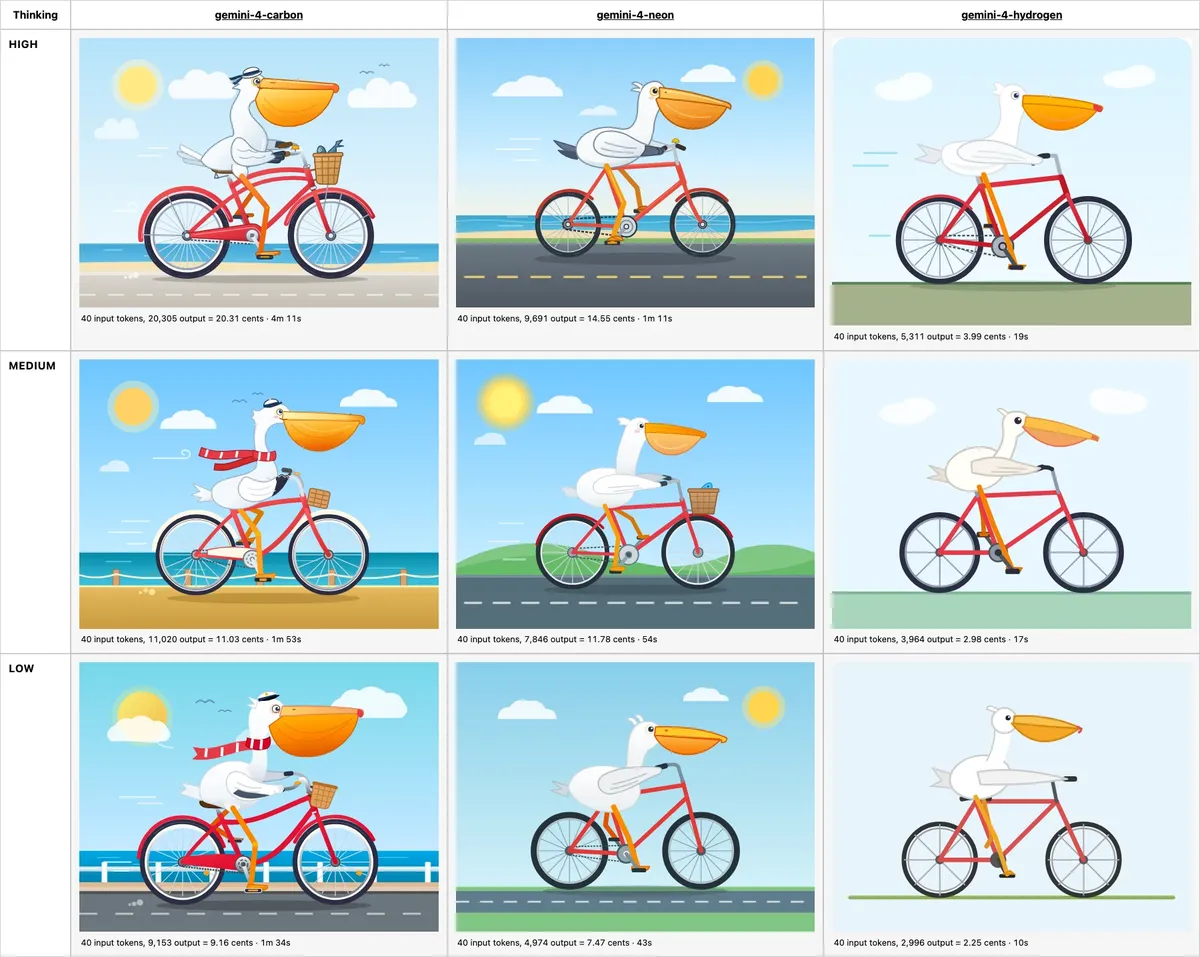
- Qualitative test: Willison's pelican drawings ranked Neon between Hydrogen and Carbon. This is informal, not a benchmark (Simon Willison).
Claims and evidence
- Google's own numbers: 65.2% on Terminal-Bench 4.1, 46.2% on FrontierCode 2.0, and 32% lower cost per task than Carbon (Google).
- Speed: Google says about 3× faster than Carbon (Digit). Artificial Analysis measured about 1.9× the output speed and about 40% less time per task.
- Cost per task: Google says 32% lower than Carbon. Artificial Analysis measured about 17% lower.
Read the full section
- Google's own numbers: 65.2% on Terminal-Bench 4.1, 46.2% on FrontierCode 2.0, and 32% lower cost per task than Carbon (Google). Google also says Neon beats Claude Opus 5.5 and GPT 6.2 Sol (Digit). Coverage reports these comparisons without independent testing.
- Speed: Google says about 3× faster than Carbon (Digit). Artificial Analysis measured about 1.9× the output speed and about 40% less time per task.
- Cost per task: Google says 32% lower than Carbon. Artificial Analysis measured about 17% lower.
- Coding agents: Artificial Analysis's Coding Agent Index gives Neon 59, level with Claude Opus 5.5 and Claude Fable 5.2, at $6.86 per task versus $12.61–$15.47 for those models (Artificial Analysis).
Context and prior work
- Neon is Google's fourth model in seven weeks (Artificial Analysis on X).
- Pricing was already confusing before Neon arrived.
- The two highest scorers on the Intelligence Index are still GPT-6.2 Astra (max) and Claude Fable 5.2 (max).
Read the full section
- Neon is Google's fourth model in seven weeks (Artificial Analysis on X).
- Pricing was already confusing before Neon arrived. Argon cost the same as Carbon, and Hydrogen ($1.50/$7.50) is about 15× the price of Claude Haiku 5.5 and GPT-6 Luna (Simon Willison, Nov 12).
- The two highest scorers on the Intelligence Index are still GPT-6.2 Astra (max) and Claude Fable 5.2 (max).
Limitations, safety and contested findings
- Argon's status is reported two ways.
- It says Neon keeps Carbon-level misuse protections, with a 0.09% misaligned-action rate and full resistance to indirect prompt injection at the highest reasoning level (Google).
- Neon's roughly 15% higher output-token count partly offsets its per-token advantage.
Read the full section
- Argon's status is reported two ways. 9to5Google says Neon replaces Argon, which is discontinued after 30 November (9to5Google). heise says Argon remains in the API and Antigravity but is gone from the Gemini app (heise).
- Safety figures come only from Google. It says Neon keeps Carbon-level misuse protections, with a 0.09% misaligned-action rate and full resistance to indirect prompt injection at the highest reasoning level (Google). No independent testing of these figures was found.
- More tokens per task. Neon's roughly 15% higher output-token count partly offsets its per-token advantage.
Business and practitioner implications
- Until 1 December, Carbon is cheaper per token. After that, Neon is 25% cheaper per token and about 17% cheaper per task (heise; Artificial Analysis).
- Agentic coding: Neon ties higher-priced Claude models on Artificial Analysis's coding-agent index at about half the cost per task, making it a strong option to test.
- Argon users: confirm with Google how long the API will keep serving Argon, given the conflicting reports.
Read the full section
- Don't migrate on today's prices. Until 1 December, Carbon is cheaper per token. After that, Neon is 25% cheaper per token and about 17% cheaper per task (heise; Artificial Analysis).
- Agentic coding: Neon ties higher-priced Claude models on Artificial Analysis's coding-agent index at about half the cost per task, making it a strong option to test.
- Argon users: confirm with Google how long the API will keep serving Argon, given the conflicting reports.
- LLM CLI users: upgrade with
llm install -U llm-gemini.