
AgentsAutonomy & tool use
Simon Willison and Prime Radiant release three open-source external sandbox servers for coding agents
Three open-source servers keep Claude Code, Codex or Pi running on a developer's Mac while routing only executed commands into a Linux sandbox restricted to user-approved folders and network hosts, aiming to make cheaper or local models safer to try.
From the Simon Willison article of November 17, 2026 and cited sources: The pattern puts the isolation boundary between the agent and the code it executes. [1] [2] [8]
SOURCES[1] External sandboxes for coding agents – Simon Willison simonwillison.net[2] External sandboxes for coding agents – Prime Radiant blog blog.primeradiant.com[8] anthropic-experimental/sandbox-runtime github.com
 AT Pulse research deskPublished · Updated · 5 min read · AI-assisted analysis
AI-assisted, not human-edited. Methodology Corrections Who owns this site
- What happened
- The pattern puts the isolation boundary between the agent and the code it executes. [1] [2] [8]
- Original source
- Simon Willison article, independent perspective
- Brief by
- AT Pulse research desk AI-assisted; publisher and contact on the desk page
- Studies
- arXiv 2610.02456 (Oct 2026) [3] date from arXiv ID
- When
- November 17, 2026 article published
- Covered
- Nov 18 edition
- Evidence
- 10 sources across 8 sites
- 1External sandboxes for coding agents – Simon Willisonsimonwillison.net
- 2External sandboxes for coding agents – Prime Radiant blogblog.primeradiant.com
- 3SideKernel: A Usable microVM Sandbox for AI Coding Agents…arxiv.org
- 4microsoft/quicksandgithub.com
- 5Dev News Digest: 18 Nov 2026 – DEV Communitydev.to
- 6prime-radiant-inc/external-sandbox-quicksandgithub.com
RisingHow it’s measured
Hacker News · 3 likes · 1 comment
Reach blends public engagement (views, likes, comments, shares, stars) from the platforms where the story or its original source lives: YouTube, Hacker News, GitHub, Substack and similar. A video and the article written from its transcript share one score, taken from the video. Platforms with no data are left out rather than counted as zero, and the age of a story never lowers its score.
The pattern puts the isolation boundary between the agent and the code it executes. Earlier in-process tools such as Anthropic's sandbox-runtime instead confine the agent's own processes. The authors argue that this setup stops an agent from modifying itself or its environment and keeps the trust boundary auditable. [1] [2] [8]
Three backends share one localhost API and a common set of conformance tests. They are v86 (Alpine Linux under WebAssembly), Apple Containers, and a QEMU virtual machine built on Microsoft's Quicksand. Teams can switch backends without reconfiguring their agents. Claude Code connects through a shell-prefix setting, Codex through a WebSocket exec-server protocol, and Pi through an extension that replaces its built-in tools. [2] [4] [6]
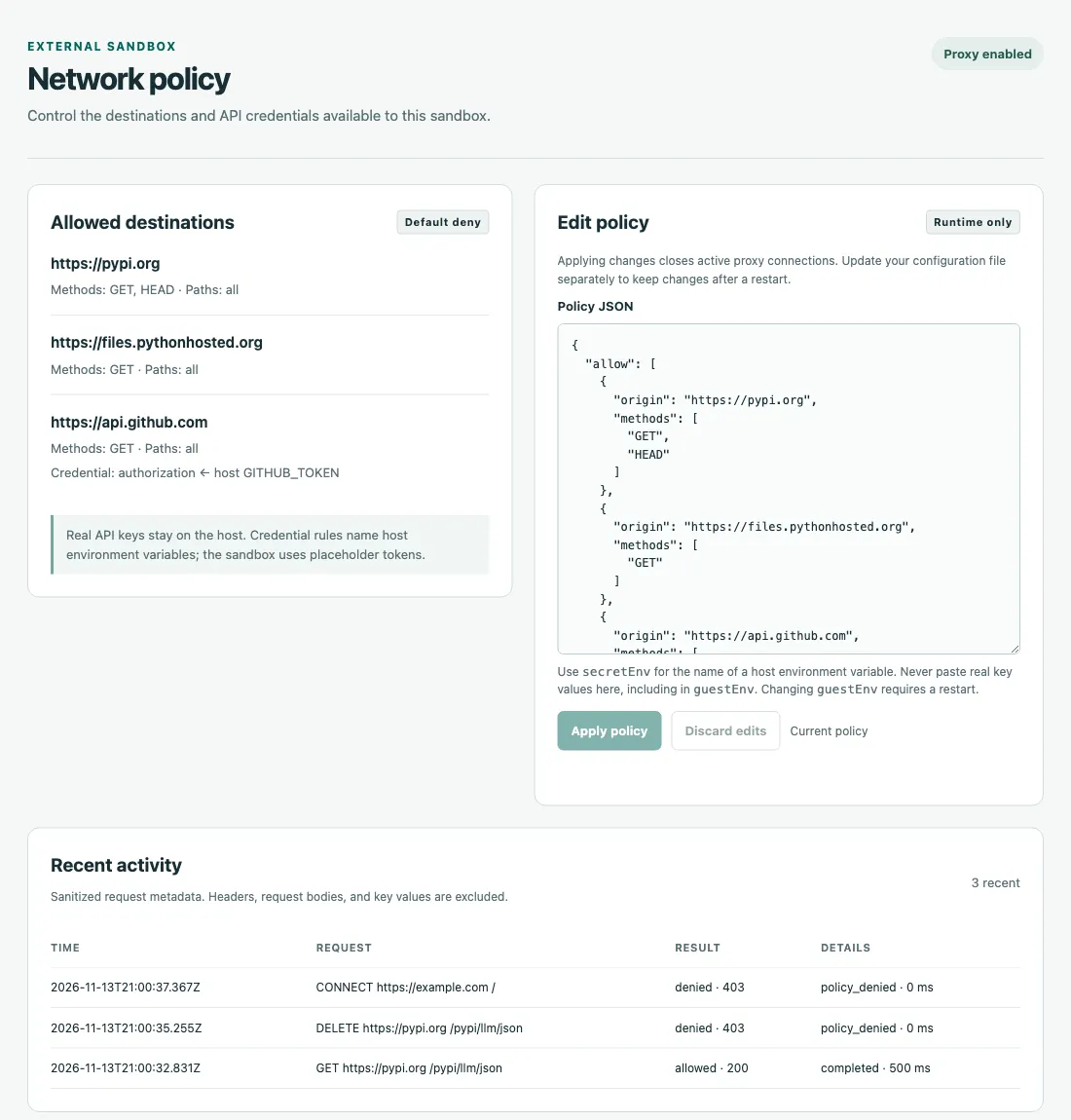
Network access is denied by default. A proxy enforces per-host allow-lists and swaps placeholder tokens for real credentials held on the host, which reduces the risk of credentials being stolen through prompt injection. The repo notes one exception: if an allowed service echoes a secret back, the sandboxed code can still see it. [2] [6]
The evidence so far is design documentation and code, with no independent benchmark or security audit. For teams trying error-prone local models, this offers a swappable isolation layer.
Read the full assessment
It works best as a reference design, not the only control in production.
Executive brief
Simon Willison and the AI lab Prime Radiant have released three open-source "external sandbox" servers. They take a common safety feature of coding agents and turn it around. The agent (Claude Code, Codex or Pi) keeps running on the developer's Mac. Only the commands it executes go to a separate Linux sandbox, and that sandbox can see only the folders and network hosts the user allows. The goal is to make it safer to try cheaper or local models, which are more likely to make mistakes or fall for prompt injection (Prime Radiant). The authors call the servers experimental prototypes that have had no security audit. No independent evaluation has been published yet.
What changed and event timeline
Survey shows few users sandbox agents
The SideKernel paper reports that fewer than 40% of AI coding-agent users run their agents in a sandbox, and names usability as the main barrier ().
Quicksand adds port forwarding
Microsoft's Quicksand, a Python library for launching QEMU virtual machines that is aimed at sandboxing AI agents, ships v0.13.0 with two-way port forwarding ().
Prime Radiant publishes the pattern
The post describes three servers that share one localhost API, along with a network allow-list proxy and a way to swap in credentials without exposing them. The page is dated a day before Willison's link post ().
Willison announces the release
He frames the work as a way to run local models without worrying that a mistake or injected instruction could cause damage on the host machine ().
First secondary coverage
A developer news digest repeats the release details. It adds no testing of its own ().
Capabilities and access
- external-sandbox-v86: Node.js 22.19 or later, running Alpine Linux under WebAssembly, on port 8686.
- external-sandbox-container: Python, using Apple Containers on Apple silicon, on port 8687.
- external-sandbox-quicksand: Python, running a QEMU virtual machine with Alpine 3.23 by default (Ubuntu 24.04 if built from source), on port 8688. Apache-2.0 licensed.
Read the full section
- external-sandbox-v86: Node.js 22.19 or later, running Alpine Linux under WebAssembly, on port 8686.
- external-sandbox-container: Python, using Apple Containers on Apple silicon, on port 8687.
- external-sandbox-quicksand: Python, running a QEMU virtual machine with Alpine 3.23 by default (Ubuntu 24.04 if built from source), on port 8688. Apache-2.0 licensed.
- All three are free and run locally. Network access is denied by default (Prime Radiant).
Technical analysis for researchers and developers
- API:
/execand/exec/wsrun commands (buffered and streaming);/codexhandles filesystem operations;/proxymanages network policy;/healthreports status. - Agent integration:
- Claude Code: the
CLAUDE_CODE_SHELL_PREFIXsetting wraps its bash commands.
Read the full section
- API:
/execand/exec/wsrun commands (buffered and streaming);/codexhandles filesystem operations;/proxymanages network policy;/healthreports status; the root path serves a browser terminal (repo). - Agent integration:
- Claude Code: the
CLAUDE_CODE_SHELL_PREFIXsetting wraps its bash commands. - Codex: connects over WebSocket using a JSON-RPC exec-server protocol.
- Pi: an npm extension replaces its native tools (bash, read, write, edit, grep and others) (Prime Radiant).
- Mounts: folders are shared read-only or read-write. A
--preserve-pathsoption keeps host paths unchanged inside the sandbox. - Testing: a shared protocol specification and conformance tests let anyone build and check new backends.
- Network in the Quicksand version: QEMU drops all guest traffic except a single forwarded stream to the proxy (repo).
Claims and evidence
- The pattern stops agents from modifying themselves or their own environment, and keeps the trust boundary auditable.
- The proxy replaces placeholder tokens with real values taken from host environment variables.
- Quicksand's io_uring support cuts disk latency by about 50%. Microsoft's own figure; nobody has replicated it (Quicksand docs).
Read the full section
- The pattern stops agents from modifying themselves or their own environment, and keeps the trust boundary auditable. Design rationale from the authors (Prime Radiant).
- Secrets never reach the agent. The proxy replaces placeholder tokens with real values taken from host environment variables. The repo adds a caveat: if an allowed upstream service echoes a credential back, the code can still see it (repo).
- Quicksand's io_uring support cuts disk latency by about 50%. Microsoft's own figure; nobody has replicated it (Quicksand docs).
- Security and performance in practice: there is no independent benchmark or security audit of any of the three servers.
Context and prior work
- In-process sandboxing: Anthropic's sandbox-runtime uses Seatbelt on macOS and bubblewrap on Linux, plus host proxies that enforce domain allow-lists, to restrict the agent's own processes (sandbox-runtime; Claude Code docs).
- macOS microVMs: SideKernel is a microVM-based sandbox for macOS. In its 23 usability tests, Docker Sandboxes and SideKernel scored highest (arXiv).
- Hosted sandboxes: FourWeekMBA's coverage contrasts this local approach with paid hosted sandboxes in its headline (FourWeekMBA). The article body could not be checked.
Read the full section
- In-process sandboxing: Anthropic's sandbox-runtime uses Seatbelt on macOS and bubblewrap on Linux, plus host proxies that enforce domain allow-lists, to restrict the agent's own processes (sandbox-runtime; Claude Code docs). The external pattern moves the boundary so it sits between the agent and the code it runs.
- macOS microVMs: SideKernel is a microVM-based sandbox for macOS. In its 23 usability tests, Docker Sandboxes and SideKernel scored highest (arXiv).
- Hosted sandboxes: FourWeekMBA's coverage contrasts this local approach with paid hosted sandboxes in its headline (FourWeekMBA). The article body could not be checked.
Limitations, safety and contested findings
- Unaudited: the servers are experimental prototypes with no security audit.
- Writable folders: read-write mounts can still be damaged by the agent.
- Proxy policy: an agent that can reach the
/proxyendpoint can change network policy during a session.
Read the full section
The authors list these limitations (Prime Radiant; repo):
- Unaudited: the servers are experimental prototypes with no security audit.
- Writable folders: read-write mounts can still be damaged by the agent.
- Proxy policy: an agent that can reach the
/proxyendpoint can change network policy during a session. - Root inside the VM: commands run as root in the guest, so the VM itself is the only isolation boundary.
- Local trust only: the listener is meant only for trusted local clients.
- Host side unrestricted: tools running on the host and the model's own network traffic are not restricted.
- Compatibility: dependencies compiled on macOS may not work inside the Linux sandbox.
- Lower layers trusted: the design relies on the Linux kernel and the emulation layers underneath it.
Business and practitioner implications
- Because all three servers share one API, teams can swap isolation backends (WebAssembly, containers, full VMs) without changing how their agents are configured.
- Credential handling may matter most.
- Treat it as a reference design, not a product.
Read the full section
- Easier to experiment safely. Because all three servers share one API, teams can swap isolation backends (WebAssembly, containers, full VMs) without changing how their agents are configured.
- Credential handling may matter most. Placeholder secrets combined with per-host allow-lists address the risk of data or credential theft through prompt injection, which matters most when trying weaker or local models.
- Treat it as a reference design, not a product. Without an audit, and given the host-side gaps above, these servers should not be the only control in regulated or production settings.
- Platform scope. The container and Quicksand versions are tested on Apple silicon. Quicksand itself also supports Linux and Windows (Quicksand).