
FundingRounds, leads & terms
Senate advances BAAJA permitting bill that would make data centers pay for the grid upgrades they trigger
A bipartisan Senate permitting bill, BAAJA, cleared two procedural votes and would make data centers pay for grid upgrades they trigger, potentially tens of billions of dollars, while facing House resistance before Congress ends in early January.
From the CTVC article of November 16, 2026 and cited sources: The Bipartisan American Affordability and Jobs Act (S. 5653) cleared Senate procedural votes of 73–25 and 70–27. [1] [4] [5] [7]
SOURCES[1] CTVC: 🌎 BAAJA blast off #322 ctvc.co[4] Senate EPW: Senate Advances BAAJA epw.senate.gov[5] Heatmap: Permitting Reform 'Survived Its First Test' heatmap.news
 AT Pulse research deskPublished · Updated · 5 min read · AI-assisted analysis
AI-assisted, not human-edited. Methodology Corrections Who owns this site
- What happened
- The Bipartisan American Affordability and Jobs Act (S. 5653) cleared Senate procedural votes of 73–25 and 70–27. [1] [4] [5] [7] [8]
- Original source
- CTVC article, independent perspective
- Brief by
- AT Pulse research desk AI-assisted; publisher and contact on the desk page
- When
- November 16, 2026 article published
- Covered
- Nov 17 edition
- Evidence
- 10 sources across 10 sites
- 1CTVC: 🌎 BAAJA blast off #322ctvc.co
- 2Inquirer/NYT: Congress looks to charge data centers billionsinquirer.com
- 3Rhodium Group: Estimating the US Energy System Impacts of…rhg.com
- 4Senate EPW: Senate Advances BAAJAepw.senate.gov
- 5Heatmap: Permitting Reform 'Survived Its First Test'heatmap.news
- 6Tech Funding News: Project Omega raises $80M from B Capitaltechfundingnews.com
Reach: not measured yet
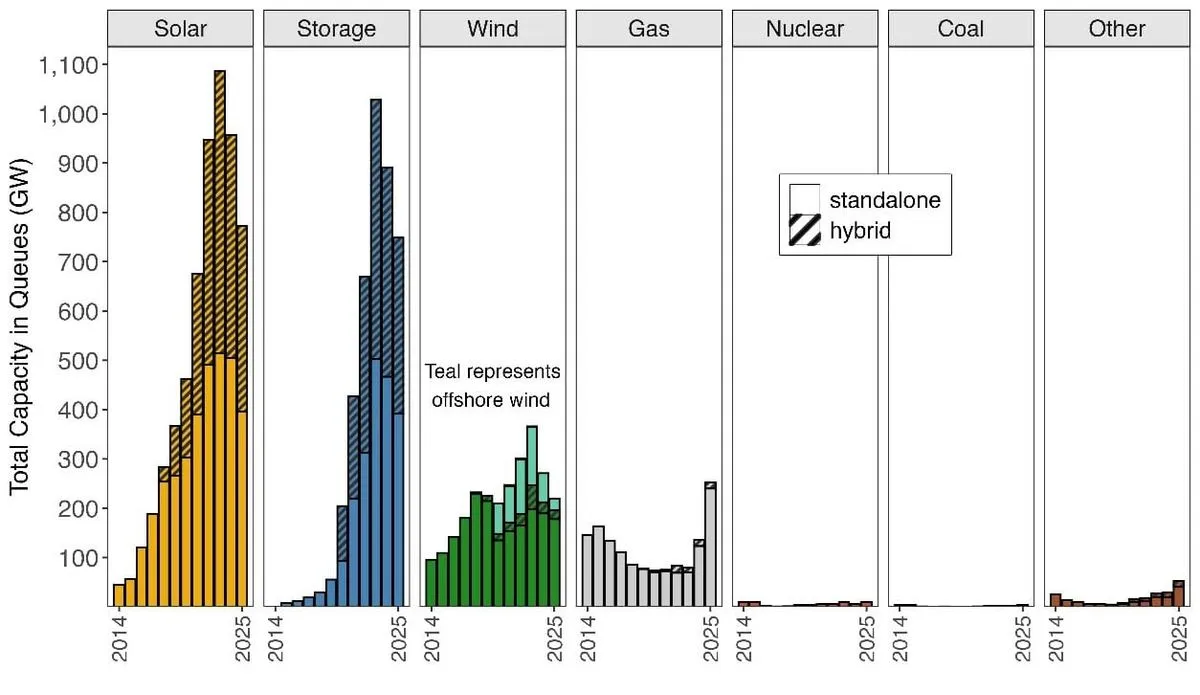
The Bipartisan American Affordability and Jobs Act (S. 5653) cleared Senate procedural votes of 73–25 and 70–27. It sets one- and two-year deadlines for environmental reviews, a 150-day window for legal challenges, joint planning across grid regions, and FERC siting authority for interstate lines of 230kV and above. House Democratic leader Hakeem Jeffries says the bill falls short, and the current Congress ends in early January. [1] [4] [5] [7] [8]
FERC would charge large loads such as data centers both for the upgrades they trigger and for their use of the existing network, reversing a 1994 precedent against double-charging. Estimates put federal charges at about $35B over 10 years, with up to $136B more if states use their new powers. [2]
Rhodium Group's modeling projects household power bills $50–78 a year lower by 2040 and annual emissions cuts of 5–148 Mt, depending on the scenario. Its model leaves out the permit-certainty provisions. Opponents, including NRDC, Sierra Club and an analysis by Kevin Kircher, warn that the bill could raise emissions through gas expansion. Accounts of its effect on tribal consultation directly conflict. [3] [8] [10] [7]
Reported estimates put federal data center charges at $35B over a decade. Implication: AI infrastructure operators may face higher interconnection costs, while developers could gain faster reviews.
Read the full assessment
Passage, emissions effects and environmental trade-offs remain unsettled.
Executive brief
A Senate permitting bill would make data centers pay for the grid upgrades they trigger. Federal rules alone could cost data centers $35 billion over 10 years, with up to $136 billion more if states use their new powers. The bill is the Bipartisan American Affordability and Jobs Act (BAAJA). It cleared Senate procedural votes of 73–25 and 70–27, but the House remains the main obstacle and the current Congress ends in early January. The same newsletter lists the week's climate deals, led by Project Omega's $80M Series A for recycling nuclear fuel.
Read the full section
A Senate permitting bill would make data centers pay for the grid upgrades they trigger. Federal rules alone could cost data centers $35 billion over 10 years, with up to $136 billion more if states use their new powers. The bill is the Bipartisan American Affordability and Jobs Act (BAAJA). CTVC's newsletter calls it the biggest permitting overhaul in decades. It cleared Senate procedural votes of 73–25 and 70–27, but the House remains the main obstacle and the current Congress ends in early January. The same newsletter lists the week's climate deals, led by Project Omega's $80M Series A for recycling nuclear fuel.
What changed and event timeline
Rhodium models the bill
Rhodium Group projects household power bills $50–78 a year lower by 2040 and 5–148 Mt a year less emissions. It leaves the permit-certainty provisions out of the model.
Senate votes 73–25 to proceed
Sponsors are Capito, Whitehouse, Lee and Heinrich. Final passage still requires further votes.
More detail
Project Omega raises $80M
B Capital leads the Series A for a startup that recycles used nuclear fuel by pyroprocessing. Total disclosed funding is $92M; valuation was not disclosed.
- Mid Nov 2026
Cloture on the substitute, 70–27
The vote on Capito's substitute amendment sets up final Senate passage. Reports disagree on its date. Incoming House leader Hakeem Jeffries says the bill "falls short."
More detail
Data center cost estimates published
The NYT puts the federal data center charges at $35B over a decade. The Data Center Coalition has not taken a position.
Capabilities and access
- Bill: BAAJA, S. 5653, 494 pages.
- Review deadlines: one year for environmental assessments, two years for environmental impact statements, and 150 days to file legal challenges (HNGN).
- Transmission: neighboring grid regions must plan jointly, and FERC can site interstate lines of 230kV and above (CTVC).
Read the full section
- Bill: BAAJA, S. 5653, 494 pages.
- Review deadlines: one year for environmental assessments, two years for environmental impact statements, and 150 days to file legal challenges (HNGN).
- Transmission: neighboring grid regions must plan jointly, and FERC can site interstate lines of 230kV and above (CTVC).
- Permit certainty: permits issued on or after November 6 are protected from revocation (CTVC).
Technical analysis for researchers and developers
- Model: Rhodium used RHG-NEMS with low-, mid- and high-emissions scenarios. It modeled the pipeline and transmission line, interconnection and regional transmission planning provisions (Rhodium).
- Not modeled: permit certainty, geothermal incentives, advanced transmission technologies, virtual power plant market access and local congestion relief (Rhodium).
- Ranges are wide: 17–249 GW of extra clean capacity and 5–148 Mt of annual emissions cuts. The headline numbers depend heavily on the scenario.
Read the full section
- Model: Rhodium used RHG-NEMS with low-, mid- and high-emissions scenarios. It modeled the pipeline and transmission line, interconnection and regional transmission planning provisions (Rhodium).
- Not modeled: permit certainty, geothermal incentives, advanced transmission technologies, virtual power plant market access and local congestion relief (Rhodium).
- Ranges are wide: 17–249 GW of extra clean capacity and 5–148 Mt of annual emissions cuts. The headline numbers depend heavily on the scenario.
- Cost allocation: FERC would charge large loads for both the upgrades they trigger and their use of the existing network. This overturns a 1994 precedent against double-charging (Inquirer/NYT).
Claims and evidence
- "Up to 148 Mt" of emissions cuts (CTVC): this is the top of Rhodium's 5–148 Mt range, not a central estimate (Rhodium).
- "$82–164B in extra economic output a year": a White House Council of Economic Advisers estimate, cited by the bill's sponsors in EPW remarks.
- Chance of passage this session: analysts cited by HNGN put it at 20–25%. That is opinion, not a measurement.
Read the full section
- "Up to 148 Mt" of emissions cuts (CTVC): this is the top of Rhodium's 5–148 Mt range, not a central estimate (Rhodium).
- "$82–164B in extra economic output a year": a White House Council of Economic Advisers estimate, cited by the bill's sponsors in EPW remarks. No independent check appears in the reviewed sources.
- Chance of passage this session: analysts cited by HNGN put it at 20–25%. That is opinion, not a measurement.
- Project Omega: the $80M round and B Capital as lead are company-announced and repeated in independent coverage (TFN, EnergyTech). Its claim of up to 90% waste-volume reduction is the company's own. The other deals in the newsletter (Reflect Orbital $74M, Optics11 $55M, among others) were not corroborated in the reviewed sources.
Context and prior work
The House has already advanced its own permitting bills, the SPEED and PERMIT Acts. Supporters point to the SunZia transmission line, which took 18 years to complete. They argue the US needs to double to triple its transmission capacity. CTVC cites a median wait of more than five years to connect transmission projects, and says over 80% of solar and wind developers avoid sites that need federal review (CTVC).
Limitations, safety and contested findings
- Opponents: NRDC, Sierra Club, UCS and Earthjustice Action say the bill weakens NEPA, Clean Water Act and Endangered Species Act protections and locks in fossil fuel projects.
- Tribal consultation: the Native American Rights Fund says the Section 106 changes curtail consultation with tribes and limit legal recourse (NARF).
- Blind spot: Rhodium did not model the permit-certainty provisions, which are the ones critics worry about most.
Read the full section
- Opponents: NRDC, Sierra Club, UCS and Earthjustice Action say the bill weakens NEPA, Clean Water Act and Endangered Species Act protections and locks in fossil fuel projects. Kevin Kircher's analysis predicts higher emissions as data center demand drives gas expansion (Canary Media).
- Tribal consultation: the Native American Rights Fund says the Section 106 changes curtail consultation with tribes and limit legal recourse (NARF). HNGN instead describes the bill as strengthening consultation (HNGN). The two accounts directly conflict.
- Blind spot: Rhodium did not model the permit-certainty provisions, which are the ones critics worry about most.
Business and practitioner implications
- AI and data center operators: budget for full-cost interconnection. Federal and state charges could total up to roughly $171B over a decade (Inquirer/NYT).
- Developers: shorter reviews and a 150-day limit on legal challenges would reduce timeline risk. Permit certainty would protect projects whatever the fuel.
- Investors: nuclear and grid-hardware rounds (Project Omega, Optics11, Atomarine) follow the push for firm power for AI.
Read the full section
- AI and data center operators: budget for full-cost interconnection. Federal and state charges could total up to roughly $171B over a decade (Inquirer/NYT).
- Developers: shorter reviews and a 150-day limit on legal challenges would reduce timeline risk. Permit certainty would protect projects whatever the fuel.
- Investors: nuclear and grid-hardware rounds (Project Omega, Optics11, Atomarine) follow the push for firm power for AI. Passage still depends on the House before early January. If the bill fails, CTVC expects a 2027 reintroduction to face steeper odds.