
StocksEquities, earnings & valuations
MBI Deep Dives model projects Google Search revenue growing through 2035 as Google's query share falls to about 52%
After Alphabet's Q3 2026 earnings miss and a stock decline of more than 10%, MBI Deep Dives modeled Google Search revenue from five drivers. It projects continued growth because total queries are expected to expand faster than Google's share falls.
From the MBI Deep Dives article of November 16, 2026 and cited sources: Q3 2026 showed strong Search results alongside financial strain. [2] [3]
SOURCES[2] Alphabet Q3 2026 Form 10-Q sec.gov[3] CNBC: Alphabet Q3 2026 earnings cnbc.com
 AT Pulse research deskPublished · Updated · 5 min read · AI-assisted analysis
AI-assisted, not human-edited. Methodology Corrections Who owns this site
- Original source
- MBI Deep Dives article, independent perspective
- Brief by
- AT Pulse research desk AI-assisted; publisher and contact on the desk page
- When
- November 16, 2026 article published
- Covered
- Nov 17 edition
- Evidence
- 16 sources across 15 sites
- 1Modeling Alphabet, Part 1: Search, Gemini, and YouTubembi-deepdives.com
- 2Alphabet Q3 2026 Form 10-Qsec.gov
- 3CNBC: Alphabet Q3 2026 earningscnbc.com
- 4PPC Land: AI Mode ads, no opt-outppc.land
- 5Search Engine Journal: AI Mode ads expansionsearchenginejournal.com
- 6Channel Insider: ChatGPT at 20% of Googlechannelinsider.com
Reach: not measured yet

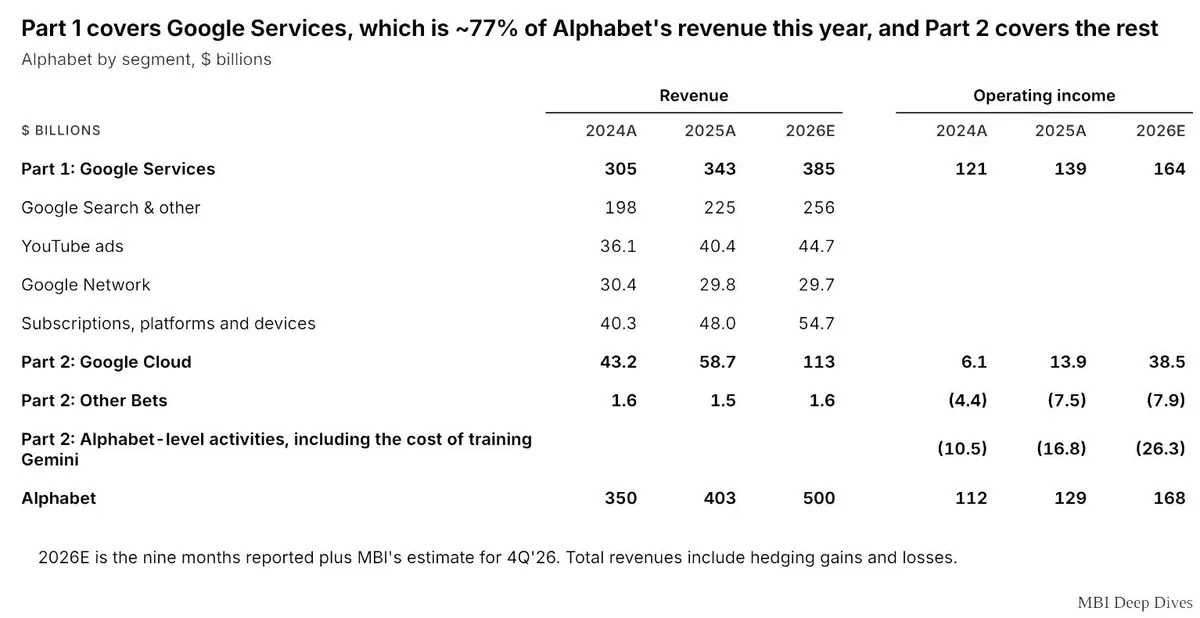
Q3 2026 showed strong Search results alongside financial strain. Search revenue rose $6.8B year over year to $63.4B. Even so, Alphabet missed both revenue and earnings estimates for the first time in almost four years, and the stock fell more than 10%. Free cash flow was −$9.07B, and capex guidance stayed at $195–205B. [2] [3]
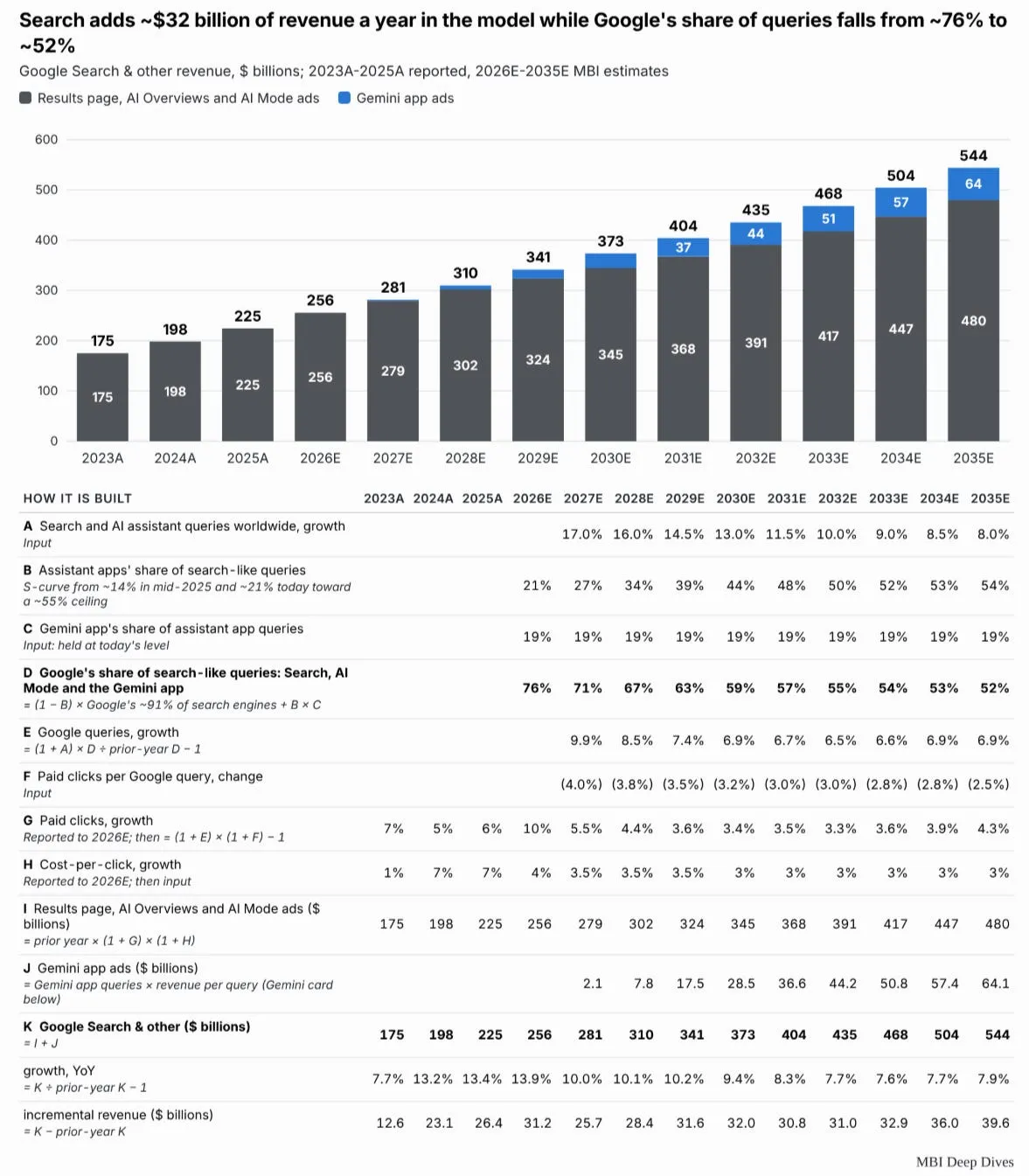
The model multiplies five drivers: total queries, assistants' share of queries, Google's share, paid clicks per query and cost per click. In it, Google's share of search-like queries falls from about 76% to about 52% by 2035, yet Search still adds about $32B of revenue a year. The result is highly sensitive. Moving the assistant plateau 10 points either way shifts 2035 Search revenue by about $50B. A one-point annual change in clicks per query or in cost per click is worth about $47B. [1]
The starting share estimate is contested. It builds on OpenAI's claim that ChatGPT handles about one-fifth as many search-like queries as Google, a figure OpenAI has not explained. Ahrefs puts ChatGPT at about 12% of Google's traditional search volume, and seoClarity puts it at 3–8%. [1] [6] [7] [13] [14]
Google is extending ads into AI surfaces. AI Mode ads now run in 10 more markets with no advertiser opt-out, and ads on follow-up questions have launched in the US. However, management said AI Mode earns less per query, and advertisers cannot see its results separately. The Gemini app has passed 1 billion users but has no ads yet. MBI's forecast of about $64B in Gemini app ad revenue by 2035 assumes ads launch next year. [1] [4] [5] [9] [10] [15]
Reported results show Search still growing while AI spending drains cash. The model implies that future Search revenue depends less on market share than on clicks per query and click prices, which AI Mode's lower monetization could pressure.
Writing the dossier now; the key numbers have been checked against Alphabet's 10-Q, earnings materials and independent reporting.
Executive brief
Google's Search revenue rose $6.8B year over year in Q3 2026, from $56.6B to $63.4B (Alphabet 10-Q). Even so, Alphabet missed estimates and its shares fell more than 10% (CNBC). MBI Deep Dives, an independent investor newsletter, built a model on that tension. It has Google's share of "search-like" queries falling from about 76% to about 52% by 2035, yet Search still adds about $32B of revenue a year, because the total number of queries keeps growing. The share figures are the author's own estimates, not disclosed data. They depend heavily on an OpenAI usage claim that outside measurements put lower.
What changed and event timeline
Q3 miss despite query surge
Search grew 12% and Cloud doubled to $30.7B, but this was Alphabet's first miss on both revenue and earnings in almost four years. Capex guidance stayed at $195–205B ().
AI Mode ads go international
Ads in AI Mode reached 10 markets outside the US, including India, Canada and Australia. Existing campaigns are enrolled with no opt-out (). Ads on follow-up questions ("multiturn" ads) launched in the US ().
OpenAI's one-fifth claim
Adam Fry, who leads ChatGPT's consumer product, told Big Technology that ChatGPT handles about 20% as many search-like queries as Google (;).
Nvidia CEO exit
Jensen Huang resigned with immediate effect. CFO Colette Kress became interim CEO (). MBI frames Alphabet as a possible beneficiary of any turmoil at Nvidia.
MBI publishes Part 1
The model covers Search, the Gemini app, YouTube and subscriptions. Part 2 is promised to cover Cloud, capex and valuation ().
Capabilities and access
- Gemini app: 1 billion users (Google CEO remarks), up about 350M in a year (PPC Land). The app does not show ads yet.
- Models: Google named two frontier models, Argon and Carbon.
- AI Mode: queries average three times the length of traditional searches. One in five uses voice, images or documents (Google).
Read the full section
- Gemini app: 1 billion users (Google CEO remarks), up about 350M in a year (PPC Land). The app does not show ads yet.
- Models: Google named two frontier models, Argon and Carbon. It says Carbon scores 59 on the Artificial Analysis Intelligence Index, which ranks it first (Google).
- AI Mode: queries average three times the length of traditional searches. One in five uses voice, images or documents (Google).
Technical analysis for researchers and developers
The model (MBI) breaks Search revenue into five drivers multiplied together: AI serving costs are modeled as a separate line. Tokens per query rise about 28x by 2035, while the work each GW of compute can handle rises about 11x. The spreadsheet has not been released yet.
Read the full section
The model (MBI) breaks Search revenue into five drivers multiplied together:
- Total queries across all search engines and assistants: up 17% next year, slowing to 8% by 2035.
- Assistants' share of queries: rises along an S-curve from about 21% today and levels off at 55%.
- Google's share: it keeps about 91% of queries that stay on search engines, and Gemini keeps about 19% of assistant queries.
- Paid clicks per query: falls about 4% a year, easing to 2.5%.
- Cost per click: grows 3–3.5% a year.
AI serving costs are modeled as a separate line. Tokens per query rise about 28x by 2035, while the work each GW of compute can handle rises about 11x. That takes the compute bill from about $4B to about $19B.
Sensitivity: if assistants level off at 65% or 45% of queries instead of 55%, 2035 Search revenue moves by roughly $50B in either direction. The spreadsheet has not been released yet.
Claims and evidence
- Search added $6.8B year over year: confirmed by the 10-Q.
- Paid clicks up 8%: reported by 9to5Google. Cost per click rose about 4% (FourWeekMBA).
- Query growth at a five-year high: this is Google's own statement (Google).
Read the full section
- Search added $6.8B year over year: confirmed by the 10-Q.
- Paid clicks up 8%: reported by 9to5Google. Cost per click rose about 4% (FourWeekMBA).
- Query growth at a five-year high: this is Google's own statement (Google).
- ChatGPT at 20% of Google: OpenAI's figure, and it has not explained its method (Channel Insider). Ahrefs puts ChatGPT at about 12% of Google's traditional search volume (Ahrefs). seoClarity puts it at 3–8% (seoClarity). MBI's 76% share estimate builds on the 20% figure.
- AI Mode earns less per query: CBO Philipp Schindler said lower monetization in AI Mode weighed on Q3 growth (transcript).
Context and prior work
In 2025, Barclays estimated that Google's query growth had not slowed after ChatGPT launched (Business Insider NL). MBI uses that same growth estimate to back out a roughly 4% annual fall in paid clicks per query in 2024–25. Ahrefs found that Google still sends about 190 times more traffic to websites than ChatGPT (Ahrefs).
Limitations, safety and contested findings
- Market shares: the author calls them ballpark figures from third-party app and web data. Alphabet does not disclose query share.
- Gemini app ads: the forecast of about $64B by 2035 assumes ads launch next year.
- Advertiser reporting: advertisers cannot see AI Mode's cost per acquisition or return on ad spend separately (Search Engine Journal).
Read the full section
- Market shares: the author calls them ballpark figures from third-party app and web data. Alphabet does not disclose query share.
- Gemini app ads: the forecast of about $64B by 2035 assumes ads launch next year. On the call, Pichai only described agents as an "expansion opportunity" (transcript).
- Advertiser reporting: advertisers cannot see AI Mode's cost per acquisition or return on ad spend separately (Search Engine Journal).
- Disclosure: the author discloses personal holdings (MBI).
Business and practitioner implications
- Advertisers: AI Mode ads are now spreading across markets without an opt-out. In AI Mode, sponsored and organic product listings already get similar click-through rates (transcript).
- Investors: MBI argues that cost per click and paid clicks per query now matter as much as market share. A one-point annual change in either is worth about $47B of 2035 revenue (MBI).
Read the full section
- Advertisers: AI Mode ads are now spreading across markets without an opt-out. In AI Mode, sponsored and organic product listings already get similar click-through rates (transcript).
- Investors: MBI argues that cost per click and paid clicks per query now matter as much as market share. A one-point annual change in either is worth about $47B of 2035 revenue (MBI). Separately, Q3 free cash flow was −$9.07B and long-term debt rose to $125.1B (CNBC). The share drop is a market reaction; the cash and debt figures are fundamentals.
The source trail.
Sources (16)
Modeling Alphabet, Part 1: Search, Gemini, and YouTube
Article text retrieved; extracted text may omit tables or interactive elements.
mbi-deepdives.com