
Fed & ratesCentral banks & interest rates
Mortgage-Bond Yields Jump 40 Basis Points in a Week as Hot October CPI Revives Fed Hike Bets
Housing economist Tom Lawler says current-coupon MBS yields rose 40 basis points in one week. That nearly erased their decline from mid-October to early November, as a hot October CPI and hawkish Fed comments pushed Treasury yields higher and mortgage spreads wider.
From the Calculated Risk article of November 16, 2026 and cited sources: Mortgage funding costs rose faster than Treasuries. [1] [8]
SOURCES[1] CalculatedRisk: Lawler note calculatedrisk.substack.com[8] Mortgage Daily weekly recap mortgagedaily.com
 AT Pulse research deskPublished · Updated · 5 min read · AI-assisted analysis
AI-assisted, not human-edited. Methodology Corrections Who owns this site
- Original source
- Calculated Risk article, independent perspective
- Brief by
- AT Pulse research desk AI-assisted; publisher and contact on the desk page
- When
- November 16, 2026 article published
- Covered
- Nov 17 edition
- Evidence
- 10 sources across 9 sites
RisingHow it’s measured
Substack · 14 likes · 1 share
Reach blends public engagement (views, likes, comments, shares, stars) from the platforms where the story or its original source lives: YouTube, Hacker News, GitHub, Substack and similar. A video and the article written from its transcript share one score, taken from the video. Platforms with no data are left out rather than counted as zero, and the age of a story never lowers its score.
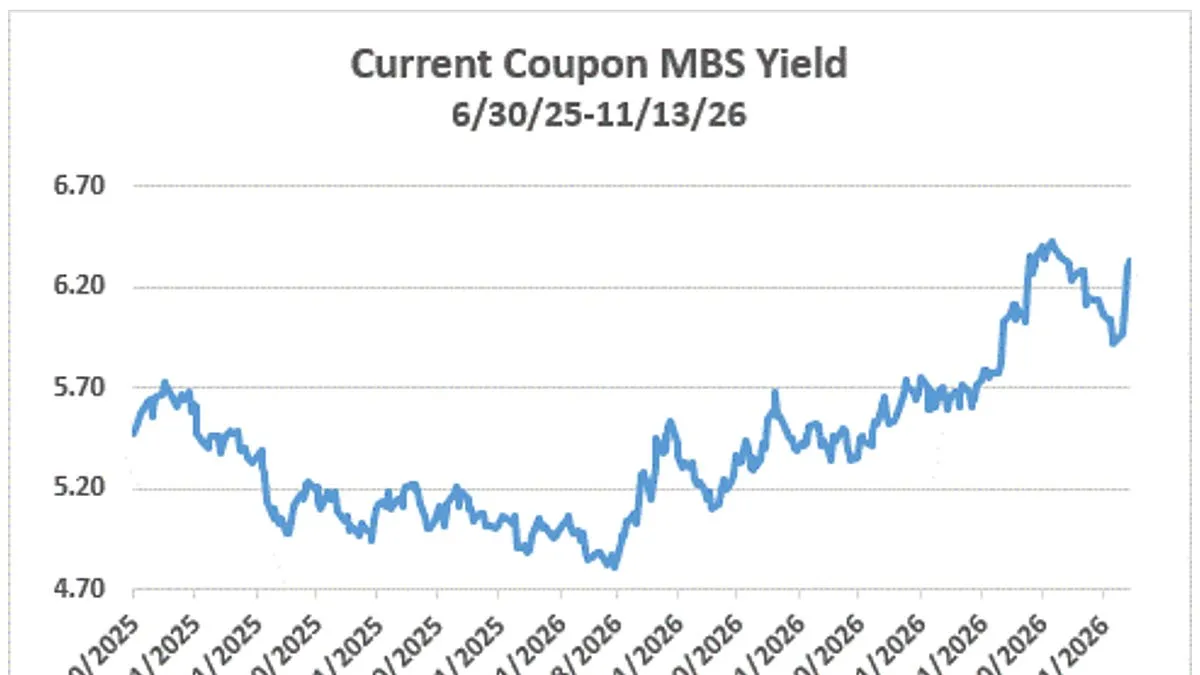
Mortgage funding costs rose faster than Treasuries. The 10-year yield gained 29 bp to close at 5.15% on November 13, its largest weekly rise of 2026. Over the same week, the current-coupon MBS yield climbed 40 bp as MBS-to-Treasury spreads widened 9–11 bp, back to about their highs for the year. Models that assume mortgage rates move one-for-one with the 10-year will understate the shock. [1] [8]
October CPI rose 0.4% overall and 0.3% at the core, each 0.1 point above forecasts. After the release, Governor Waller raised the possibility of a 50 bp hike in December, and Dallas Fed President Logan suggested tightening might need to speed up. Markets now treat a December hike as close to certain. One estimate puts the odds at 85% for 25 bp and 15% for 50 bp. [5] [9] [4] [8]
The weekly benchmark missed the move. On November 12, Freddie Mac's survey showed the 30-year rate falling to 7.11%, its fourth straight weekly decline. Daily trackers had already risen to between 7.25% and 7.30%. Teams that rely only on weekly survey rates will see rate shocks late. [7] [6] [8] [10]
BLS data and reported Treasury closes document the inflation and yield shock. The extra spread widening rests only on Lawler's figures. If it holds, mortgage costs could rise faster than Fed hikes alone imply heading into the December 8–9 meeting.
The dossier is below. Every figure in it is tied to a source. The one claim that could not be checked against other data is Lawler's own spread figure.
Executive brief
Mortgage rates rose faster than Treasury yields last week. Housing economist Tom Lawler reports that the Current Coupon MBS (CCMBS) yield rose 40 bp in one week. That nearly erased a decline that had run from October 14 to November 5. MBS-to-Treasury spreads also widened 9–11 bp, back to about their highs for the year (CalculatedRisk). The triggers were a hotter-than-expected October CPI and hawkish comments from several Fed officials. Markets now treat a December rate hike as close to certain. Borrowing costs are rising even faster than the Fed's own moves.
What changed and event timeline
September CPI runs hot
Consumer prices rose 0.6% for the month and 3.7% over the year, partly because gas jumped 9.1% during the Iran war. The 10-year Treasury yield neared 5.3% (;).
- Late Oct 2026
Fed holds rates
The FOMC left rates unchanged at its October meeting, but two members voted for a hike ().
Freddie Mac's weekly survey lags the move
Freddie Mac's 30-year average fell to 7.11%, its fourth straight weekly decline, while daily rate trackers were already rising ().
Largest weekly Treasury rise of 2026
The 10-year closed at 5.15%, up 29 bp from November 6. Governor Waller raised the possibility of a 50 bp hike in December, and Dallas Fed President Logan suggested tightening might need to speed up (;).
Capabilities and access
The rate figures come from four kinds of measure, which update on different schedules:
Read the full section
The rate figures come from four kinds of measure, which update on different schedules:
- CCMBS yield and its spread to Treasuries: the market yield on newly issued agency MBS, which feeds into lender rate sheets. Lawler's numbers (CalculatedRisk).
- Daily lender-rate indices: 7.25% on Nov 12 (Mortgage Daily), and 7.27% from Zillow data current as of Nov 13 (Yahoo Finance).
- Freddie Mac PMMS: a weekly average built from loan applications, so it trails market moves (Freddie Mac).
- BLS CPI: monthly figures only this time. October 2025 data was never collected because of the government shutdown (BLS).
Technical analysis for researchers and developers
- The PMMS showed a decline on Nov 12 while daily indices rose 20 bp. Models that use weekly survey rates will register shocks late.
- Spreads made it worse. Assuming mortgage rates move one-for-one with the 10-year understates the shock.
- With no October year-over-year CPI, any analysis based on annual inflation needs month-over-month figures or another reconstruction.
Read the full section
- Why the mortgage measures disagree. The PMMS showed a decline on Nov 12 while daily indices rose 20 bp. This is a timing difference between how the surveys are collected, not a real conflict. Models that use weekly survey rates will register shocks late.
- Spreads made it worse. The 10-year rose about 29 bp, but the CCMBS yield rose 40 bp, because spreads widened. Assuming mortgage rates move one-for-one with the 10-year understates the shock.
- Missing annual inflation. With no October year-over-year CPI, any analysis based on annual inflation needs month-over-month figures or another reconstruction. UBS cites three-month annualized core inflation of 3.75% (UBS).
Claims and evidence
- October CPI +0.4% headline, +0.3% core, energy +0.7%, shelter +0.3%: official BLS data (BLS).
- 10-year +29 bp for the week, the largest rise of 2026: reported by a trade outlet (Mortgage Daily).
- CCMBS +40 bp and spreads near their 2026 highs: comes only from Lawler's commentary. None of the reviewed sources independently checks the spread data.
Read the full section
- October CPI +0.4% headline, +0.3% core, energy +0.7%, shelter +0.3%: official BLS data (BLS).
- 10-year +29 bp for the week, the largest rise of 2026: reported by a trade outlet (Mortgage Daily). The quoted daily closes (4.88% on Nov 9 to 5.15% on Nov 13) match it.
- CCMBS +40 bp and spreads near their 2026 highs: comes only from Lawler's commentary. None of the reviewed sources independently checks the spread data.
- December hike odds: Yahoo Finance put the odds at 85% for a 25 bp hike and 15% for 50 bp (Yahoo Finance). Mortgage Daily reports a quarter-point hike fully priced in (Mortgage Daily).
Context and prior work
- The Fed had raised its policy rate to about 3.9% earlier in 2026, its first increase in three years (KBTX/AP).
- The 30-year mortgage rate's 52-week range runs from 5.90% (Feb 27) to 7.46% (Oct 5) (Mortgage Daily).
- Freddie Mac's 30-year average is 87 bp above its level a year ago (Freddie Mac).
Read the full section
- The Fed had raised its policy rate to about 3.9% earlier in 2026, its first increase in three years (KBTX/AP).
- The 30-year mortgage rate's 52-week range runs from 5.90% (Feb 27) to 7.46% (Oct 5) (Mortgage Daily).
- Freddie Mac's 30-year average is 87 bp above its level a year ago (Freddie Mac).
- Energy shocks from the Iran war and AI-driven costs for chips and electronics are cited as inflation drivers (KBTX/AP).
Limitations, safety and contested findings
- The source is a short note. Its charts were not part of the extracted text.
- The rate measures disagree in direction and level (7.11% from Freddie Mac vs 7.25–7.30% from daily indices).
- UBS expects 25 bp hikes in December and March.
Read the full section
- The source is a short note. Its charts were not part of the extracted text.
- The rate measures disagree in direction and level (7.11% from Freddie Mac vs 7.25–7.30% from daily indices).
- UBS expects 25 bp hikes in December and March. It warns against assuming a long hiking cycle, because higher yields are already slowing the economy (UBS).
- Waller's possible 50 bp hike is one official's view, not the Fed's consensus.
Business and practitioner implications
- Housing finance: at the same $2,500 monthly payment, a borrower can now borrow $366,000, versus $409,000 a year ago (Mortgage Daily).
- Forecasts: the MBA projects a 7.3% Q4 average and Fannie Mae 7.4% (Yahoo Finance).
- Upcoming data: the October FOMC minutes (Nov 18) and PCE inflation (Nov 25) come before the December 8–9 meeting.
Read the full section
- Housing finance: at the same $2,500 monthly payment, a borrower can now borrow $366,000, versus $409,000 a year ago (Mortgage Daily). Refinance applications are down 57% year over year (CNBC).
- Forecasts: the MBA projects a 7.3% Q4 average and Fannie Mae 7.4% (Yahoo Finance).
- Upcoming data: the October FOMC minutes (Nov 18) and PCE inflation (Nov 25) come before the December 8–9 meeting.
- Data teams: track spreads and daily indices, not only weekly survey rates.