
Fed & ratesCentral banks & interest rates
Fed Chair Warsh says AI could become a services-sector 'China shock' at first Productivity and Jobs Task Force conference
At the first public conference of his Productivity and Jobs Task Force, Fed Chair Kevin Warsh suggested AI could cut prices and jobs in services such as legal and administrative work, as Chinese imports did for goods, while offering no conclusion on interest rates.
From the CNBC · Economy article of November 17, 2026 and cited sources: Warsh compared AI to the China shock, which peer-reviewed research links to roughly 2–2.4 million net US job losses from 1999 to 2011. [1] [13] [14]
SOURCES[1] CNBC: Analysis on Warsh and the AI revolution cnbc.com[13] NBER w20395: Import Competition and the Great US… nber.org[14] NBER Digest summary nber.org
 AT Pulse research deskPublished · Updated · 5 min read · AI-assisted analysis
AI-assisted, not human-edited. Methodology Corrections Who owns this site
- What happened
- Warsh compared AI to the China shock, which peer-reviewed research links to roughly 2–2.4 million net US job losses from 1999 to 2011. [1] [13] [14]
- Original source
- CNBC · Economy article, independent perspective
- Brief by
- AT Pulse research desk AI-assisted; publisher and contact on the desk page
- When
- November 17, 2026 article published
- Covered
- Nov 17 edition
- Evidence
- 18 sources across 9 sites
- 1CNBC: Analysis on Warsh and the AI revolutioncnbc.com
- 2Axios: Andreessen among new Fed task force leadersaxios.com
- 3CNBC: New Fed task force members share Warsh's embrace of AIcnbc.com
- 4Fortune: Voters restricted data centers in 40 of 41 measuresfortune.com
- 5CNBC: Data center ballot measures 2026cnbc.com
- 6CNBC: Waller sees December hike likelycnbc.com
Reach: not measured yet
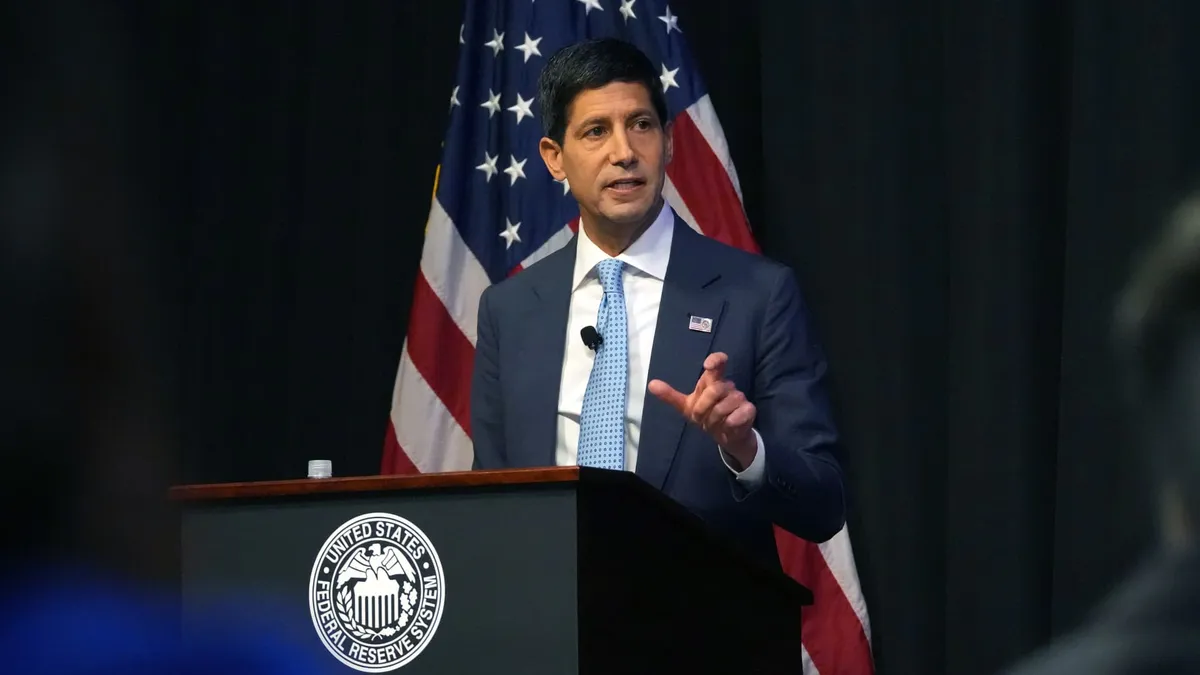
Warsh compared AI to the China shock, which peer-reviewed research links to roughly 2–2.4 million net US job losses from 1999 to 2011. He suggested AI could likewise lower prices and displace workers in legal and administrative services, though he said he was holding the idea loosely. [1] [13] [14]
Warsh described three scenarios rather than a forecast. In the first, broad productivity gains with full employment push inflation down. In the second, displacement raises unemployment while GDP still grows. In the third, AI disappoints: returns fall, valuations drop and growth slows. The task force, whose members include Marc Andreessen and Charles Jones, will report to Warsh in the coming months. [8] [12] [10] [1] [2]
The timing pulls two ways. Panelists judged AI-driven disinflation in services only possible over the medium term. Meanwhile, heavy AI investment is cited as adding to current inflation, with September CPI at 3.7%, and markets fully price a 25 basis point December hike to 4.00%–4.25%. [1] [15] [16] [17] [6]
Executives on the panels expected displacement to be slow. Andreessen pointed to regulation in sectors like healthcare and education, and Palo Alto Networks CEO Nikesh Arora to AI's continued need for human oversight. Both are opinions from people with stakes in AI. Conflicts were also disclosed: Andreessen is a longtime friend of Warsh, and Jones works at Anthropic, which is going public this week. [1] [12] [9]
The Fed chair has made AI a formal input to policy deliberations. The implication, still unproven: services disinflation could eventually support lower rates, even as AI investment currently adds to inflation ahead of an expected December hike.
Executive brief
Fed Chair Kevin Warsh compared AI to the "China shock." The China shock cut goods prices and cost about 2–2.4 million US jobs. The event was the first public conference of his Productivity and Jobs Task Force, held in San Francisco on 16 November 2026.
Read the full section
Fed Chair Kevin Warsh compared AI to the "China shock." The China shock cut goods prices and cost about 2–2.4 million US jobs. Warsh suggested AI could do the same thing to services: lower prices for legal and administrative work while displacing the people who do it. The event was the first public conference of his Productivity and Jobs Task Force, held in San Francisco on 16 November 2026. Panelists mostly agreed that AI-driven disinflation over the medium term is possible. That could eventually point toward lower interest rates. In the near term, though, heavy AI investment is adding to inflation, and markets expect a rate hike in December. Warsh gave no conclusion on rates (CNBC analysis).
What changed and event timeline
Voters turn against data centers
Of 41 local ballot measures in 10 states, all but one restricted data center development. The exception was in Harwood, North Dakota (;).
Hike signals and an IPO range
Governor Waller backed a December hike and left a half-point move open. The same day, Anthropic set its IPO range, valuing it at up to $1.4 trillion (;).
Task force conference
Warsh set out three AI scenarios, described the economy as at a "hinge point," and moderated three of the four sessions ().
18–19 Nov 2026: Anthropic pricing, then trading
Pricing is planned for Wednesday and trading is expected Thursday. Task force member Jones did not speak at the conference because of Anthropic's pre-IPO blackout ().
Capabilities and access
There was no model release. This is a policy process.
Read the full section
There was no model release. This is a policy process.
- Charge: to assess "the pace, the reach, [and] the economic impact" of general-purpose technologies, including AI, to inform policy on employment and inflation (Federal Reserve).
- Output: the three members will write a report for Warsh "in the next few months." The Fed then decides whether and how to use it (CNBC analysis).
- Public record: the session was broadcast by C-SPAN.
Technical analysis for researchers and developers
- Scenario framing, not a forecast.
- The China-shock comparison borrows a well-studied identification design, regional exposure to trade with input-output linkages (NBER).
- No released model, dataset or quantitative framework yet. Nothing has been published that could be reproduced.
Read the full section
- Scenario framing, not a forecast. The three cases are: (1) broad productivity gains with full employment that also reduce inflation; (2) displacement with rising unemployment while GDP still grows; (3) a "disappointment" case where returns fall, equity valuations drop and growth slows with no productivity payoff (CNBC; Yahoo Finance).
- Analogy as method. The China-shock comparison borrows a well-studied identification design, regional exposure to trade with input-output linkages (NBER). A matching AI-exposure measure for services is not documented in the reviewed sources.
- No released model, dataset or quantitative framework yet. Nothing has been published that could be reproduced.
Claims and evidence
- AI could act as a services "China shock."
- The China shock cost 2–2.4 million net US jobs, 1999–2011. This comes from peer-reviewed research (NBER Digest).
- AI spending is adding to near-term inflation. This is reporting and Fed officials' view, backed by September CPI of 3.7% year on year (TheStreet).
Read the full section
- AI could act as a services "China shock." This was Warsh's speculation, and he said he did not want to "hold this too tightly" (CNBC analysis).
- The China shock cost 2–2.4 million net US jobs, 1999–2011. This comes from peer-reviewed research (NBER Digest).
- AI spending is adding to near-term inflation. This is reporting and Fed officials' view, backed by September CPI of 3.7% year on year (TheStreet).
- Rapid displacement is unlikely.
- Andreessen attributes this to regulation in sectors like healthcare and education (CNBC analysis).
- Palo Alto Networks CEO Nikesh Arora attributes it to AI still needing human oversight (Yahoo Finance).
- Both are opinions from executives with stakes in AI, not evidence.
Context and prior work
- Warsh has long criticized the Fed as insular. The task forces bring in outside expertise rather than relying on Fed staff economists (CNBC analysis).
- Rates: the Fed hiked in September and paused in October. About 55% expect it to be the last hike of the cycle (Yahoo/Reuters).
- CME FedWatch put the odds of a December hike at 100% as of 12 November (Motley Fool).
Read the full section
- Warsh has long criticized the Fed as insular. The task forces bring in outside expertise rather than relying on Fed staff economists (CNBC analysis).
- Rates: the Fed hiked in September and paused in October. All 101 economists in a 6–10 November Reuters poll expect a 25 bp hike to 4.00%–4.25% in December. About 55% expect it to be the last hike of the cycle (Yahoo/Reuters).
- CME FedWatch put the odds of a December hike at 100% as of 12 November (Motley Fool).
Limitations, safety and contested findings
- Andreessen is a longtime friend of Warsh, and Jones works at Anthropic during its IPO. Both relationships are disclosed (CNBC analysis).
- AI spending raises inflation now, while AI could lower services inflation later. Panelists only judged the second effect "possible."
- How fast AI is being adopted. Stripe's Patrick Collison says US AI adoption is unusually intense (Yahoo Finance), but others expect slow displacement.
Read the full section
- Conflicts of interest. Andreessen is a longtime friend of Warsh, and Jones works at Anthropic during its IPO. Both relationships are disclosed (CNBC analysis).
- Direction of inflation. AI spending raises inflation now, while AI could lower services inflation later. Panelists only judged the second effect "possible."
- How fast AI is being adopted. Stripe's Patrick Collison says US AI adoption is unusually intense (Yahoo Finance), but others expect slow displacement.
- Scope of the ballot measures. CNBC's analysis calls them "state-level," while Fortune counts 41 local measures (Fortune).
Business and practitioner implications
- AI has become an explicit input to Fed thinking. No policy change has been announced.
- Legal and administrative services are the categories Warsh named. Rising productivity there could mean falling prices as well as smaller payrolls.
- Data center siting now carries electoral risk. Gina Raimondo called the ballot results "a very troubling sign."
Read the full section
- Fed policy. AI has become an explicit input to Fed thinking. Expect AI to show up in Fed communications on how much the economy can grow without inflation and on labor-market slack. No policy change has been announced.
- Services firms. Legal and administrative services are the categories Warsh named. Rising productivity there could mean falling prices as well as smaller payrolls.
- Physical buildout. Data center siting now carries electoral risk. Gina Raimondo called the ballot results "a very troubling sign."
- Market facts, not advice. Anthropic's IPO range is $70–$78 per share on 825 million shares (Motley Fool). This is a priced event, separate from the evidence on productivity.