
ModelsArchitectures & capability
Black Forest Labs leaders say FLUX 3 shifts the company from image generation toward video and robot-action models
Black Forest Labs' Andreas Blattmann and Dustin Podell describe FLUX 3 as one multimodal model that learns from images, video, audio and robot actions. They say video, not image generation, was always the company's route to physical-world visual intelligence.
From the Latent Space podcast episode of November 16, 2026 and cited sources: BFL says it pitched investors on video from the start and calls image generation a detour that succeeded commercially. [1] [9]
SOURCES[1] Building Visual Intelligence — Andreas Blattmann & Dustin… latent.space[9] BFL: FLUX 3 blog bfl.ai
 AT Pulse research deskPublished · Updated · 5 min read · AI-assisted analysis
AI-assisted, not human-edited. Methodology Corrections Who owns this site
- What happened
- BFL says it pitched investors on video from the start and calls image generation a detour that succeeded commercially. [1] [9]
- Original source
- Latent Space podcast episode, independent perspective
- Brief by
- AT Pulse research desk AI-assisted; publisher and contact on the desk page
- Studies
- arXiv 2603.06507 (Mar 2026) [8] date from arXiv ID
- When
- November 16, 2026 podcast episode published
- Covered
- Nov 17 edition
- Evidence
- 14 sources across 12 sites; transcript sourced
- 1Building Visual Intelligence — Andreas Blattmann & Dustin…latent.space
- 2Transcript: Building Visual Intelligence — Andreas…rss.beehiiv.com
- 3TopicQueue: FLUX 3 Action licencetopicqueue.substack.com
- 4arXiv 2506.15742: FLUX.1 Kontextarxiv.org
- 5Unite.AI: $300M Series Bunite.ai
- 6Sacra: Black Forest Labssacra.com
RisingHow it’s measured
YouTube video · 3.1K views · 24 likes
Reach blends public engagement (views, likes, comments, shares, stars) from the platforms where the story or its original source lives: YouTube, Hacker News, GitHub, Substack and similar. A video and the article written from its transcript share one score, taken from the video. Platforms with no data are left out rather than counted as zero, and the age of a story never lowers its score.
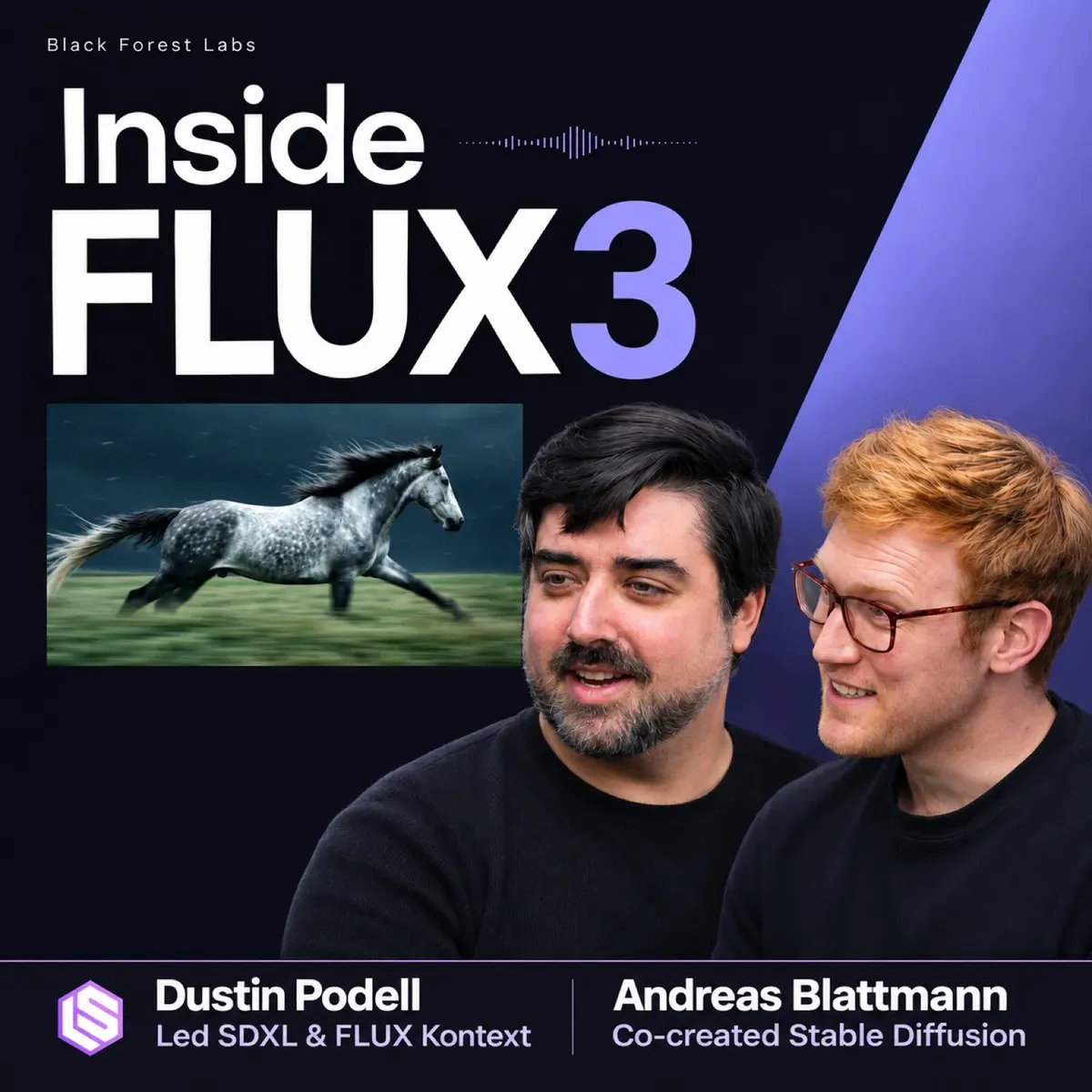
BFL says it pitched investors on video from the start and calls image generation a detour that succeeded commercially. FLUX 3 extends that plan into a single diffusion/flow-matching model trained across images, video, audio and actions. The goal is intuitive, 'system one' understanding of the physical world rather than language-style reasoning. [1] [9]
FLUX 3 Action is a 7B open-weights 'world action model.' It predicts short chunks of robot motion and runs in a loop without a high-level planner. Reports place it near the top of NVIDIA's RoboLab-120 leaderboard. Its licence allows commercial use only by firms with less than $5M in revenue. [1] [3] [12]
Data and pretraining shaped key results more than architectural changes did. Image editing first appeared after a training run of a few hours on a small dataset describing spatial relationships. Separately, about 1,000 fine-tuning steps turned a video model into a 3D-view model. [1] [4]
On the podcast, the founders recall that adapting the action model to an industrial task needed about 8× less data than π0.5, roughly four hours of robot data. No independent source confirms this figure. Their next target is in-context robot learning, where a robot learns a task from a single demonstration. [1]
an open 7B action model that competes on RoboLab-120, from a company that has raised $450M and says revenue has passed $100M.
Read the full assessment
Implication: generative-media labs are positioning pretrained video models as foundations for robotics, though the licence limits commercial use by larger firms.
Sources checked; writing the dossier now.
Executive brief
Black Forest Labs (BFL) was founded by the team behind latent diffusion, and its leaders now say video, not images, is their main route to "visual intelligence." The goal is a model that predicts robot actions as well as pixels. In a Latent Space episode published on 16 November 2026, Andreas Blattmann and Dustin Podell say BFL has raised about $450M and has passed the $100M revenue figure it disclosed last December. FLUX 3 Action is an open-weights model with 7 billion parameters (7B). It sits near the top of NVIDIA's RoboLab leaderboard, but other reported results rank three models above it, and its licence allows commercial use only by firms with less than $5M in revenue.
What changed and event timeline
Kontext paper and benchmark
BFL published FLUX.1 Kontext, a flow-matching model for image editing and in-context generation. It also released KontextBench, a set of 1,026 image–prompt pairs for testing editing.
$300M Series B
The round valued BFL at $3.25B after the investment. Salesforce Ventures and Anjney Midha's AMP co-led, with a16z and NVIDIA also investing.
More detail
Self-Flow method
BFL described a flow-matching training method with a built-in self-supervised objective. It reports convergence about 2.8× faster than REPA, an earlier representation-alignment method.
More detail
FLUX 3 early access
One model covers image, video and audio. Video clips run up to 20 seconds at 720p with sound. Access is gated and pricing has not been announced.
More detail
FLUX 3 Action released
This is a 7B open-weights "world action model" that BFL reports as first on RoboLab-120.
More detail
Founders explain the plan
In the podcast, the founders describe a single "system one" model that also covers robotics and in-context robot learning.
Capabilities and access
- FLUX 3 Video, Image, Action and Dev (open weights). These are rolling out in stages. Video and Action began in gated early access. BFL
- FLUX 3 Action
- 7B parameters.
Read the full section
- FLUX 3 Video, Image, Action and Dev (open weights). These are rolling out in stages. Video and Action began in gated early access. BFL
- FLUX 3 Action
- 7B parameters.
- Outputs 32 actions per chunk, about 2 seconds of motion, at 15 Hz.
- BFL reports 41 ms per chunk on a B200 GPU.
- Separate checkpoints for the SO-101 arm and the DROID robot dataset.
- Released under the FLUX Kommunity License v1.0.
- DataNorth
- FLUX-mimic. A variant built with Zurich-based mimic for dexterous manipulation. Audi is testing it. VentureBeat
Technical analysis for researchers and developers
- Flow matching over diffusion. Blattmann describes flow matching as learning a vector field between two distributions and integrating it with simple ODE (Euler) steps.
- In Stable Video Diffusion, data filtering mattered most. About 1,000 fine-tuning steps turned a 2D video model into a 3D-view model (00:34:49–00:37:21).
- Podell says editing emerged from a short run of 4–6 hours on a small dataset that described spatial relationships.
Read the full section
- Flow matching over diffusion. Blattmann describes flow matching as learning a vector field between two distributions and integrating it with simple ODE (Euler) steps. He says it is easier to distill into fast models. SD3's main contribution was choosing which noise levels to sample more often during training (00:42:00–00:44:54).
- Data over architecture. In Stable Video Diffusion, data filtering mattered most. About 1,000 fine-tuning steps turned a 2D video model into a 3D-view model (00:34:49–00:37:21).
- How Kontext began. Podell says editing emerged from a short run of 4–6 hours on a small dataset that described spatial relationships. Most of the later work was building data, followed by distillation (00:58:30–01:00:24).
- Diffusion vs. autoregressive. Diffusion models are less data-efficient in training. They are faster at inference because 50 steps can be distilled to about 4 (01:14:14–01:15:41).
- Action model design. It predicts chunks of 9–21 frames and runs at about 10 FPS with no high-level planner (01:23:22–01:24:22). Written sources give different figures (see Limitations).
- Model size and training data. Self-Flow's demonstration model had 4B parameters and was trained on 200M images, 6M videos and 2M audio-video pairs. Gigazine
Claims and evidence
- RoboLab-120. The DataNorth report gives 42.2%, against 36.8% for Cosmos 3 Nano and 28.0% for π0.5 in single-step mode. A newsletter citing NVIDIA's leaderboard gives 42.9%.
- 28 of 30 tasks succeeded on a Franka arm. This comes from BFL's own testing. DataNorth
- Fine-tuning data. Three different figures exist:
Read the full section
- RoboLab-120. The DataNorth report gives 42.2%, against 36.8% for Cosmos 3 Nano and 28.0% for π0.5 in single-step mode. A newsletter citing NVIDIA's leaderboard gives 42.9%. Every model compared is open-weights.
- Real robot. 28 of 30 tasks succeeded on a Franka arm. This comes from BFL's own testing. DataNorth
- Fine-tuning data. Three different figures exist:
- On the podcast, Blattmann recalls 8× less data than π0.5 and about 4 hours for an industrial task, from work with Dyna Robotics (01:24:51–01:25:18). No independent source confirms this.
- mimic's CTO cites 30 minutes of robot data. VentureBeat
- DataNorth reports about 200 demonstrations per task. DataNorth
- Revenue. The Financial Times reported about $96M in annual recurring revenue by August 2025. Sacra The founders say BFL has passed the $100M figure but give no number (00:19:55).
Context and prior work
- Blattmann co-created latent diffusion and worked on NVIDIA's Align Your Latents video paper (00:34:02).
- The founders say the investor pitch was always about video. Image generation was a "detour" that paid off commercially (00:52:47–00:53:39).
- The host places BFL alongside Runway and others in a move from generative media into world models and robotics (00:02:17).
Read the full section
- Lineage. Blattmann co-created latent diffusion and worked on NVIDIA's Align Your Latents video paper (00:34:02). Podell led SDXL, which introduced multi-aspect bucketed training and multi-stage post-training (00:28:28–00:29:07).
- Strategy. The founders say the investor pitch was always about video. Image generation was a "detour" that paid off commercially (00:52:47–00:53:39).
- Peers. The host places BFL alongside Runway and others in a move from generative media into world models and robotics (00:02:17).
Limitations, safety and contested findings
- Benchmark wins are contested. One newsletter reports that HiDream-O1-Embodied, Atomic-WAM and OASIS score higher.
- Commercial use is limited to firms under $5M in revenue, and using outputs to distill other models is banned. TopicQueue
- FLUX 3 video evidence is thin. Preference tests used older rivals. Against Gemini Omni Flash the result was 52%, roughly a tie.
Read the full section
- Benchmark wins are contested. One newsletter reports that HiDream-O1-Embodied, Atomic-WAM and OASIS score higher. The reviewed sources also give two different FLUX scores (42.2% vs 42.9%). TopicQueue
- Licence limits. Commercial use is limited to firms under $5M in revenue, and using outputs to distill other models is banned. TopicQueue
- FLUX 3 video evidence is thin. Preference tests used older rivals. Against Gemini Omni Flash the result was 52%, roughly a tie. No pricing or evaluation method has been published. VentureBeat
- Speed and frame-rate figures conflict. The founders recall about 10 FPS, while written reports say 15 Hz. Speedups over π0.5 are given as 1.45–1.66× in one report (AlphaSignal) and 1.34–2.28× in another (TopicQueue).
Business and practitioner implications
- Editing tools are converging on one model that takes multiple reference images.
- Startups can fine-tune FLUX 3 Action now. Larger companies need a separate commercial agreement.
- Watch next: BFL's stated target is in-context robot learning, where a robot learns from a single demonstration instead of fine-tuning (01:25:24).
Read the full section
- Creative tools. Editing tools are converging on one model that takes multiple reference images. FLUX.2 handles about 10 references, and the founders argue more than about 10 is hard for people to manage (01:06:11–01:07:14).
- Robotics teams. Startups can fine-tune FLUX 3 Action now. Larger companies need a separate commercial agreement.
- Watch next: BFL's stated target is in-context robot learning, where a robot learns from a single demonstration instead of fine-tuning (01:25:24). The open-weights FLUX 3 Dev release and FLUX 3 pricing are also still to come.
The source trail.
Sources (14)
Building Visual Intelligence — Andreas Blattmann & Dustin Podell, Black Forest Labs
Transcript retrieved via published_transcript; language en. Timestamped text, not direct audiovisual review. Source: https://rss.beehiiv.com/podcasts/transcriptions/01a1e63a-78bd-7778-8571-0e1880c6e9a2.vtt. Automatic captions/transcription may contain errors.
latent.spaceTranscript: Building Visual Intelligence — Andreas Blattmann & Dustin Podell, Black Forest Labs
published_transcript
rss.beehiiv.com