
EcosystemsRegions, accelerators & hubs
Grok Bot's builders say their AI agents merge their own pull requests, with little human code review
SpaceXAI's Grok Bot gives each AI teammate its own cloud computer and app logins. On YC's Light Cone, its builders describe agents that merge their own code and the identity and permission gaps that bots still face inside companies.
From the Y Combinator video of November 14, 2026 and cited sources: Grok Bot is built around persistent bots instead of chats or files. [1] [2] [5] [8]
SOURCES[1] The Rise Of AI Coworkers youtube.com[2] Unite.AI: xAI Launches Grok Bot unite.ai[5] xAI: Team Bots x.ai
 AT Pulse research deskPublished · Updated · 6 min read · AI-assisted analysis
AI-assisted, not human-edited. Methodology Corrections Who owns this site
- What happened
- Grok Bot is built around persistent bots instead of chats or files. [1] [2] [5] [8] [11]
- Original source
- Y Combinator video, independent perspective
- Brief by
- AT Pulse research desk AI-assisted; publisher and contact on the desk page
- When
- November 14, 2026 video published
- Covered
- Nov 15 edition
- Evidence
- 13 sources across 11 sites; transcript sourced
RisingHow it’s measured
YouTube video · 40.8K views · 565 likes
Reach blends public engagement (views, likes, comments, shares, stars) from the platforms where the story or its original source lives: YouTube, Hacker News, GitHub, Substack and similar. A video and the article written from its transcript share one score, taken from the video. Platforms with no data are left out rather than counted as zero, and the age of a story never lowers its score.
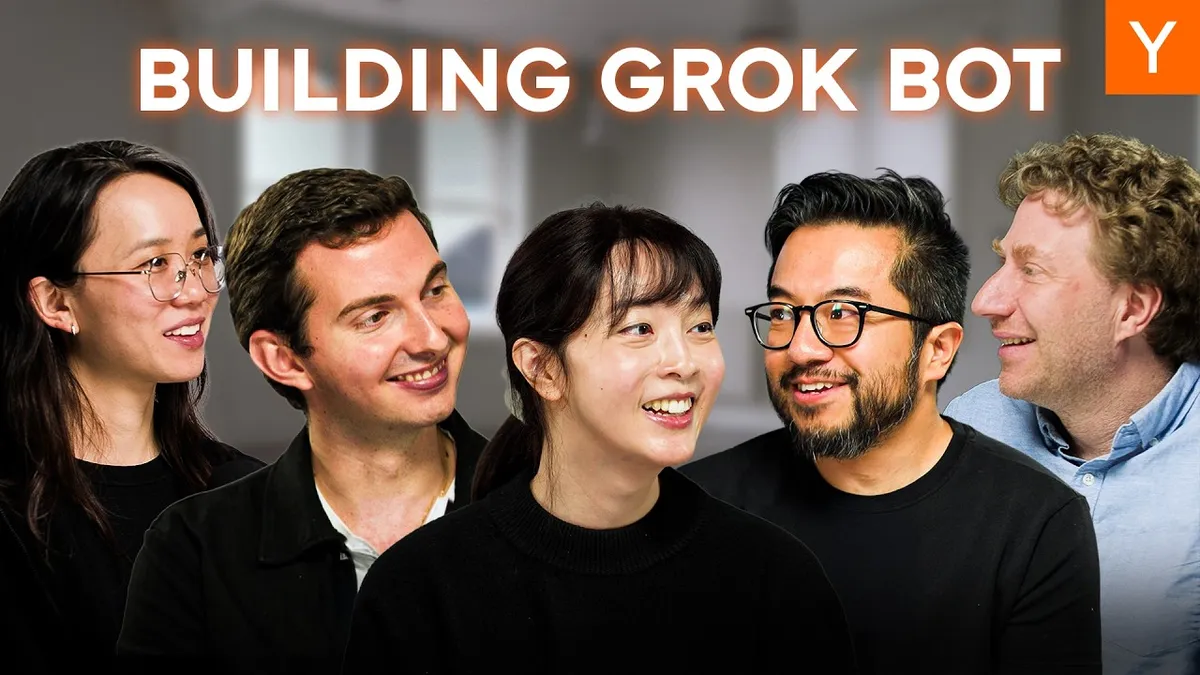
Grok Bot is built around persistent bots instead of chats or files. Each bot runs all the time, has its own cloud computer and works in the same apps a person would use. The team says it went from first line of code to launch in about seven weeks. Later releases added shared Team Bots and the ability to add bots to Slack, Microsoft Teams and video calls. [1] [2] [5] [8] [11]
Engineer Lauren Tan says she merges more than 4,000 pull requests a month, and her agents merge their own without her reading the code. That figure is self-reported, and she works with unlimited tokens. Her approach puts most of the effort into codebase architecture and static analysis, and has agents run and check their own code. She says this makes the code correct, but not necessarily good. [1]
Trust is still being worked out. The guests suggest starting with read-only bots. They say bots cannot tell who in a thread has authority, and that identity and permissions remain unsolved. A CEO reported that a read-only bot posted his personal bank balances into an executive Slack channel. [1] [6] [7] [9] [13]
one well-resourced team reports building features end to end in Slack with minimal human code review. Implication: if this spreads, the limit shifts from engineering hours to roadmap alignment, access controls and checking work outside of code.
The dossier is below. No independent evaluation of Grok Bot turned up in the reviewed sources, so performance figures are company or self-reported, and the bank-data incident is not confirmed.
Executive brief
The most consequential claim in the episode is about output, not the bot. Lauren Tan, a Grok Bot engineer, says she merges more than 4,000 pull requests a month, and agents merge their own PRs without anyone reading the code. Grok Bot is SpaceXAI's "AI teammate" product.
Read the full section
The most consequential claim in the episode is about output, not the bot. Lauren Tan, a Grok Bot engineer, says she merges more than 4,000 pull requests a month, and agents merge their own PRs without anyone reading the code. She also says she has unlimited tokens because she works at an AI lab. Grok Bot is SpaceXAI's "AI teammate" product. Each bot is always on, has its own cloud computer and signs into the same tools a person would use. It went from first line of code to launch in about seven weeks, and the multiplayer 1.0 release came in November 2026. Treat it as early and lightly governed: the security problems below are real, and no independent benchmark exists.
What changed and event timeline
Beta launch
Always-on bots with their own cloud computers that sign into existing apps. Access came only through SuperGrok Heavy, Cursor Ultra ($200/month) and Cursor Teams Premium ().
Team Bots
Shared bots that carry common files, plugins, credentials and memories. Public beta on Teams and Enterprise plans, with pre-built Customer, EPD (engineering, product and design), Marketing and Data bots ().
Bank-data incident
XMTP Labs CEO Shane Mac reported that a read-only "CFO" bot posted his personal bank balances into his company's executive Slack channel (;).
Grok Bot 1.0
Bots can now be shared into Slack, Microsoft Teams and video calls, and can propose work unprompted (). The YC Light Cone episode was published Nov 14 ().
Capabilities and access
- Model: no public source names the model behind Grok Bot.
- What bots can do: use a cloud browser and terminal, run scheduled routines, learn skills from recorded demonstrations of up to 10 minutes, keep memory at user, bot and project level, and message each other in group chats (DataCamp; xAI).
- Where they work: a desktop app (Linux build) and iOS app (Unite.AI). Users can tag @bot on X (xAI docs) and connect Slack and Teams.
Read the full section
- Model: no public source names the model behind Grok Bot. DataCamp mentions Grok 4.6, jointly trained by SpaceXAI and Cursor, but does not say it powers the product (DataCamp).
- What bots can do: use a cloud browser and terminal, run scheduled routines, learn skills from recorded demonstrations of up to 10 minutes, keep memory at user, bot and project level, and message each other in group chats (DataCamp; xAI).
- Where they work: a desktop app (Linux build) and iOS app (Unite.AI). Users can tag @bot on X (xAI docs) and connect Slack and Teams.
- Pricing: plans run from $30 to $200 a month, with pay-as-you-go charges above the weekly allowance (Pillitteri).
Technical analysis for researchers and developers
- Design choices: work is organized around bots rather than chats or files.
- Smallest useful loop: Tan's advice is to teach the agent to run its own code and check it empirically, including CPU traces.
- "Inverted pyramid": put most investment into codebase architecture and static analysis, then rules and skills, with little human review.
Read the full section
- Design choices: work is organized around bots rather than chats or files. Bots operate real GUIs instead of relying only on MCP connectors, and they run all the time (1:58).
- Smallest useful loop: Tan's advice is to teach the agent to run its own code and check it empirically, including CPU traces. That makes output correct, which is not the same as good (40:23). Next step: monitoring alerts trigger bots that reproduce and fix the issue on their own.
- "Inverted pyramid": put most investment into codebase architecture and static analysis, then rules and skills, with little human review. Tan calls the codebase "memory" that saves tokens. She has stepped back from adversarial agent review because the reviewing agent can't judge which feedback matters (44:52).
- Reproducibility: this is one internal team's practice with unlimited tokens (50:51). No method or evaluation has been published.
Claims and evidence
- Seven weeks to launch: four weeks to a working internal product, then three to public launch, built from scratch rather than inside Cursor (Lenny's Newsletter; 0:38).
- 4,000+ PRs a month: self-reported. PR count measures volume, not quality (22:42).
- Harper saved customers over $120,000: a vendor customer story, not independently checked (xAI).
Read the full section
- Seven weeks to launch: four weeks to a working internal product, then three to public launch, built from scratch rather than inside Cursor (Lenny's Newsletter; 0:38). Company-reported.
- 4,000+ PRs a month: self-reported. PR count measures volume, not quality (22:42).
- Harper saved customers over $120,000: a vendor customer story, not independently checked (xAI).
- Adoption: the team calls the launch "hugely successful" but has published no user, revenue or ARR figures (Lenny's Newsletter).
- Team Bots timing: in the episode, the guests say Team Bots launched "about two weeks ago" (10:53). xAI dates the launch Sep 28, so the episode was probably recorded well before it aired on Nov 14.
Context and prior work
- Corporate background: SpaceX bought xAI in February 2026 in an all-stock deal valuing xAI at $250B. No funding round is involved in this story.
- Earlier ideas the episode builds on: Steve Yegge's "Gas Town" software-factory post, Garry Tan's GStack, YC's open-source Quartermaster (one "super employee" bot that inherits the user's permissions), and Jack Dorsey's AI-native org model (11:29; 17:03).
- Host conflict: host Garry Tan is YC's president. He praises the workflow and his own GStack tool in the episode.
Read the full section
- Corporate background: SpaceX bought xAI in February 2026 in an all-stock deal valuing xAI at $250B. SpaceXAI's acquisition of Cursor closed Aug 14, 2026, reportedly at a $60B valuation. Both figures come from Wikipedia and were not checked against filings (Wikipedia). No funding round is involved in this story.
- Earlier ideas the episode builds on: Steve Yegge's "Gas Town" software-factory post, Garry Tan's GStack, YC's open-source Quartermaster (one "super employee" bot that inherits the user's permissions), and Jack Dorsey's AI-native org model (11:29; 17:03).
- Host conflict: host Garry Tan is YC's president. He praises the workflow and his own GStack tool in the episode.
Limitations, safety and contested findings
- Shared computer, weak isolation: all of an account's bots share one computer, so there is no security isolation between them.
- Mac incident: the bot confused two similarly named chats and posted his finances to the exec Slack. Grok Bot reportedly added channel permissions afterward.
- Guests' own caveats: bots don't know who in a thread holds authority (15:06). Identity and authorization remain unsolved (16:21).
Read the full section
- Shared computer, weak isolation: all of an account's bots share one computer, so there is no security isolation between them. Audit trails and spend caps were not shipped at launch (DataCamp).
- Mac incident: the bot confused two similarly named chats and posted his finances to the exec Slack. Grok Bot reportedly added channel permissions afterward. SpaceXAI has not confirmed the incident and it has not been independently verified (Cybernews; LetsDataScience).
- Guests' own caveats: bots don't know who in a thread holds authority (15:06). Identity and authorization remain unsolved (16:21). Bots that own a whole job are "quite far away" (22:16).
Business and practitioner implications
- Roll out in trust stages: start with read-only bots, such as a Data Bot that queries the warehouse in Slack, before giving bots power to act (21:20).
- Code is easier than other work: code has compilers and CI to check it, and its context lives in the repo.
- New bottleneck: with this much output, the constraint moves to agreeing on the roadmap and taste rather than engineering hours (52:35).
Read the full section
- Roll out in trust stages: start with read-only bots, such as a Data Bot that queries the warehouse in Slack, before giving bots power to act (21:20). Grant credentials the way you would scope a new hire's access.
- Code is easier than other work: code has compilers and CI to check it, and its context lives in the repo. Most other knowledge work has neither, so expect slower gains outside engineering (35:36).
- New bottleneck: with this much output, the constraint moves to agreeing on the roadmap and taste rather than engineering hours (52:35).
- Small businesses were among the most enthusiastic early users, according to the hosts, because they find hiring hardest.
The source trail.
Sources (13)
The Rise Of AI Coworkers
Transcript retrieved via youtube_auto_captions; language en. Timestamped text, not direct audiovisual review. Source: https://www.youtube.com/watch?v=y1-9yeYLJUo. Automatic captions/transcription may contain errors.
www.youtube.com