
StocksEquities, earnings & valuations
Braemar Hotels becomes self-managed after paying Ashford about $505 million; shareholder-blogger argues the company should now be sold
Braemar Hotels & Resorts ended its external management by Ashford Inc. on November 10. It paid about $505 million in fees and sold five hotels to do it. A shareholder-blogger argues a sale of the company should follow now that a new board and incentive plan are in place.
From the Clark Street Value article of November 14, 2026 and cited sources: Leaving Ashford was very expensive. [2] [3]
SOURCES[2] Braemar PREC14A (Nov 10, 2026) sec.gov[3] MarketScreener: BHR quote marketscreener.com
 AT Pulse research deskPublished · Updated · 5 min read · AI-assisted analysis
AI-assisted, not human-edited. Methodology Corrections Who owns this site
- Original source
- Clark Street Value article, independent perspective
- Brief by
- AT Pulse research desk AI-assisted; publisher and contact on the desk page
- When
- November 14, 2026 article published
- Covered
- Nov 15 edition
- Evidence
- 11 sources across 8 sites
- 1Braemar Hotels & Resorts: Updated Thoughts, Needs to be Soldclarkstreetvalue.blogspot.com
- 2Braemar PREC14A (Nov 10, 2026)sec.gov
- 3MarketScreener: BHR quotemarketscreener.com
- 4Hotel Dive: Al Shams weighs inhoteldive.com
- 5Bisnow: Monty Bennett To Collect $480M Breakup Feebisnow.com
- 6Panabee: $372 Million Asset Salepanabee.com
Reach: not measured yet
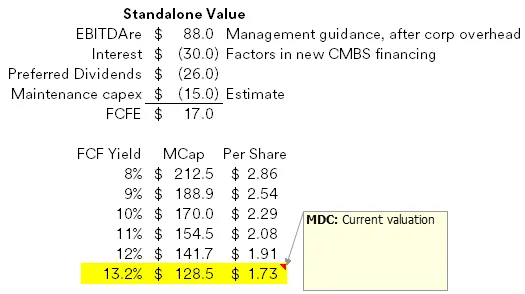
Leaving Ashford was very expensive. Braemar paid about $505 million in fees and sold five luxury hotels for $999.5 million. That fee is roughly four times the company's market value of about $119 million at a $1.73 share price. [2] [3]
The new structure is meant to cut costs. Braemar expects yearly corporate overhead to fall from about $42 million to $15 million. A new $358 million interest-only loan replaced $290.4 million of debt at a lower spread. Seven of the eight directors are now independent. [2] [8]
The blogger, who owns the stock, argues a sale of the company is the likely next step, with incentive equity going to management. He puts the stock's value at about $2.25 on its own and about $7 in a sale, and calls the sale figure probably far too optimistic. No acquirer interest has been reported. [1] [3]
Board control is still contested. Dissident Brancous, which owns about 0.9% of the shares, says the departing board picked its own successors and is fighting in court to nominate directors. Braemar says it will not count votes for those nominees unless a court orders it. The largest holder, Al Shams, settled in October. [2] [6] [7]
Braemar paid roughly four times its market value to end external management and expects overhead to fall by about $27 million a year.
Read the full assessment
Implication: the December 21 incentive-plan vote and the Maryland court ruling should show whether management pursues a sale.
Sources are gathered; writing the dossier now.
Executive brief
Braemar Hotels & Resorts (NYSE: BHR) became self-managed on November 10, 2026. To get there it paid $505 million in fees to its former external manager, Ashford Inc., and sold five hotels for $999.5 million (BHR PREC14A). That fee is several times the company's market value: about $119 million at a $1.73 share price on November 13 (MarketScreener). The Clark Street Value blogger owns the stock. He argues that with Ashford gone, a new board in place and management about to receive incentive equity, a sale of the company is the likely next step. Shareholders vote on that incentive plan on December 21 (Clark Street Value).
What changed and event timeline
Largest holder objects
Al Shams Investments warned the board against more hotel sales and accused it of self-dealing that favoured Ashford founder Monty Bennett ().
Sale process ends
The board stopped trying to sell the company and chose to become self-managed. It said selling would destroy more value than paying Ashford's $480M fee. The stock was at $2.29 ().
Five hotels sold
Ritz-Carlton Sarasota, Hotel Yountville, Bardessono, Pier House and Four Seasons Scottsdale ($372M) were sold, raising $999.5M in total ().
Al Shams settles
Al Shams withdrew its board nominees and agreed to standstill and voting terms (). A dissident's filing says the deal included $40M in payments ().
Self-management and refinancing
The Ashford agreements ended and a $358M CMBS loan replaced $290.4M of existing debt ().
Annual meeting
Shareholders vote on the 2026 Performance Incentive Plan and on charter changes. Brancous's attempt to nominate directors is in court ().
Capabilities and access
- Remaining hotels: luxury properties including the Ritz-Carlton Lake Tahoe and Ritz-Carlton St. Thomas (MarketScreener).
- Management: CEO Richard Stockton, CFO Justin Coe and Chief Legal Officer Robert Haiman.
- Board: seven of the eight directors are independent. The chair is Stephen Haggerty, a former Marriott and Hyatt executive (BHR PREC14A).
Read the full section
- Remaining hotels: luxury properties including the Ritz-Carlton Lake Tahoe and Ritz-Carlton St. Thomas (MarketScreener).
- Management: CEO Richard Stockton, CFO Justin Coe and Chief Legal Officer Robert Haiman. All three have contracts through November 2029, with base salaries of $725K, $450K and $450K (Panabee).
- Board: seven of the eight directors are independent. The chair is Stephen Haggerty, a former Marriott and Hyatt executive (BHR PREC14A).
- Charter vote: Proposal 5 would cut the vote needed for certain charter amendments from two-thirds to a simple majority (BHR PREC14A).
Technical analysis for researchers and developers
- Overhead: the company expects corporate G&A to fall from about $42M to $15M a year (Panabee).
- New loan: interest is SOFR plus 2.37%, which is 1.04 points below the old loans.
- Leverage: net debt was 33.3% of gross assets at the end of Q3 (TradingView).
Read the full section
- Overhead: the company expects corporate G&A to fall from about $42M to $15M a year (Panabee). The blogger estimates overhead still takes about half of the free cash flow left for shareholders. That is his own estimate; the company has not said it.
- New loan: interest is SOFR plus 2.37%, which is 1.04 points below the old loans. Payments are interest-only, with a two-year initial term and extensions possible to 2031 (Panabee).
- Leverage: net debt was 33.3% of gross assets at the end of Q3 (TradingView). Because debt and preferred stock rank ahead of common shares, a small change in property values moves the common equity by a much larger percentage.
- The blog's models: the article shows them as images, so they cannot be checked. The blogger's sale scenario includes a $100M deduction for friction costs.
Claims and evidence
- The $480M fee was negotiated down from $574.8M. This is the company's own disclosure (BHR PREC14A).
- Activists scared off buyers. This is the blogger's interpretation.
- Q3 results: a net loss of $240.9M ($3.51 per share), mainly from the termination fee.
Read the full section
- The $480M fee was negotiated down from $574.8M. This is the company's own disclosure (BHR PREC14A).
- Activists scared off buyers. This is the blogger's interpretation. The board's stated reason for ending the sale process was the value lost to the fee (Bisnow).
- Q3 results: a net loss of $240.9M ($3.51 per share), mainly from the termination fee. Comparable RevPAR (revenue per available room) rose 14.4% to $284 (TradingView).
- The ~$2.25 standalone value and ~$7 sale value are the blogger's own figures. He calls the sale figure "probably wildly optimistic." No other source backs either number.
- The $40M Al Shams payment appears only in Brancous's filing (Brancous DEFC14A).
Context and prior work
Braemar was spun out of Ashford Hospitality Trust in 2013. By June 2026 its stock had fallen almost 90% since then (Bisnow). Selling hotels to pay the fee and becoming independent was the board's alternative (CoStar).
Read the full section
Braemar was spun out of Ashford Hospitality Trust in 2013. By June 2026 its stock had fallen almost 90% since then (Bisnow). Under the advisory agreement, a sale of the company would also have triggered the fee to Ashford. Selling hotels to pay the fee and becoming independent was the board's alternative (CoStar). The blogger has written about the stock before and says he has lost money on it over the past year.
Limitations, safety and contested findings
- Board legitimacy: Brancous owns about 0.9% of the shares.
- Brancous votes: Braemar says it will not count votes for Brancous nominees unless a court orders it to (BHR PREC14A).
- Cash flow: adjusted FFO was a loss of $18.7M in Q3 (TradingView).
Read the full section
- Board legitimacy: Brancous owns about 0.9% of the shares. It argues the departing board picked its own successors and that three of the new directors served together on Broadmark's board, which faced merger litigation (Brancous DEFC14A).
- Brancous votes: Braemar says it will not count votes for Brancous nominees unless a court orders it to (BHR PREC14A).
- Cash flow: adjusted FFO was a loss of $18.7M in Q3 (TradingView).
- Economy: the blogger names an economic downturn as the main risk, since hotels depend heavily on consumer spending.
Business and practitioner implications
- Cost of externalisation: internalising cost about four times the company's current market value in fees.
- Signals to watch: the incentive plan vote, the Maryland court ruling on Brancous and the 2027 guidance (reaffirmed with Q3 results).
- Market reading: the two covering analysts have a consensus of hold, according to MarketScreener (MarketScreener). No source reviewed confirms any acquirer interest.
Read the full section
- Cost of externalisation: internalising cost about four times the company's current market value in fees. That makes the case a reference point for what external-management contracts can cost REITs.
- Signals to watch: the incentive plan vote, the Maryland court ruling on Brancous and the 2027 guidance (reaffirmed with Q3 results). These will be the first evidence of whether management pursues a sale (TradingView).
- Market reading: the two covering analysts have a consensus of hold, according to MarketScreener (MarketScreener). No source reviewed confirms any acquirer interest.
The source trail.
Sources (11)
Braemar Hotels & Resorts: Updated Thoughts, Needs to be Sold
Article text retrieved; extracted text may omit tables or interactive elements.
clarkstreetvalue.blogspot.com