
StocksEquities, earnings & valuations
BlackRock TCP Capital sells half its loan book to a Pantheon vehicle, cutting leverage to 0.16x as a strategic review continues
BlackRock TCP Capital sold about $523 million of loans to a Pantheon-backed continuation vehicle, cutting net leverage from 1.38x to 0.16x. NAV fell to $5.61, income no longer covers the dividend, and a KBW-led strategic review continues.
From the Clark Street Value article of November 14, 2026 and cited sources: On August 4, TCPC signed and closed the sale of 95% of a vehicle holding about $523 million of loans across 78 companies to Pantheon funds. [4] [2] [8]
SOURCES[4] TCPC 8-K, Aug 4, 2026 sec.gov[2] TCPC Q3 2026 results, 8-K Ex. 99.1 sec.gov[8] Motley Fool: TCPC Q3 2026 earnings call transcript fool.com
 AT Pulse research deskPublished · Updated · 5 min read · AI-assisted analysis
AI-assisted, not human-edited. Methodology Corrections Who owns this site
- What happened
- On August 4, TCPC signed and closed the sale of 95% of a vehicle holding about $523 million of loans across 78 companies to Pantheon funds. [4] [2] [8]
- Original source
- Clark Street Value article, independent perspective
- Brief by
- AT Pulse research desk AI-assisted; publisher and contact on the desk page
- When
- November 14, 2026 article published
- Covered
- Nov 15 edition
- Evidence
- 9 sources across 6 sites
- 1BlackRock TCP Capital Corp: Deleveraged, For Sale Signclarkstreetvalue.blogspot.com
- 2TCPC Q3 2026 results, 8-K Ex. 99.1sec.gov
- 3Capital Brief: BlackRock TCP boss to depart amid valuation…capitalbrief.com
- 4TCPC 8-K, Aug 4, 2026sec.gov
- 5Panabee: TCPC names Jason Mehring CEOpanabee.com
- 6TCPC 8-K, leadership changesec.gov
Reach: not measured yet
On August 4, TCPC signed and closed the sale of 95% of a vehicle holding about $523 million of loans across 78 companies to Pantheon funds. TCPC kept the other 5%. The base price was 95% of fair value as of December 31, 2025. Gross proceeds were about $152 million, and the company expected a NAV hit of about $57 million. Net leverage fell from 1.38x to 0.16x, and the remaining $330 million of debt is all unsecured, non-callable bonds. [4] [2] [8]
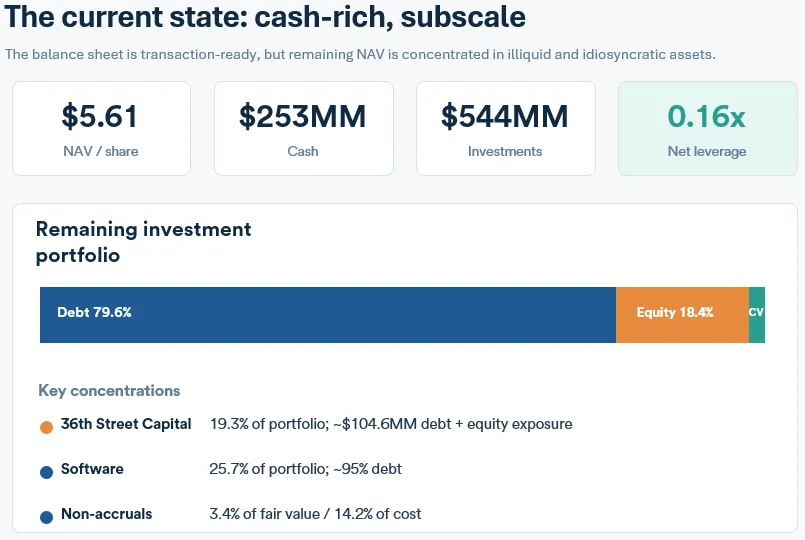
The smaller fund earns less. In Q3, NAV fell to $5.61 from $6.58, and adjusted net investment income was $0.15 per share against a $0.17 dividend. Credit stress and concentration remain. Non-accruals are 3.4% of the portfolio at fair value and 14.2% at cost. The controlled equipment lessor 36th Street Capital makes up 19.3% of fair value, and software makes up 25.7%. [2] [8]
The board's review, advised by KBW, covers reinvesting, buybacks and combining with a BlackRock fund or a peer. A Clark Street Value commentary argues that selling or merging the company is now the most logical outcome. Ares Capital's agreed purchase of MidCap Financial at a 30.1% premium is a recent BDC deal for comparison. At the commentary's $4.11 share price, the stock trades at roughly 73% of September NAV. [4] [1] [7]
Leadership changed while valuations were under scrutiny. In July, Bloomberg-sourced reporting said Manhattan federal prosecutors were examining the fund's valuations, after markdowns of about 19% in January and 5% in May. CEO Phil Tseng resigned effective August 31. Jason Mehring became CEO and Dan Worrell became president. [3] [6] [5]
Filings confirm the lower leverage and the dividend shortfall. Not yet established: whether a smaller TCPC is worth more to a buyer than as a standalone lender. The discounted sale price gives an outside check on how the fund values its loans.
Sources are gathered; writing the dossier now.
Executive brief
BlackRock TCP Capital (TCPC) sold about half of its debt book, roughly $523 million of loans, to a Pantheon-backed continuation vehicle. After the sale, net leverage fell from 1.38x to 0.16x (Q3 release). The cost was a $0.68-per-share NAV hit. NAV ended Q3 2026 at $5.61, down from $6.58. Adjusted income no longer covers the $0.17 dividend. A strategic review run by KBW is ongoing. A Clark Street Value commentary, whose author owns shares, argues the likely end point is selling TCPC (Clark Street Value). Separately, Manhattan federal prosecutors have reportedly been examining the fund's valuation practices (Capital Brief).
What changed and event timeline
CEO exit reported amid probe
Bloomberg-sourced reporting said CEO Phil Tseng would leave while the Manhattan US Attorney's office examined valuations. The fund had been marked down about 19% in January and 5% in May ().
Continuation-vehicle sale signed and closed
TCPC sold 95% of a vehicle holding about $523M of loans across 78 companies to Pantheon funds and kept 5%. The board also opened a strategic review with Keefe, Bruyette & Woods (KBW) as adviser ().
Leadership change
Tseng resigned as chair, CEO and co-CIO. Jason Mehring became CEO and Dan Worrell became president (;).
Peer BDC deal sets a reference point
Ares Capital agreed to buy MidCap Financial for about $2.6B in stock and cash, a 30.1% premium to the prior close ().
Q3 results
NAV fell to $5.61. Adjusted net investment income was $0.15 per share against a $0.17 dividend. Cash stood at $253.1M ().
Commentary makes a "for sale" case
Clark Street Value argued that, after deleveraging, a sale or merger is TCPC's most logical outcome ().
Capabilities and access
- The company: TCPC is a Nasdaq-listed business development company (BDC), a listed vehicle that lends to private companies. It is externally managed by BlackRock.
- Remaining portfolio (Sept 30): about $543.5M across 126 companies, 79.6% senior secured (Q3 release).
- Debt: $330M, all unsecured, non-callable bonds at a 6.9% weighted average rate (Q3 call transcript).
Read the full section
- The company: TCPC is a Nasdaq-listed business development company (BDC), a listed vehicle that lends to private companies. It is externally managed by BlackRock.
- Remaining portfolio (Sept 30): about $543.5M across 126 companies, 79.6% senior secured (Q3 release).
- Debt: $330M, all unsecured, non-callable bonds at a 6.9% weighted average rate (Q3 call transcript).
- Liquidity: $258.1M of available capacity.
Technical analysis for researchers and developers
- Deal structure: The base price was 95% of fair value as of 12/31/25. The expected NAV impact was about $57M (8-K).
- Inference, not disclosed: proceeds well below $523M suggest the vehicle carries its own financing.
- What was sold: about two-thirds of each included position, so TCPC still holds residual stakes in the same names.
Read the full section
- Deal structure: The base price was 95% of fair value as of 12/31/25. TCPC received about $152M in gross proceeds for the 95% equity stake. The expected NAV impact was about $57M (8-K).
- Inference, not disclosed: proceeds well below $523M suggest the vehicle carries its own financing.
- What was sold: about two-thirds of each included position, so TCPC still holds residual stakes in the same names.
- Unfunded commitments: fell from about $90M to $36M.
- Fees: BlackRock manages the vehicle without compensation.
- Valuation check: the cash price for a large loan book can be compared with the Level 3 fair-value marks (model-based valuations of illiquid assets), which is relevant given the reported valuation probe.
Claims and evidence
- Deleveraging: 0.16x net leverage is confirmed by company filings (Q3 release).
- Fee waivers (conflicting): The commentary says BlackRock has been waiving base fees. The Q3 release reports no management fee waivers in Q3.
- Leadership timing (conflicting): The commentary says the CEO and COO resigned in September. The filing dates Tseng's resignation to August 31.
Read the full section
- Deleveraging: 0.16x net leverage is confirmed by company filings (Q3 release).
- Fee waivers (conflicting): The commentary says BlackRock has been waiving base fees. The Q3 release reports no management fee waivers in Q3.
- Leadership timing (conflicting): The commentary says the CEO and COO resigned in September. The filing dates Tseng's resignation to August 31. The reviewed sources do not confirm a COO departure.
- Market significance: PE Insights calls the deal a benchmark for secondary pricing of BDC loan books. That is interpretation, not data (PE Insights).
- Author's valuation: The commentary's ~$5.25 "blended value" is the author's own estimate. The author holds the stock.
Context and prior work
- Origins: TCPC launched in 2012 under Tennenbaum. BlackRock bought Tennenbaum in 2018 and later merged TCPC with BlackRock Capital Investment Corp (Clark Street Value).
- Share price: TCPC shares fell more than 35% in 2026 through early July (Capital Brief).
- Discount: At the commentary's $4.11 share price, the stock trades at about 73% of September NAV (inference from the two figures).
Read the full section
- Origins: TCPC launched in 2012 under Tennenbaum. BlackRock bought Tennenbaum in 2018 and later merged TCPC with BlackRock Capital Investment Corp (Clark Street Value).
- Share price: TCPC shares fell more than 35% in 2026 through early July (Capital Brief).
- Discount: At the commentary's $4.11 share price, the stock trades at about 73% of September NAV (inference from the two figures).
- Consolidation: The Ares–MidCap deal shows BDC mergers happening; Ares expects to close in the first half of 2027 (Ares 8-K exhibit).
Limitations, safety and contested findings
- Concentration: 36th Street Capital, an equipment-leasing platform TCPC controls, is 19.3% of portfolio fair value. Software is 25.7% across 40 companies (Q3 call transcript).
- Credit stress: Non-accruals (loans no longer paying interest) are 3.4% at fair value and 14.2% at cost (Q3 release).
- No timeline: Management gave no timeline for the review and did not discuss buybacks.
Read the full section
- Concentration: 36th Street Capital, an equipment-leasing platform TCPC controls, is 19.3% of portfolio fair value. Software is 25.7% across 40 companies (Q3 call transcript).
- Credit stress: Non-accruals (loans no longer paying interest) are 3.4% at fair value and 14.2% at cost (Q3 release). Job & Talent cost $0.15 per share of NAV in Q3.
- No timeline: Management gave no timeline for the review and did not discuss buybacks.
- Regulatory scrutiny: The valuation probe is reported but unresolved. No charges appear in the reviewed sources.
Business and practitioner implications
- Continuation vehicles for BDCs: GP-led secondaries can now shrink a listed BDC quickly.
- The dividend: A deleveraged BDC earns too little to cover its dividend.
- Possible outcomes: Reinvesting, buybacks, or a combination with a BlackRock fund or a peer. The KBW mandate lists all of these (8-K).
Read the full section
- Continuation vehicles for BDCs: GP-led secondaries can now shrink a listed BDC quickly. The trade-off is that sellers lock in a discount to their marks.
- The dividend: A deleveraged BDC earns too little to cover its dividend. The board says the dividend will be evaluated in the context of the review.
- Possible outcomes: Reinvesting, buybacks, or a combination with a BlackRock fund or a peer. The KBW mandate lists all of these (8-K).
- What buyers would price: the 36th Street stake and the software book.
The source trail.
Sources (9)
BlackRock TCP Capital Corp: Deleveraged, For Sale Sign
Article text retrieved; extracted text may omit tables or interactive elements.
clarkstreetvalue.blogspot.com