
AgentsAutonomy & tool use
datasette-llm 0.1a11 lets Datasette Agent run on local models through OpenAI-compatible endpoints
Simon Willison's datasette-llm 0.1a11 alpha lets Datasette connect to any server implementing the OpenAI Chat Completions or Responses API, including LM Studio, Ollama and llama.cpp, so Datasette Agent can answer plain-language questions about SQLite data using a model running locally.
From the Simon Willison article of November 14, 2026 and cited sources: One configuration setting now does the job that used to need a separate plugin for each provider. [1] [5] [7]
SOURCES[1] datasette-llm 0.1a11 simonwillison.net[5] datasette-llm GitHub releases github.com[7] datasette-llm README github.com
 AT Pulse research deskPublished · Updated · 5 min read · AI-assisted analysis
AI-assisted, not human-edited. Methodology Corrections Who owns this site
- What happened
- One configuration setting now does the job that used to need a separate plugin for each provider. [1] [5] [7]
- Original source
- Simon Willison article, independent perspective
- Brief by
- AT Pulse research desk AI-assisted; publisher and contact on the desk page
- When
- November 14, 2026 article published
- Covered
- Nov 15 edition
- Evidence
- 8 sources across 6 sites
- 1datasette-llm 0.1a11simonwillison.net
- 2tbreak: llama.cpp 1.0 reaches stable releasetbreak.com
- 3Datasette Agent, an extensible AI assistant for Datasettedatasette.io
- 4Simon Willison: datasette-agent 0.5a0simonwillison.net
- 5datasette-llm GitHub releasesgithub.com
- 6mlq.ai: llama.cpp reaches version 1.0mlq.ai
Reach: not measured yet
One configuration setting now does the job that used to need a separate plugin for each provider. A model can point to an api_base URL, and a new endpoints setting registers servers. Each endpoint entry maps a Datasette-facing model name to the name on the remote server. An optional flag switches from /chat/completions to /responses. [1] [5] [7]
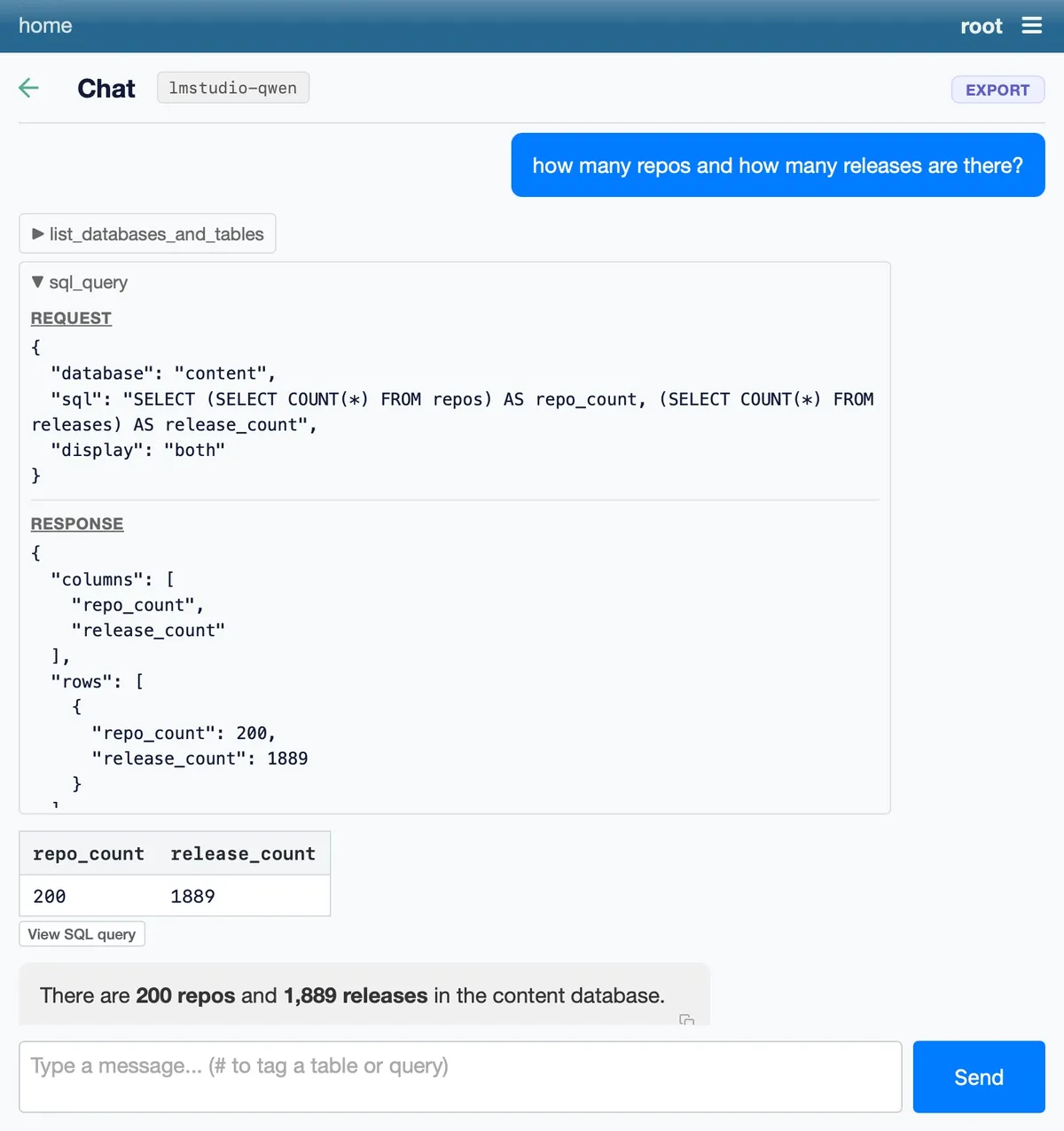
Willison's example starts Datasette Agent with a single uvx command, backed by a Qwen model served by LM Studio on localhost. Nothing has to be installed permanently. This shows the setup works, but it is not a measure of answer quality. [1]
Operators declare what each server supports by hand, such as streaming, tool use, schemas, vision and reasoning, and can add custom headers. Each purpose, for example the SQL assistant, can have its own model, allowlist and blocklist. That lets administrators send some tasks to local models and others to hosted ones. Because the flags are set manually, a mistake such as wrongly declaring tool support could break the agent. [7]
first-party docs and a working command show local inference is configurable.
Read the full assessment
Implication: teams could trial conversational SQL analytics on sensitive SQLite data without sending rows to a cloud provider, and route tasks between local and hosted models.
Executive brief
Datasette's agent can now run entirely on a laptop. On 14 November 2026, Simon Willison released datasette-llm 0.1a11, which lets Datasette use any server that speaks the OpenAI-compatible API. That covers local runners such as LM Studio, Ollama and llama.cpp, so you don't need a separate plugin for each provider (Willison). His example starts a Datasette Agent backed by a local Qwen model with a single uvx command. The release came one day after llama.cpp reached a stable 1.0.0 (tbreak). The plugin is still an alpha. No outside testing of how well the agent works with local models was found.
What changed and event timeline
Datasette Agent launches
An open-source assistant that answers plain-language questions about SQLite data by writing SQL. It runs on Willison's LLM library, and datasette-llm is the layer that connects the two ().
Agent 0.5a0 adds a side panel
The agent's chat can now sit next to Datasette table and query pages. Paired with datasette-apps, it can build and then modify database-backed apps ().
Datasette-llm 0.1a10
Fixes a bug where the plugin overrode model allowlists that had already been configured ().
Llama.cpp and ggml hit v1.0.0
Both projects commit to semantic versioning and remove 35 deprecated functions. The server gets security fixes for request forgery (SSRF), CORS and DNS rebinding (;).
Datasette-llm 0.1a11 adds OpenAI-compatible endpoints
A model setting can now include an
api_baseURL, and a newendpointssetting registers servers (;).
Capabilities and access
- Version: datasette-llm 0.1a11, still an alpha.
- What it connects to: any server that implements the OpenAI Chat Completions or Responses protocol (GitHub releases).
- Model in the example:
qwen/qwen3.8-27b, served by LM Studio atlocalhost:1234/v1(Willison).
Read the full section
- Version: datasette-llm 0.1a11, still an alpha.
- What it connects to: any server that implements the OpenAI Chat Completions or Responses protocol (GitHub releases).
- Model in the example:
qwen/qwen3.8-27b, served by LM Studio atlocalhost:1234/v1(Willison). - How to run it: a single
uvx --with datasette-agent datasette ...command with a-s plugins.datasette-llm.default_modelsetting. No permanent install is needed. - Public demo: agent.datasette.io, which requires GitHub sign-in and runs on Gemini 3.1 Flash-Lite, a hosted model (Datasette blog).
Technical analysis for researchers and developers
- Endpoint fields: each entry in
endpointstakesmodel(the name Datasette uses),model_name(the name on the remote server),api_base, and an optionalresponses: trueto use/responsesinstead of/chat/completions. - Capability flags: you declare what the server supports by hand:
can_stream,supports_tools,supports_schema,vision,audio,reasoning, plus customheaders. - Per-purpose settings: "purposes" such as
sql-assistantcan each have their own model, allowlist and blocklist.
Read the full section
According to the README:
- Endpoint fields: each entry in
endpointstakesmodel(the name Datasette uses),model_name(the name on the remote server),api_base, and an optionalresponses: trueto use/responsesinstead of/chat/completions. - Capability flags: you declare what the server supports by hand:
can_stream,supports_tools,supports_schema,vision,audio,reasoning, plus customheaders. Tools and streaming are on by default. - Per-purpose settings: "purposes" such as
sql-assistantcan each have their own model, allowlist and blocklist.require_keys: truehides models that have no API key configured. - Key lookup order: datasette-secrets environment variables first, then LLM's stored keys, then LLM's environment variables.
- Practical consequence: since you set the flags yourself, a local server whose tool calling is incomplete may break the agent unless you set
supports_toolscorrectly. This is an inference from the design, not a reported failure.
Claims and evidence
- A local model can power Datasette Agent: shown in Willison's own command example (Willison). This is a working demonstration, not a quality benchmark.
- The feature set (endpoints, Responses protocol, capability flags): documented in the release notes and the README. These are first-party sources.
- llama.cpp 1.0 details: reported by several secondary outlets (tbreak, DEV). The upstream release notes were not checked directly.
Read the full section
- A local model can power Datasette Agent: shown in Willison's own command example (Willison). This is a working demonstration, not a quality benchmark.
- The feature set (endpoints, Responses protocol, capability flags): documented in the release notes and the README. These are first-party sources.
- llama.cpp 1.0 details: reported by several secondary outlets (tbreak, DEV). The upstream release notes were not checked directly.
- Independent coverage of datasette-llm 0.1a11: none found. There is also no third-party evaluation of how accurately Datasette Agent writes SQL with local models.
Context and prior work
- Earlier releases: previous datasette-llm alphas added per-purpose configuration, separate API keys per use, and a fallback to LLM's default model in 0.1a9 (GitHub releases).
- Model reach: the LLM library already covered hundreds of tool-calling models through plugins, both hosted and local (Datasette blog).
- Why "pseudo-standard": Willison calls the OpenAI API a "pseudo-standard".
Read the full section
- Earlier releases: previous datasette-llm alphas added per-purpose configuration, separate API keys per use, and a fallback to LLM's default model in 0.1a9 (GitHub releases).
- Model reach: the LLM library already covered hundreds of tool-calling models through plugins, both hosted and local (Datasette blog). The difference now is that one setting replaces the need for a plugin per provider.
- Why "pseudo-standard": Willison calls the OpenAI API a "pseudo-standard". There is no formal spec, but local runners widely copy it. llama.cpp 1.0 even added an OpenAI-style
/v1/audio/speechendpoint (tbreak). - Ecosystem: datasette-llm-accountant, which tracks budgets and costs, builds on the same layer (README).
Limitations, safety and contested findings
- Alpha status: both datasette-llm (0.1a11) and Datasette Agent (0.5a0) are alpha releases, so their interfaces may still change.
- Demo flags: the example runs with
--root --secret 1, which gives full admin access and uses a placeholder signing secret. - No measured performance: none of the reviewed sources report accuracy, speed or how reliably local models call tools.
Read the full section
- Alpha status: both datasette-llm (0.1a11) and Datasette Agent (0.5a0) are alpha releases, so their interfaces may still change.
- Demo flags: the example runs with
--root --secret 1, which gives full admin access and uses a placeholder signing secret. That is fine for a local test but unsafe on any shared network. - No measured performance: none of the reviewed sources report accuracy, speed or how reliably local models call tools.
- Risky combinations: agent tool plugins such as code execution in a sandbox (datasette-agent-sprites) increase the impact of a model mistake (Datasette blog). The reviewed sources say little about their security design.
Business and practitioner implications
- Data stays on your own hardware: teams with sensitive SQLite data can try conversational analytics without sending queries or rows to a cloud provider.
- Fewer vendor-specific integrations: one endpoint setting covers LM Studio, Ollama, llama.cpp, vLLM-style servers and internal gateways (using custom headers).
- Governance: per-purpose allowlists and blocklists let administrators send cheap tasks to local models and keep stronger hosted models for others.
Read the full section
- Data stays on your own hardware: teams with sensitive SQLite data can try conversational analytics without sending queries or rows to a cloud provider.
- Fewer vendor-specific integrations: one endpoint setting covers LM Studio, Ollama, llama.cpp, vLLM-style servers and internal gateways (using custom headers).
- Governance: per-purpose allowlists and blocklists let administrators send cheap tasks to local models and keep stronger hosted models for others.
- Before adopting: pilot on test data, set capability flags carefully, and wait for stable releases.
The source trail.
Sources (8)
datasette-llm 0.1a11
Article text retrieved; extracted text may omit tables or interactive elements.
simonwillison.net