
StocksEquities, earnings & valuations
MBI Deep Dives author says AI makes him work longer, as his daily newsletter now goes out about 90 minutes later
The author of MBI Deep Dives says AI now updates his earnings-season charts and spreadsheets and helps draft his nightly notes. Yet his daily email goes out later than before, because AI produces more material to question, combine and edit.
From the MBI Deep Dives article of November 13, 2026 and cited sources: The author says his daily send time has moved from about 7:30 AM PT through May to about 9 AM PT since September. [1] [2] [4]
SOURCES[1] How I Am Using AI — MBI Deep Dives mbi-deepdives.com[2] AI Doesn't Reduce Work—It Intensifies It — Benton… benton.org[4] Cognitive Mercantilism — Contraptions contraptions.venkateshrao.com
 AT Pulse research deskPublished · Updated · 5 min read · AI-assisted analysis
AI-assisted, not human-edited. Methodology Corrections Who owns this site
- What happened
- The author says his daily send time has moved from about 7:30 AM PT through May to about 9 AM PT since September. [1] [2] [4]
- Original source
- MBI Deep Dives article, independent perspective
- Brief by
- AT Pulse research desk AI-assisted; publisher and contact on the desk page
- Studies
- arXiv 2507.09089 (Jul 2025) [8] date from arXiv ID
- When
- November 13, 2026 article published
- Covered
- Nov 15 edition
- Evidence
- 11 sources across 8 sites
- 1How I Am Using AI — MBI Deep Divesmbi-deepdives.com
- 2AI Doesn't Reduce Work—It Intensifies It — Benton…benton.org
- 3Meta debuts its Muse AI agent — TechCrunchtechcrunch.com
- 4Cognitive Mercantilism — Contraptionscontraptions.venkateshrao.com
- 5Experiments with Monstrousness — Contraptionscontraptions.venkateshrao.com
- 6Uber Announces Results for Third Quarter 2026seekingalpha.com
Reach: not measured yet
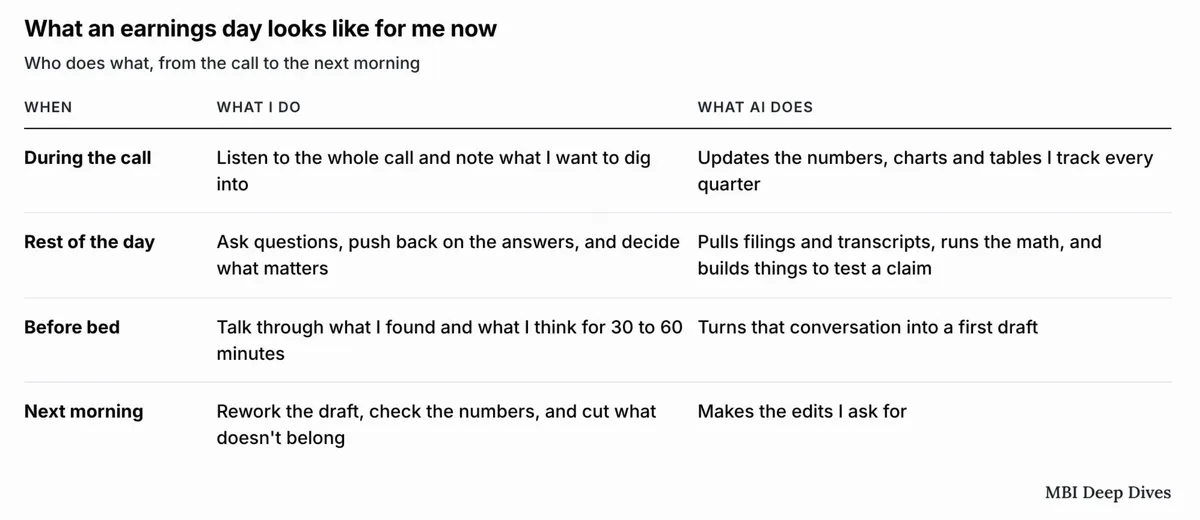
The author says his daily send time has moved from about 7:30 AM PT through May to about 9 AM PT since September. He says the earnings calendar does not explain the shift: AI-generated groundwork has increased what he has to review. A field study at one US tech firm found the same pattern, with staff taking on more kinds of tasks and working longer hours, mostly by choice. Venkatesh Rao offers a related idea: AI could set off a cognitive version of the 'industrious revolution,' in which workers chose longer days because more became worth pursuing. [1] [2] [4]
His workflow is orchestration rather than drafting. Each night he talks with Claude for 30 to 60 minutes about the day's findings, has it do groundwork from several angles, argues with the results, and then asks for a draft. In his telling, the bottleneck has moved to combining and editing. The METR trial shows why this kind of account needs care: experienced developers using AI took 19% longer while believing they were about 20% faster. [1] [8] [9]
He places himself between two writers. Ben Thompson, by the author's account, avoids AI-made charts. Rao now writes with AI by default and acknowledges that some long-time readers say they feel betrayed. Together they show that how a writer uses AI, and whether they disclose it, now affects audience trust. [1] [5]
a field study at one firm of about 200 people found AI led staff to take on more tasks and work longer hours. Implication: teams adopting AI should expect scope to grow and editing to become the constraint, rather than expect hours back.
Sources are gathered and checked. The dossier is below.
Executive brief
The most notable claim in this post is that AI has made its author work more, not less. MBI Deep Dives is a paywalled investing newsletter. A Harvard Business Review field study found the same pattern of AI making work more intense.
Read the full section
The most notable claim in this post is that AI has made its author work more, not less. MBI Deep Dives is a paywalled investing newsletter. Its author writes that since September his daily email has gone out at about 9 AM PT, compared with about 7:30 AM through May, because AI produces far more material to sort and edit (MBI Deep Dives). He sits between two positions: Ben Thompson's refusal to use AI even for charts, and Venkatesh Rao's AI-by-default writing. In his account, AI now handles earnings-season spreadsheet and chart updates, and that frees time for more open-ended questions. This is one writer's own account. A Harvard Business Review field study found the same pattern of AI making work more intense.
What changed and event timeline
HBR study finds AI intensifies work
Aruna Ranganathan and Xingqi Maggie Ye spent eight months observing a US tech firm of about 200 employees. Staff worked faster, took on more kinds of tasks and worked longer hours, mostly by choice ().
Meta launches Muse
Muse is a consumer agent that books, fills in forms and buys things. It runs on Meta's Muse Spark model and has free, $20 and $100 tiers ().
Rao publishes "Cognitive Mercantilism."
He argues that worry about AI treats intelligence like a fixed supply, the way mercantilists treated gold, and pays little attention to how much demand for it could grow ().
Rao calls AI his default writing tool
He says hand-written pieces are now the exception. His motto is "be slightly monstrous," and he acknowledges that some long-time readers say they feel betrayed ().
Uber and Airbnb report Q3
Uber expects about 700 driverless vehicles on its platform by year-end (). Airbnb CEO Brian Chesky said general-purpose agents are a poor fit for travel ().
MBI publishes "How I Am Using AI."
The post describes using Claude for nightly drafts, testing Muse on a family trip, and later send times ().
Capabilities and access
- Claude: The author talks with it for 30–60 minutes each night about the day's findings, then asks it for a draft.
- Muse: Meta's agent runs on Muse Spark.
- Unnamed tools: The post does not say which tools updated its quarterly charts and tables.
Read the full section
- Claude: The author talks with it for 30–60 minutes each night about the day's findings, then asks it for a draft. The post does not name the model version (MBI).
- Muse: Meta's agent runs on Muse Spark. It is available on the web, iOS, Android and WhatsApp to US adults only, with Power ($20/month) and Maximum ($100/month) plans (TechCrunch).
- Unnamed tools: The post does not say which tools updated its quarterly charts and tables. Its table of a typical earnings day is an image, not text.
Technical analysis for researchers and developers
The workflow is orchestration rather than drafting. The human asks questions from several angles, AI does the groundwork on each, and the human then probes and argues with the results (MBI). Neither the MBI post nor METR measures output quality as an experiment would, and MBI's evidence is a single person's own report.
Read the full section
The workflow is orchestration rather than drafting. The human asks questions from several angles, AI does the groundwork on each, and the human then probes and argues with the results (MBI). The author says the bottleneck has moved to combining and editing, and that he is "early to mid innings" in learning to produce first drafts that need less editing. This matches the METR trial: experienced open-source developers took 19% longer with AI tools while believing they were about 20% faster, with review and correction work as one likely reason (InfoWorld). Neither the MBI post nor METR measures output quality as an experiment would, and MBI's evidence is a single person's own report.
Claims and evidence
- Send times moved from about 7:30 to about 9 AM PT, and the earnings calendar does not explain it. Only the author reports this.
- AI-made charts are "better" than the author's hand-made ones. This is his own judgement; the post does not show any comparison.
- AI makes work more intense. A field study supports this, though at one company with about 200 people (Benton/HBR).
Read the full section
- Send times moved from about 7:30 to about 9 AM PT, and the earnings calendar does not explain it. Only the author reports this. No independent check exists (MBI).
- AI-made charts are "better" than the author's hand-made ones. This is his own judgement; the post does not show any comparison.
- AI makes work more intense. A field study supports this, though at one company with about 200 people (Benton/HBR).
- General agents are wrong for travel. This is Chesky's view, and Airbnb plans to launch its own agent in the first half of 2027 (TechCrunch).
- Thompson avoids AI-made charts. This is the author's paraphrase of a Sharp Tech podcast. No independent confirmation was found.
Context and prior work
Rao draws on Joyce Appleby's account of the "industrious revolution." In it, workers chose to raise their working days from about 250 to 300 a year because more goods became worth buying. Rao's Oct 24 post reworks Steve Jobs's "bicycle for the mind" metaphor, describing AI as a motorcycle.
Read the full section
Rao draws on Joyce Appleby's account of the "industrious revolution." In it, workers chose to raise their working days from about 250 to 300 a year because more goods became worth buying. Rao suggests AI could trigger a similar "cognitive industrious revolution" (Contraptions). MBI applies the idea to questions instead of goods. Rao's Oct 24 post reworks Steve Jobs's "bicycle for the mind" metaphor, describing AI as a motorcycle. MBI's phrase "accelerator for thinking" makes a similar point.
Limitations, safety and contested findings
- The author admits it can become "too easy" to let AI do the thinking (MBI).
- METR's perception gap means people can feel productive while working more slowly.
- Rao's readers objected to undisclosed AI use, which shows real tension over trust and disclosure (Contraptions).
Read the full section
- The author admits it can become "too easy" to let AI do the thinking (MBI).
- METR's perception gap means people can feel productive while working more slowly. That casts doubt on any productivity claim people make about themselves, including this one (arXiv).
- Rao's readers objected to undisclosed AI use, which shows real tension over trust and disclosure (Contraptions).
- Muse depends on safeguards Meta describes itself: an isolated virtual machine, no access to passwords, and a separate "Sentinel" monitoring agent (TechCrunch).
Business and practitioner implications
- Plan for scope to grow, not hours to fall.
- The editing step is now the constraint. It is worth investing in prompts, briefs and conversations that produce first drafts needing less editing.
- Thompson and Rao have taken opposite positions, and readers have reacted.
Read the full section
- Plan for scope to grow, not hours to fall. The HBR study and the MBI account both suggest that time AI saves gets spent on more work.
- The editing step is now the constraint. It is worth investing in prompts, briefs and conversations that produce first drafts needing less editing.
- Disclosure policy affects the audience. Thompson and Rao have taken opposite positions, and readers have reacted.
- Market context: Uber reported Q3 revenue of $14.8B (up 10%) and gross bookings of $59.8B (up 20%) on Nov 4 (Uber). Airbnb reported Q3 revenue of $4.87B (up 19%) on Nov 5 (TechCrunch). These are fundamentals, not price moves, and nothing here is investment advice. On the Airbnb call, Chesky said agents such as Muse send little traffic so far (OfficeChai).