
EcosystemsRegions, accelerators & hubs
United Airlines Bans AI Booking Agents as Amazon Blocks Perplexity and Shopify Opens Checkout to Bots
United Airlines now bars AI agents from booking tickets, and Amazon holds a preliminary injunction against Perplexity's shopping agent. Shopify has opened its checkout to agents. Tomasz Tunguz argues the split follows business models: ads and add-ons versus per-payment fees.
From the Tomasz Tunguz article of November 13, 2026 and cited sources: Large sellers are restricting AI agents through contract terms and the courts. [2] [9] [3] [4]
SOURCES[2] United Bars AI Agents From Booking Flights — destination.com destination.com[9] United Airlines bans AI agents — BetaNews betanews.com[3] Amazon Wins Court Order Blocking Perplexity — ChannelNews channelnews.com.au
 AT Pulse research deskPublished · Updated · 5 min read · AI-assisted analysis
AI-assisted, not human-edited. Methodology Corrections Who owns this site
- What happened
- Large sellers are restricting AI agents through contract terms and the courts. [2] [9] [3] [4]
- Original source
- Tomasz Tunguz article, independent perspective
- Brief by
- AT Pulse research desk AI-assisted; publisher and contact on the desk page
- When
- November 13, 2026 article published
- Covered
- Nov 15 edition
- Evidence
- 16 sources across 16 sites
- 1No Shirt, No Shoes, No Service for Botstomtunguz.com
- 2United Bars AI Agents From Booking Flights — destination.comdestination.com
- 3Amazon Wins Court Order Blocking Perplexity — ChannelNewschannelnews.com.au
- 4Amazon Wins Court Order — Bloomberg Lawnews.bloomberglaw.com
- 5Shopify opens checkout to browser-based AI agents —…techcrunch.com
- 6WebMCP support for checkout — Shopify changelogshopify.dev
QuietHow it’s measured
Hacker News · 1 like · 1 comment
Reach blends public engagement (views, likes, comments, shares, stars) from the platforms where the story or its original source lives: YouTube, Hacker News, GitHub, Substack and similar. A video and the article written from its transcript share one score, taken from the video. Platforms with no data are left out rather than counted as zero, and the age of a story never lowers its score.
Large sellers are restricting AI agents through contract terms and the courts. United's new Rule 6.J.6 bars agents from making, changing or servicing tickets, even with a human supervising. Another rule lets United cancel reservations an agent made. AI-assisted fare search is still allowed. Separately, a March preliminary injunction ordered Perplexity to keep its Comet agent off Amazon and destroy Amazon data it had collected. Perplexity said it would fight the order. [2] [9] [3] [4]
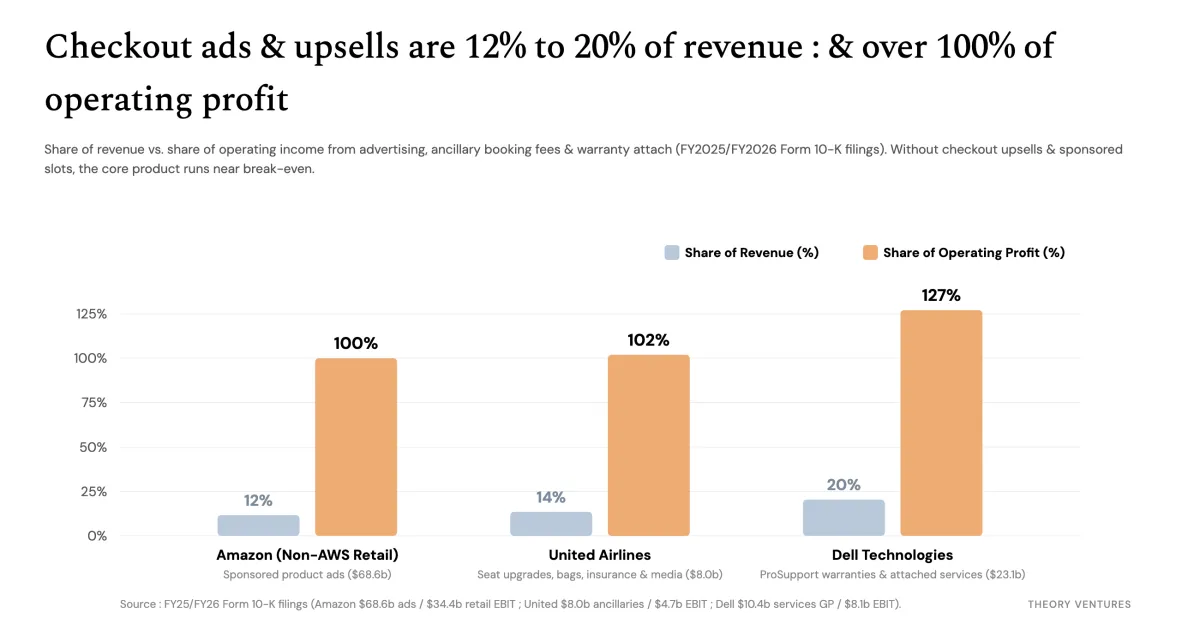
Tunguz argues that profit protection, more than security, drives the blocking. By his arithmetic, Amazon's advertising and United's add-on fees and loyalty income each exceed the company's operating income. Shopping agents skip sponsored listings, seat upgrades and warranties. Amazon's 2025 ad revenue of $68.6B is confirmed, but the roughly 50% ad margin behind his conclusion is his assumption. [1] [12]
Shopify earns a cut of each payment, and it now offers WebMCP checkout tools to all eligible merchants with no setup. Agents can read a checkout, change the address, delivery option or discount code, and submit the order once the buyer confirms. The buyer takes over for 3D Secure checks. In Shopify's own test with a single model, WebMCP completed 60 of 60 tasks against 56 of 60 for browser automation, and took 10.3 seconds against 27.4. [5] [6] [10]
two major sellers now restrict agents through contract terms and litigation, while Shopify builds them in.
Read the full assessment
Implication: agent builders should expect access to depend on each merchant's revenue model, and bookings made by agents can be cancelled after purchase.
Sources are checked; writing the dossier now.
Executive brief
Tom Tunguz's essay argues that big storefronts block AI shopping agents to protect their profits, and the security reasons they give are secondary. In his own arithmetic, Amazon's ads and United's add-on fees and loyalty income each equal more than 100% of operating income. A shopping agent skips sponsored listings, seat upgrades and warranties. United now bans AI agents from booking tickets, even when a human supervises (destination.com). Amazon already has a court order against Perplexity's agent. Shopify, which takes a cut of each payment, has opened its checkout to agents. The essay's profit attributions are the author's estimates, not company disclosures.
What changed and event timeline
Court blocks Perplexity's Comet on Amazon
A preliminary injunction ordered Perplexity to stop its agents from accessing Amazon and to destroy Amazon data it had collected. Perplexity said it would fight the order (;).
Shopify opens checkout to browser agents
Shopify added WebMCP checkout tools for all eligible merchants, with no merchant setup needed. TechCrunch named Amazon and Adidas as retailers blocking agents (;).
HUMAN publishes its October agent-traffic benchmark
Meta's Muse made 59% of observed agent requests and OpenAI products about 30%. The data covers only HUMAN's own customers ().
a16z publishes "Welcome to the B2A Economy."
Olivia and Justine Moore, both a16z partners, argue that businesses which block agents risk losing out. They cite HUMAN's 8x agent-traffic growth from August to October ().
United bans AI agents
New Rule 6.J.6 bars agents from making, changing or servicing tickets. Rule 5.H lets United cancel reservations an agent made. Searching for fares with AI is still allowed (;).
Tunguz connects the moves to margins
His essay presents the blocking as a defence of ad and add-on profits and Shopify's openness as the result of its per-payment fee model ().
Capabilities and access
- Shopify WebMCP checkout has three tools:
get_checkout,update_checkoutandcomplete_checkout. - United: agents can show schedules and prices, but a person has to complete the purchase.
- Agents with the most traffic: Meta Muse; ChatGPT Agent (15.9%), Codex Browser (8.8%) and the Codex Chrome extension (5.2%) (PPC Land).
Read the full section
- Shopify WebMCP checkout has three tools:
get_checkout,update_checkoutandcomplete_checkout. Agents can read a checkout, change the address, delivery option or discount code, and submit the order after the buyer confirms. Control goes back to the buyer for 3D Secure authentication and for blocking UI extensions (Shopify changelog). - United: agents can show schedules and prices, but a person has to complete the purchase. The ban covers AI browsers, consumer assistants and agents working through travel agencies (BetaNews).
- Agents with the most traffic: Meta Muse; ChatGPT Agent (15.9%), Codex Browser (8.8%) and the Codex Chrome extension (5.2%) (PPC Land).
Technical analysis for researchers and developers
- Structured tools vs. screen-clicking. Browser automation instead drives the page the way a person would.
- HUMAN identifies agents from behaviour, user-agent strings and integrations with publishers. It counts requests, not users or sessions (PPC Land).
- Hiding as a browser. Amazon alleged that Comet presented itself as ordinary Chrome to avoid detection (Shopifreaks).
Read the full section
- Structured tools vs. screen-clicking. WebMCP exposes the checkout to agents as callable tools inside the existing page, with no new API. Browser automation instead drives the page the way a person would. Shopify ran one test using a single model (GPT-6 Sol), ten tasks and two test shops. WebMCP succeeded 60/60 times versus 56/60, took 10.3 s versus 27.4 s, and cost 58% less at OpenAI list prices (Search Engine Journal).
- Detection. HUMAN identifies agents from behaviour, user-agent strings and integrations with publishers. It counts requests, not users or sessions (PPC Land).
- Hiding as a browser. Amazon alleged that Comet presented itself as ordinary Chrome to avoid detection (Shopifreaks). This is why bans that rely on detection are hard to enforce.
Claims and evidence
- Agent traffic grew 8x from August to October. This comes from HUMAN and is repeated by a16z.
- Amazon's 2025 ad revenue was $68.6B. Confirmed by Marketing Dive. The "roughly 50% margin" is Tunguz's assumption.
- United's and Dell's percentages are the author's calculations from 10-K line items. No independent analysis of them appeared in the reviewed sources.
Read the full section
- Agent traffic grew 8x from August to October. This comes from HUMAN and is repeated by a16z. The February–October figure conflicts: Tunguz cites 16.3x, while PPC Land's chained monthly rates give about 10.8x (PPC Land).
- Amazon's 2025 ad revenue was $68.6B. Confirmed by Marketing Dive. The "roughly 50% margin" is Tunguz's assumption. Amazon does not disclose its ad margin, so "ads are all of retail profit" is an inference.
- United's and Dell's percentages are the author's calculations from 10-K line items. No independent analysis of them appeared in the reviewed sources.
- Amazon updating robots.txt and sending cease-and-desist letters is not corroborated beyond the Perplexity litigation.
- Shopify's benchmark is Shopify's own test. Search Engine Journal flags inconsistencies in the reported totals (SEJ).
Context and prior work
- Bot blocking used to be about scraping and fraud.
- Perplexity's main argument in court was the same as Tunguz's thesis: agents skip Amazon's ads, so protecting ad revenue is the real motive (Decrypt).
- a16z set out its agentic-commerce investment thesis back in 2025 (Fortune). The firm's post discloses that a16z holds stakes in companies it mentions (a16z).
Read the full section
- Bot blocking used to be about scraping and fraud. HUMAN also reports four times more post-login account-takeover attempts per organisation than the year before (HUMAN).
- Perplexity's main argument in court was the same as Tunguz's thesis: agents skip Amazon's ads, so protecting ad revenue is the real motive (Decrypt).
- a16z set out its agentic-commerce investment thesis back in 2025 (Fortune). The firm's post discloses that a16z holds stakes in companies it mentions (a16z).
Limitations, safety and contested findings
- United cites consumer protection and the risk of sharing login details.
- Analysts say United may not be able to tell when a booking made through a travel agency was executed by an agent (destination.com).
- HUMAN's sector shares reflect its own customer base, not the whole web.
Read the full section
- United cites consumer protection and the risk of sharing login details. CEO Scott Kirby, however, said plainly that he does not want another middleman between United and its customers (destination.com).
- Analysts say United may not be able to tell when a booking made through a travel agency was executed by an agent (destination.com).
- HUMAN's sector shares reflect its own customer base, not the whole web.
- The Amazon order is a preliminary injunction, not a final ruling on the merits (ChannelNews).
Business and practitioner implications
- Agent builders: expect access to depend on how each merchant makes money. Payment-fee platforms like Shopify will integrate; ad- and add-on-driven storefronts will block.
- Merchants: the options Tunguz outlines are to raise base prices, charge an explicit fee for agent checkouts, or pay incentives that get agents to upsell.
- Security teams: agents that disguise themselves undermine user-agent rules. Behavioural detection and authenticated agent protocols are becoming the main controls.
Read the full section
- Agent builders: expect access to depend on how each merchant makes money. Payment-fee platforms like Shopify will integrate; ad- and add-on-driven storefronts will block. Contract-of-carriage terms can void a booking after it is made, so agent-booked tickets carry legal risk.
- Merchants: the options Tunguz outlines are to raise base prices, charge an explicit fee for agent checkouts, or pay incentives that get agents to upsell.
- Security teams: agents that disguise themselves undermine user-agent rules. Behavioural detection and authenticated agent protocols are becoming the main controls.
The source trail.
Sources (16)
No Shirt, No Shoes, No Service for Bots
Article text retrieved; extracted text may omit tables or interactive elements.
tomtunguz.com