
FundingRounds, leads & terms
Sequen CEO Zoë Weil names Wayfair and Priceline as customers after $90M raise at $1.44B valuation
Sequen, a two-year-old New York startup that reorders what shoppers see on retail sites using live browsing signals, raised $90M at a $1.44B valuation; its CEO now names Wayfair and Priceline as customers and claims profitability.
From the Upstarts Media article of November 12, 2026 and cited sources: Sequen has raised money quickly. [3] [4] [5]
SOURCES[3] Cooley: Sequen AI Announces $90 Million Series B cooley.com[4] TechCrunch: Sequen snags $16M techcrunch.com[5] Axios Pro: Sequen raises $90 million at $1.4 billion… axios.com
 AT Pulse research deskPublished · Updated · 5 min read · AI-assisted analysis
AI-assisted, not human-edited. Methodology Corrections Who owns this site
- Original source
- Upstarts Media article, independent perspective
- Brief by
- AT Pulse research desk AI-assisted; publisher and contact on the desk page
- When
- November 12, 2026 article published
- Covered
- Nov 15 edition
- Evidence
- 7 sources across 7 sites
- 1Upstarts: Her $1.4B Startup Decides What You See When You…upstartsmedia.com
- 2Linked video: Her $1.4B Startup Decides What You See When…youtube.com
- 3Cooley: Sequen AI Announces $90 Million Series Bcooley.com
- 4TechCrunch: Sequen snags $16Mtechcrunch.com
- 5Axios Pro: Sequen raises $90 million at $1.4 billion…axios.com
- 6Digital Commerce 360: Wayfair agentic AI commercedigitalcommerce360.com
RisingHow it’s measured
YouTube video · 8.3K views · 22 likes
Reach blends public engagement (views, likes, comments, shares, stars) from the platforms where the story or its original source lives: YouTube, Hacker News, GitHub, Substack and similar. A video and the article written from its transcript share one score, taken from the video. Platforms with no data are left out rather than counted as zero, and the age of a story never lowers its score.
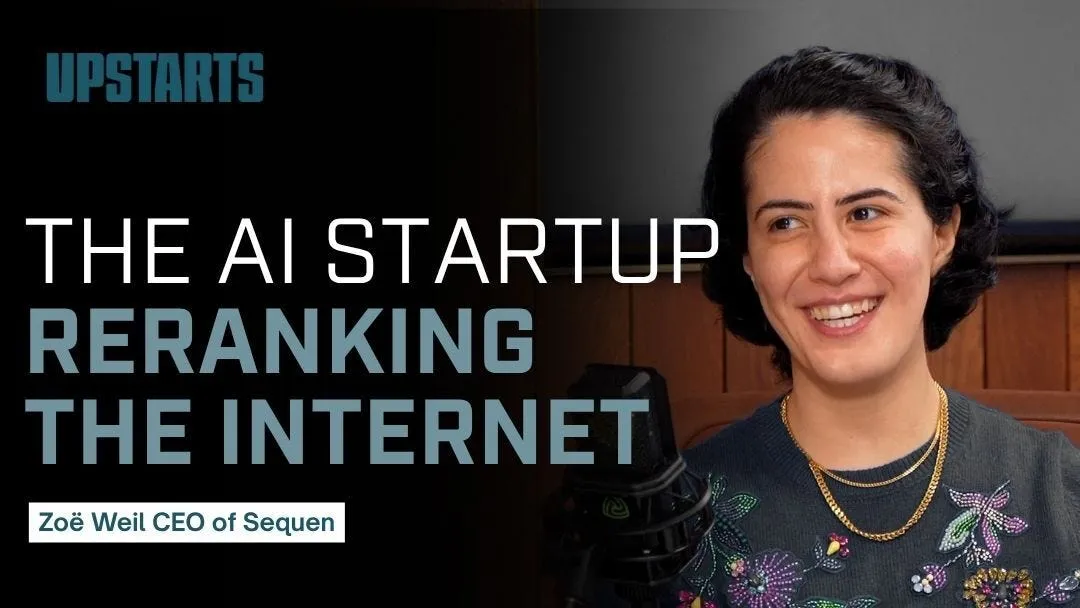
Sequen has raised money quickly. In March 2026 it closed a $16M Series A co-led by White Star Capital and Threshold Ventures, bringing its total to $22M. In September 2026 it raised a $90M Series B led by Prysm Capital at a $1.44B valuation and launched its Recursive Ranking Intelligence platform. [3] [4] [5]
Sequen ranks every item and every page module, such as a catalog or gifts section. Its models learn from live session events like hovers and scrolls, not from who the shopper is. Weil says the system uses event models and mixture-of-experts designs rather than LLMs, and that each customer gets its own model, kept separate from Sequen's base models. [2] [4]
Weil says customers run the A/B tests on their own systems. She claims Sequen has beaten some publicly traded retailers' annual revenue targets by 3–4x within weeks, and that the company is profitable. She frames the goal as nudging spending up slightly at scale, not just improving search relevance. [2] [4]
Sequen used to offer free pilots of black-box ranking models. It dropped them because outperforming customers' in-house teams strained the relationships. It now sells Recursive, a self-improving tool that customers' own scientists use to build ranking models. It is also expanding into ad bidding with large manufacturers and plans to move into wearables. [1] [2]
The funding is documented by the company's law firm and Axios; the lift figures come from Sequen alone.
Read the full assessment
If they hold, retailers with sparse data could get social-media-style personalization without cookies, pressuring in-house ranking teams and raising questions about steering consumer spending.
Sources are gathered and I'm writing the dossier now.
Executive brief
Sequen's CEO says the company has helped publicly traded retailers beat annual revenue targets by 3–4x "in just a couple of weeks," and in one case added "tens of billions of dollars" (Upstarts video, 05:13). No outside party has confirmed these figures. Sequen is a two-year-old New York company that reorders what shoppers see on sites like Wayfair and Priceline, using models that learn from live browsing behavior instead of cookies. It raised a $90M Series B at a $1.44B valuation in September 2026 (Cooley). The funding facts are confirmed. The revenue impact rests on what Weil says.
What changed and event timeline
Sequen founded
Zoë Weil started it after Etsy, where she says she and her current chief scientist drove $1B in GMV lift in one year (;).
$16M Series A
White Star Capital and Threshold Ventures co-led, with Greycroft (the seed lead) joining. Total raised reached $22M. The company named five early customers and said contracts ran to seven figures ().
$90M Series B at $1.44B
Prysm Capital led, with Threshold and White Star participating. Sequen also launched its "Recursive Ranking Intelligence" platform (;).
First long-form interview
On The Upstarts Podcast, Weil names Wayfair and Priceline as customers, says Sequen is profitable, and describes plans for ads and wearables ().
Capabilities and access
- What it does: ranks every item on a page, plus the order of page modules such as catalog or gifts sections.
- Product names: "RankTune" APIs at Series A (TechCrunch).
- Weil says the smallest customer has about $4B in annual revenue (video, 02:44). No public model versions or pricing exist.
Read the full section
- What it does: ranks every item on a page, plus the order of page modules such as catalog or gifts sections. The layout can change for the same user over the course of a day (video, 12:28).
- Product names: "RankTune" APIs at Series A (TechCrunch). Now "Recursive," a self-improving platform that customers' own scientists use to build ranking models, which Weil compares to using coding agents (video, 25:40).
- Access: enterprise only. Weil says the smallest customer has about $4B in annual revenue (video, 02:44). No public model versions or pricing exist.
Technical analysis for researchers and developers
- Architecture (as described, not published): "large event models," "large mesh models," mixture-of-experts, and custom architectures that Weil says have never been described publicly.
- Inputs: live session events such as hovers and scrolls, not user identity (video, 31:44).
- Objective: shift what shoppers want, not just how relevant results are.
Read the full section
- Architecture (as described, not published): "large event models," "large mesh models," mixture-of-experts, and custom architectures that Weil says have never been described publicly. She says no LLMs are involved (video, 11:49).
- Inputs: live session events such as hovers and scrolls, not user identity (video, 31:44).
- Objective: shift what shoppers want, not just how relevant results are. Weil gives the example of nudging a $100 couch purchase to $101, repeated at scale (video, 23:32).
- Data isolation: each customer gets its own model. Weil says customer data never feeds back into Sequen's base models (video, 34:34).
- Reproducibility: none. There are no papers, benchmarks or architecture details.
Claims and evidence
No independent confirmation was found for any performance claim.
Read the full section
| Claim | Source | Status |
| $90M Series B, $1.44B valuation, Prysm lead | Cooley, Axios Pro | Announced by the company and its law firm, repeated by Axios. No filing found |
| 7% revenue lift for a furniture retailer; 20% net revenue lift at Fetch Rewards in 11 days | TechCrunch | Self-reported |
| Customers run the A/B tests on their own systems; "none of these results are reported by us" | video, 07:43 | Self-reported. No customer has published results |
| Profitable | video, 08:42 | Self-reported |
| Traffic over 100x a Fortune-10 company's requests per second | video, 34:08 | Self-reported |
No independent confirmation was found for any performance claim.
Context and prior work
- In-session ranking is long-established at Meta, TikTok and Instagram.
- Weil says earlier enterprise search vendors never won publicly traded customers because they treated the problem as search, which hits diminishing returns (video, 20:41).
- Wayfair is also building agentic shopping features with Google (Digital Commerce 360).
Read the full section
- In-session ranking is long-established at Meta, TikTok and Instagram. Weil's pitch is that those methods need huge data volumes, while most retailers' data is sparse (video, 01:57).
- Weil says earlier enterprise search vendors never won publicly traded customers because they treated the problem as search, which hits diminishing returns (video, 20:41).
- Wayfair is also building agentic shopping features with Google (Digital Commerce 360).
Limitations, safety and contested findings
- Inconsistent numbers across sources:
- Latency: "sub-20ms" in March (TechCrunch) versus "sub 10 milliseconds at P99" in the interview (video, 39:28).
- Customers: Weil says all customers are publicly traded (video, 02:44), but TechCrunch cited Fetch Rewards, which is privately held.
Read the full section
- Inconsistent numbers across sources:
- Latency: "sub-20ms" in March (TechCrunch) versus "sub 10 milliseconds at P99" in the interview (video, 39:28).
- Customers: Weil says all customers are publicly traded (video, 02:44), but TechCrunch cited Fetch Rewards, which is privately held.
- Headcount: 21 staff per The Stack versus a "25 person team" in the interview.
- Founders: TechCrunch lists four co-founders. In the interview Weil says she co-founded with her husband and brother (video, 36:28).
- Manipulation concern: Weil describes the goal as shaping desire, not just helping people find things. TechCrunch quotes her as "bending your will in subtle ways over time." She argues it is good for consumers and says it is not like political radicalization (video, 22:21).
Business and practitioner implications
- Build vs. buy: the "your models, your data, your moat" pitch is aimed at in-house ranking teams that worry about outsourcing.
- Due diligence: ask for holdout A/B results run on your own instrumentation. Public lift numbers so far come from Sequen.
- Agentic shopping: Weil expects routine purchases like specific flights or diapers to move to AI agents, while open-ended browsing, Sequen's core market, stays with humans (video, 30:05).
Read the full section
- Build vs. buy: the "your models, your data, your moat" pitch is aimed at in-house ranking teams that worry about outsourcing. Weil says Sequen dropped free pilots because beating customers' internal teams strained the relationships (video, 26:59).
- Due diligence: ask for holdout A/B results run on your own instrumentation. Public lift numbers so far come from Sequen.
- Agentic shopping: Weil expects routine purchases like specific flights or diapers to move to AI agents, while open-ended browsing, Sequen's core market, stays with humans (video, 30:05).
- Expansion: Sequen is moving into ad bidding with large manufacturers (video, 37:22).
The source trail.
Sources (7)
Upstarts: Her $1.4B Startup Decides What You See When You Shop Online
upstartsmedia.comLinked video: Her $1.4B Startup Decides What You See When You Shop Online
linked video auto captions
www.youtube.com