
ModelsArchitectures & capability
Google launches Gemini 4 Hydrogen at $1.50/$7.50 per million tokens as llm-gemini 0.37 adds support
Google's Gemini 4 Hydrogen replaces the Flash tier at $1.50 input and $7.50 output per million tokens, scores near Gemini 4 Argon on Artificial Analysis, ships breaking API changes, and now powers free Gemini app use and Search.
From the Simon Willison article of November 12, 2026 and cited sources: Hydrogen costs a flat $1.50 input, $0.075 cached input and $7.50 output per million tokens. [1] [3]
SOURCES[1] Simon Willison: llm-gemini 0.37 simonwillison.net[3] VentureBeat: Google launches Gemini 4 Hydrogen venturebeat.com
 AT Pulse research deskPublished · Updated · 4 min read · AI-assisted analysis
AI-assisted, not human-edited. Methodology Corrections Who owns this site
- What happened
- Hydrogen costs a flat $1.50 input, $0.075 cached input and $7.50 output per million tokens. [1] [3]
- Source caveat
- Artificial Analysis scores Hydrogen 51 at its default high reasoning level and 54 at xhigh. [3] [6] [8]
- Original source
- Simon Willison article, independent perspective
- Brief by
- AT Pulse research desk AI-assisted; publisher and contact on the desk page
- When
- November 12, 2026 article published
- Covered
- Nov 13 edition
- Evidence
- 10 sources across 8 sites
- 1Simon Willison: llm-gemini 0.37simonwillison.net
- 2Google: Search upgrade with Gemini 4 Hydrogenblog.google
- 3VentureBeat: Google launches Gemini 4 Hydrogenventurebeat.com
- 4SmartScope: Carbon availability vs Argonsmartscope.blog
- 5Let's Data Science: llm-gemini 0.35 adds Argonletsdatascience.com
- 6Crypto Briefing: Hydrogen 2.5x faster than 3.8 Flashcryptobriefing.com
Reach: not measured yet
Hydrogen costs a flat $1.50 input, $0.075 cached input and $7.50 output per million tokens. That is about 15 times the price of Claude Haiku 5.5 and GPT-6 Luna. It is 25% cheaper per token than Carbon and Argon at their current $2/$10. If their scheduled 1 December increase to $4/$20 goes ahead, the gap widens to 75%. Gemini 3.8 Flash moves to the same $1.50/$7.50 after its introductory rate ends on 31 December. [1] [3]
Artificial Analysis scores Hydrogen 51 at its default high reasoning level and 54 at xhigh. Argon scores 50 and 3.8 Flash scores 31, both at high. Google's own figures are not independently checked. They include a 2.5x speedup over 3.8 Flash, 57% versus 18.2% on Terminal-Bench 4.1, and 52.3% on Vals Tax Agent Bench. Because scores shift with the reasoning level, cost comparisons should be made at matched effort levels. [3] [6] [8]
Moving from 3.8 Flash requires code changes. The default reasoning level rises from medium to high. The old thinking_budget parameter and the MINIMAL setting are rejected. Automatic caching now starts at 4,096 tokens instead of 6,144. The model ID is gemini-4-hydrogen, with a 1M-token input window and four reasoning levels. Simon Willison's llm-gemini 0.37 plugin added CLI support on launch day. [3] [8] [9] [1]
Hydrogen edges Argon on Artificial Analysis at a lower per-token price and is now the default for free app users and Search.
Read the full assessment
Implication: teams leaving 3.8 Flash face code changes and higher December rates, while Haiku-class rivals remain far cheaper for bulk work.
Sources gathered; writing the dossier now.
Executive brief
Gemini 4 Hydrogen launched on 12 November 2026 at $1.50 per million input tokens and $7.50 per million output. That is 15x the price of Claude Haiku 5.5 and GPT-6 Luna (Willison). It is now the default free-tier model and powers AI features in Google Search worldwide (Google Search blog). Artificial Analysis scores it 51, one point above Gemini 4 Argon (VentureBeat). Simon Willison's llm-gemini 0.37 plugin added support the same day.
Read the full section
Google's new "budget" model isn't cheap. Gemini 4 Hydrogen launched on 12 November 2026 at $1.50 per million input tokens and $7.50 per million output. That is 15x the price of Claude Haiku 5.5 and GPT-6 Luna (Willison). It is now the default free-tier model and powers AI features in Google Search worldwide (Google Search blog). Artificial Analysis scores it 51, one point above Gemini 4 Argon (VentureBeat). Simon Willison's llm-gemini 0.37 plugin added support the same day.
What changed and event timeline
Argon arrives
Gemini 4 Argon became generally available, and llm-gemini 0.35 added support for it the same day (;).
- Late Oct 2026
Hydrogen tested under a codename
Crypto Briefing reports the public tested Hydrogen as "gemini-3.8-flash" before launch ().
Carbon announced, gated
At first, Carbon was open only to selected cyber defenders through Google's Fairwind Program ().
Carbon widens
Carbon opened to paid API developers, enterprise customers and Ultra subscribers. It is not on the free tier ().
Hydrogen and llm-gemini 0.37
Google launched Hydrogen across the API, AI Studio, the Gemini app and Search. The plugin added
gemini-4-hydrogenthe same day (;).(scheduled): price doubling
Carbon and Argon go from $2/$10 to $4/$20 per million tokens ().
Capabilities and access
- Model ID:
gemini-4-hydrogen. Context window of 1M input tokens and up to 1M output. - Price: a flat $1.50 input, $0.075 cached input and $7.50 output per million tokens (Willison).
- Where it runs: Gemini API, AI Studio, Android Studio, Gemini for business, the Gemini app (picked automatically for free users), Search, Sheets (Pro/Ultra) and Antigravity (paid) (Google).
Read the full section
- Model ID:
gemini-4-hydrogen. Context window of 1M input tokens and up to 1M output. Four thinking levels: low, medium, high (the default) and xhigh (Google). - Price: a flat $1.50 input, $0.075 cached input and $7.50 output per million tokens (Willison).
- Where it runs: Gemini API, AI Studio, Android Studio, Gemini for business, the Gemini app (picked automatically for free users), Search, Sheets (Pro/Ultra) and Antigravity (paid) (Google).
- Free tier: a rate-limited free API tier, the first for any Gemini 4 model (VentureBeat).
- CLI access:
llm -m gemini-4-hydrogen(GitHub).
Technical analysis for researchers and developers
- No architecture details appear in the reviewed sources.
- Breaking API changes from 3.8 Flash: the default reasoning level rises from medium to high, the old
thinking_budgetparameter andMINIMALsetting are rejected, and automatic caching now starts at 4,096 tokens instead of 6,144 (VentureBeat). - Effort level drives cost.
Read the full section
- No architecture details appear in the reviewed sources. Google links a model card.
- Breaking API changes from 3.8 Flash: the default reasoning level rises from medium to high, the old
thinking_budgetparameter andMINIMALsetting are rejected, and automatic caching now starts at 4,096 tokens instead of 6,144 (VentureBeat). Migrations from Flash will need code changes. - Effort level drives cost. Benchmark scores change with the reasoning level (51 at high, 54 at xhigh), so compare cost per task at matched effort levels (Crypto Briefing).
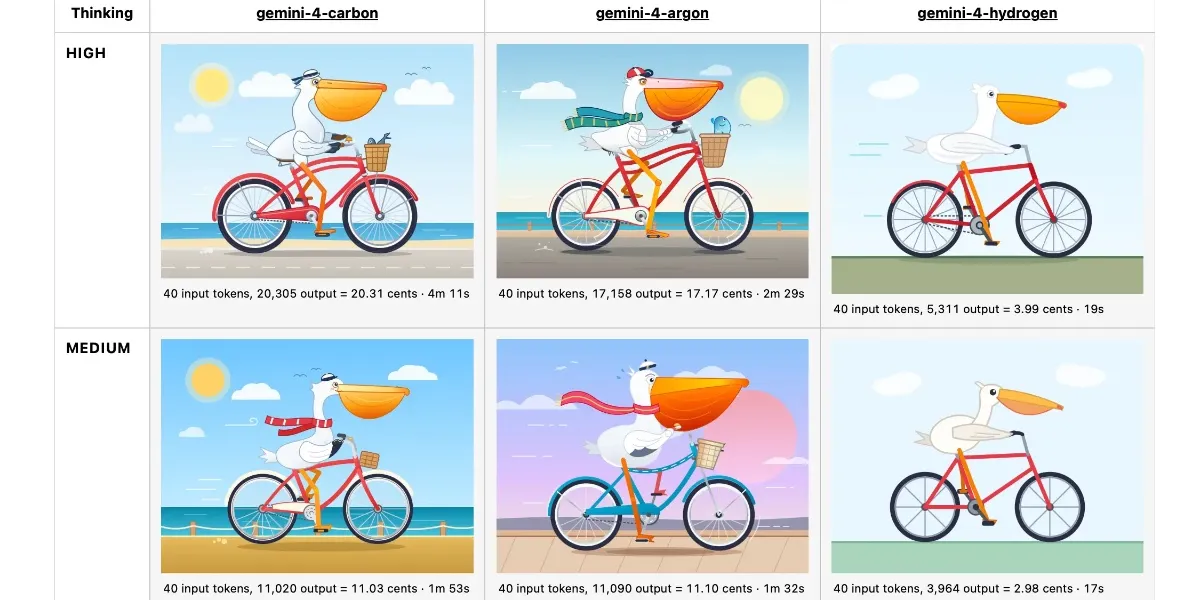
- Willison's pelican test (an informal drawing prompt) compared all three models at three effort levels. It is a quick reproducible check, not a benchmark (pelican grid).
Claims and evidence
- Independent: Artificial Analysis scores Hydrogen 51 at its default setting (Argon at high: 50; 3.8 Flash at high: 31).
- Google-reported: tasks finish 2.5x faster than 3.8 Flash. Terminal-Bench 4.1 score of 57% vs 18.2%.
- Customer-reported: Box says accuracy on its Complex Work Eval rose from 74% to 79% (VentureBeat).
Read the full section
- Independent: Artificial Analysis scores Hydrogen 51 at its default setting (Argon at high: 50; 3.8 Flash at high: 31). It scores 54 at xhigh (VentureBeat; Crypto Briefing).
- Google-reported: tasks finish 2.5x faster than 3.8 Flash; Terminal-Bench 4.1 score of 57% vs 18.2%; first place on Vals Tax Agent Bench at 52.3% (Google).
- Customer-reported: Box says accuracy on its Complex Work Eval rose from 74% to 79% (VentureBeat).
- Commentary: Willison found Hydrogen's pelicans much weaker than its siblings', given how close the prices are (Willison).
Context and prior work
Gemini 3.8 Flash costs $0.75/$3.75 at its introductory rate through 31 December, then moves to the same $1.50/$7.50 as Hydrogen (VentureBeat). Carbon ranked first on Artificial Analysis when announced (score 59) (SmartScope). By 10 November it had dropped to fourth (OrcaRouter). Willison's llm 0.37 core release on 2 November preceded this plugin update (Willison).
Read the full section
Hydrogen replaces the Flash tier. Gemini 3.8 Flash costs $0.75/$3.75 at its introductory rate through 31 December, then moves to the same $1.50/$7.50 as Hydrogen (VentureBeat). Carbon ranked first on Artificial Analysis when announced (score 59) (SmartScope). By 10 November it had dropped to fourth (OrcaRouter). Willison's llm 0.37 core release on 2 November preceded this plugin update (Willison).
Limitations, safety and contested findings
- Google-reported safety figures: 81% less "agentic overreach" (acting beyond what was asked), a 96.7% honesty rate and 2.3x more resistance to prompt injection (Google).
- Conflicting reports on Argon's price. SmartScope lists Argon at $2/$10 with no scheduled increase (SmartScope). Willison's table shows it doubling on 1 December.
- Conflicting reports on Carbon access. SmartScope describes Carbon as restricted to cyber defenders. OrcaRouter reports general availability on 10 November.
Read the full section
- Google-reported safety figures: 81% less "agentic overreach" (acting beyond what was asked), a 96.7% honesty rate and 2.3x more resistance to prompt injection (Google). No independent replication of these figures was found.
- Conflicting reports on Argon's price. SmartScope lists Argon at $2/$10 with no scheduled increase (SmartScope). Willison's table shows it doubling on 1 December.
- Conflicting reports on Carbon access. SmartScope describes Carbon as restricted to cyber defenders. OrcaRouter reports general availability on 10 November. The difference likely reflects when each was published.
- A date mismatch on the GitHub release page shows 2024, which conflicts with the 2026 release posts.
Business and practitioner implications
- Cost per task: Before 1 December, Hydrogen is only 25% cheaper per token than Carbon and Argon. Afterward it is 75% cheaper (Willison).
- Workflow split: Google pitches Hydrogen as the fast model that writes code, runs tests and checks changes, while Carbon or Argon handle system design and hard bugs.
- Search footprint: Search's VP of Product Robby Stein calls this Search's biggest model upgrade yet (Google Search).
Read the full section
- Cost per task: Before 1 December, Hydrogen is only 25% cheaper per token than Carbon and Argon; afterward it is 75% cheaper (Willison). Budget for December rates now.
- Workflow split: Google pitches Hydrogen as the fast model that writes code, runs tests and checks changes, while Carbon or Argon handle system design and hard bugs.
- Search footprint: Search's VP of Product Robby Stein calls this Search's biggest model upgrade yet (Google Search). Publishers should expect AI Mode to show a broader range of links.
- High-volume work: for cheap bulk tasks, Haiku 5.5 and Luna stay far cheaper per token.