
RoboticsMachines in the physical world
Amazon's Ring launches Ring Robotics with an indoor Drone Cam and a $999.99 Rover Cam patrol robot for businesses
Ring has formed Ring Robotics and is launching two products: an indoor flying Drone Cam for homes and a wheeled Rover Cam for businesses. Both run on a shared autonomy system called AI Pilot. They revive two earlier Amazon devices that failed to last.
From the TechCrunch AI article of November 10, 2026 and cited sources: Rover Cam is scheduled to ship in the US on December 16 for $999.99. [1] [3] [7] [8]
SOURCES[1] Ring, known for its doorbell cameras, launches a home… techcrunch.com[3] CNBC: Amazon's Ring unveils flying drone and robot cnbc.com[7] CEPro: Ring Launches Ring Robotics cepro.com
 AT Pulse research deskPublished · Updated · 5 min read · AI-assisted analysis
AI-assisted, not human-edited. Methodology Corrections Who owns this site
- Original source
- TechCrunch AI article, independent perspective
- Brief by
- AT Pulse research desk AI-assisted; publisher and contact on the desk page
- When
- November 10, 2026 article published
- Covered
- Nov 11 edition
- Evidence
- 9 sources across 8 sites
- 1Ring, known for its doorbell cameras, launches a home…techcrunch.com
- 2Hands-on with Ring’s new AI drone camera for your hometheverge.com
- 3CNBC: Amazon's Ring unveils flying drone and robotcnbc.com
- 4Digital Trends: Ring Always Home Camdigitaltrends.com
- 5TechCrunch: Amazon discontinues Astro for Businesstechcrunch.com
- 6ABC17/CNN: Ring cancels Flock partnershipabc17news.com
Reach: not measured yet
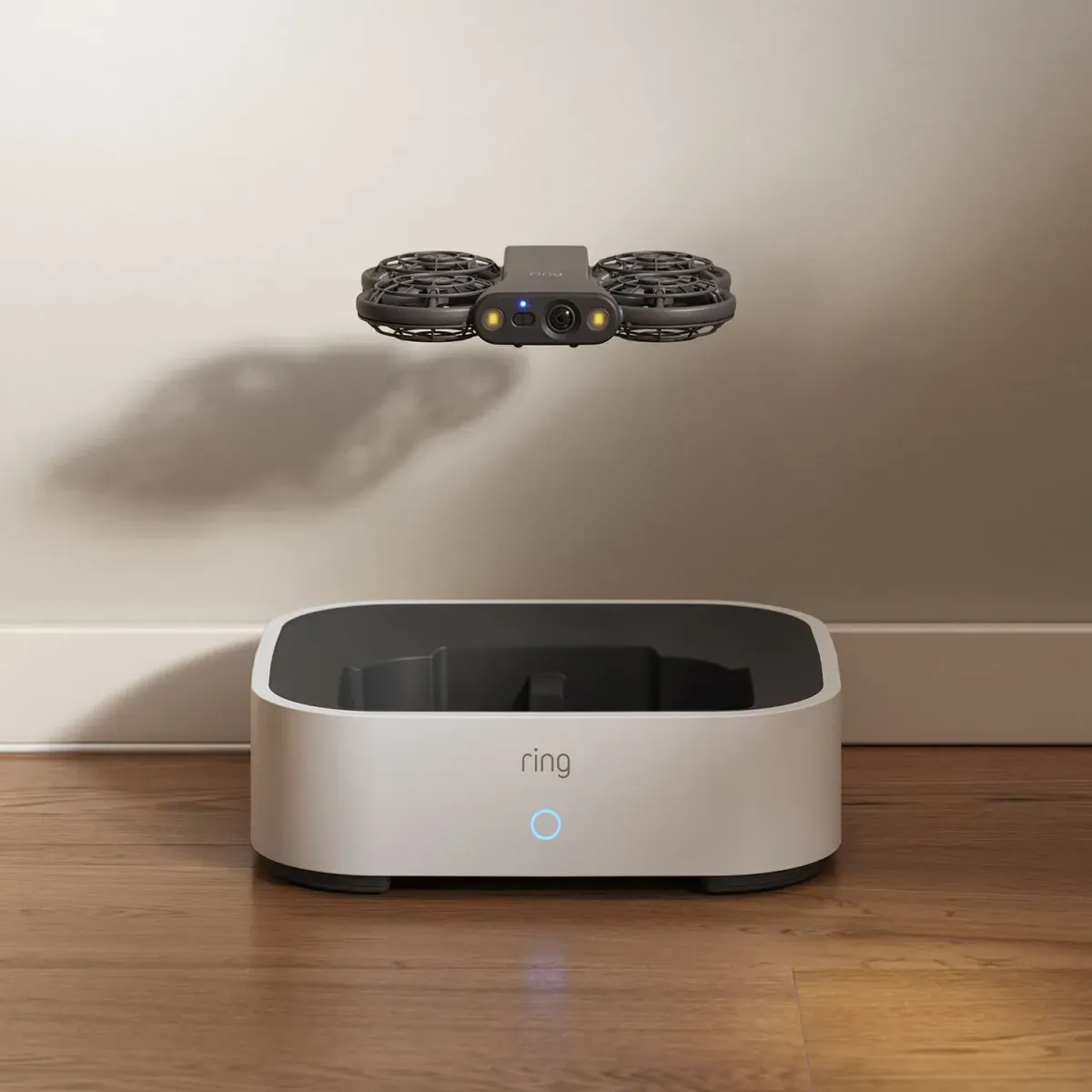
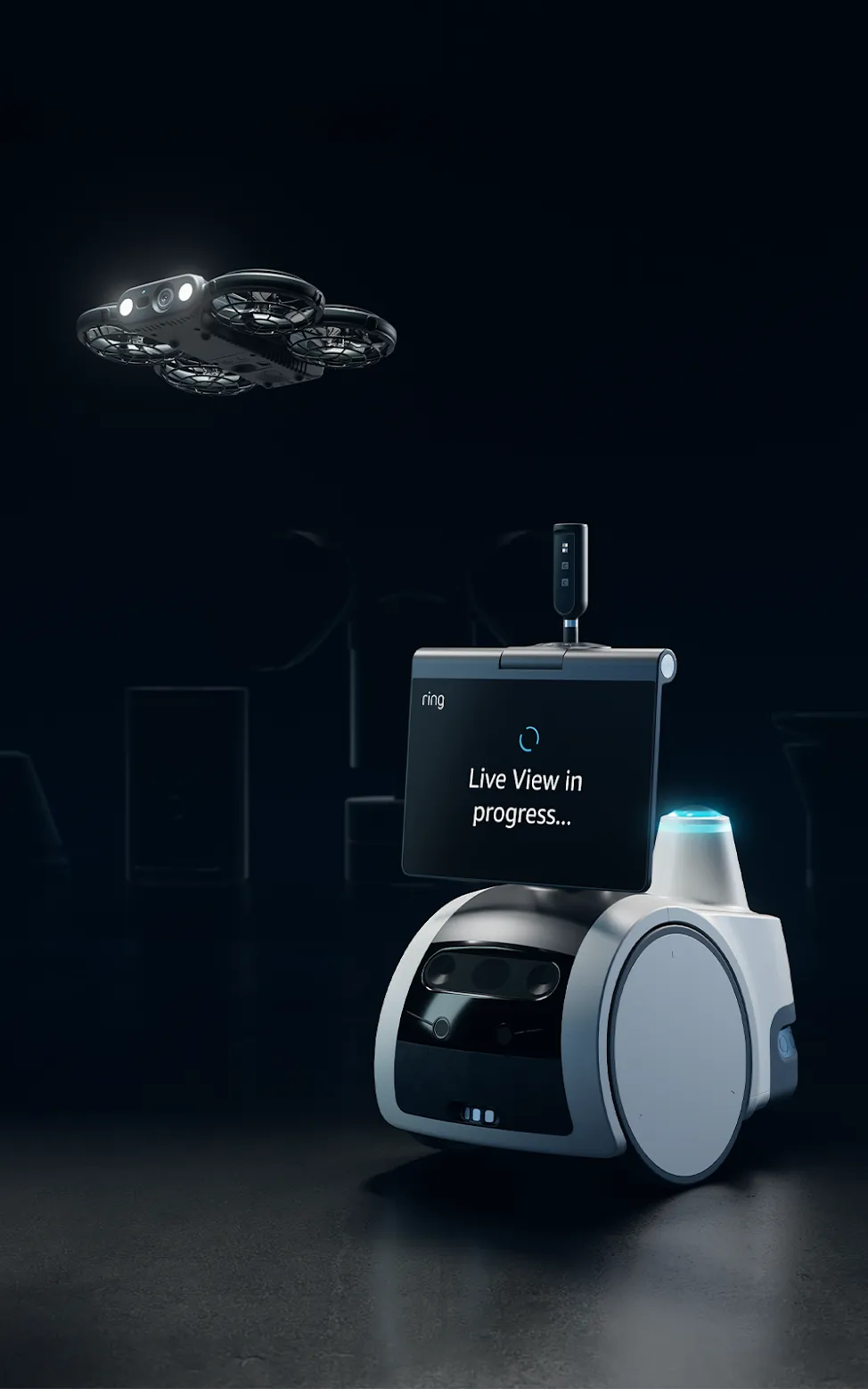
Rover Cam is scheduled to ship in the US on December 16 for $999.99. It has video up to 4K, a telescoping periscope camera, a siren and a light tower. Drone Cam is due January 27, 2027, if it gets FCC approval. It records 2K video, launches from a dock, runs scheduled patrols and flies to Ring Alarm triggers. Both need a $5/month subscription and are controlled through Alexa Home Map. [1] [3] [7] [8]
Both products build on earlier Amazon devices. Drone Cam returns to the roughly $250 flying Always Home Cam that Ring first showed in 2020, which never shipped widely. Rover Cam is described as a repurposed Astro. Amazon shut down the business version of Astro in 2024, and it cost $2,350 plus $60 a month, compared with $999.99 plus $60 a year for Rover Cam. [3] [4] [5]
Ring's documentation lists clear operating limits. Drone Cam flies up to 8 minutes under controlled conditions and has trouble with mirrors, glass, reflective floors and plain walls. Rover Cam works on one floor only, cannot climb stairs, and cannot handle floor transitions over 1.375 inches or black glossy floors. Ring has not disclosed AI Pilot's model design, how processing is split between device and cloud, or any navigation benchmarks. [7] [9]
Privacy objections are already being raised. A surveillance-oversight advocate warned that cameras moving around inside homes raise the risk of breaches. Reporting notes that Ring's cloud can still briefly access recordings under its TAKE encryption, and Amazon did not say how floor-plan data is secured. The launch also follows Ring's 2023 FTC settlement and its cancelled partnership with police-tech firm Flock Safety. [6] [8] [9]
So far the evidence is specs, prices and Ring's own list of limits; no independent testing exists.
Read the full assessment
If the robots ship as described, a patrol robot under $1,000 makes small-business pilots cheaper, while cameras that move around homes raise new data-governance questions.
Executive brief
Ring has created a robotics division, Ring Robotics. Its first two products are an indoor flying camera for homes and a wheeled patrol robot for businesses. The most notable detail is how long the drone took: Ring first showed a $250 flying home camera in September 2020, and the new Drone Cam is due January 27, 2027, at about the same price. Amazon also says the drone still lacks FCC authorization. The business robot, Rover Cam, ships December 16 for $999.99 and builds on Amazon's Astro, whose business version was shut down in 2024. Privacy advocates are already objecting.
What changed and event timeline
Flying camera first shown
Ring announced the Always Home Cam at Amazon's devices event for $250, with shipping promised for 2021. It never shipped widely ().
Astro for Business discontinued
Amazon shut down its $2,350 business security robot seven months after launch. Units stopped working September 25, and buyers got refunds plus a $300 credit ().
Flock partnership cancelled
After a criticized Super Bowl ad for its "Search Party" feature, Ring dropped a planned integration with police-tech firm Flock Safety. Ring says the integration never went live ().
Ring Robotics announced
Ring unveiled Drone Cam and Rover Cam, both running a shared autonomy system it calls "AI Pilot" ().
Capabilities and access
- Ring Drone Cam (indoor only): 2K video, 148° field of view, 360° rotation in flight, and LED lights for low-light recording.
- Ring Rover Cam: up to 4K video, a telescoping periscope camera, 360° scans at each stop, a siren, a light tower, two-way audio, and person detection while docked (CEPro).
- Subscription: both require a plan at $5/month or $60/year (NBC News).
Read the full section
- Ring Drone Cam (indoor only): 2K video, 148° field of view, 360° rotation in flight, and LED lights for low-light recording. Ring says flights last up to 8 minutes on a new battery under controlled conditions. It launches from a dock, can run scheduled patrols, and flies to Ring Alarm triggers (CEPro). FAA rules keep it indoors (CNBC).
- Ring Rover Cam: up to 4K video, a telescoping periscope camera, 360° scans at each stop, a siren, a light tower, two-way audio, and person detection while docked (CEPro).
- Subscription: both require a plan at $5/month or $60/year (NBC News).
- Control: both work through the new Alexa Home Map.
Technical analysis for researchers and developers
- AI Pilot: Ring describes it as combining cameras, "specialized vision models," on-device sensors and cloud processing (The Register).
- Mapping: during setup, the user carries the drone through the space.
- Known failure modes: Ring's own documentation lists several.
Read the full section
- AI Pilot: Ring describes it as combining cameras, "specialized vision models," on-device sensors and cloud processing (The Register). Ring has not disclosed model architecture, how work is split between the device and the cloud, or any navigation benchmarks.
- Mapping: during setup, the user carries the drone through the space. The system builds a floor plan, labels rooms and suggests patrol points such as doors and windows (CEPro).
- Known failure modes: Ring's own documentation lists several.
- The drone struggles with reflective floors, plain matte walls, glass and mirrors, which fits a vision-based localization system.
- The Rover can't climb stairs, works on one floor only, and can't handle floor transitions over 1.375″ or black glossy floors (CEPro).
- No independent evaluation exists yet.
Claims and evidence
- "Guard on patrol who never clocks out": this is Ring's marketing line (TechCrunch).
- Drone price conflicts: TechCrunch reports $270. CNBC and Ring-sourced trade coverage report $249.99 (CNBC).
- Rover video: TechCrunch describes "continuous 4K" streaming, while CEPro says "up to 4K."
Read the full section
- "Guard on patrol who never clocks out": this is Ring's marketing line (TechCrunch). The 8-minute flight time and controlled test conditions undercut it for the drone.
- Drone price conflicts: TechCrunch reports $270. CNBC and Ring-sourced trade coverage report $249.99 (CNBC).
- Rover video: TechCrunch describes "continuous 4K" streaming, while CEPro says "up to 4K."
- "Privacy is the default": this is Ring's own statement (NBC News).
- Inspired by Astro customer feedback: reported by TechCrunch, citing Ring.
Context and prior work
- Always Home Cam: the 2020 flying camera had the same price and concept (Digital Trends).
- Astro for Business: it offered route patrols for $2,350 plus $60/month and was retired in 2024 (TechCrunch).
- Earlier privacy disputes: The Register lists Ring's $5.8M FTC settlement in 2023 and the iRobot acquisition that collapsed amid privacy objections, both involving home-data concerns (The Register).
Read the full section
- Always Home Cam: the 2020 flying camera had the same price and concept (Digital Trends).
- Astro for Business: it offered route patrols for $2,350 plus $60/month and was retired in 2024 (TechCrunch). CNBC describes the Rover as a repurposed Astro (CNBC).
- Earlier privacy disputes: The Register lists Ring's $5.8M FTC settlement in 2023 and the iRobot acquisition that collapsed amid privacy objections, both involving home-data concerns (The Register).
Limitations, safety and contested findings
- Breach risk: Michelle Dahl of the Surveillance Technology Oversight Project warns that cameras moving around inside homes raise breach risk.
- Encryption caveat: The Register reports that TAKE encryption still briefly lets Ring's cloud access recordings, and that Amazon did not answer how floor-plan data is secured (The Register).
- Storage: it's unclear whether local video storage will be offered (TechCrunch).
Read the full section
- Breach risk: Michelle Dahl of the Surveillance Technology Oversight Project warns that cameras moving around inside homes raise breach risk. She called the launch "bizarre" given those issues (NBC News).
- Encryption caveat: The Register reports that TAKE encryption still briefly lets Ring's cloud access recordings, and that Amazon did not answer how floor-plan data is secured (The Register).
- Storage: it's unclear whether local video storage will be offered (TechCrunch).
- Ring's mitigations: LED recording indicators, and a Rover Sleep Mode that retracts the mast and turns off the microphone (CEPro).
Business and practitioner implications
- Price shift: the Rover costs less than half of Astro for Business, $999.99 plus $60/year versus $2,350 plus $60/month.
- Shipping risk: the drone depends on FCC approval and on a concept that slipped for six years.
- Data governance: buyers should ask for written terms on floor-plan data, cloud access under TAKE, and law-enforcement request policies before deploying.
Read the full section
- Price shift: the Rover costs less than half of Astro for Business, $999.99 plus $60/year versus $2,350 plus $60/month. That lowers the bar for small-business pilots, but floor constraints (one level, no stairs, limited floor transitions) will rule out many sites.
- Shipping risk: the drone depends on FCC approval and on a concept that slipped for six years. Plan around the possibility that it doesn't ship on time.
- Data governance: buyers should ask for written terms on floor-plan data, cloud access under TAKE, and law-enforcement request policies before deploying.
- Benchmarking: Ring's documented limitations on reflective and featureless surfaces are a useful checklist for comparing it with other indoor autonomy products.
The source trail.
Sources (9)
Ring, known for its doorbell cameras, launches a home security drone and an enterprise security robot
Article text retrieved; extracted text may omit tables or interactive elements.
techcrunch.comHands-on with Ring’s new AI drone camera for your home
Related coverage; assess separately
theverge.com