
ModelsArchitectures & capability
Meta releases Muse Ember, a low-cost small model for high-volume agent tasks
Meta Superintelligence Labs' Muse Ember is a proprietary small model built to carry out agent work planned by the larger Muse Wonder. It ranks second of 33 comparable models on the Artificial Analysis index at about $0.14 per task, but trails Haiku 5.5 on one coding benchmark.
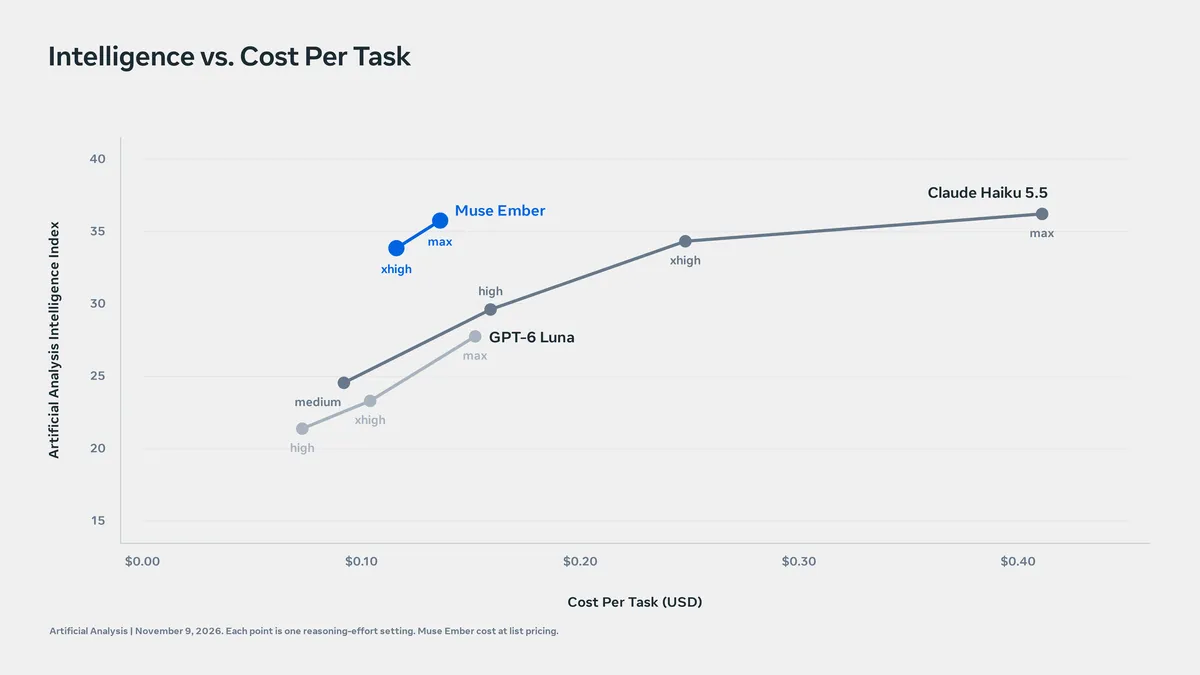
From the TechCrunch AI article of November 9, 2026 and cited sources: Artificial Analysis scores Ember at 36 on its Intelligence Index, second among 33 comparable models, at about $0.14 per task. [4] [5] [2]
SOURCES[4] Artificial Analysis: Muse Ember artificialanalysis.ai[5] Meta: Introducing Muse Ember research.meta.ai[2] Simon Willison: Muse Ember simonwillison.net
 AT Pulse research deskPublished · Updated · 5 min read · AI-assisted analysis
AI-assisted, not human-edited. Methodology Corrections Who owns this site
- What happened
- Artificial Analysis scores Ember at 36 on its Intelligence Index, second among 33 comparable models, at about $0.14 per task. [4] [5] [2]
- Original source
- TechCrunch AI article, independent perspective
- Brief by
- AT Pulse research desk AI-assisted; publisher and contact on the desk page
- When
- November 9, 2026 article published
- Covered
- Nov 10 edition
- Evidence
- 9 sources across 8 sites
- 1TechCrunch: Meta releases Muse Embertechcrunch.com
- 2Simon Willison: Muse Embersimonwillison.net
- 3Meta Just Released a CRAZY CHEAP AI Model?!reddit.com
- 4Artificial Analysis: Muse Emberartificialanalysis.ai
- 5Meta: Introducing Muse Emberresearch.meta.ai
- 6Meta Model API docs: Muse Emberdev.meta.ai
QuietHow it’s measured
Hacker News · 10 likes
Reach blends public engagement (views, likes, comments, shares, stars) from the platforms where the story or its original source lives: YouTube, Hacker News, GitHub, Substack and similar. A video and the article written from its transcript share one score, taken from the video. Platforms with no data are left out rather than counted as zero, and the age of a story never lowers its score.
Artificial Analysis scores Ember at 36 on its Intelligence Index, second among 33 comparable models, at about $0.14 per task. Meta says this matches Claude Haiku 5.5's best score at roughly a third of the cost per task. Ember's list prices are the same as Haiku's and GPT-6 Luna's: $0.10 per million input tokens and $0.50 per million output tokens. Prices triple above 200K input tokens, and Ember uses more output tokens than the median model. [4] [5] [2]
Meta's own figures put Ember ahead of Haiku and Luna on agent and computer-use tests. The widest gap is on AutomationBench-AA, where Ember scores 37.8% against 13.9% and 20.2%. Its leads on OSWorld 2.1 and Terminal-Bench 4.0 are small. These are vendor-reported numbers, and most have not been reproduced. Meta also reports that Ember loses to Haiku on FrontierCode 2.0-AA, 27.2% to 34.9%. [5] [8] [7]
Meta positions Ember as the high-volume worker under Muse Wonder, a planner priced about 40 times higher. According to Meta, Ember takes text, image, video, audio and PDF input and returns text only. It has a context window of about 1 million tokens and works with the Messages and Chat Completions APIs. Ember is also listed on Google Cloud and Oracle Cloud. [1] [2] [6] [7]
Reasoning effort has six levels and defaults to max, and Meta published benchmark results only at max. In early hands-on tests, quality did not rise steadily with effort, and one request at the high setting failed to return a complete drawing. Teams should therefore test effort levels on each task. [5] [6] [2]
Artificial Analysis ranks Ember near the top of its tier on cost per task. Implication: the three small models share the same list prices, so real workload cost depends on token use, caching and context length. Teams should test on their own tasks.
Executive brief
Meta Superintelligence Labs' new small model, Muse Ember, is the second-highest scorer of 33 comparable models on the Artificial Analysis Intelligence Index (36 points), at about $0.14 per task. Meta claims that equals Claude Haiku 5.5's best score at roughly a third of the cost per task (Meta). Per-token list prices match Haiku and GPT-6 Luna: $0.10 per million input tokens and $0.50 per million output. Meta pitches Ember as the cheap worker in a two-tier agent setup: "Muse Wonder plans, Muse Ember handles the volume" (TechCrunch). Meta's own tables show Ember still loses to Haiku on one coding benchmark.
What changed and event timeline
Muse Spark launches
Meta's mid-weight model was the first under the Muse brand. Ember is the fourth ().
Glimmer and Muse Agent
Glimmer, an open-source twin of Spark, shipped in August. The consumer Muse Agent followed in September, and TechCrunch describes its success as unexpected ().
Muse Wonder, the frontier tier
Wonder is the planner Meta pairs with Ember. Simon Willison puts it at about 40 times Ember's price ().
Muse Ember released
Ember shipped as
muse-ember-1.0on Meta's Model API and Muse Code, with Google Cloud and Oracle Cloud also listed (;).First hands-on tests and pricing analysis
Willison found that output quality did not track reasoning level cleanly, and the "high" setting failed to return a complete SVG. He also showed that long-context pricing places Ember between Luna and Haiku ().
Capabilities and access
- Model:
muse-ember-1.0. It reads text, images, video, audio and PDFs and outputs text only (Meta API docs). - Size limits: a 1,048,576-token context window and up to 524,288 output tokens per call.
- Reasoning effort: six levels, from minimal to max. The default is max.
Read the full section
- Model:
muse-ember-1.0. It reads text, images, video, audio and PDFs and outputs text only (Meta API docs). - Size limits: a 1,048,576-token context window and up to 524,288 output tokens per call.
- Reasoning effort: six levels, from minimal to max. The default is max.
- Endpoints: Responses, Chat Completions and Messages APIs. The Model API offers it in Standard (pay-as-you-go) mode only, and all Muse Code plans include it.
- Pricing: $0.10 in / $0.004 cached / $0.50 out per million tokens up to 200K input tokens. Above 200K it rises to $0.30 / $0.012 / $1.50 (Simon Willison).
- Weights: proprietary, not released (Artificial Analysis).
Technical analysis for researchers and developers
- Architecture: Meta has not disclosed parameter count, architecture or training data.
- How Meta evaluated it: Meta's results mix Artificial Analysis Intelligence Index v5 (dated November 9) with Meta's internal tests.
- Speed and verbosity: Artificial Analysis measured 446 output tokens per second and 4.37 seconds to the first answer token.
Read the full section
- Architecture: Meta has not disclosed parameter count, architecture or training data. It describes Ember only as the "efficient execution model" of the Muse family (Meta API docs).
- How Meta evaluated it: Meta's results mix Artificial Analysis Intelligence Index v5 (dated November 9) with Meta's internal tests. All models ran at maximum reasoning effort (Meta). Results at lower effort levels, which are cheaper, are not reported.
- Speed and verbosity: Artificial Analysis measured 446 output tokens per second and 4.37 seconds to the first answer token. Ember used 115M output tokens on the index, against a median of 90M, so it is somewhat verbose (Artificial Analysis).
- Implementation: routing a request across the 200K-token line triples input cost. Effort level is a cost and quality setting that needs testing per task, not a guaranteed quality dial.
Claims and evidence
- Agent and computer-use benchmarks (Meta-reported): AutomationBench-AA 37.8% vs Haiku 13.9% and Luna 20.2%. OSWorld 2.1 69.5% vs 68.9% and 50.5%.
- A loss Meta reports: FrontierCode 2.0-AA 27.2% vs Haiku's 34.9% (Meta; BigGo).
- Third-party check: Artificial Analysis's own model page independently lists Ember at 36 on the index and $0.14 per task (Artificial Analysis).
Read the full section
- Agent and computer-use benchmarks (Meta-reported): AutomationBench-AA 37.8% vs Haiku 13.9% and Luna 20.2%. OSWorld 2.1 69.5% vs 68.9% and 50.5%. Terminal-Bench 4.0 40.9% vs 39.2% and 16.4% (Meta).
- A loss Meta reports: FrontierCode 2.0-AA 27.2% vs Haiku's 34.9% (Meta; BigGo).
- Third-party check: Artificial Analysis's own model page independently lists Ember at 36 on the index and $0.14 per task (Artificial Analysis). That supports Meta's efficiency-frontier claim. Most of the other benchmark figures have not been reproduced independently.
- Willison's comparison: he judged Ember's test drawings comparable to Wonder's. This is an informal test, not a benchmark (Simon Willison).
Context and prior work
Ember enters the small-model tier occupied by Claude Haiku 5.5 and GPT-6 Luna (Simon Willison). TechCrunch also describes it as price-competitive with open models such as DeepSeek V4.1 Flash and GLM 5.3 Flash (TechCrunch). Within Meta's own lineup, open-weight Muse Glimmer costs less per task, about $0.06 (Artificial Analysis). The planner/executor split Meta promotes is an established way to build agents.
Limitations, safety and contested findings
- Safety: Meta says it evaluated Ember under its Superintelligence Scaling Framework for chemical/biological, cyber and loss-of-control risks. No outside party has audited these results.
- Media inputs: Meta lists native audio and video input (Meta API docs), while Artificial Analysis lists text and image only (Artificial Analysis).
- Effort levels: Willison saw a failure at "high" and inconsistent quality across levels (Simon Willison).
Read the full section
- Safety: Meta says it evaluated Ember under its Superintelligence Scaling Framework for chemical/biological, cyber and loss-of-control risks. It reports results below high-risk thresholds and also tested prompt-injection resistance (Meta). No outside party has audited these results.
- Media inputs: Meta lists native audio and video input (Meta API docs), while Artificial Analysis lists text and image only (Artificial Analysis).
- Effort levels: Willison saw a failure at "high" and inconsistent quality across levels (Simon Willison).
- Engineering tasks: Haiku leads on real-world engineering tasks (Digital Trends).
Business and practitioner implications
- Price competition has moved to cost per task.
- Cached input is cheap. Ember's $0.004 per million suits repeated-prompt workloads such as support triage and extraction.
- Switching is easy to try. Teams should benchmark on their own tasks, especially coding.
Read the full section
- Price competition has moved to cost per task. All three small models list at $0.10/$0.50 per million tokens, so token efficiency and long-context thresholds decide what a workload actually costs (Simon Willison).
- Cached input is cheap. Ember's $0.004 per million suits repeated-prompt workloads such as support triage and extraction.
- Switching is easy to try. Support for the Messages and Chat Completions APIs means existing harnesses can test Ember with little change (Meta API docs). Teams should benchmark on their own tasks, especially coding.
- Deployment options are wider. Google Cloud and Oracle Cloud availability means teams are not limited to Meta's API (Digital Trends).
The source trail.
Sources (9)
TechCrunch: Meta releases Muse Ember
techcrunch.comSimon Willison: Muse Ember
simonwillison.netMeta Just Released a CRAZY CHEAP AI Model?!
Related coverage; assess separately
reddit.com