
CodingSoftware & developer tools
Stanford's CS146S returns for a second year, with students now contributing to open-source AI projects
Stanford's CS146S, taught by Monaco Head of AI Mihail Eric, returns for its second year with assignments built around maintainer-reviewed contributions to open-source AI projects, reflecting a classroom where students now rely on coding agents rather than typing code.
From the Latent Space podcast episode of November 8, 2026 and cited sources: Last year's course relied mostly on simple teaching exercises that students could often finish in one pass. [2] [3]
SOURCES[2] Transcript: [One Million AI Engineer Special] How Stanford… rss.beehiiv.com[3] CS146S course site themodernsoftware.dev
 AT Pulse research deskPublished · Updated · 4 min read · AI-assisted analysis
AI-assisted, not human-edited. Methodology Corrections Who owns this site
- What happened
- Last year's course relied mostly on simple teaching exercises that students could often finish in one pass. [2] [3]
- Original source
- Latent Space podcast episode, independent perspective
- Brief by
- AT Pulse research desk AI-assisted; publisher and contact on the desk page
- When
- November 8, 2026 podcast episode published
- Covered
- Nov 9 edition
- Evidence
- 8 sources across 8 sites; transcript sourced
- 1Latent Space episode page and transcriptlspace.beehiiv.com
- 2Transcript: [One Million AI Engineer Special] How Stanford…rss.beehiiv.com
- 3CS146S course sitethemodernsoftware.dev
- 4Benzatine (republished Business Insider story)benzatine.com
- 5Built In: Monaco raises $50M Series Bbuiltin.com
- 6AIToolly: CS146S assignments on GitHub Trendingaitoolly.com
RisingHow it’s measured
YouTube video · 6.7K views · 82 likes
Reach blends public engagement (views, likes, comments, shares, stars) from the platforms where the story or its original source lives: YouTube, Hacker News, GitHub, Substack and similar. A video and the article written from its transcript share one score, taken from the video. Platforms with no data are left out rather than counted as zero, and the age of a story never lowers its score.
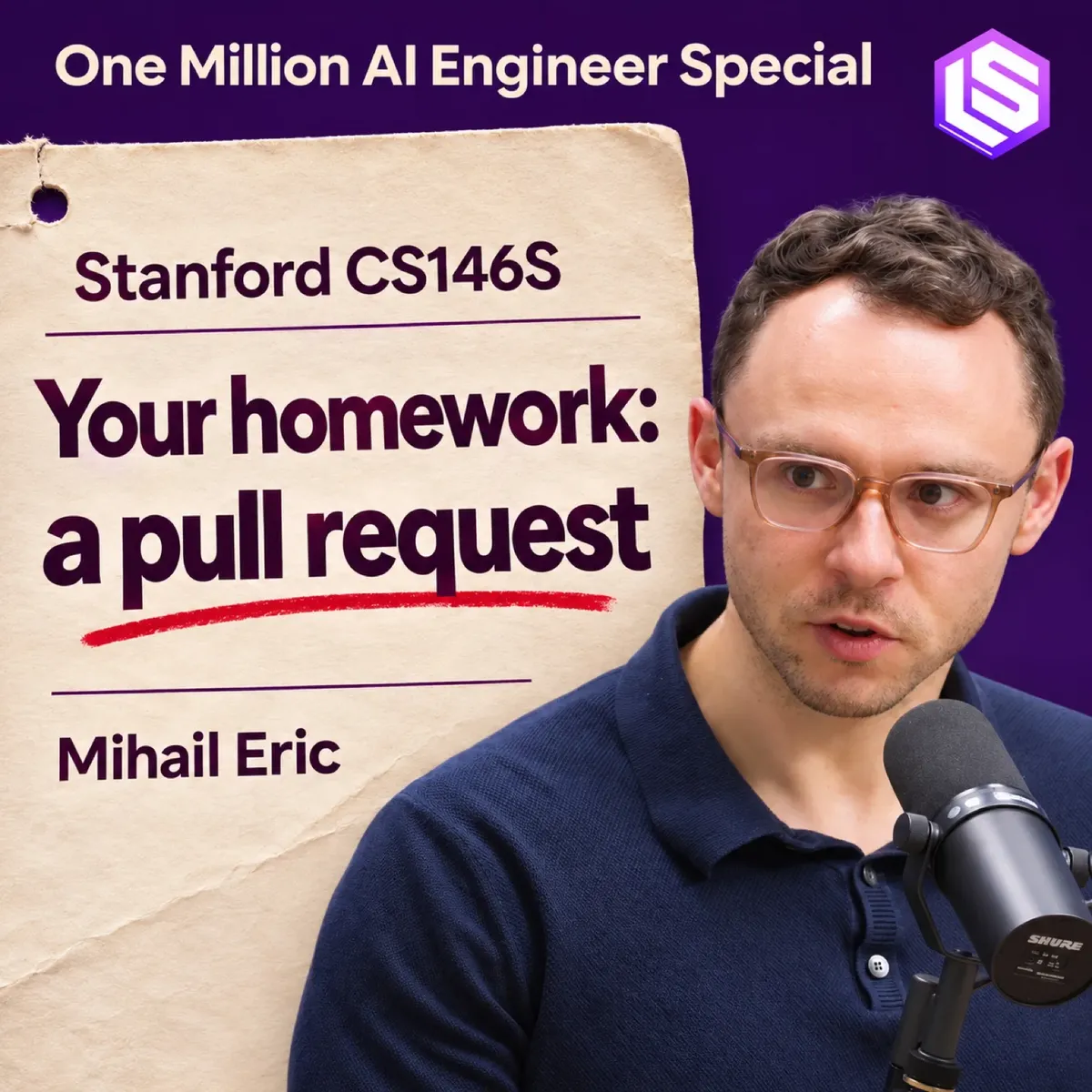
Last year's course relied mostly on simple teaching exercises that students could often finish in one pass. The Fall 2026 version replaces many of them with real contributions to 16 open-source AI projects, and those projects' maintainers review the work. Eric made the change after an informal survey found that none of his students still write code by hand; all of them use coding agents. [2] [3]
Eric says code review is now the main bottleneck, because one developer can open more than 30 pull requests a day. Teams can either review every change by hand or build agentic review they trust. He adds that many large companies are held back by more basic problems, such as backed-up merge queues and slow CI/CD, rather than a missing agent. [2]
Eric says Claude Code's system prompt has shrunk. Guidance it used to contain, such as how to use Git, is now expected to come from the model itself. This raises a trade-off between investing in the model or in the harness around it. As the hosts note, weaker local models may still need the examples that frontier models no longer require. [2]
Monaco follows a rule of buying tools to learn and building them to keep. It uses Devin for code review, a choice made on qualitative judgment. It built its own tools where no mature product existed, including Monocoder, a multi-agent coding environment built on Coder, and Hal, a Slack bot that debugs issues and opens pull requests. [2] [5]
The reviewed sources document a course redesign and practitioner claims, not measured outcomes.
Read the full assessment
The implication: as agents make code generation cheap, teams and educators may need to invest in review, CI/CD and mentorship rather than more generation tools.
Executive brief
Stanford's CS146S, "The Modern Software Developer," is back for a second year. Its instructor, Mihail Eric, says that in an informal survey of his students, not one still writes code by hand. Everyone uses coding agents (Latent Space episode, 00:10:58). Last year's course was mostly simple exercises. The 2026 version replaces many of those with real contributions to 16 open-source projects, reviewed by their maintainers (course site). Eric is also Head of AI at Monaco, a sales-software startup backed by Benchmark, and he uses Monaco's internal tooling as the practitioner side of the course.
What changed and event timeline
Course conceived
Eric says scattered blog posts on agentic coding pushed him to build a formal curriculum. He spent nine to ten months on the proposal before Stanford's committee approved it ().
Fall 2025: First offering draws press
Business Insider called it Stanford's hottest CS class because it embraces tools like Cursor and Claude. Guest speakers included Claude Code creator Boris Cherny ().
Monaco raises $50M Series B
Benchmark led the round, bringing total funding past $85M. Monaco had come out of stealth in February with an agent-driven sales platform ().
Assignments trend on GitHub
The public assignments repo reached GitHub Trending (). It now shows about 5.4k stars ().
Latent Space episode published
The conversation was recorded at the end of week one of the second offering, so it predates publication. The episode doubles as a celebration of the AI Engineer YouTube channel reaching one million subscribers ().
Capabilities and access
- CS146S is a 3-unit Fall 2026 course. Open-source partners include Browserbase, OpenHands, CrewAI and Vercel (course site).
- The public assignments use Python 3.12 with Poetry. The repo currently covers weeks 1 to 5 (GitHub).
- On top of the education plans students already have, Eric says Factory, Cognition and OpenAI are adding extra credits.
Read the full section
- CS146S is a 3-unit Fall 2026 course. Topics include MCP, agent skills, spec-driven development, "loop engineering" and the "software factory." Open-source partners include Browserbase, OpenHands, CrewAI and Vercel (course site).
- The public assignments use Python 3.12 with Poetry. The repo currently covers weeks 1 to 5 (GitHub).
- On top of the education plans students already have, Eric says Factory, Cognition and OpenAI are adding extra credits. The aim is that a $20/month plan does not cap student experiments (episode, 00:11:42).
Technical analysis for researchers and developers
- Eric says Claude Code's system prompt has shrunk. Host swyx describes the prompt as having grown and been cut more than once (00:29:59).
- Code review is now the bottleneck.
- Monaco runs a custom agent harness for sales work. "Monocoder," built on Coder, runs isolated multi-agent coding environments.
Read the full section
- Model vs. harness. Eric says Claude Code's system prompt has shrunk. Guidance that used to live there, such as how to use Git, is now expected to come from the model itself. Host swyx describes the prompt as having grown and been cut more than once (00:29:59). The practical point: a weaker local model may still need examples that a frontier model does not.
- Code review is now the bottleneck. Once one developer can open 30+ PRs a day, the choice is between gating every change by hand or building agentic review that people trust (01:12:45).
- Monaco's internal stack. Monaco runs a custom agent harness for sales work. "Monocoder," built on Coder, runs isolated multi-agent coding environments. "Hal" is a Slack bot that debugs issues and opens PRs (01:00:20).
Claims and evidence
- "No student types code by hand." This comes from Eric's informal class survey; no data is published (00:10:58).
- Leading agent vendors claim only about 30% fully agent-driven contributions. swyx said this about Warp and Factory in conversation.
- Claude Code's system prompt is about 20k tokens, later cut by roughly 80%. These are swyx's figures and no reviewed source corroborates them (00:29:59).
Read the full section
- "No student types code by hand." This comes from Eric's informal class survey; no data is published (00:10:58).
- Leading agent vendors claim only about 30% fully agent-driven contributions. swyx said this about Warp and Factory in conversation. There is no cited source (00:20:44).
- Claude Code's system prompt is about 20k tokens, later cut by roughly 80%. These are swyx's figures and no reviewed source corroborates them (00:29:59).
- Monaco chose Devin for code review. Eric says this was based on qualitative judgment, not a benchmark. swyx, who discloses past work on Devin's review feature, adds that review benchmarks exist but are rarely used (00:22:09).
- Monaco's growth. Customer and funding figures come from the company (Built In).
Context and prior work
- Eric modeled the course process on Chip Huyen's Stanford class on designing machine learning systems (00:02:31).
- The first offering's stated principle was "human-agent engineering" rather than vibe coding (course summary).
- Last year's lessons included k-shot prompting. Eric now treats that material as basic (01:59:27).
Limitations, safety and contested findings
- Dependencies are disputed.
- Strong "dark factory" positions get reversed. swyx notes that people who pushed full automation hard later recanted, and that even Claude Code's creator says he is often wrong (00:20:58).
- Eric warned in 2025 that week-one content could be outdated by week seven (BI story as republished).
Read the full section
- Dependencies are disputed. Eric leans toward building in-house to reduce supply-chain risk. swyx objects that custom code loses the bug discovery that comes from open source's large user base (01:22:10).
- Strong "dark factory" positions get reversed. swyx notes that people who pushed full automation hard later recanted, and that even Claude Code's creator says he is often wrong (00:20:58).
- Material ages fast. Eric warned in 2025 that week-one content could be outdated by week seven (BI story as republished).
Business and practitioner implications
- Fix the basics before adding agents.
- Monaco builds in-house only when no mature product exists (01:02:03).
- Ambitious projects (writing a browser, not photo-to-app demos) and rigorous benchmarks or evals stand out to hiring teams.
Read the full section
- Fix the basics before adding agents. For large companies, Eric says the real blockers are often backed-up merge queues and slow CI/CD, not a missing SRE bot (01:12:11).
- "Buy to learn, build to keep." Monaco builds in-house only when no mature product exists (01:02:03).
- Hiring signals. Ambitious projects (writing a browser, not photo-to-app demos) and rigorous benchmarks or evals stand out to hiring teams. SWE-bench started as a Princeton undergraduate project (02:00:05).
The source trail.
Sources (8)
Latent Space episode page and transcript
lspace.beehiiv.comTranscript: [One Million AI Engineer Special] How Stanford Teaches AI-Native Engineering — Mihail Eric, Monaco
published_transcript
rss.beehiiv.com