
CodingSoftware & developer tools
Simon Willison moves agent-written PR descriptions into collapsed GitHub details blocks under a human-approved summary
Simon Willison now puts a short, human-selected summary at the top of agent-opened pull requests and tucks the agent's full write-up inside a collapsed details/summary block labelled with the model, using HTML that GitHub Markdown already supports.
From the Simon Willison article of November 9, 2026 and cited sources: Willison says agent-written PR descriptions are usually accurate and thorough, but they are so long that reviewers stop reading. [1] [2] [5]
SOURCES[1] Simon Willison: Hide your slop PR descriptions behind… simonwillison.net[2] I've recently started hiding the bulk of my AI-generated… x.com[5] datasette PR #3052 github.com
 AT Pulse research deskPublished · Updated · 5 min read · AI-assisted analysis
AI-assisted, not human-edited. Methodology Corrections Who owns this site
- What happened
- Willison says agent-written PR descriptions are usually accurate and thorough, but they are so long that reviewers stop reading. [1] [2] [5]
- Original source
- Simon Willison article, independent perspective
- Brief by
- AT Pulse research desk AI-assisted; publisher and contact on the desk page
- Studies
- arXiv 2602.17084 (Feb 2026) [3] date from arXiv ID
- When
- November 9, 2026 article published
- Covered
- Nov 9 edition
- Evidence
- 9 sources across 7 sites
- 1Simon Willison: Hide your slop PR descriptions behind…simonwillison.net
- 2I've recently started hiding the bulk of my AI-generated…x.com
- 3Watanabe et al., How AI Coding Agents Communicate (arXiv)arxiv.org
- 4Simon Willison: Kenton Varda quote (8 July 2026)simonwillison.net
- 5datasette PR #3052github.com
- 6GitHub Docs: Organizing information with collapsed sectionsdocs.github.com
QuietHow it’s measured
Hacker News · 9 likes
Reach blends public engagement (views, likes, comments, shares, stars) from the platforms where the story or its original source lives: YouTube, Hacker News, GitHub, Substack and similar. A video and the article written from its transcript share one score, taken from the video. Platforms with no data are left out rather than counted as zero, and the age of a story never lowers its score.
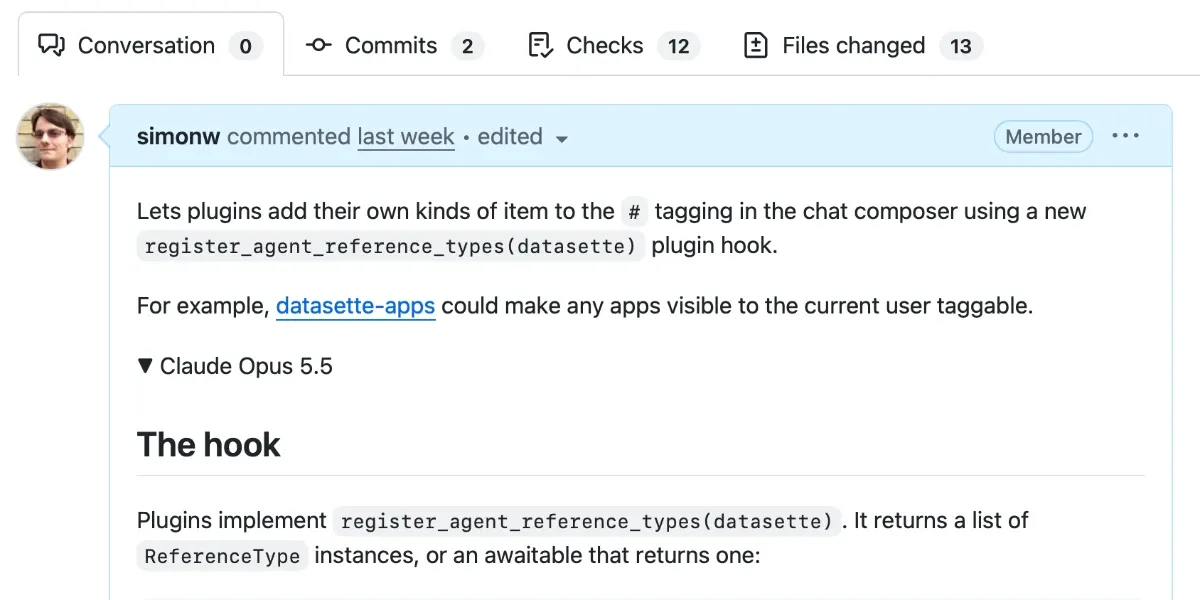
Willison says agent-written PR descriptions are usually accurate and thorough, but they are so long that reviewers stop reading. His fix is a brief opener he has approved, sometimes lifted from the agent's own output, followed by the full agent text in a collapsed section. The section is labelled with the model and effort level, for example "Claude Opus 5.5 Medium". [1] [2] [5]
The pattern uses only existing features. GitHub renders <details> and <summary> as a collapsible section that can hold headers, code blocks and images. Browsers have broadly supported the element since 2020, and agents can be told to produce the layout themselves. [6] [7]
an MSR '26 study of 33,596 agent PRs links description style to reviewer engagement and merge rates, though only by association.
Read the full assessment
Implication: a cheap layout convention could ease review load and record which model wrote what, but its effect is untested.
Executive brief
Simon Willison says AI-written pull request descriptions are a problem because they are too complete, not because they are wrong. Long, accurate agent prose still reads like slop, and reviewers stop reading. On 9 November 2026 he described his fix: put a short, human-approved opener at the top of the PR. Below it, the agent's full write-up sits in a collapsed <details><summary> block that GitHub already renders, labelled with the model name, such as "Claude Opus 5.5 Medium". It uses existing HTML and needs no tooling. It answers a complaint that has been growing among maintainers. No study has tested this specific pattern.
What changed and event timeline
Study links PR description style to review outcomes
Watanabe et al. finding that five coding agents write PR descriptions in different styles. Those differences go along with differences in reviewer engagement and merge rates. The paper was accepted at MSR '26.
Team ban on AI-written change descriptions
Kenton Varda said AI descriptions described details already visible in the code and left out the higher-level framing. He banned them from his team's PRs, commits and tickets,.
Datasette row-page PR merged
Replaced the one-row table with a vertical list of fields and was merged into main. It is one of the PRs Willison later cited as an example of the pattern.
Willison publishes the details-summary pattern
The gives five example PRs across datasette, datasette-agent and llm.
More detail
Capabilities and access
- Agents: Willison says most of his changes now arrive as PRs opened by Claude Code or Codex. The post gives no Codex model version.
- Mechanism: GitHub Markdown supports
<details>and<summary>, and anything inside stays collapsed until clicked. Adding<details open>makes a section start expanded (GitHub Docs). - Cost and access: free, and works in any GitHub issue, comment or PR description.
Read the full section
- Agents: Willison says most of his changes now arrive as PRs opened by Claude Code or Codex. The collapsed sections are labelled with the model and effort level, for example "Claude Opus 5.5 Medium" (post). The post gives no Codex model version.
- Mechanism: GitHub Markdown supports
<details>and<summary>, and anything inside stays collapsed until clicked. Adding<details open>makes a section start expanded (GitHub Docs). - Cost and access: free, and works in any GitHub issue, comment or PR description.
Technical analysis for researchers and developers
- Element rules:
<summary>must be the first child of<details>. Without it, browsers show a default label. - Content: headers, images and code blocks all work inside the collapsed block (GitHub Docs).
- Automation: agents can be told to produce this layout themselves.
Read the full section
- Element rules:
<summary>must be the first child of<details>. Without it, browsers show a default label. Anameattribute groups sections so only one is open at a time, and atoggleevent fires on state change. Browser support has been broad since January 2020 (MDN). - Content: headers, images and code blocks all work inside the collapsed block (GitHub Docs).
- Automation: agents can be told to produce this layout themselves. The summary label also serves as a light provenance record, showing which model and effort level wrote the text.
- Evaluation: the only evidence is Willison's own examples. No one has measured reviewer time or outcomes for this pattern.
Claims and evidence
- Agent descriptions are "accurate and comprehensive" but tiring to read. This is Willison's own experience (post).
- AI descriptions leave out higher-level framing. This is one practitioner's account (Varda via Willison), and it partly conflicts with Willison's view that the content is useful.
- Description style is associated with review responses and merge rates. The study covered 33,596 PRs from Copilot, Codex, Claude Code, Devin and Cursor (arXiv HTML).
Read the full section
- Agent descriptions are "accurate and comprehensive" but tiring to read. This is Willison's own experience (post).
- AI descriptions leave out higher-level framing. This is one practitioner's account (Varda via Willison), and it partly conflicts with Willison's view that the content is useful.
- Description style is associated with review responses and merge rates. The study covered 33,596 PRs from Copilot, Codex, Claude Code, Devin and Cursor (arXiv HTML). The data is observational, so it shows association, not cause.
- The pattern reduces reviewer burden. No source independently supports this.
Context and prior work
- Maintainers increasingly describe floods of AI-generated PRs as "slop" that adds to review load (search coverage, e.g. DEV Community).
- Willison treats the PR as his "unit of work": he uses it to bundle commits, record decisions and merge finished features (post).
- Collapsed sections are an old GitHub feature, long used for logs and long outputs (GitHub Docs).
Read the full section
- Maintainers increasingly describe floods of AI-generated PRs as "slop" that adds to review load (search coverage, e.g. DEV Community). Some argue the real bottleneck is reviewer attention, not code generation.
- Willison treats the PR as his "unit of work": he uses it to bundle commits, record decisions and merge finished features (post).
- Collapsed sections are an old GitHub feature, long used for logs and long outputs (GitHub Docs). The new part is using them to separate human judgement from agent text.
Limitations, safety and contested findings
- The two disagree on whether the agent text is worth keeping at all.
- Errors can hide in the collapsed text. Reviewers who never expand it will miss mistakes inside it.
- Willison says he sometimes lifts it from the agent's own output.
Read the full section
- Fix or ban? Varda bans AI descriptions outright (source). Willison keeps them but hides them. The two disagree on whether the agent text is worth keeping at all.
- Errors can hide in the collapsed text. Reviewers who never expand it will miss mistakes inside it. The opener is only as good as the judgement behind it.
- The human opener isn't always human-written. Willison says he sometimes lifts it from the agent's own output. His promise is that a human selected it, not that a human wrote it (post).
- The research is correlational. The MSR study does not test layout changes (arXiv).
Business and practitioner implications
- Team convention: put one or two human-checked sentences and a screenshot at the top of each PR, with the agent's detail in a collapsed block labelled with the model.
- Agent prompts and templates: tell agents to output this structure, which makes it cheap to enforce.
- Provenance: model and effort labels make AI involvement visible, which helps with audits and contribution policies.
Read the full section
- Team convention: put one or two human-checked sentences and a screenshot at the top of each PR, with the agent's detail in a collapsed block labelled with the model.
- Agent prompts and templates: tell agents to output this structure, which makes it cheap to enforce.
- Provenance: model and effort labels make AI involvement visible, which helps with audits and contribution policies.
- Policy choice: teams that see reviewer fatigue should decide between collapsing AI descriptions (Willison) and banning them (Varda), and track review time to see which works.
The source trail.
Sources (9)
Simon Willison: Hide your slop PR descriptions behind details/summary
simonwillison.netI've recently started hiding the bulk of my AI-generated GitHub PR descriptions behind a collapsed <details><summary> HTML tag (thankfully supported by GitHub Markdown) a
Related coverage; assess separately
x.com