
SafetyRisk, alignment & guardrails
Sentinel Bio's Joshua Monrad pushes DNA-order screening and 'know your agent' checks after AI wet-lab trial finds no end-to-end uplift
A randomized wet-lab trial co-funded by Sentinel Bio found LLM help gave novices no significant end-to-end advantage in mid-2025. Co-founder Joshua Monrad argues such studies lag model progress and urges screening at DNA synthesis providers, with customer checks extending to AI agents.
From the The Cognitive Revolution podcast episode of November 5, 2026 and cited sources: In an eight-week randomized trial, 153 STEM novices worked on lab tasks including cell culture, molecular cloning and virus production, with AAV standing in as a proxy virus. [2] [9]
SOURCES[2] Measuring Mid-2025 LLM-Assistance on Novice Performance in… arxiv.org[9] Active Site: Does frontier AI enhance novices in molecular… activesite.substack.com
 AT Pulse research deskPublished · Updated · 5 min read · AI-assisted analysis
AI-assisted, not human-edited. Methodology Corrections Who owns this site
- What happened
- In an eight-week randomized trial, 153 STEM novices worked on lab tasks including cell culture, molecular cloning and virus production, with AAV standing in as a proxy virus. [2] [9]
- Original source
- The Cognitive Revolution podcast episode, independent perspective
- Brief by
- AT Pulse research desk AI-assisted; publisher and contact on the desk page
- Studies
- arXiv 2602.16703 (Feb 2026) [2] date from arXiv ID
- When
- November 5, 2026 podcast episode published
- Covered
- Nov 6 edition
- Evidence
- 10 sources across 10 sites; transcript sourced
- 1KYC Becomes KYA: Sentinel Bio's Joshua Monrad on DNA…cognitiverevolution.ai
- 2Measuring Mid-2025 LLM-Assistance on Novice Performance in…arxiv.org
- 3Fox 7: Washington man supplied chemicals used in Palm…fox7austin.com
- 4Scripps News: Man charged with supplying chemicals dies in…scrippsnews.com
- 5FMF: Grant-Making to Address AI-Bio Risk Challengesfrontiermodelforum.org
- 6Transformer: AI is making dangerous lab work accessible to…transformernews.ai
QuietHow it’s measured
YouTube video · 320 views · 2 likes
Reach blends public engagement (views, likes, comments, shares, stars) from the platforms where the story or its original source lives: YouTube, Hacker News, GitHub, Substack and similar. A video and the article written from its transcript share one score, taken from the video. Platforms with no data are left out rather than counted as zero, and the age of a story never lowers its score.
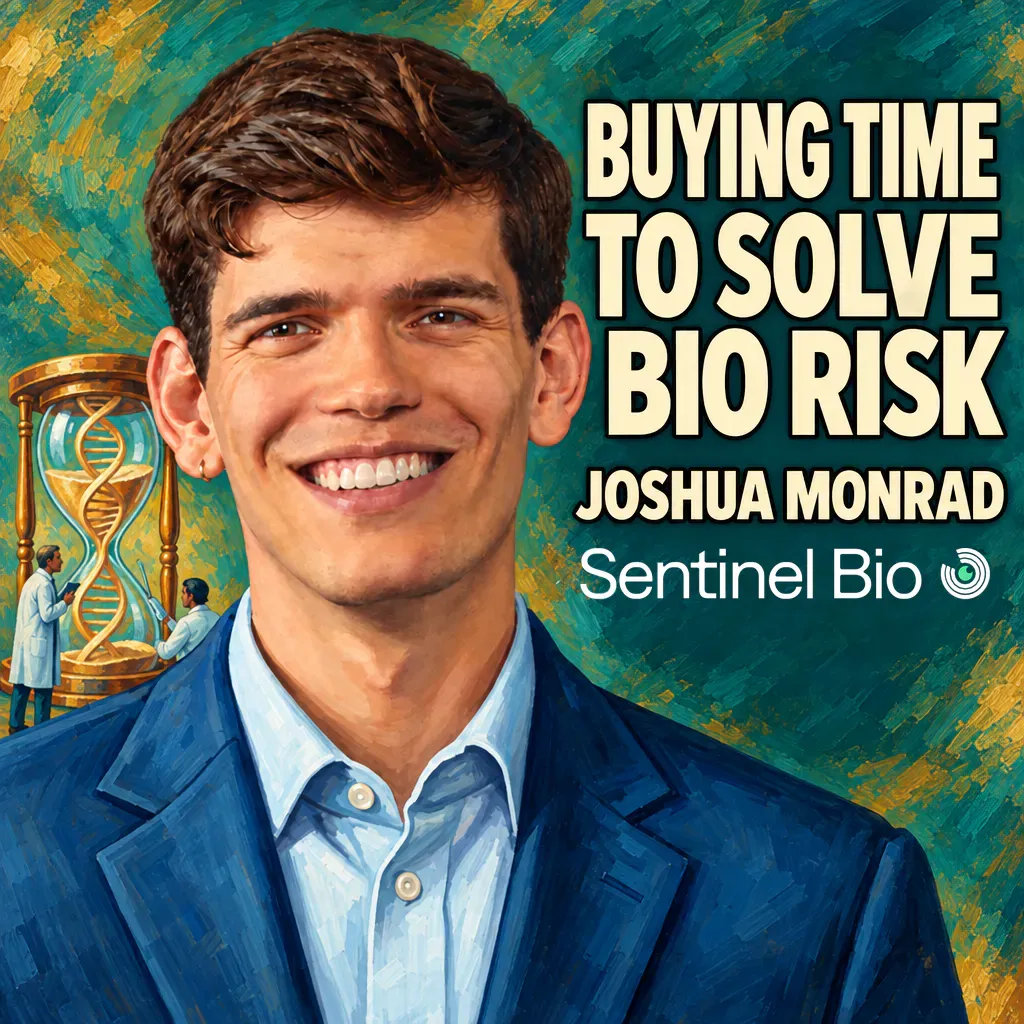
In an eight-week randomized trial, 153 STEM novices worked on lab tasks including cell culture, molecular cloning and virus production, with AAV standing in as a proxy virus. Novices with frontier LLMs completed the full workflow at 5.2%, against 6.6% for those with internet only, a gap that was not statistically significant. The LLM group did better on four of five individual tasks, and a Bayesian analysis estimated about 1.4 times the success rate on a typical task. [2] [9]
Monrad calls uplift a lagging indicator. Trials are slow and costly, and models improve faster than results come out. He also says the tacit-knowledge barriers to lab work are falling, partly because companies are collecting video of humans doing lab tasks to train robots and smart-glasses coaching tools. He wants repeatable trials run every few months by many groups, not one study a year. UK AISI found that novices can succeed at hard wet-lab tasks with LLM help, and forecasters expected far more uplift than the trial found. Both point to an evidence base that is unsettled. [1] [6] [7]
Monrad's main proposal is defense in depth at physical chokepoints. His goal is for at least 80% of the world's roughly 200 DNA synthesis providers, plus cloud labs, to screen orders, verify customers and share misuse signals with law enforcement. That 80% target comes from a guide he co-authored, not from independent analysis. He expects customer verification to expand to cover AI agents placing orders. He opposes deliberately slowing synthesis, because outbreak diagnostics depend on fast turnaround. [1] [8]
one mid-2025 trial found no end-to-end uplift, while UK AISI reported novices succeeding at hard lab tasks with LLMs.
Read the full assessment
Implication: one-off evaluations may miss fast-moving risk, pushing safeguards toward repeated trials and controls at physical chokepoints like DNA synthesis.
Status: research is finished. Here is the dossier.
Executive brief
The largest in-person trial of whether AI helps novices do lab biology found that people using LLMs did slightly worse end to end: 5.2% completed the full workflow, against 6.6% with internet only (arXiv). Joshua Monrad co-founded Sentinel Bio, which co-funded that trial. On The Cognitive Revolution he argued that such results lag behind model progress. He wants defense in depth, mainly getting at least 80% of the world's roughly 200 DNA synthesis providers to screen orders, check customers (KYC) and share warning signals. KYC will eventually have to become "know your agent" (KYA) (episode transcript).
What changed and event timeline
Palm Springs fertility clinic bombing
The bomber had nihilist, anti-IVF views. Reports of FBI filings say he asked an AI chat app about explosives months before the attack (;).
Wet-lab uplift trial announced
The Frontier Model Forum (FMF) and Sentinel Bio co-funded Active Site's trial, which compared novices on Biosafety Level 2 (BSL-2) procedures with and without frontier AI ().
UK AISI publishes its Frontier AI Trends Report
The AI Security Institute reported that LLMs make non-experts almost five times more likely to write feasible viral-recovery protocols. It also said novices can succeed at hard wet-lab tasks with LLM help ().
Trial results released
End-to-end success showed no significant difference between arms (P=0.759) (). Forecasters had expected much larger uplift ().
DNA supply-chain field guide
Monrad and Janika Schmitt set 80% screening coverage by 2030 as the "victory condition" ().
Podcast published
Monrad, who recently left an advisory role at the OpenAI Foundation, set out his four-way risk taxonomy and grant strategy ().
Capabilities and access
- Trial models (June–August 2025): Claude Opus 4 and Sonnet 4, Gemini 2.5, o3, o4-mini and GPT-4.5. GPT-5 was added on day 28 and Claude Opus 4.1 on day 35 (Active Site).
- Newer models: Monrad, speaking from memory, described a SecureBio/UK AISI test of whether frontier models can train a narrow biological design tool from a paper plus a dataset (episode, 01:10:04).
Read the full section
- Trial models (June–August 2025): Claude Opus 4 and Sonnet 4, Gemini 2.5, o3, o4-mini and GPT-4.5. GPT-5 was added on day 28 and Claude Opus 4.1 on day 35 (Active Site).
- Newer models: Monrad, speaking from memory, described a SecureBio/UK AISI test of whether frontier models can train a narrow biological design tool from a paper plus a dataset (episode, 01:10:04). That paper could not be found in the reviewed sources.
Technical analysis for researchers and developers
- Trial design: a randomized controlled trial with n=153 STEM novices over eight weeks.
- Per-task results: the LLM arm did better on 4 of 5 tasks. Cell culture was 68.8% vs 55.3% (P=0.059).
- Study limits: low baseline success, a compressed timeline and a simple virus model (Active Site).
Read the full section
- Trial design: a randomized controlled trial with n=153 STEM novices over eight weeks. Three core tasks (cell culture, molecular cloning, virus production with AAV as a proxy) plus two supplementary tasks (Active Site).
- Per-task results: the LLM arm did better on 4 of 5 tasks. Cell culture was 68.8% vs 55.3% (P=0.059). A Bayesian analysis estimated about 1.4× success on a typical task. The authors highlight a gap between in-silico benchmarks and real lab use (arXiv).
- Study limits: low baseline success, a compressed timeline and a simple virus model (Active Site).
- Practical implication: Monrad argues for repeatable trials every quarter, run by "10 Active Sites" rather than one (00:32:07).
Claims and evidence
- No significant end-to-end uplift in mid-2025: supported by the preprint (arXiv).
- Trial cost of more than $1M: Monrad's own figure (00:28:48). No independent corroboration.
- About 200 providers; 80% coverage is enough: this comes from Monrad's own co-authored guide, so it is advocacy rather than independent finding.
Read the full section
- No significant end-to-end uplift in mid-2025: supported by the preprint (arXiv).
- Trial cost of more than $1M: Monrad's own figure (00:28:48). No independent corroboration.
- About 200 providers; 80% coverage is enough: this comes from Monrad's own co-authored guide, so it is advocacy rather than independent finding. The guide says coverage below 50–60% gives little benefit (IFP).
- AI cuts KYC cost from about $14 to about $1.18 per customer: also from the IFP guide (IFP).
- Palm Springs bombing timing: Monrad placed it in "early this year, late last year." It happened in May 2025 (Scripps).
Context and prior work
- Uplift studies from 2023–24 were in silico only, such as virology question-answering (00:28:48).
- The FMF also funded SecureBio's Virology Capabilities Test (322 multimodal questions) and Nemesys Insights' bacterial biothreat benchmark (FMF).
- Policy context: the 2024 US screening framework (a May 2025 executive order ordered its revision), the EU Biotech Act and the UK's 2025 Biological Security Strategy (IFP).
Read the full section
- Uplift studies from 2023–24 were in silico only, such as virology question-answering (00:28:48).
- The FMF also funded SecureBio's Virology Capabilities Test (322 multimodal questions) and Nemesys Insights' bacterial biothreat benchmark (FMF).
- Policy context: the 2024 US screening framework (a May 2025 executive order ordered its revision), the EU Biotech Act and the UK's 2025 Biological Security Strategy (IFP).
- Monrad credits Sonia Ben Ouagrham-Gormley's work on tacit-knowledge barriers to bioweapons, but says those barriers are now falling (00:37:15).
Limitations, safety and contested findings
- AISI's internal studies found that novices can succeed at hard wet-lab tasks with LLMs (Transformer). The Active Site trial found no end-to-end effect.
- Forecasters predicted 27% success with LLMs; the result was 5.2%. Virologists were the least accurate group (FRI).
- Lab-skill data is a growing risk.
Read the full section
- The evidence conflicts. AISI's internal studies found that novices can succeed at hard wet-lab tasks with LLMs (Transformer). The Active Site trial found no end-to-end effect.
- Experts misjudged uplift. Forecasters predicted 27% success with LLMs; the result was 5.2%. Virologists were the least accurate group (FRI).
- Lab-skill data is a growing risk. Monrad warns that training data showing humans doing lab tasks, used for robots and smart-glasses coaching, could erode tacit-knowledge barriers (00:37:15).
- Benchtop synthesizers have no dedicated security staff (IFP).
Business and practitioner implications
- DNA synthesis providers and cloud labs: expect screening to become mandatory, and expect customer checks to extend to AI agents placing orders (the KYA idea) (episode, 00:55:46).
- Speed matters too: Monrad opposes deliberately slowing supply chains, because outbreak diagnostics depend on fast synthesis (01:02:44).
- Model developers: one-off evaluations are not enough. Expect demand for repeated wet-lab trials and for training-data filtering (SecureBio).
Read the full section
- DNA synthesis providers and cloud labs: expect screening to become mandatory, and expect customer checks to extend to AI agents placing orders (the KYA idea) (episode, 00:55:46).
- Speed matters too: Monrad opposes deliberately slowing supply chains, because outbreak diagnostics depend on fast synthesis (01:02:44).
- Model developers: one-off evaluations are not enough. Expect demand for repeated wet-lab trials and for training-data filtering (SecureBio).
- Startups: AI-assisted KYC tooling and independent screening audits are open areas (IFP).
The source trail.
Sources (10)
KYC Becomes KYA: Sentinel Bio's Joshua Monrad on DNA Screening, Uplift Studies & Agent Monitoring
Transcript retrieved via published_transcript; language en. Timestamped text, not direct audiovisual review. Source: https://cognitiverevolution.ai/kyc-becomes-kya-sentinel-bio-s-joshua-monrad-on-dna-screening-uplift-studies-agent-monitoring. Automatic captions/transcription may contain errors.
cognitiverevolution.ai