
RoboticsMachines in the physical world
NVIDIA releases Isaac Lab 3.0 and unveils Agile ONE SN reference humanoid at GTC Berlin
At GTC Berlin, NVIDIA released Isaac Lab 3.0 and announced the Agile ONE SN reference humanoid. In an interview, Spencer Huang argued that robot learning will depend on mixing real data, physics simulation and neural world models such as Cosmos.
From the Two Minute Papers video of November 6, 2026 and cited sources: NVIDIA's GTC Berlin update made Isaac Lab 3.0 generally available. [2] [1] [6]
SOURCES[2] NVIDIA press release, Oct 21, 2026 investor.nvidia.com[1] The Future of AI Is Absolutely Incredible (Spencer Huang) youtube.com[6] Unite.AI coverage unite.ai
 AT Pulse research deskPublished · Updated · 4 min read · AI-assisted analysis
AI-assisted, not human-edited. Methodology Corrections Who owns this site
- Original source
- Two Minute Papers video, independent perspective
- Brief by
- AT Pulse research desk AI-assisted; publisher and contact on the desk page
- Studies
- arXiv 2511.07820 (Nov 2025) [4] date from arXiv ID
- When
- November 6, 2026 video published
- Covered
- Nov 6 edition
- Evidence
- 8 sources across 8 sites; transcript sourced
- 1The Future of AI Is Absolutely Incredible (Spencer Huang)youtube.com
- 2NVIDIA press release, Oct 21, 2026investor.nvidia.com
- 3Linux Foundation Newton announcementlinuxfoundation.org
- 4SONIC, arXiv 2511.07820arxiv.org
- 5NYU Shanghai RITS on SONIC releaserits.shanghai.nyu.edu
- 6Unite.AI coverageunite.ai
RisingHow it’s measured
YouTube video · 6.4K views · 197 likes
Reach blends public engagement (views, likes, comments, shares, stars) from the platforms where the story or its original source lives: YouTube, Hacker News, GitHub, Substack and similar. A video and the article written from its transcript share one score, taken from the video. Platforms with no data are left out rather than counted as zero, and the age of a story never lowers its score.
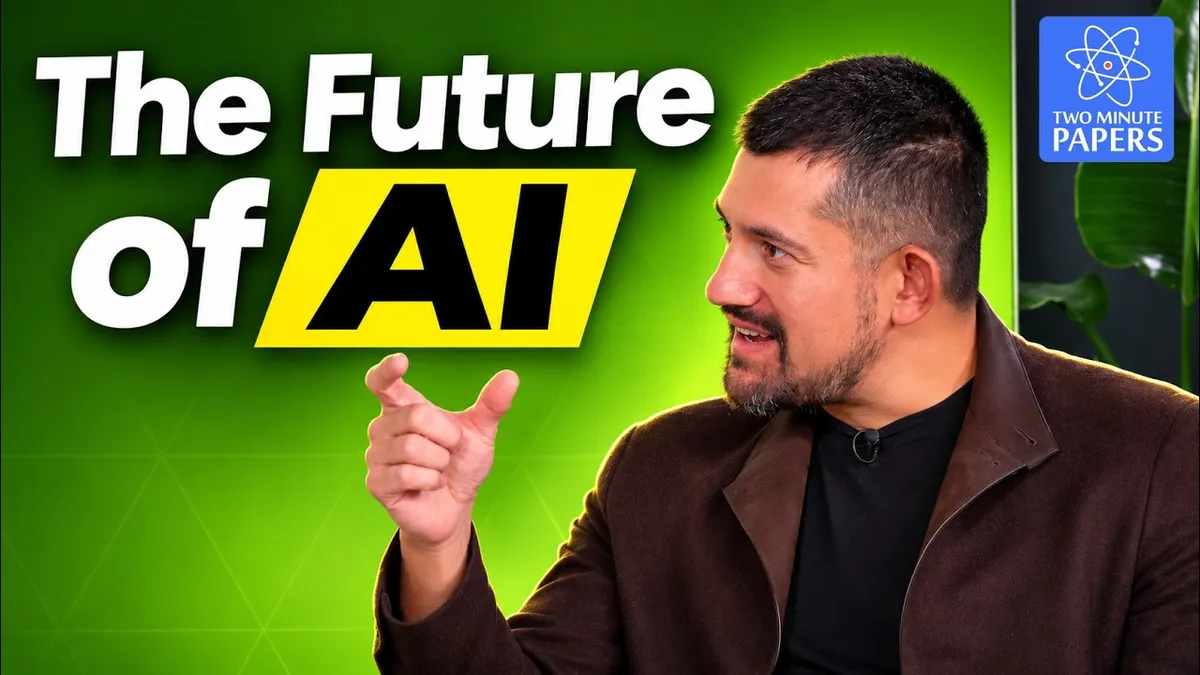
NVIDIA's GTC Berlin update made Isaac Lab 3.0 generally available. Isaac Lab 3.0 is open source, supports multi-GPU training, and runs on both the Newton and PhysX physics engines, with the move to Newton happening gradually. The update also added three DGX Station workflows: reinforcement-learning refinement of GR00T 1.7, dexterous manipulation training, and Cosmos post-training. Alongside these, NVIDIA announced Agile ONE SN, a 1.40 m, 40 kg humanoid with 31 degrees of freedom. It ships with WUJI hands, Jetson Thor and GR00T already installed, and is due in early 2027. [2] [1] [6]
Huang described a hybrid training setup. A conventional physics simulator handles contact and dynamics, and a world model like Cosmos re-renders the robot's camera view with different materials and lighting, which avoids the cost of rendering realistic images. He named three uses for Cosmos: generating training data, evaluating policies, and serving as the backbone of world action models for future GR00T versions. Because world models can get physics wrong, he said they still need to be grounded by physics simulators. [1]
SONIC is a 42M-parameter whole-body motion-tracking controller for humanoids. It learns from more than 100M frames (about 700 hours) of motion capture without hand-designed rewards, and accepts input from VR teleoperation, human video or vision-language-action models (VLAs). Its authors report that performance improves with more compute and more varied data. It was released openly as part of GR00T Whole-Body Control. Huang noted that it needs a lot of demonstration data and is meant to work alongside a higher-level VLA that handles long-horizon reasoning. [4] [5] [1]
Huang said the hard part of physical AI is data that captures how the world pushes back, which does not exist at web scale. Teleoperation is difficult without force feedback, so NVIDIA is turning to egocentric and third-person human video. That footage has to be retargeted to robot bodies whose joints differ from human ones. He described closing the sim-to-real gap as a loop that runs from data collection through deployment, not a single step. [1]
A humanoid that ships with hands and software already integrated could save teams weeks of setup.
Read the full assessment
The specs and SONIC's scaling results come from NVIDIA without independent evaluation, so practical gains for data strategy and sim-to-real transfer are not yet shown.
Writing the dossier now, based on the interview transcript, NVIDIA's GTC Berlin press release, the SONIC paper and the Newton/Linux Foundation materials.
Executive brief
NVIDIA's Spencer Huang says AI agents have cut a 10-year timeline for physical AI to three to five years. He named "Astra" and "Opus 5.5" as tools that make building simulation scenes cheap (video, 11:41; 37:01). That is his opinion, and nothing in the reviewed sources measures it. The concrete news is NVIDIA's October 21 GTC Berlin release: Isaac Lab 3.0, three DGX Station workflows, and the Agile ONE SN reference humanoid, shipping in early 2027 (NVIDIA). The interview's main argument is that robots will learn from a mix of real data, physics simulators and neural world models.
What changed and event timeline
Newton goes to the Linux Foundation
Disney Research, Google DeepMind and NVIDIA contributed Newton, a GPU physics engine built on Warp and OpenUSD that can run several solvers ().
SONIC paper posted
NVIDIA researchers show that a whole-body motion-tracking controller for humanoids improves as it is scaled up to 42M parameters ().
GTC Berlin Isaac expansion
NVIDIA announced Isaac Lab 3.0 (generally available), Isaac OS, DGX Station workflows, the Human 1M dataset and Agile ONE SN ().
Two Minute Papers interview published
Huang walks through the launch and NVIDIA's simulation strategy with host Károly Zsolnai-Fehér ().
Capabilities and access
- Isaac Lab 3.0: open source, supports multi-GPU training, and runs on both Newton and PhysX.
- DGX Station workflows: reinforcement-learning refinement of GR00T 1.7, dexterous manipulation training in Isaac Lab, and Cosmos post-training using ChatGPT Astra (Unite.AI).
- Agile ONE SN: 1.40 m tall, 40 kg, 31 degrees of freedom, two 20-DoF WUJI Hand 2 hands, Jetson Thor, GR00T preinstalled.
Read the full section
- Isaac Lab 3.0: open source, supports multi-GPU training, and runs on both Newton and PhysX. Huang describes the move from PhysX to Newton as gradual (NVIDIA; video, 1:01).
- DGX Station workflows: reinforcement-learning refinement of GR00T 1.7, dexterous manipulation training in Isaac Lab, and Cosmos post-training using ChatGPT Astra (Unite.AI).
- Agile ONE SN: 1.40 m tall, 40 kg, 31 degrees of freedom, two 20-DoF WUJI Hand 2 hands, Jetson Thor, GR00T preinstalled. Available early 2027; price not disclosed (NVIDIA).
Technical analysis for researchers and developers
- Hybrid simulation: a physics simulator handles contact and dynamics while a world model such as Cosmos re-renders the camera images with varied materials and lighting.
- Three uses for Cosmos: generating training data, acting as a policy evaluator, and serving as the backbone of "world action models" for future GR00T versions (20:36).
- Isaac Lab Arena: breaks tasks into subtasks with success criteria, so teams can test which factors (collisions, lighting) cause failures (23:07).
Read the full section
- Hybrid simulation: a physics simulator handles contact and dynamics while a world model such as Cosmos re-renders the camera images with varied materials and lighting. This avoids the cost of rendering realistic pixels (video, 12:11).
- Three uses for Cosmos: generating training data, acting as a policy evaluator, and serving as the backbone of "world action models" for future GR00T versions (20:36).
- Isaac Lab Arena: breaks tasks into subtasks with success criteria, so teams can test which factors (collisions, lighting) cause failures (23:07).
- SONIC: learns from more than 100M frames (700 hours) of motion capture, without hand-designed rewards. One token space takes input from VR teleoperation, human video or VLAs (arXiv).
Claims and evidence
- Scaling: SONIC's performance improves with more compute and more varied data. This is reported by the authors (arXiv).
- Compute is reported inconsistently: 9k GPU hours in arXiv v1 versus 21,000 on the project page.
- Huang's anecdotes are unverified: robots whose policies adapted on their own to broken joints, and the agent-driven speedup (30:41). No independent source corroborates them.
Read the full section
- Scaling: SONIC's performance improves with more compute and more varied data. This is reported by the authors (arXiv).
- Compute is reported inconsistently: 9k GPU hours in arXiv v1 versus 21,000 on the project page.
- Huang's anecdotes are unverified: robots whose policies adapted on their own to broken joints, and the agent-driven speedup (30:41). No independent source corroborates them.
- No independent evaluation: news coverage largely repeats the press release (Unite.AI).
Context and prior work
- Earlier VLAs: Huang says they controlled the upper and lower body separately, so a robot "couldn't walk and drink coffee." SONIC handles whole-body control and leaves long-horizon reasoning to GR00T or another VLA (video, 17:50).
- Why physical AI lags LLMs: robots need data on how the world pushes back, which does not exist at web scale.
Read the full section
- Earlier VLAs: Huang says they controlled the upper and lower body separately, so a robot "couldn't walk and drink coffee." SONIC handles whole-body control and leaves long-horizon reasoning to GR00T or another VLA (video, 17:50).
- Why physical AI lags LLMs: robots need data on how the world pushes back, which does not exist at web scale. Teleoperation is hard without force feedback, so NVIDIA is turning to egocentric and third-person human video (4:00–6:05).
Limitations, safety and contested findings
- World models get physics wrong: they can drop or multiply objects, so they must be anchored to physics simulators (video, 10:02).
- SONIC is data-hungry: it needs a lot of demonstration data (17:25).
- Sim-to-real is still unsolved: Huang describes it as a loop that runs through every stage, from data collection to deployment.
Read the full section
- World models get physics wrong: they can drop or multiply objects, so they must be anchored to physics simulators (video, 10:02).
- SONIC is data-hungry: it needs a lot of demonstration data (17:25).
- Sim-to-real is still unsolved: Huang describes it as a loop that runs through every stage, from data collection to deployment. Human data also has to be retargeted to robot bodies whose joints differ from ours (28:33).
- Hardware limits: humans cannot demonstrate 0.003 mm precision, so demonstration data will not cover that level of work (39:13).
- Skepticism: one outlet questions Jensen Huang's claim that a "ChatGPT moment" for robotics is near (AI Insider).
Business and practitioner implications
- Faster setup: a humanoid that ships with hands and software already integrated targets the weeks to months Huang says that work usually takes (video, 2:04).
- Data strategy: the advantage now lies in deciding the mix of real, simulated and generated data, which Huang calls "the art" (9:25).
- Lock-in: the stack runs Newton, Cosmos, GR00T, Thor and DGX together. Newton's neutral governance under the Linux Foundation partly offsets the dependence on NVIDIA.
Read the full section
- Faster setup: a humanoid that ships with hands and software already integrated targets the weeks to months Huang says that work usually takes (video, 2:04). Unknown price and early-2027 shipping limit near-term planning.
- Data strategy: the advantage now lies in deciding the mix of real, simulated and generated data, which Huang calls "the art" (9:25).
- Lock-in: the stack runs Newton, Cosmos, GR00T, Thor and DGX together. Newton's neutral governance under the Linux Foundation partly offsets the dependence on NVIDIA.
The source trail.
Sources (8)
The Future of AI Is Absolutely Incredible (Spencer Huang)
Transcript retrieved via youtube_auto_captions; language en. Timestamped text, not direct audiovisual review. Source: https://www.youtube.com/watch?v=XgC1QTs6A2U. Automatic captions/transcription may contain errors.
www.youtube.com