
ModelsArchitectures & capability
Google releases Gemini Omni 1.2 Flash with 15-second video clips and 30% lower price
Google's Gemini Omni 1.2 Flash, now generally available, extends generated video clips from 10 to 15 seconds, adds multi-turn editing and cuts 720p pricing to about $0.07 per second. API calls to version 1.1 will route to 1.2 from December 3.
From the Google AI article of November 5, 2026 and cited sources: The model generates, edits, extends and upscales video with synchronized audio. [1] [3] [8]
SOURCES[1] Google blog: Gemini Omni 1.2 Flash blog.google[3] Gemini API docs: Omni aistudio.google.com[8] Google Cloud docs: Gemini Omni 1.2 Flash docs.cloud.google.com
 AT Pulse research deskPublished · Updated · 5 min read · AI-assisted analysis
AI-assisted, not human-edited. Methodology Corrections Who owns this site
- What happened
- The model generates, edits, extends and upscales video with synchronized audio. [1] [3] [8]
- Original source
- Google AI article, company source
- Brief by
- AT Pulse research desk AI-assisted; publisher and contact on the desk page
- When
- November 5, 2026 article published
- Covered
- Nov 6 edition
- Evidence
- 11 sources across 10 sites
- 1Google blog: Gemini Omni 1.2 Flashblog.google
- 2Gemini Omni 1.2 Flash: Fast and cost-effective with longer…deepmind.google
- 3Gemini API docs: Omniaistudio.google.com
- 4eesel.ai: Omni 1.1 Flash explainedeesel.ai
- 5ETV Bharat: Omni 1.1 Flash launchetvbharat.com
- 6Google Cloud blog: Omni 1.2 Flash GAcloud.google.com
RisingHow it’s measured
Hacker News · 8 likes · 1 comment
Reach blends public engagement (views, likes, comments, shares, stars) from the platforms where the story or its original source lives: YouTube, Hacker News, GitHub, Substack and similar. A video and the article written from its transcript share one score, taken from the video. Platforms with no data are left out rather than counted as zero, and the age of a story never lowers its score.
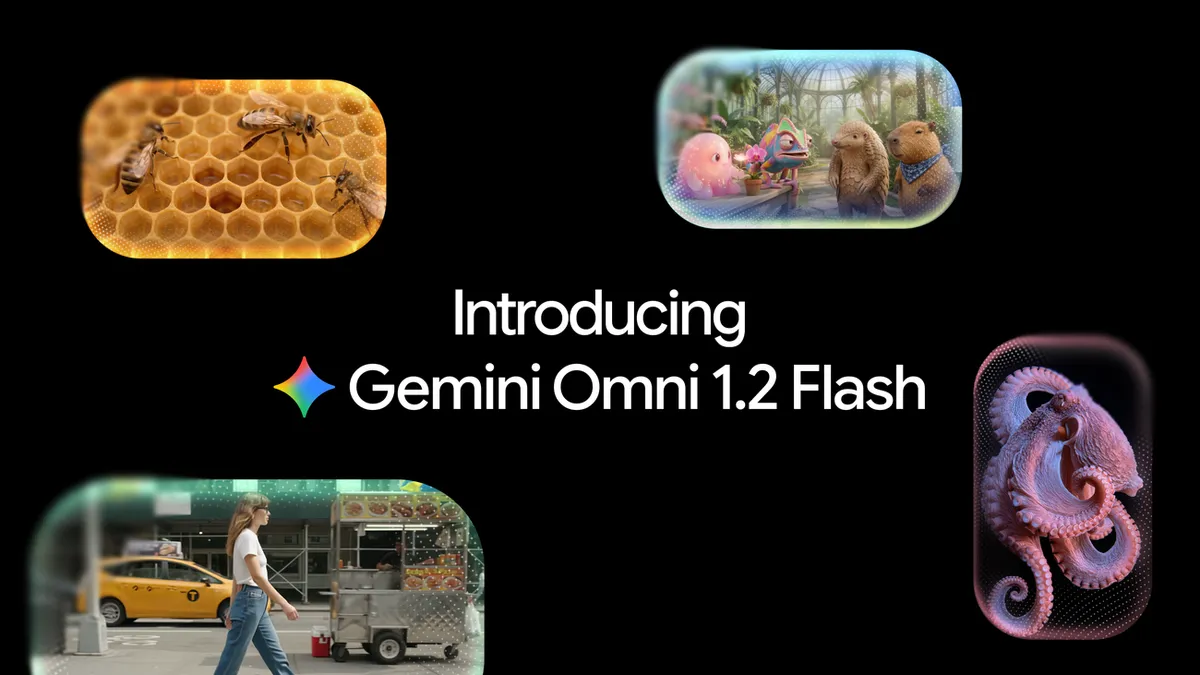
The model generates, edits, extends and upscales video with synchronized audio. Single clips run 3 to 15 seconds, and turn-by-turn extension reaches 30 seconds in total. Output comes in 360p, 720p, 1080p or 4K, in 16:9 or 9:16. [1] [3] [8]
Video output is billed by token. At 720p that is 5,792 tokens per second at $12 per million, down from $17.50, or about $0.07 per second. A 15-second 720p clip costs roughly $1.04. Drafting at 360p and editing across turns instead of regenerating lowers the cost of each iteration further. [7] [1]
From December 3, all Gemini API calls to the 1.1 model will be served by 1.2 and billed at 1.2 rates, with no code change needed. The API has no temperature or top_p controls, so exact runs are hard to reproduce. Teams on 1.1 should run regression tests on their prompts before the switch. [3] [7]
The model does not support function calling, structured output, system instructions or context caching. The Gemini API and Google Cloud currently disagree on several points: the reference-image limit (6 vs. 10), support for audio references, and whether reserved Provisioned Throughput is offered. This affects which platform to choose. [3] [8] [6]
published token rates confirm the 30% price cut, and documentation confirms 15-second clips and multi-turn editing.
Read the full assessment
Implication: cheaper iteration for production video pipelines, but 1.1 users face a forced model swap and should re-test outputs before December 3.
Executive brief
Starting December 3, 2026, Google will automatically send every Gemini API call for gemini-omni-1.1-flash to the new gemini-omni-1.2-flash model. Developers don't change any code, and the swap happens whether they want it or not (Gemini API docs). Google launched Gemini Omni 1.2 Flash as generally available on November 5, 2026. Clip length rises from 10 to 15 seconds, editing can now happen over several conversational turns, and the 720p price drops 30% to $0.07 per second (Google blog). The quality claims come only from Google, and the reviewed sources contain no independent evaluation of version 1.2.
What changed and event timeline
Omni Flash enters preview
Google released Gemini Omni Flash in public preview on the Gemini API and AI Studio, priced at a flat $0.10 per second for 720p ().
Omni 1.1 Flash adds control
This version added scene extension that looks back at up to 10 seconds of earlier footage, start and end frame control, cheaper 360p drafts, 4K upscaling, and video references of up to 3 seconds ().
Omni 1.2 Flash goes GA
Clips run up to 15 seconds, editing works across multiple turns, and the price is 30% lower. It shipped across the Gemini API, Google Cloud, Flow, Vids, Ads and the Gemini app (;).
1.1 requests start routing to 1.2
All API calls to 1.1 go to 1.2 and are billed at 1.2 rates ().
Capabilities and access
- Model:
gemini-omni-1.2-flash. It handles video generation, editing, extension and upscaling, with synchronized audio, and can return text in the same response (Cloud docs). - Output: 3 to 15 seconds in one-second steps (first/last-frame mode is limited to 3–10 seconds). Resolutions are 360p, 720p, 1080p and 4K.
- Extension: each turn adds 3–10 seconds, up to 30 seconds in total (Gemini API docs).
Read the full section
- Model:
gemini-omni-1.2-flash. It handles video generation, editing, extension and upscaling, with synchronized audio, and can return text in the same response (Cloud docs). - Output: 3 to 15 seconds in one-second steps (first/last-frame mode is limited to 3–10 seconds). Resolutions are 360p, 720p, 1080p and 4K. Aspect ratios are 16:9 and 9:16 (Cloud docs).
- Extension: each turn adds 3–10 seconds, up to 30 seconds in total (Gemini API docs).
- Consumer access: 15-second clips in the Gemini app are for Ultra subscribers. Free Vids users get three 15-second videos a month (Android Authority).
Technical analysis for researchers and developers
- Interface: the model accepts text, images and video as input, with up to 131,072 input tokens.
- Pricing unit: video output is billed by token.
- Evaluation: Google's evidence is a set of curated side-by-side comparisons with 1.1. It published no benchmark, no evaluation protocol and no architecture details (Google blog).
Read the full section
- Interface: the model accepts text, images and video as input, with up to 131,072 input tokens. It does not support system instructions, structured output, function calling, grounding or context caching (Cloud docs). On the Gemini API, temperature, top_p and negative prompts are also unavailable (Gemini API docs).
- Pricing unit: video output is billed by token. 720p uses 5,792 tokens per second at $12 per million tokens, which works out to about $0.07 per second (pricing).
- Evaluation: Google's evidence is a set of curated side-by-side comparisons with 1.1. It published no benchmark, no evaluation protocol and no architecture details (Google blog).
- Reproducibility: the API offers no sampling controls, so runs are hard to reproduce exactly.
Claims and evidence
- 30% price cut: the published token rates confirm it.
- Better reference adherence, consistency, lip-sync and camera control: these come only from Google's demos (Google blog). The Decoder and Android Authority repeat the claims without testing them.
- Customer adoption: Google names Artlist, FLORA, invideo, Krea, Picsart, Photoroom, QuickFrame AI and Runway as customers (Cloud blog).
Read the full section
- 30% price cut: the published token rates confirm it. The video-output rate falls from $17.50 to $12 per million tokens, and 1.1's 720p price was about $0.10 per second (pricing).
- Better reference adherence, consistency, lip-sync and camera control: these come only from Google's demos (Google blog). The Decoder and Android Authority repeat the claims without testing them. None of the reviewed sources independently corroborates them.
- Customer adoption: Google names Artlist, FLORA, invideo, Krea, Picsart, Photoroom, QuickFrame AI and Runway as customers (Cloud blog).
Context and prior work
Version 1.2 is the third Omni release in about four months, after the June preview and 1.1 in August (eesel.ai; ETV Bharat). The prices keep falling: $0.10 per second at preview, about $0.10 for 1.1, and $0.07 for 1.2 at 720p (pricing). Google is pitching the model as production infrastructure rather than a creative demo.
Read the full section
Version 1.2 is the third Omni release in about four months, after the June preview and 1.1 in August (eesel.ai; ETV Bharat). The prices keep falling: $0.10 per second at preview, about $0.10 for 1.1, and $0.07 for 1.2 at 720p (pricing). Google is pitching the model as production infrastructure rather than a creative demo. It comes with Provisioned Throughput (reserved capacity) and SynthID watermarking (Cloud blog).
Limitations, safety and contested findings
- Known weak spots: Google says it is still working on fast sports action, rapid script changes and complex physics (Google blog).
- Language: only English is fully supported. Other languages have not been evaluated (Gemini API docs).
- Docs disagree on four points:
Read the full section
- Known weak spots: Google says it is still working on fast sports action, rapid script changes and complex physics (Google blog).
- Language: only English is fully supported. Other languages have not been evaluated (Gemini API docs).
- Docs disagree on four points:
- Audio cues: the launch blog advertises them. The Gemini API docs say audio references are unsupported. The Cloud blog says they require allowlisting.
- Reference images: the API allows 6, while Cloud lists 10 images per prompt.
- Provisioned Throughput: the Gemini API says it is not supported, while Google Cloud offers it.
- Sources for these points: Gemini API docs; Cloud docs; Cloud blog.
- Safety: SynthID is an invisible watermark. It identifies where content came from but does not filter harmful content.
Business and practitioner implications
- Costs: at published rates, a 15-second 720p clip costs about $1.04 and 4K costs about $0.21 per second (pricing).
- Before December 3: teams on 1.1 should run regression tests on prompts and outputs, since 1.1 traffic will be served by 1.2.
- Platform choice: pick between the Gemini API and Vertex/Cloud based on what you need.
Read the full section
- Costs: at published rates, a 15-second 720p clip costs about $1.04 and 4K costs about $0.21 per second (pricing). Drafting at 360p (about $0.023 per second) and editing over several turns, instead of regenerating, cuts the cost of each iteration further.
- Before December 3: teams on 1.1 should run regression tests on prompts and outputs, since 1.1 traffic will be served by 1.2.
- Platform choice: pick between the Gemini API and Vertex/Cloud based on what you need. They currently differ on reference-image limits, audio references and reserved capacity.
- Quality checks: check brand-consistency claims on your own assets before relying on them in production.
The source trail.
Sources (11)
Google blog: Gemini Omni 1.2 Flash
blog.googleGemini Omni 1.2 Flash: Fast and cost-effective with longer clips
Related coverage; assess separately
deepmind.google