
RoboticsMachines in the physical world
Tau Robotics' remotely piloted humanoids clean San Francisco homes and gather training data on each visit
Tau Robotics sends modified Unitree G1 humanoids, steered by remote human operators, to clean San Francisco homes at low prices, using each visit to gather demonstration data for future autonomous robots. A hands-on test showed real progress alongside clumsy failures.
From the MIT Technology Review · AI article of November 6, 2026 and cited sources: Tau keeps prices low because each cleaning doubles as data collection. [1] [7]
SOURCES[1] MIT Technology Review: I watched a humanoid robot clean my… technologyreview.com[7] Humanoid.guide: Tau Robotics humanoids offer cleaning at… humanoid.guide
 AT Pulse research deskPublished · Updated · 5 min read · AI-assisted analysis
AI-assisted, not human-edited. Methodology Corrections Who owns this site
- Original source
- MIT Technology Review · AI article, independent perspective
- Brief by
- AT Pulse research desk AI-assisted; publisher and contact on the desk page
- When
- November 6, 2026 article published
- Covered
- Nov 6 edition
- Evidence
- 8 sources across 7 sites
- 1MIT Technology Review: I watched a humanoid robot clean my…technologyreview.com
- 2GitHub: low_cost_robotgithub.com
- 3Gigazine: Build your own open source robot armgigazine.net
- 4Engadget: 1X Neo is a $20,000 home robotengadget.com
- 5MIT Technology Review: The human work behind humanoid…technologyreview.com
- 6ABC7: You can hire these humanoid robots from Tau Roboticsabc7news.com
Reach: not measured yet
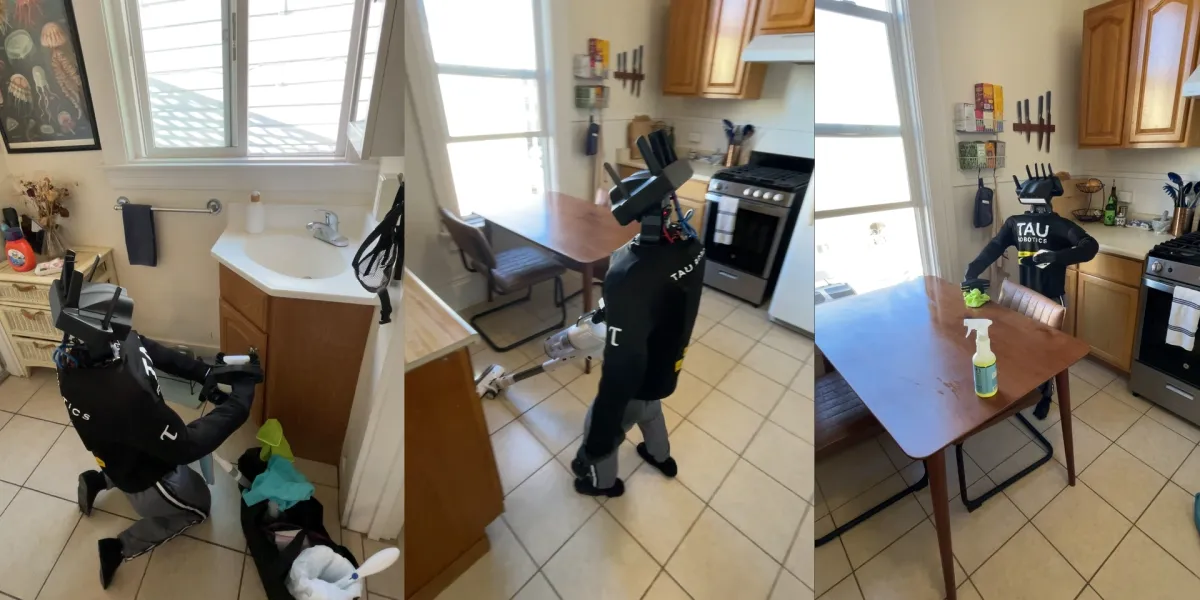
Tau keeps prices low because each cleaning doubles as data collection. For tasks like folding laundry and making beds, an operator acts out the motions and the robot copies them. These demonstrations are treated as the most valuable training data for robots meant to work on their own later. [1] [7]
In a reporter's two home visits, the first ended early when heat shut down the remote operator's viewing equipment. The second cleaned the kitchen and toilet but left taps dripping, knocked over an air purifier it couldn't right, and could not climb a carpeted staircase. [1]
one reporter's two visits and limited fleet statistics.
Read the full assessment
Implication: paying customers can fund the demonstration data home robots need, but reliability depends on networks, operator equipment and staffing, and buyers have no disclosed autonomy rates to go on.
Executive brief
Tau Robotics charges San Franciscans to have humanoid robots clean their homes, but people at the company's headquarters drive the robots remotely. In MIT Technology Review's hands-on report, the first visit ended early. The robot itself was fine; heat had shut down the remote operator's viewing equipment. The service is cheap because every visit also collects training data. That data is meant to train future robots that clean on their own. A second visit went better: the robot cleaned the kitchen and the toilet. It also left taps dripping and knocked over an air purifier it couldn't stand back up.
What changed and event timeline
Founder's low-cost arm goes public
Alexander Koch's leader-follower robot arm cost about $430 for the pair. It was built for collecting demonstrations, and Hugging Face's LeRobot later adapted it (;).
1X opens NEO preorders
The $20,000 home humanoid comes with a teleoperated "expert mode" for tasks it can't yet do alone. That set the "teleoperation now, autonomy later" template ().
Hidden-labor scrutiny
MIT Technology Review reported that humanoid companies often don't adequately disclose how much humans control their robots ().
Tau launches $30/hour cleaning
The service opened to selected applicants. CEO Alex Koch said a person drives each robot remotely with AI assistance. UC Berkeley's Ken Goldberg called it too early ().
Fleet figures surface
The company reported eight modified Unitree G1 robots, about 160 paid hours and nearly 100 cleanings. Customers can ask for their data to be deleted ().
Hands-on review
Two visits: one cut short by an equipment failure, one mostly successful. Pricing is now $60 per weekly two-robot cleaning or $100 for a one-time visit ().
Capabilities and access
- Hardware: modified Unitree G1 robots, about $55,000 each before modification. They have pincer grippers and cameras in the head and wrists (Humanoid.guide).
- Access: San Francisco only, through a waitlist or for selected applicants (ABC7).
- Tasks seen: vacuuming, mopping, wiping counters, cleaning toilets, folding laundry and making beds. Folding is slow, about four minutes per towel (Humanoid.guide).
Read the full section
- Hardware: modified Unitree G1 robots, about $55,000 each before modification. They have pincer grippers and cameras in the head and wrists (Humanoid.guide). MIT TR describes 3D-printed claw "hands" and a robot about 4.5 ft tall (MIT TR).
- Access: San Francisco only, through a waitlist or for selected applicants (ABC7).
- Tasks seen: vacuuming, mopping, wiping counters, cleaning toilets, folding laundry and making beds. Folding is slow, about four minutes per towel (Humanoid.guide).
- No named AI model or version is public.
Technical analysis for researchers and developers
- Control: for laundry and bed-making, the operator acts out the motions and sensors relay them to the robot, which copies them (MIT TR calls this "kinematic guidance").
- Latency: network lag between operator and robot hurts walking. Tau puts heavy work into timing and connectivity (MIT TR).
- Weak point: the robot depends on the remote operator's equipment, so a failure on the operator side stops the robot.
Read the full section
- Control: for laundry and bed-making, the operator acts out the motions and sensors relay them to the robot, which copies them (MIT TR calls this "kinematic guidance"). These demonstrations are treated as the most valuable training data (MIT TR). This continues the leader-follower approach to imitation learning in Koch's low-cost arm.
- Latency: network lag between operator and robot hurts walking. Tau puts heavy work into timing and connectivity (MIT TR).
- Weak point: the robot depends on the remote operator's equipment, so a failure on the operator side stops the robot.
- Evaluation: no benchmarks, autonomy rates or papers have been published.
Claims and evidence
- Some tasks run without help. Cofounder Cornelia Weinzierl says vacuuming and mopping run without human help (MIT TR).
- MIT TR reports "a couple hundred" cleanings. Three weeks earlier, the company reported nearly 100 (Humanoid.guide).
- The figures differ: one report gives $60/hour for a pair of robots (Humanoid.guide), while MIT TR gives $60 per weekly visit.
Read the full section
- Some tasks run without help. Cofounder Cornelia Weinzierl says vacuuming and mopping run without human help (MIT TR). At launch in July, Koch described remote operation assisted by AI (ABC7). The autonomy claim comes from the company alone; no outside check exists.
- Volume. MIT TR reports "a couple hundred" cleanings. Three weeks earlier, the company reported nearly 100 (Humanoid.guide).
- Pricing. The figures differ: one report gives $60/hour for a pair of robots (Humanoid.guide), while MIT TR gives $60 per weekly visit.
- Performance. Only one reporter's two visits have been observed independently.
Context and prior work
- 1X's NEO also mixes autonomy with remote operation, which drew privacy criticism (Engadget).
- Tau grew out of Koch's work on cheap hardware for collecting data in the real world.
- MIT TR's February investigation frames the open question across the sector: how much of a robot's work humans are actually doing.
Read the full section
- 1X's NEO also mixes autonomy with remote operation, which drew privacy criticism (Engadget).
- Tau grew out of Koch's work on cheap hardware for collecting data in the real world. His arm became a LeRobot-supported platform.
- MIT TR's February investigation frames the open question across the sector: how much of a robot's work humans are actually doing.
Limitations, safety and contested findings
- Failures seen: taps left dripping, a bottle knocked over, a toppled air purifier left down, and a carpeted staircase the robot couldn't climb.
- Grip: some dishwashing tasks failed for lack of fine grip control (Humanoid.guide).
- Privacy: unblurred footage is kept indefinitely unless the customer asks for deletion or excludes rooms (Humanoid.guide).
Read the full section
- Failures seen: taps left dripping, a bottle knocked over, a toppled air purifier left down, and a carpeted staircase the robot couldn't climb. It also staggered on stairs (MIT TR).
- Grip: some dishwashing tasks failed for lack of fine grip control (Humanoid.guide).
- Privacy: unblurred footage is kept indefinitely unless the customer asks for deletion or excludes rooms (Humanoid.guide).
- Skepticism: Goldberg doubted the robots could do useful household cleaning (ABC7).
- Jobs: MIT TR raises the risk of job losses for cleaners.
Business and practitioner implications
- Customers subsidize data: Tau prices low because the customer's home becomes training ground.
- Scale is the challenge: a few hundred cleanings is small next to how much data varied home tasks likely require (MIT TR).
- Where the risk sits: network links, operator equipment and staffing are operational risks, not just model risks.
Read the full section
- Customers subsidize data: Tau prices low because the customer's home becomes training ground. That makes data collection a revenue line rather than a pure cost (Humanoid.guide).
- Scale is the challenge: a few hundred cleanings is small next to how much data varied home tasks likely require (MIT TR).
- Where the risk sits: network links, operator equipment and staffing are operational risks, not just model risks.
- Next markets: Tau is considering mold remediation and home health care.
- Questions for buyers: ask for disclosed autonomy rates and data-retention terms.