
PolicyLaw, regulation & governance
MPs say UK failed all 10 tests for cutting reliance on China for critical minerals
A Commons committee says the UK government failed all 10 of its tests for cutting dependence on Chinese critical minerals. It says rearmament, AI infrastructure and net zero are exposed, refining is the main bottleneck and a US–China export-control truce ends in January 2027.
From the The Guardian · AI article of November 5, 2026 and cited sources: A Commons committee chaired by Liam Byrne found that the government failed all 10 of its tests on critical-minerals resilience. [1] [2] [6]
SOURCES[1] UK found to be ‘dangerously’ reliant on China for critical… theguardian.com[2] Telegraph via Yahoo: Britain 'dangerously exposed' to… yahoo.com[6] BISI: China's rare earth processing dominance and what the… bisi.org.uk
 AT Pulse research deskPublished · Updated · 5 min read · AI-assisted analysis
AI-assisted, not human-edited. Methodology Corrections Who owns this site
- What happened
- A Commons committee chaired by Liam Byrne found that the government failed all 10 of its tests on critical-minerals resilience. [1] [2] [6]
- Original source
- The Guardian · AI article, independent perspective
- Brief by
- AT Pulse research desk AI-assisted; publisher and contact on the desk page
- When
- November 5, 2026 article published
- Covered
- Nov 5 edition
- Evidence
- 8 sources across 8 sites
- 1UK found to be ‘dangerously’ reliant on China for critical…theguardian.com
- 2Telegraph via Yahoo: Britain 'dangerously exposed' to…yahoo.com
- 3Rinnovabili: Chinese rare earth exports, Trump–Xi truce…rinnovabili.net
- 4The National: Nexperia seizure puts skids on European car…thenationalnews.com
- 5Mining.com: Britain unveils critical minerals strategymining.com
- 6BISI: China's rare earth processing dominance and what the…bisi.org.uk
Reach: not measured yet
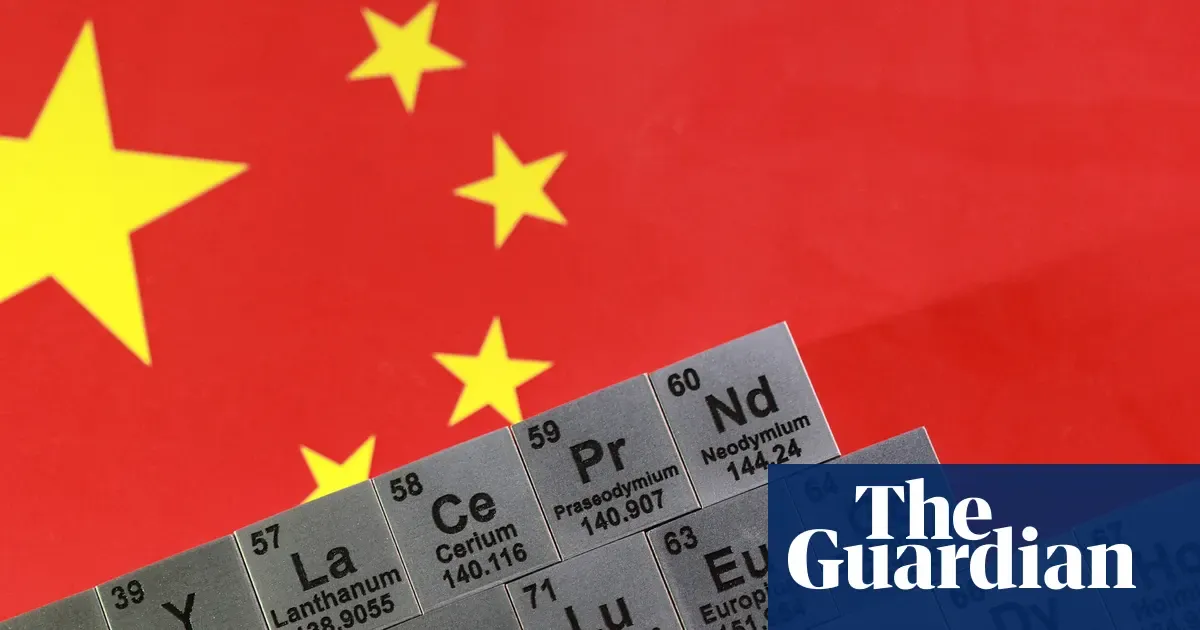
A Commons committee chaired by Liam Byrne found that the government failed all 10 of its tests on critical-minerals resilience. The committee says this leaves defence, AI infrastructure and net-zero supply chains dangerously exposed. The weak point is refining rather than mining: one analysis puts China's share of rare-earth oxide separation at about 88% for light and 97% for heavy elements. [1] [2] [6]
The near-term risk is tied to US–China relations. The suspension of China's tighter rare-earth controls was extended to 10 January 2027, and rare earths were left for later talks. China's licensing for medium and heavy rare earths, in place since April 2025, has stayed in force throughout the truce. Its rules can also reach foreign-made products that contain Chinese-origin rare earths. [3] [6] [8]
The UK's Vision 2035 strategy aims for 10% of demand from domestic production, 20% from recycling and no more than 60% from any one country. The government's own projections reach only about 6% and 18% by 2035. The government now cites £400m in backing, while £50m was the figure at launch, and the reviewed sources do not reconcile the two. [1] [5] [7]
China dominates rare-earth separation and refining, and its heavy rare-earth licensing never lapsed.
Read the full assessment
Implication: UK data-centre, chip, defence and EV supply chains could face disruption if controls return after 10 January 2027, unless refining and recycling capacity grows.
Executive brief
A House of Commons committee says the UK government failed all 10 of its tests for reducing the country's reliance on China for critical minerals. MPs say this leaves Britain "dangerously" exposed in three areas: rearmament, AI infrastructure and net zero. The Guardian reports that the main bottleneck is refining, not mining. China dominates refining in seven mineral categories. The current US–China pause on China's rare-earth export controls runs only to January 2027, and the committee says this leaves the UK depending on how Washington and Beijing get along. The committee wants a dedicated critical minerals finance facility. The government replies that it already has a strategy and is putting £400m behind it.
What changed and event timeline
China's licensing controls arrive
China required licences for exports of medium and heavy rare earths, including samarium, gadolinium and terbium. Those licences, even under later truces.
Nexperia shock and a US–China truce
After the Netherlands took control of Nexperia, China halted the company's chip exports. European carmakers warned that. Trump and Xi agreed to.
UK strategy published
"Vision 2035" set targets of 10% of demand from domestic production, 20% from recycling and no more than 60% from any one country. At launch it carried through the Department for Business and Trade.
Truce extended
During Xi's state visit to Washington, the suspension was moved from 10 November 2026. Negotiation on rare earths was.
Committee report
Chaired by Liam Byrne, the committee found the government failed all 10 tests. It proposed allied "buyers' clubs" and a.
Capabilities and access
This is a policy story; no AI model or product is involved. The "AI" angle is about physical inputs. Data centres, chips, defence electronics and electric vehicles depend on refined lithium, cobalt, copper and rare-earth permanent magnets. The Telegraph says the report singles out copper, lithium and cobalt. The Guardian highlights refined lithium and rare earths used in military aircraft.
Technical analysis for researchers and developers
- The risk is concentrated in separation and refining. One analysis puts China's share at 88% of light and 97% of heavy rare-earth oxide separation capacity.
- Controls reach finished goods. Chinese rules can apply abroad to foreign-made products that contain Chinese-origin rare earths.
- How the committee assessed the government. It used a 10-test framework. Outsiders therefore cannot reproduce the government's own risk assessment.
Read the full section
- Where the bottleneck sits. The risk is concentrated in separation and refining. One analysis puts China's share at 88% of light and 97% of heavy rare-earth oxide separation capacity.
- Controls reach finished goods. Chinese rules can apply abroad to foreign-made products that contain Chinese-origin rare earths. Developers sourcing hardware therefore need visibility of their bill of materials beyond direct suppliers.
- How the committee assessed the government. It used a 10-test framework. It says it could not see which capabilities the government wants to protect, which vulnerabilities it has found or which projects it backs (Guardian). Outsiders therefore cannot reproduce the government's own risk assessment.
Claims and evidence
- Lithium demand will rise 45-fold and rare-earth magnet demand 16-fold by 2030. These figures are testimony to MPs; none of the reviewed sources independently checks them.
- The government cites £400m, but £50m was the figure at the strategy's launch. The reviewed sources do not reconcile the two.
- The government's own projections reach only 6% domestic production and 18% recycling by 2035, short of the 10% and 20% targets.
Read the full section
- Demand growth (testimony only). Lithium demand will rise 45-fold and rare-earth magnet demand 16-fold by 2030. These figures are testimony to MPs; none of the reviewed sources independently checks them.
- Funding (figures differ). The government cites £400m, but £50m was the figure at the strategy's launch. The reviewed sources do not reconcile the two.
- Targets vs. projections. The government's own projections reach only 6% domestic production and 18% recycling by 2035, short of the 10% and 20% targets.
- Scrap exports. Roughly 80% of UK scrap metal is exported rather than recycled at home.
Context and prior work
- Origin of the "16 years" claim. Byrne dates China's weaponisation of rare earths to its 2010 curbs on supplies to Japan.
- In January 2027, the US faces a White House target and a Pentagon procurement-rule (DFARS) cutoff for Chinese-sourced magnets. It has roughly 15,000 tonnes of separation capacity against about 45,000 tonnes of demand.
- Benchmark Minerals judged Vision 2035 vague on international partnerships. Unlike the US, Canada and the EU, it has no price-support mechanism.
Read the full section
- Origin of the "16 years" claim. Byrne dates China's weaponisation of rare earths to its 2010 curbs on supplies to Japan.
- US deadlines. In January 2027, the US faces a White House target and a Pentagon procurement-rule (DFARS) cutoff for Chinese-sourced magnets. It has roughly 15,000 tonnes of separation capacity against about 45,000 tonnes of demand.
- Earlier verdict on the UK plan. Benchmark Minerals judged Vision 2035 vague on international partnerships. Unlike the US, Canada and the EU, it has no price-support mechanism.
Limitations, safety and contested findings
- It denies lacking a strategy and points to its 2035 targets (Guardian).
- Conflicting accounts of the recommendations. The Guardian describes a 10-point plan; the Telegraph describes a five-point strategy.
- Beijing had not published a notice confirming the January 2027 date.
Read the full section
- The government disputes the core charge. It denies lacking a strategy and points to its 2035 targets (Guardian).
- Conflicting accounts of the recommendations. The Guardian describes a 10-point plan; the Telegraph describes a five-point strategy. The two outlets also name the committee differently.
- Uncertain truce date. Beijing had not published a notice confirming the January 2027 date.
- No full report text. The committee's report itself was not among the reviewed sources, so these findings rest on press coverage.
Business and practitioner implications
- Plan around January 2027. Planning for AI infrastructure, defence and EV supply chains should allow for China's controls returning after 10 January 2027.
- Heavy rare earths are already restricted. Licensing has stayed in place throughout the truce.
- Possible new UK funding.
Read the full section
- Plan around January 2027. Planning for AI infrastructure, defence and EV supply chains should allow for China's controls returning after 10 January 2027.
- Heavy rare earths are already restricted. Licensing has stayed in place throughout the truce.
- Possible new UK funding. Mining, refining and recycling firms could see a new finance facility and allied "buyers' clubs" that pool demand, if ministers adopt the recommendations.
- Map exposure by origin. Buyers should trace rare-earth content in components back to where it was refined, not just to the supplier's country.
- Expect government pressure on procurement. The committee wants a strategy to steer business purchasing away from China.
The source trail.
Sources (8)
UK found to be ‘dangerously’ reliant on China for critical minerals needed for defence and AI
Article text retrieved; extracted text may omit tables or interactive elements.
theguardian.com