
PolicyLaw, regulation & governance
DuckDuckGo pitches AI-free search to schools after Google ties student Search to Gemini AI features
Google said K-12 student Search will be off by default and available only with AI features. DuckDuckGo then offered school administrators an AI-free search option they can set as the Chrome default, sharpening debate over who controls classroom AI.
From the TechCrunch AI article of November 4, 2026 and cited sources: On November 3, 2026, Google said Gemini, Gemini Notebook, Gemini in Classroom and Search will be off by default for K-12 student accounts. [6] [8] [2]
SOURCES[6] Phys.org: Google turns off AI for schoolchildren by default phys.org[8] Tech Insider: Google turns off student Search and Gemini… tech-insider.org[2] TechCrunch: Google faces backlash techcrunch.com
 AT Pulse research deskPublished · Updated · 4 min read · AI-assisted analysis
AI-assisted, not human-edited. Methodology Corrections Who owns this site
- What happened
- On November 3, 2026, Google said Gemini, Gemini Notebook, Gemini in Classroom and Search will be off by default for K-12 student accounts. [6] [8] [2]
- Original source
- TechCrunch AI article, independent perspective
- Brief by
- AT Pulse research desk AI-assisted; publisher and contact on the desk page
- When
- November 4, 2026 article published
- Covered
- Nov 5 edition
- Evidence
- 10 sources across 8 sites
- 1DuckDuckGo pitches itself to schools amid backlash over…techcrunch.com
- 2TechCrunch: Google faces backlashtechcrunch.com
- 3GovTech: Blumenthal and Hawley question Googlegovtech.com
- 4TechCrunch: DuckDuckGo installs up 30%techcrunch.com
- 5Let's Data Science: Senators press Googleletsdatascience.com
- 6Phys.org: Google turns off AI for schoolchildren by defaultphys.org
Reach: not measured yet
On November 3, 2026, Google said Gemini, Gemini Notebook, Gemini in Classroom and Search will be off by default for K-12 student accounts. Administrators must turn each one on separately. Google argued that Search and AI are too deeply integrated to separate. One report says a school that enables Search must pick an AI Overviews mode or the more limited Guided Learning mode, so there is no plain search option. [6] [8] [2]
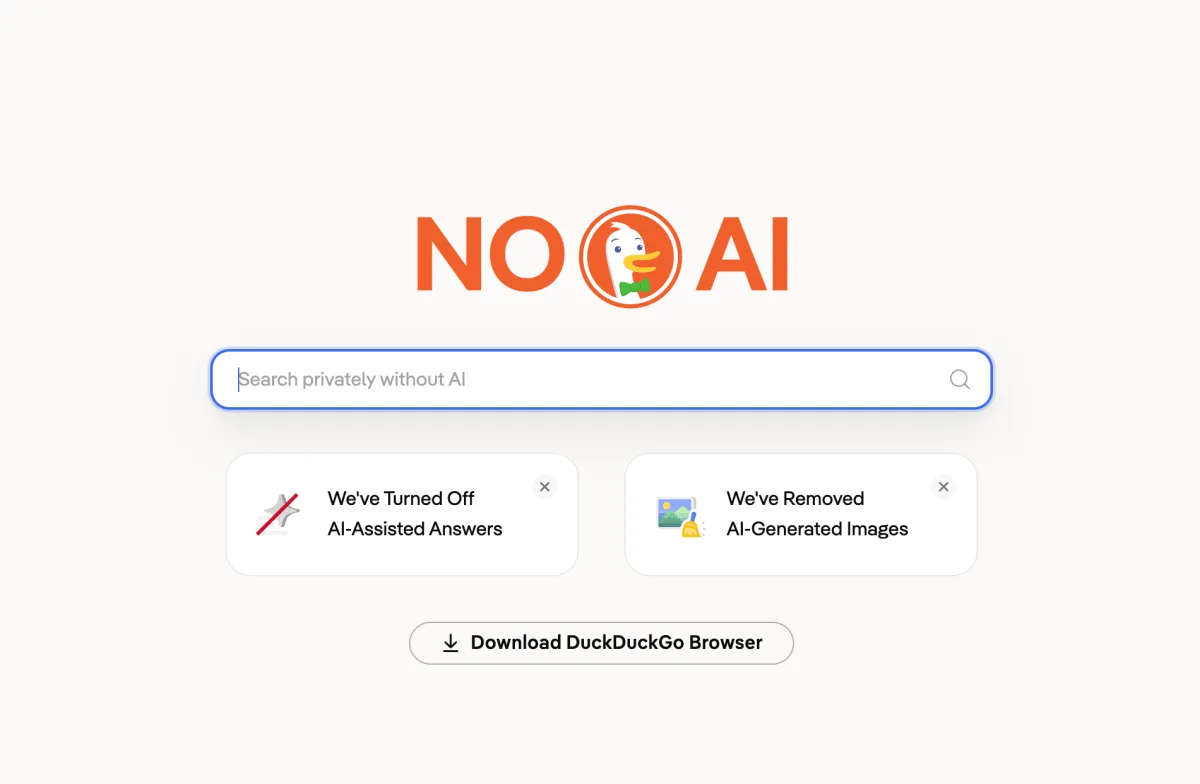
DuckDuckGo responded by pointing schools to noai.duckduckgo.com, which turns off AI answers, AI images and AI feature suggestions. Administrators can make it the default through Chrome's search-provider policies in the Google Admin console. That change affects only the Chrome address bar, though. Gemini inside Classroom, Docs and Drive stays as it is. [1] [9]
Google made the change under political pressure. Senators Blumenthal and Hawley had asked Google why AI was on by default on school devices. Their letter said AI Overviews could not be disabled in Chrome and that other browsers are not natively available on Chromebooks. Critics including Lina Khan called the coupling coercive, while Google described it as giving schools more choice. [3] [5] [2] [7]
Chromebooks make up about 59% of U.S. school devices, so Google's coupling sets AI defaults for many students. If schools respond by switching search engines, default search could become a practical lever for AI policy.
Read the full assessment
Critics already frame the coupling as an antitrust issue.
Executive brief
Google will let K-12 schools switch off Gemini, but students then also lose Google Search. On November 3, 2026, Google said Search for school accounts cannot be separated from its AI features (TechCrunch). DuckDuckGo responded by offering schools its own search with AI turned off and pointing administrators to setup instructions (TechCrunch). This affects a large installed base: Chromebooks are about 59% of U.S. school devices (GovTech). The open question is whether a school's default search engine becomes a way to set AI policy.
What changed and event timeline
DuckDuckGo reports an install surge
After Google I/O made AI answers central to Search, DuckDuckGo said U.S. app installs rose. CEO Gabriel Weinberg said Google is "force-feeding AI with no way to opt out" ().
Senators question Google
Senators Blumenthal and Hawley asked Sundar Pichai why AI was on by default on school devices and set a November 2 deadline. Reports date the letter to October 21 () or October 26 ().
Google ties Search to AI
Gemini, Gemini Notebook, Gemini in Classroom and Search will be off by default for students. Google education VP Chris Phillips said "Search and AI are deeply integrated" ().
Google clarifies and critics respond
Google said the change gives schools "more choice, not less" (). Lina Khan, Zohran Mamdani and Bernie Sanders criticized the move ().
DuckDuckGo pitches schools
Weinberg linked to deployment instructions. Public affairs chief Kamyl Bazbaz called Google's approach monopolist behavior ().
Capabilities and access
- Google: Administrators turn on each of four products separately for school-managed K-12 accounts. Neither option is plain search without AI.
- DuckDuckGo: noai.duckduckgo.com turns off AI answers, AI images and AI feature suggestions.
- No model versions are named.
Read the full section
- Google: Administrators turn on each of four products separately for school-managed K-12 accounts. One report says a school that enables Search must choose either "AI Overviews with AI chat" or the more limited "Guided Learning". Neither option is plain search without AI. The same report puts rollout in early 2027 (Tech Insider). Phys.org says no date has been announced (Phys.org).
- DuckDuckGo: noai.duckduckgo.com turns off AI answers, AI images and AI feature suggestions. Its Duck.ai chat stays available on the main site but can be turned off (TechCrunch).
- No model versions are named.
Technical analysis for researchers and developers
- How a school switches: In the Google Admin console (Devices > Chrome > Settings > User & Browser), administrators set the OmniboxSearchProvider policies for an organizational unit.
- What it doesn't cover: The policy only changes the Chrome address bar. Classroom, Docs and Drive are unaffected (DuckDuckGo Help).
- Google's coupling claim: No technical documentation shows why AI can't be separated from Search. DuckDuckGo says Google could easily turn it off (TechCrunch).
Read the full section
- How a school switches: In the Google Admin console (Devices > Chrome > Settings > User & Browser), administrators set the OmniboxSearchProvider policies for an organizational unit. To block AI answers, they set the search URL to
https://noai.duckduckgo.com/?q={searchTerms}(DuckDuckGo Help). - What it doesn't cover: The policy only changes the Chrome address bar. Classroom, Docs and Drive are unaffected (DuckDuckGo Help).
- Google's coupling claim: No technical documentation shows why AI can't be separated from Search. DuckDuckGo says Google could easily turn it off (TechCrunch).
- Evaluation: None of the reviewed sources includes an evaluation of how well Guided Learning teaches.
Claims and evidence
- Search can't be offered without AI: Google executives said this themselves (Phys.org).
- DuckDuckGo growth: DuckDuckGo reported 18.1% average week-over-week growth in U.S. installs, peaking at 30.5% on May 25. These figures cover a single week (TechCrunch).
- Scale: More than 150 million Google Classroom users and about 50 million school Chromebooks.
Read the full section
- Search can't be offered without AI: Google executives said this themselves (Phys.org).
- DuckDuckGo growth: DuckDuckGo reported 18.1% average week-over-week growth in U.S. installs, peaking at 30.5% on May 25. Its noai site traffic grew 22.7% on average. Apptopia, an outside firm, measured a 29% rise in U.S. daily downloads, which partly backs this up. These figures cover a single week (TechCrunch).
- Scale: More than 150 million Google Classroom users and about 50 million school Chromebooks. Both figures come from Google (TechCrunch).
- Demand from schools: No independent data shows schools actually adopting DuckDuckGo.
Context and prior work
- In early October, Google expanded its Gemini student hub to all K-12 Workspace for Education users (GovTech).
- New York City had already disabled Gemini on student Chromebooks, and Los Angeles announced its own restrictions (Phys.org).
- Weinberg testified at the 2023 U.S. antitrust trial that Google's default-search deals hurt DuckDuckGo (Fortune).
Limitations, safety and contested findings
- The senators' letter says AI Overview and AI Mode can't be disabled in Chrome and that other browsers aren't natively available on Chromebooks (Let's Data Science).
- The letter cites Google's own researchers warning of "heightened risks for children" (GovTech).
- Google says the change responds to what schools asked for.
Read the full section
- The senators' letter says AI Overview and AI Mode can't be disabled in Chrome and that other browsers aren't natively available on Chromebooks (Let's Data Science).
- The letter cites Google's own researchers warning of "heightened risks for children" (GovTech). It also describes a Maryland student who was hospitalized after relying on Google's AI (Let's Data Science).
- Google says the change responds to what schools asked for. Critics call it coercion (TechCrunch).
- The rollout date is reported inconsistently.
Business and practitioner implications
- School IT teams: Switching the search engine is one policy change, but Gemini still sits inside Classroom and Docs.
- Search competitors: Being able to turn AI off is now something to sell, especially to regulated or public-sector buyers.
- Google: Tying Search to AI exposes it to antitrust arguments. Khan has already framed it that way (TechCrunch).
Read the full section
- School IT teams: Switching the search engine is one policy change, but Gemini still sits inside Classroom and Docs. Turning off AI fully means turning off each product separately.
- Search competitors: Being able to turn AI off is now something to sell, especially to regulated or public-sector buyers.
- Google: Tying Search to AI exposes it to antitrust arguments. Khan has already framed it that way (TechCrunch).
- Edtech vendors: Expect buyers to ask for off-by-default AI with separate controls for each feature.
The source trail.
Sources (10)
DuckDuckGo pitches itself to schools amid backlash over Google’s AI policy
Article text retrieved; extracted text may omit tables or interactive elements.
techcrunch.com