
ModelsArchitectures & capability
Nathan Lambert estimates open-model inference hosts now run at roughly Gemini API token scale
Inference startups built mainly on open models now process tokens at roughly the scale of Google's Gemini API, according to Nathan Lambert's analysis. The measurements are sparse, and the revenue goes to the hosts, not the labs that train the models.
From the Interconnects article of November 4, 2026 and cited sources: In July, Fireworks AI said it serves more than 40 trillion tokens a day. [1] [2] [3] [4]
SOURCES[1] Interconnects: How big is the open model economy today? interconnects.ai[2] Linked video: How big is the open model economy today? youtube.com[3] Fireworks Series D fireworks.ai
 AT Pulse research deskPublished · Updated · 5 min read · AI-assisted analysis
AI-assisted, not human-edited. Methodology Corrections Who owns this site
- What happened
- In July, Fireworks AI said it serves more than 40 trillion tokens a day. [1] [2] [3] [4]
- Original source
- Interconnects article, independent perspective
- Brief by
- AT Pulse research desk AI-assisted; publisher and contact on the desk page
- Studies
- arXiv 2601.10088 (Jan 2026) [11] date from arXiv ID
- When
- November 4, 2026 article published
- Covered
- Nov 5 edition
- Evidence
- 12 sources across 12 sites
- 1Interconnects: How big is the open model economy today?interconnects.ai
- 2Linked video: How big is the open model economy today?youtube.com
- 3Fireworks Series Dfireworks.ai
- 4Motley Fool: Alphabet Q3 2026 callfool.com
- 5DataNorth: GLM‑5.2datanorth.ai
- 6Crypto Briefing: Together AIcryptobriefing.com
RisingHow it’s measured
YouTube video · 9.1K views · 116 likes
Reach blends public engagement (views, likes, comments, shares, stars) from the platforms where the story or its original source lives: YouTube, Hacker News, GitHub, Substack and similar. A video and the article written from its transcript share one score, taken from the video. Platforms with no data are left out rather than counted as zero, and the age of a story never lowers its score.
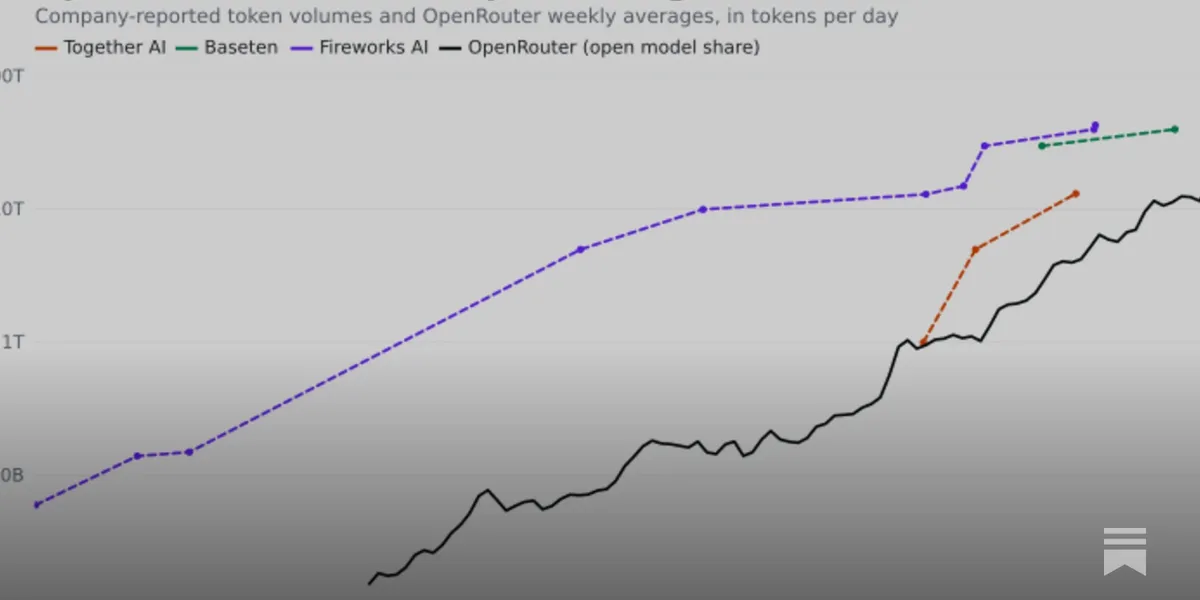
In July, Fireworks AI said it serves more than 40 trillion tokens a day. In October, Alphabet said Google's own model APIs handle nearly 32 billion tokens a minute, or about 46 trillion a day. Both figures come from the companies themselves. Lambert reads them as evidence that open-model serving is a substantial business. [1] [2] [3] [4]
The size of the market is hard to pin down. Lambert's estimate combines occasional token disclosures, usually made at fundraises, with OpenRouter's open-model share. Big clouds like Bedrock and Azure don't break out open-model usage. Lambert also treats Fireworks' 40 trillion as customized-model traffic only and estimates the total at over 100 trillion. The company's release gives 40 trillion as its total daily volume. [1] [2] [3]
Lambert argues the economics are split. Hosts like Fireworks, Baseten and Together earn the inference revenue, while the model labs rely on revenue shares even as frontier training heads into the billions of dollars. He also argues that closed labs now cover the whole cost-performance frontier, so open models aren't automatically cheaper. [2]
Lambert says open models win on adaptability, privacy and owning the weights. One example is legal-AI company Harvey's Tenet, which was post-trained from Kimi K3. On Harvey's own benchmark, it completed nearly twice as many held-out tasks as the base model. Fireworks' new LoRA-adapter serving and self-hosted Sovereign deployment option follow the same pattern. [2] [7] [9]
The evidence: open-model hosts report token volumes comparable to Gemini's API. The implication: open models are a real procurement option that competes on customization, privacy and weight ownership rather than price.
Read the full assessment
Thin economics for the model labs could slow new releases.
Sources are checked; writing up the dossier now.
Executive brief
Fireworks AI, a startup that mainly serves open models, said in July 2026 that it handles more than 40 trillion tokens a day (Fireworks). Alphabet says Google's own model APIs process nearly 32 billion tokens a minute (Motley Fool transcript), which works out to about 46 trillion a day. So open-model hosts now run at roughly Gemini API scale. Nathan Lambert's paid research note argues this shows the open-model inference market is a real business and not a rounding error. He also says every available measure is noisy, and that the companies serving the models earn the revenue while the labs that build them do not.
What changed and event timeline
GLM‑5.2 ships with open weights
Zhipu released an MIT‑licensed MoE model with a 1M‑token context, built for coding agents (). Lambert calls it the start of practical open agents ().
Together AI volume reported
A secondary report put Together at 400T tokens a month, up from 30B a year earlier (). The same piece's daily figure ("over 1 trillion") doesn't match that monthly total.
Fireworks reaches $1B annualized revenue
Daily tokens rose from 15T to over 40T, and 95% came from specialized models. The Series D raised $1.505B at a $17.5B valuation ().
- Late Aug 2026
Harvey ships Tenet on Kimi K3
The legal-AI company post-trained Moonshot's open‑weight Kimi K3 with Fireworks (;).
Alphabet discloses API volume
Google's first‑party APIs process nearly 32B tokens a minute, up 40% on the quarter and more than 4x on the year ().
Forge conference, then Lambert's note
Fireworks launched serverless LoRA serving and a self-hosted option called Sovereign (). Lambert then published his market estimate ().
Capabilities and access
- Models named: GLM‑5.2 (MIT license. Weights at zai-org/GLM-5.2) (DataNorth). Kimi K3, the base for Harvey's Tenet.
- Fireworks Specialized Model Inference (public preview): customers pay the base model's per-token price to run LoRA adapters on GLM‑5.3 Flash, with no charge for idle adapters (Unite.AI).
- Kimi K3.1: in the video Lambert expected it 2–3 days after recording (video 4:58). Its release is not confirmed in the reviewed sources.
Read the full section
- Models named: GLM‑5.2 (MIT license; weights at zai-org/GLM-5.2) (DataNorth); Kimi K3, the base for Harvey's Tenet; DeepSeek V4.1 Flash, which Fireworks says reaches up to 1,500 tokens/s in an "Ultra‑fast" preview (Unite.AI).
- Fireworks Specialized Model Inference (public preview): customers pay the base model's per-token price to run LoRA adapters on GLM‑5.3 Flash, with no charge for idle adapters (Unite.AI).
- Kimi K3.1: in the video Lambert expected it 2–3 days after recording (video 4:58). Its release is not confirmed in the reviewed sources.
Technical analysis for researchers and developers
- How Lambert measures the market: he combines sparse token disclosures from Baseten, Fireworks and Together (usually announced at fundraises) with OpenRouter's open-model share, plotted on a log scale (video 0:35).
- What it leaves out: Bedrock, Azure and other clouds don't break usage down by model type.
- Model gap: using Artificial Analysis's index, he says open models trail closed ones by roughly 4–8 months (video 3:46).
Read the full section
- How Lambert measures the market: he combines sparse token disclosures from Baseten, Fireworks and Together (usually announced at fundraises) with OpenRouter's open-model share, plotted on a log scale (video 0:35). Google's earnings figures are the closed-model benchmark.
- What it leaves out: Bedrock, Azure and other clouds don't break usage down by model type. Lambert believes those clouds serve most open-model traffic (video 1:22).
- Model gap: using Artificial Analysis's index, he says open models trail closed ones by roughly 4–8 months (video 3:46).
- Research use: his own text search of arXiv finds Qwen mentioned in almost as many papers as OpenAI's models (video 3:07). The method is not published.
Claims and evidence
- Open models are at Gemini‑API scale. The arithmetic checks out: about 40T/day for Fireworks (Fireworks) against about 46T/day for Google's APIs (Motley Fool).
- Conflicting read of the 40T figure. The 100T figure is Lambert's estimate.
- One analysis says open models passed 50% of OpenRouter tokens by mid‑2026 (Capital and Compute).
Read the full section
- Open models are at Gemini‑API scale. The arithmetic checks out: about 40T/day for Fireworks (Fireworks) against about 46T/day for Google's APIs (Motley Fool). Both numbers are self-reported.
- Conflicting read of the 40T figure. Lambert treats 40T as only Fireworks' customized-model traffic, announced "this week," and expects total volume above 100T (Interconnects). Fireworks' July release gives 40T as all daily tokens, 95% of them specialized. The 100T figure is Lambert's estimate.
- OpenRouter share. One analysis says open models passed 50% of OpenRouter tokens by mid‑2026 (Capital and Compute). This is not independently checked, and share of tokens is not share of revenue.
- Harvey's Tenet. It completed nearly twice as many held‑out tasks as base Kimi K3 on Harvey's own benchmark (The Next Web). The comparison is with the base model, not with frontier models.
Context and prior work
- An a16z–OpenRouter study of more than 100T tokens had already recorded substantial open‑weight adoption, with roleplay and coding as major uses (arXiv 2601.10088).
- Baseten reportedly grew token volume 40x year over year (Digg).
- Lambert's dashboard pulls these scattered signals together; the data stays free, while his notes are paid (Interconnects).
Read the full section
- An a16z–OpenRouter study of more than 100T tokens had already recorded substantial open‑weight adoption, with roleplay and coding as major uses (arXiv 2601.10088).
- Baseten reportedly grew token volume 40x year over year (Digg).
- Lambert's dashboard pulls these scattered signals together; the data stays free, while his notes are paid (Interconnects).
Limitations, safety and contested findings
- All volume figures come from the companies themselves, and they count tokens in different ways.
- The Together AI figures don't match each other (Crypto Briefing).
- Lambert argues closed labs now cover the whole cost‑performance frontier (video 5:15).
Read the full section
- All volume figures come from the companies themselves, and they count tokens in different ways.
- The Together AI figures don't match each other (Crypto Briefing).
- Open models aren't always cheaper. Lambert argues closed labs now cover the whole cost‑performance frontier (video 5:15).
- The economics don't reward the model builders. Inference providers capture the revenue, while labs depend on revenue shares (video 8:47). Frontier training already costs billions, so the capability gap could widen (video 10:35).
Business and practitioner implications
- Where open models compete: Lambert says it's on adaptability, privacy and ownership of weights, not on raw price (video 15:15).
- Expect price pressure: he argues open-model providers will have to push prices toward marginal cost to win share (video 12:20).
- Supplier risk for buyers: the labs that fund open models face an unresolved revenue problem, so the supply of new models may be fragile.
Read the full section
- Where open models compete: Lambert says it's on adaptability, privacy and ownership of weights, not on raw price (video 15:15). Harvey's Tenet and Fireworks' LoRA and Sovereign products follow that pattern.
- Expect price pressure: he argues open-model providers will have to push prices toward marginal cost to win share (video 12:20).
- Supplier risk for buyers: the labs that fund open models face an unresolved revenue problem, so the supply of new models may be fragile.
The source trail.
Sources (12)
Interconnects: How big is the open model economy today?
interconnects.aiLinked video: How big is the open model economy today?
linked video auto captions
www.youtube.com