
PolicyLaw, regulation & governance
Census Bureau business survey replaces "AI" with "Super Intelligence" after Executive Order 14434
Since October 19, the Census Bureau's Business Trends and Outlook Survey has asked firms about "Super Intelligence or SI" instead of AI, following Executive Order 14434. It is the series' second wording change in a year, complicating any reading of adoption trends.
From the Simon Willison article of November 2, 2026 and cited sources: Executive Order 14434 was signed September 29, 2026, and published October 2. [6] [7] [9]
SOURCES[6] What's in a Name? (Arnold & Porter) arnoldporter.com[7] EO 14434 text (White House PDF) whitehouse.gov[9] Executive Order Rebrands AI as "Super Intelligence" (Wiley) wiley.law
 AT Pulse research deskPublished · Updated · 5 min read · AI-assisted analysis
AI-assisted, not human-edited. Methodology Corrections Who owns this site
- What happened
- Executive Order 14434 was signed September 29, 2026, and published October 2. [6] [7] [9]
- Original source
- Simon Willison article, independent perspective
- Brief by
- AT Pulse research desk AI-assisted; publisher and contact on the desk page
- When
- November 2, 2026 article published
- Covered
- Nov 3 edition
- Evidence
- 12 sources across 11 sites
- 1The U.S. Census Bureau and "Super Intelligence"…simonwillison.net
- 2In updating a graphic showing U.S. company AI adoption…x.com
- 3Monitoring AI Adoption in the U.S. Economy…federalreserve.gov
- 4FRN on Revising the BTOS (The Census Project)thecensusproject.org
- 5Federal Register 2026-18304govinfo.gov
- 6What's in a Name? (Arnold & Porter)arnoldporter.com
StrongHow it’s measured
Hacker News · 122 likes · 52 comments
Reach blends public engagement (views, likes, comments, shares, stars) from the platforms where the story or its original source lives: YouTube, Hacker News, GitHub, Substack and similar. A video and the article written from its transcript share one score, taken from the video. Platforms with no data are left out rather than counted as zero, and the age of a story never lowers its score.
Executive Order 14434 was signed September 29, 2026, and published October 2. It directs federal agencies to use "Super Intelligence" in place of "AI" in non-statutory materials. The term keeps the existing statutory AI definition, and the order carries no enforcement penalties. [6] [7] [9]
From October 19, the survey asks whether firms used "Super Intelligence or SI (formerly referred to as Artificial Intelligence or AI)." It also swaps the old examples (machine learning, natural language processing, voice recognition) for newer ones such as generative tools for marketing and coding, and virtual agents. That swap could shift answers on its own, apart from the rename. The first results under the new wording are due November 5. [1] [8]
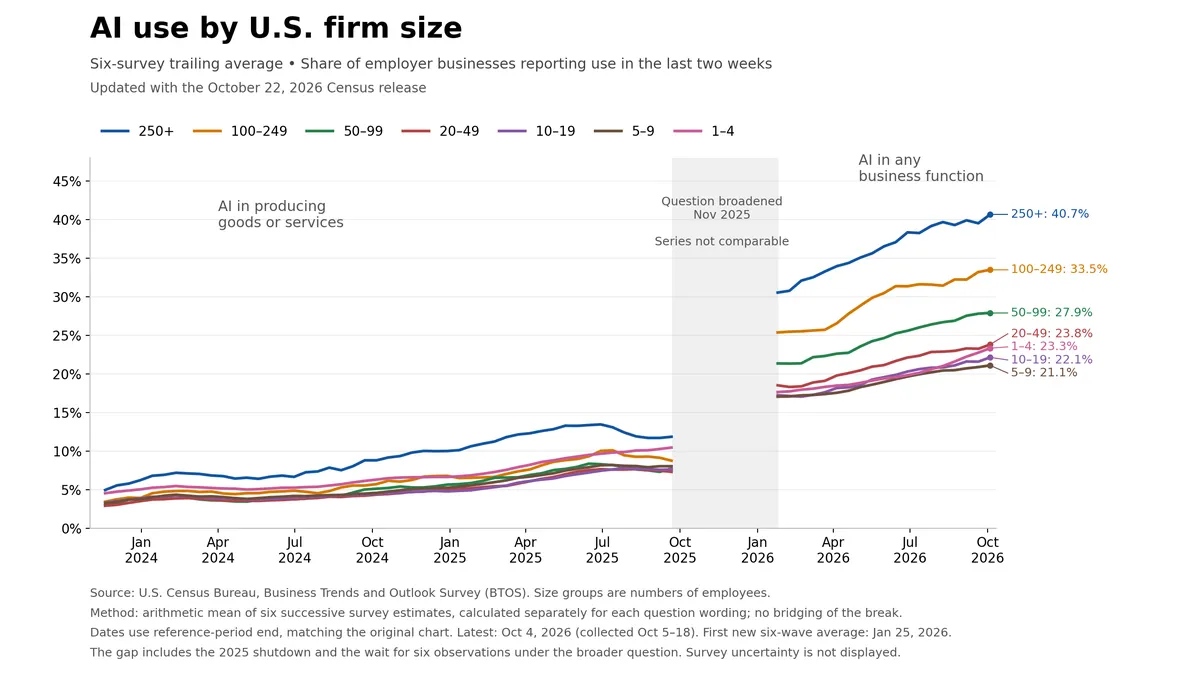
The adoption series now has three regimes separated by two breaks. In November 2025, the question was broadened from AI used in producing goods or services to AI used in any business function. Willison's reading of the size-class data shows large firms answering yes rising from about 12% in September 2025 to about 40% in October 2026, with much of that rise coming from the redefined question. The Census Bureau's own figure for firms with 250 or more employees was 37% as of May 2026. [1] [3] [10]
The survey runs every two weeks, but each firm answers only about once every 12 weeks. Any effect of the new wording should therefore build up gradually, roughly through mid-January 2027, rather than appear as a single jump. Further revisions have already been proposed, including skip logic for AI follow-up questions and a new question on how AI affects hiring. [1] [4] [5]
the question wording has changed twice in a year. Implication: BTOS adoption growth, whether framed as falling or tripling, cannot be cited across November 2025 or October 2026 without flagging the breaks.
Read the full assessment
No analysis yet measures the SI wording's effect.
Executive brief
Since October 19, 2026, the U.S. Census Bureau's main business survey has no longer asked companies about "Artificial Intelligence." The change follows Executive Order 14434, which tells federal agencies to use the new term (Willison). Large firms answering "yes" went from about 12% in September 2025 to about 40% in October 2026, and much of that jump comes from the redefined question.
Read the full section
Since October 19, 2026, the U.S. Census Bureau's main business survey has no longer asked companies about "Artificial Intelligence." It now asks whether they used "Super Intelligence or SI (formerly referred to as Artificial Intelligence or AI)." The change follows Executive Order 14434, which tells federal agencies to use the new term (Willison). The first results under the new wording are due Thursday, November 5. That is the second wording break in a year. The November 2025 broadening of the question had already made the AI-adoption series hard to compare over time. Large firms answering "yes" went from about 12% in September 2025 to about 40% in October 2026, and much of that jump comes from the redefined question.
What changed and event timeline
Apollo chart suggests big firms are using less AI
Apollo Global Management used Business Trends and Outlook Survey (BTOS) data to argue that large companies' AI adoption was falling. Willison later reworked the chart in his own analyses ().
Question broadened
The question changed from AI used "in producing goods or services" to AI used "in any of its business functions." The Bureau announced the change on December 3 (;).
Survey revision notice
In the Federal Register, the Census Bureau proposed moving the generative-AI and AI-employment questions into the core survey and adding a question on how AI affects hiring (;).
EO 14434 signed
"Inaugurating the Era of Super Intelligence" tells agencies to replace "AI" with "SI" in non-statutory materials. It was published October 2 (;).
BTOS switches to "SI"
The BTOS about page says the questionnaire wording changed because of EO 14434. Data published October 22 still reflects the old AI wording ().
Capabilities and access
- BTOS runs every two weeks. Results come out on alternating Thursdays at 10am (Willison).
- Size-class data is published as an "Employment size class" XLSX file. The questionnaire is public (Census PDF).
- Willison built the updated chart with "GPT-6 Astra Extra High" and published the transcript.
Read the full section
- BTOS runs every two weeks. Each round goes to about 200,000 of 1.2 million businesses, so each firm answers roughly once every 12 weeks. Results come out on alternating Thursdays at 10am (Willison).
- Size-class data is published as an "Employment size class" XLSX file. The questionnaire is public (Census PDF).
- Willison built the updated chart with "GPT-6 Astra Extra High" and published the transcript.
- Under the EO, "SI" still means the statutory AI definition in 15 U.S.C. § 9401(3) (Wiley).
Technical analysis for researchers and developers
- The series splits into "producing goods or services" (before November 17, 2025), "any business functions" with AI wording, and "any business functions" with SI wording (from October 19, 2026).
- Each firm sees the question only every 12 weeks, so the new SI wording reaches respondents over a full panel cycle.
- The SI version adds examples such as "generative SI for marketing… coding" and "virtual SI agents," replacing the old list (machine learning, NLP, voice recognition).
Read the full section
- Three regimes, two breaks. The series splits into "producing goods or services" (before November 17, 2025), "any business functions" with AI wording, and "any business functions" with SI wording (from October 19, 2026). Treat each as its own series. Don't fit one trend line across the breaks.
- Effects arrive gradually. Each firm sees the question only every 12 weeks, so the new SI wording reaches respondents over a full panel cycle. Any wording effect should therefore show up slowly, not as a single step.
- The new examples change the prompt. The SI version adds examples such as "generative SI for marketing… coding" and "virtual SI agents," replacing the old list (machine learning, NLP, voice recognition). That could shift answers independently of the rename (Willison).
- More changes are planned. The proposed skip logic would ask AI follow-up questions only of firms that report using AI (Census Project).
Claims and evidence
- Large-firm adoption rose from about 12% to about 40%.
- Overall adoption was 17–20% from December 2025 to May 2026 (Census).
- About 18% of firms had adopted AI by the end of 2025.
Read the full section
- Large-firm adoption rose from about 12% to about 40%. These figures are Willison's reading of the BTOS XLSX across a wording break, not a like-for-like trend (Willison). The Census Bureau's own figure for 250+ employee firms was 37% as of May 3, 2026 (Census).
- Overall adoption was 17–20% from December 2025 to May 2026 (Census).
- About 18% of firms had adopted AI by the end of 2025. The Fed note also says adoption grew 68% in the year before the wording change (FEDS Note).
- No published analysis yet measures how the SI wording affects responses.
Context and prior work
- Other surveys give much higher numbers. The Real-Time Population Survey finds 41% of workers use generative AI at work. The Survey of Business Uncertainty finds 78% adoption when weighted by employment.
- BTOS has run an AI supplement since at least 2024 (Census 2024 release).
Read the full section
- Other surveys give much higher numbers. The Real-Time Population Survey finds 41% of workers use generative AI at work. The Survey of Business Uncertainty finds 78% adoption when weighted by employment. The Fed note attributes most of the gap to how each survey samples and weights, plus question framing (FEDS Note).
- BTOS has run an AI supplement since at least 2024 (Census 2024 release).
Limitations, safety and contested findings
- The deadline for a legal definition is disputed. Wiley's summary says no deadline is specified (Wiley).
- The definition could expand. A future statutory definition could reach beyond today's AI definition (Wiley).
- The order carries no enforcement penalties. Arnold & Porter also points to political framing that goes beyond the order's technical scope (Arnold & Porter).
Read the full section
- The deadline for a legal definition is disputed. Arnold & Porter reads the EO as requiring proposed legislative language defining "Super Intelligence" within 60 days, which means late November (Arnold & Porter). Wiley's summary says no deadline is specified (Wiley).
- The definition could expand. A future statutory definition could reach beyond today's AI definition (Wiley).
- The order carries no enforcement penalties. Arnold & Porter also points to political framing that goes beyond the order's technical scope (Arnold & Porter).
- Willison's concerns are commentary, not evidence. He calls the wording absurd and raises possible respondent confusion, but no data yet tests either point.
Business and practitioner implications
Read the full section
- Don't cite BTOS adoption growth across November 2025 or October 2026 without flagging the breaks. Investor decks that repeat the "adoption falling" or "adoption tripled" story are both affected.
- Watch the November 5 release for a level shift. Expect more uncertainty through roughly mid-January 2027, when a full 12-week panel cycle will have seen the new wording.
- Federal contractors should expect "SI" in agency documents. Existing contracts and statutes are unchanged (fast.io; Wiley).
- Compare adoption figures only within the same survey. The weighting differences between surveys are large.
The source trail.
Sources (12)
The U.S. Census Bureau and "Super Intelligence" (Simon Willison)
simonwillison.netIn updating a graphic showing U.S. company AI adoption over time according to a long-running U.S. Census Bureau survey, I found out that the Bureau's work has been sullie
Related coverage; assess separately
x.com