
PolicyLaw, regulation & governance
Tech CEOs and federal agencies split on Trump's order to replace "AI" with "Super Intelligence"
A September 29 executive order requires executive-branch communications to say "Super Intelligence" instead of "AI." A month later, tech CEOs and agencies are split along political lines. A safety accord signed the same day has no penalties and no published audits.
From the MIT Technology Review · AI article of November 3, 2026 and cited sources: The order changes wording only. [3] [8]
SOURCES[3] White House fact sheet: Inaugurates the Era of Super… whitehouse.gov[8] Crowell & Moring client alert crowell.com
 AT Pulse research deskPublished · Updated · 5 min read · AI-assisted analysis
AI-assisted, not human-edited. Methodology Corrections Who owns this site
- Original source
- MIT Technology Review · AI article, independent perspective
- Brief by
- AT Pulse research desk AI-assisted; publisher and contact on the desk page
- When
- November 3, 2026 article published
- Covered
- Nov 3 edition
- Evidence
- 8 sources across 7 sites
- 1MIT Technology Review: Here's who is falling in line for…technologyreview.com
- 2Al Jazeera: How does Trump's White House AI accord work?aljazeera.com
- 3White House fact sheet: Inaugurates the Era of Super…whitehouse.gov
- 4CNBC: Trump tries to rename AI 'super intelligence'cnbc.com
- 5Just the News: Trump complains WSJ won't use 'super…justthenews.com
- 6Daily Beast: Trump declares war on two wordsthedailybeast.com
Reach: not measured yet
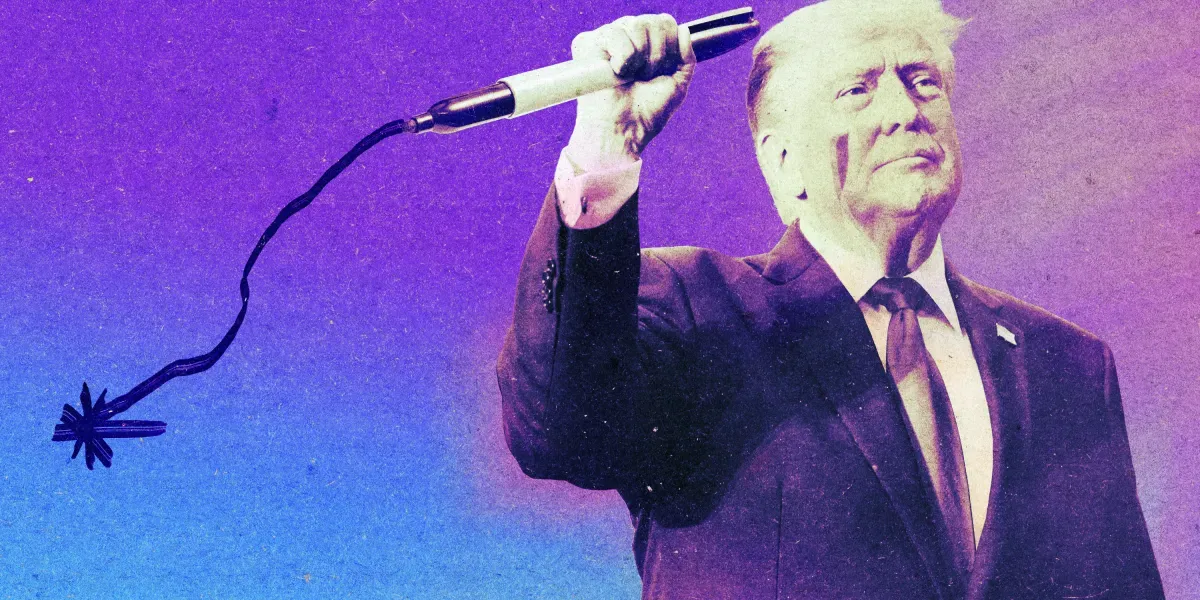
The order changes wording only. It covers executive-branch correspondence, public communications and policy documents. It does not apply retroactively to existing regulations or contracts, and it changes no AI capability or regulatory requirement. Until a federal definition exists, "SI" in a solicitation has no technical meaning and should not be read as artificial superintelligence in the research sense. [3] [8]
Uptake is uneven. On October 30 earnings calls, Musk and Zuckerberg used the new term, while Nadella, Jassy and Pichai kept saying "AI." In government, "SI" appeared in ICE solicitations and on an NIH banner, but the Pentagon, FTC and HHS went back to the old wording. Trump also publicly criticized the Wall Street Journal for not switching. [7] [1] [5] [6]
Six executives also signed a voluntary accord with four layers: internal risk controls, oversight teams, external audits and board committees. It sets no audit standard, required evaluations, disclosure rules or penalties. Crowell & Moring notes that competitors jointly agreeing on standards could draw antitrust scrutiny. [2] [8]
The sources show only a change in terms and a nonbinding accord. For practitioners, that means mapping "SI" in federal contracts to existing AI compliance language. Executives' word choice now signals political alignment.
Status: the research is done and the dossier is below.
Executive brief
The only thing the September 29 executive order does is rename things. Federal agencies must now say "Super Intelligence" (SI) where they used to say "artificial intelligence" (AI). The heads of Microsoft, Amazon and Alphabet stuck with "AI."
Read the full section
The only thing the September 29 executive order does is rename things. Federal agencies must now say "Super Intelligence" (SI) where they used to say "artificial intelligence" (AI). It does not change what any AI system can do or how it is regulated. A month later, adoption follows political lines. Musk and Zuckerberg used the new term on earnings calls. The heads of Microsoft, Amazon and Alphabet stuck with "AI." Trump publicly criticized the Wall Street Journal for not switching. The same day as the order, six tech leaders signed a voluntary safety accord, the White House Accord on Super Intelligence. It carries no penalties and doesn't require audits to be published. Practitioners should watch it more closely than the name change.
What changed and event timeline
Weak polling backdrop
A Quinnipiac poll found 25% approved of Trump's handling of AI and 58% disapproved, according to.
Rebrand order and accord signed
The order "Inaugurating the Era of Super Intelligence" applies to executive-branch communications. Six executives signed the voluntary accord at the same event (;).
Trump attacks the WSJ over terminology
On Truth Social he called "AI" inaccurate and said "AI" would soon be officially banned from relevant documents (;).
Earnings calls split
Musk and Zuckerberg used the new term. Nadella, Jassy and Pichai kept saying "AI" ().
Uneven uptake across government
MIT Technology Review found "SI" in ICE solicitations and an NIH website banner. The Pentagon, FTC and HHS slipped back to the old wording ().
Capabilities and access
- No model, product or capability is involved.
- It covers executive-branch correspondence, public communications, policy documents and non-statutory documents (White House).
- It does not apply retroactively to existing regulations or contracts (Crowell).
Read the full section
- No model, product or capability is involved. The order changes vocabulary only.
- It covers executive-branch correspondence, public communications, policy documents and non-statutory documents (White House).
- It does not apply retroactively to existing regulations or contracts (Crowell).
- A new task force, the Super Intelligence Force, owes a report on AI risks and opportunities within 120 days (Crowell).
Technical analysis for researchers and developers
- What "SI" means is still open. The order calls for a proposed federal definition of "Super Intelligence." The White House fact sheet gives no deadline, while Crowell reports 60 days, which is late November.
- It sets out four layers: internal controls covering cyber and biosecurity risks during training and deployment, internal oversight teams, independent external audits, and board committees. No audit standard, set of evaluations or disclosure requirement is specified (Al Jazeera).
Read the full section
- What "SI" means is still open. The order calls for a proposed federal definition of "Super Intelligence." The White House fact sheet gives no deadline, while Crowell reports 60 days, which is late November. Until that text is published, "SI" in a federal solicitation has no technical criteria. Researchers should not read it as artificial superintelligence (ASI) in the research sense.
- What the accord asks for. It sets out four layers: internal controls covering cyber and biosecurity risks during training and deployment, internal oversight teams, independent external audits, and board committees. No audit standard, set of evaluations or disclosure requirement is specified (Al Jazeera).
Claims and evidence
- Claim: Today's systems "amplify" rather than "imitate" human intelligence. This is the White House's stated reason for the rename (fact sheet).
- Claim: "Virtually everyone" uses SI.
- CNBC counted eight "super intelligence" mentions in Microsoft's annual report. MIT Technology Review cites a shareholder letter referring to the "Super Intelligence era."
Read the full section
- Claim: Today's systems "amplify" rather than "imitate" human intelligence. This is the White House's stated reason for the rename (fact sheet). It is a framing with no evidence.
- Claim: "Virtually everyone" uses SI. Trump's own assertion. CNBC's earnings-call review contradicts it (CNBC).
- Microsoft's usage. CNBC counted eight "super intelligence" mentions in Microsoft's annual report. MIT Technology Review cites a shareholder letter referring to the "Super Intelligence era."
- Musk's company naming. CNBC says the SpaceX AI division was renamed SpaceXSI. MIT Technology Review describes this only as a pledge. The two accounts conflict.
Context and prior work
- The order fits a pattern of renamings: the Gulf of America and the Department of War.
- Meta has used "superintelligence" in its own branding since 2025.
- Congress is debating harder limits. Senators Sanders and Casar introduced the Ban Artificial Superintelligence Act (Al Jazeera).
Read the full section
- The order fits a pattern of renamings: the Gulf of America and the Department of War. After the Associated Press declined to use "Gulf of America," it was barred from some White House events (MIT Technology Review).
- Meta has used "superintelligence" in its own branding since 2025.
- Congress is debating harder limits. Senators Sanders and Casar introduced the Ban Artificial Superintelligence Act (Al Jazeera).
Limitations, safety and contested findings
- The accord has no penalties and no requirement to publish audits. Compliance is left to each company (Al Jazeera).
- Crowell flags possible antitrust scrutiny, because competitors jointly agreed on standards.
- Sources disagree on the X poll options: "Superior Intelligence" per CNBC, versus "Extreme" and "Supreme" per MIT Technology Review.
Read the full section
- The accord has no penalties and no requirement to publish audits. Compliance is left to each company (Al Jazeera). Senator Mark Warner said renaming AI does nothing about its real risks (CNBC).
- Crowell flags possible antitrust scrutiny, because competitors jointly agreed on standards.
- Sources disagree on the X poll options: "Superior Intelligence" per CNBC, versus "Extreme" and "Supreme" per MIT Technology Review.
- On Huang, CNBC counts him among adopters, while MIT Technology Review notes he still says "AI" as well.
Business and practitioner implications
- Federal contracting: Expect "SI" wording in RFPs and in new contracts, such as ICE's request for "SI-powered" surveillance.
- Communications risk: Which word a company uses now reads as a political signal.
- Governance: The accord's audit-and-board structure lines up with California's emerging AI auditor framework (Crowell).
Read the full section
- Federal contracting: Expect "SI" wording in RFPs and in new contracts, such as ICE's request for "SI-powered" surveillance. Map those terms to your existing AI compliance language rather than assuming the scope has changed (Crowell).
- Communications risk: Which word a company uses now reads as a political signal. Executives at Microsoft, Amazon and Alphabet have kept "AI" on calls without any reported consequences so far.
- Governance: The accord's audit-and-board structure lines up with California's emerging AI auditor framework (Crowell). Firms should prepare for that model even though it isn't binding.
- Upcoming milestones: the federal definition (late November, per Crowell) and the 120-day task-force report.