
InfrastructureCompute, chips & cloud
Google's first Project Suncatcher satellite runs Gemma 4 on an orbiting TPU and sends back a haiku
Google's first Project Suncatcher satellite has run a Gemma 4 model on a data-center-class TPU in orbit and sent a haiku to the ground. The result shows the hardware and software survive in space but does not yet show useful compute.
From the TechCrunch AI article of October 30, 2026 and cited sources: The satellite, built with Planet, launched on SpaceX's Transporter-18 rideshare on October 1. [1] [6] [7] [8]
SOURCES[1] TechCrunch: Google's first data center satellite is online… techcrunch.com[6] Payload: Transporter-18 tests the building blocks of… payloadspace.com[7] Mixed: Suncatcher satellite reached orbit, contact confirmed mixed-news.com
 AT Pulse research deskPublished · Updated · 5 min read · AI-assisted analysis
AI-assisted, not human-edited. Methodology Corrections Who owns this site
- What happened
- The satellite, built with Planet, launched on SpaceX's Transporter-18 rideshare on October 1. [1] [6] [7] [8]
- Original source
- TechCrunch AI article, independent perspective
- Brief by
- AT Pulse research desk AI-assisted; publisher and contact on the desk page
- Studies
- arXiv 2511.19468 (Nov 2025) [4] date from arXiv ID
- When
- October 30, 2026 article published
- Covered
- Oct 31 edition
- Evidence
- 11 sources across 11 sites
- 1TechCrunch: Google's first data center satellite is online…techcrunch.com
- 2Google’s satellite AI server transmits its first response…theverge.com
- 3SiliconANGLE: Suncatcher announcementsiliconangle.com
- 4arXiv 2511.19468: Towards a future space-based, highly…arxiv.org
- 5FourWeekMBA: Google's 1,800 Starship launches, a conditionalfourweekmba.com
- 6Payload: Transporter-18 tests the building blocks of…payloadspace.com
QuietHow it’s measured
Hacker News · 4 likes
Reach blends public engagement (views, likes, comments, shares, stars) from the platforms where the story or its original source lives: YouTube, Hacker News, GitHub, Substack and similar. A video and the article written from its transcript share one score, taken from the video. Platforms with no data are left out rather than counted as zero, and the age of a story never lowers its score.
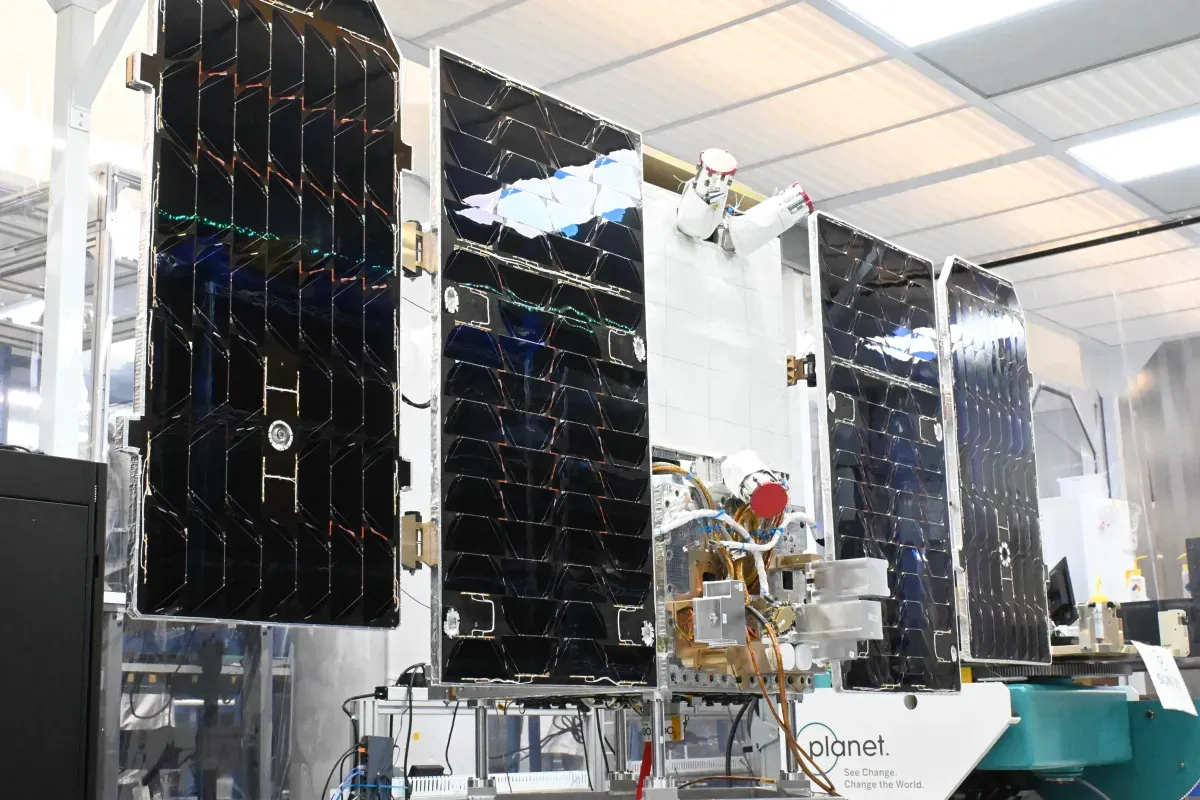
The satellite, built with Planet, launched on SpaceX's Transporter-18 rideshare on October 1. After about three weeks of commissioning, it ran Gemma 4 on a Trillium TPU and sent its answer to a haiku prompt down during a ground-station pass over Svalbard. Later tests included limericks and prompts asking the model to report the satellite's own telemetry. [1] [6] [7] [8]
The satellite carries four TPUs and solar arrays rated at about 1 kW. Power and heat limits let it run only one TPU at a time, in short bursts. TechCrunch reports about 20 minutes per burst, while a pre-launch report said about 15. No benchmarks or measurements from orbit have been published. [1] [6] [8] [9]
The long-term design is a cluster of 81 satellites within a 1 km radius, linked by lasers so they can share one workload. In Google's own ground tests, TPUs absorbed a radiation dose equal to a five-year mission without permanent failure. Random bit errors looked more harmful to training than to inference, and the satellite will now test that in orbit. Two linked satellites are planned for 2027. [1] [4]
So far, the evidence shows a TPU and its software working after launch.
Read the full assessment
The bigger goal, clustered orbital compute for inference in the 2030s, still depends on untested radiation behavior in orbit, laser-linked formation flying and much cheaper Starship launches.
Writing the dossier now from the reviewed sources.
Executive brief
Google's first Project Suncatcher satellite has run a Gemma 4 model on a data-center-class TPU in orbit and sent the output to the ground. The output was a haiku. TechCrunch reports that the satellite carries four TPUs and up to 1 kW of power, but can only run one TPU at a time, for about 20 minutes. So this is a test of whether the hardware survives in space. It is not yet useful compute. The real data will come from tests of heat and radiation, and from twin linked satellites planned for 2027. The long-term economics depend on SpaceX's Starship rocket becoming fully reusable.
What changed and event timeline
Suncatcher announced
Google's Travis Beals described a long-term "moonshot" to run machine-learning compute on solar-powered satellites. Google also released a preprint describing an 81-satellite design (;).
Preprint revised
Version 2 of the system-design paper was posted. A version later appeared in the journal Joule, according to secondary accounts (;).
Launch on Transporter-18
The "MVP" satellite, built with Planet, launched on a SpaceX Falcon 9 rideshare. Google confirmed contact the same day and said the satellite was working as expected (;).
First answer from orbit
After about three weeks of commissioning, Gemma 4 answered the haiku prompt. The output came down during a ground-station pass over Svalbard (;).
Capabilities and access
- Hardware: four Trillium-generation TPUs, about one server's worth of compute, with solar arrays rated at roughly 1 kW (Payload).
- Model: Gemma 4, Google DeepMind's open-weights model, loaded before launch. The exact model size has not been disclosed (TechCrunch).
- Tests so far: a haiku, limericks, and prompts asking the satellite to report its own telemetry, which checks that the chip and the spacecraft can talk to each other (Hardware Busters).
Read the full section
- Hardware: four Trillium-generation TPUs, about one server's worth of compute, with solar arrays rated at roughly 1 kW (Payload).
- Model: Gemma 4, Google DeepMind's open-weights model, loaded before launch. The exact model size has not been disclosed (TechCrunch).
- Tests so far: a haiku, limericks, and prompts asking the satellite to report its own telemetry, which checks that the chip and the spacecraft can talk to each other (Hardware Busters).
- Access: this is an internal research satellite. There is no external access.
Technical analysis for researchers and developers
- Target design: a cluster of 81 satellites within a 1 km radius, connected by free-space optical (laser) links so they can share one workload.
- Radiation: in ground tests, Trillium TPUs took a total radiation dose equal to a five-year mission without permanent failure.
- Heat and power: with no air in space, cooling relies on heat pipes and radiators (Light Reading).
Read the full section
- Target design: a cluster of 81 satellites within a 1 km radius, connected by free-space optical (laser) links so they can share one workload. This needs precise formation flying (arXiv).
- Radiation: in ground tests, Trillium TPUs took a total radiation dose equal to a five-year mission without permanent failure. The bit-flip rates were measured (arXiv). Those ground results suggested bit flips matter more for training than for inference. The satellite will now test that in real orbit (TechCrunch).
- Heat and power: with no air in space, cooling relies on heat pipes and radiators (Light Reading). Power and heat limits allow only short bursts on a single TPU. Ground contact only happens during passes, which makes scheduling work harder.
Claims and evidence
- Satellite is online and operating normally: Google's blog post and a spokesperson quoted by TechCrunch. No independent telemetry has been published (TechCrunch).
- How long a TPU can run: TechCrunch reports about 20 minutes. The two figures have not been reconciled.
- Radiation tolerance: comes from Google's own ground tests, described in its paper (arXiv). No results from orbit have been released yet.
Read the full section
- Satellite is online and operating normally: Google's blog post and a spokesperson quoted by TechCrunch. No independent telemetry has been published (TechCrunch).
- How long a TPU can run: TechCrunch reports about 20 minutes. Light Reading reported about 15 minutes before launch (Light Reading). The two figures have not been reconciled.
- Radiation tolerance: comes from Google's own ground tests, described in its paper (arXiv). No results from orbit have been released yet.
- Starship launches needed: TechCrunch cites 1,800. Other coverage of the white paper says about 1,600 (KuCoin).
Context and prior work
- The same Transporter-18 launch carried other orbital data-center demos (Payload):
- Cowboy Space's Reason-1, a laser power-beaming test, with Reason-2 planned to carry H200 GPUs in the first half of 2027.
- Star Catcher's Protostar, a power-beaming demo.
Read the full section
- The same Transporter-18 launch carried other orbital data-center demos (Payload):
- Cowboy Space's Reason-1, a laser power-beaming test, with Reason-2 planned to carry H200 GPUs in the first half of 2027.
- Star Catcher's Protostar, a power-beaming demo.
- Starcloud and Cowboy Space plan to run inference on individual satellites. Suncatcher is unusual because it plans tightly linked clusters that work as one system (TechCrunch).
- SpaceX is also expected to use laser links, but its satellites would orbit too far apart to share processing well.
- Alphabet holds a significant stake in SpaceX.
Limitations, safety and contested findings
- A coherent answer shows the hardware survived launch and the software stack works. It says nothing about performance under sustained workloads (Hardware Busters).
- No benchmarks, error rates or measurements from orbit have been published.
- Google has not released orbital parameters or a timeline for releasing its data (Mixed).
Read the full section
- A coherent answer shows the hardware survived launch and the software stack works. It says nothing about performance under sustained workloads (Hardware Busters).
- No benchmarks, error rates or measurements from orbit have been published.
- Google has not released orbital parameters or a timeline for releasing its data (Mixed).
- The Starship launch count is a condition inside a cost model, not a forecast. It is the launch volume consistent with a learning rate of about 20%, reaching under $200/kg by about 2035 (FourWeekMBA).
- TechCrunch frames the number more as a hurdle that must be cleared first.
Business and practitioner implications
- Timeline: treat Suncatcher as infrastructure for the 2030s.
- Workloads: in the near term, orbit favors inference that can tolerate errors and run in short bursts. It does not favor training.
- Key risk: the economics depend on Starship becoming fully and rapidly reusable, which is still in development.
Read the full section
- Timeline: treat Suncatcher as infrastructure for the 2030s. The next milestone is two satellites in 2027 with more power and laser links between them (TechCrunch).
- Workloads: in the near term, orbit favors inference that can tolerate errors and run in short bursts. It does not favor training.
- Key risk: the economics depend on Starship becoming fully and rapidly reusable, which is still in development. That ties Google's plans to SpaceX.
- Vendors: for teams building radiation-tolerant inference, error detection and checking for silent data corruption are the obvious areas for tools.
The source trail.
Sources (11)
TechCrunch: Google's first data center satellite is online and writing poetry
techcrunch.comGoogle’s satellite AI server transmits its first response to Earth
Related coverage; assess separately
theverge.com