
BusinessMarkets, money & strategy
Microsoft's fiscal Q1 2027 revenue rises 19% to $92.3 billion as Azure grows 48% and quarterly capex reaches $45.2 billion
Microsoft's fiscal Q1 2027 revenue rose 19% to $92.3 billion, led by 48% Azure growth and a $677 billion commercial backlog, while quarterly capital spending reached $45.2 billion with leases and guidance points to roughly $170 billion in calendar 2027.
From the TechCrunch AI article of October 28, 2026 and cited sources: Azure grew 48% to $33.2 billion, up from 39% constant-currency growth in fiscal Q3 2026. [4] [6] [7] [8]
SOURCES[4] Microsoft Investor Relations: FY27 Q1 press release microsoft.com[6] investingLive: Microsoft Q3 beats on revenue, EPS and cloud investinglive.com[7] CNBC: Microsoft stock jumps as cloud growth drives beat cnbc.com
 AT Pulse research deskPublished · Updated · 5 min read · AI-assisted analysis
AI-assisted, not human-edited. Methodology Corrections Who owns this site
- What happened
- Azure grew 48% to $33.2 billion, up from 39% constant-currency growth in fiscal Q3 2026. [4] [6] [7] [8]
- Original source
- TechCrunch AI article, independent perspective
- Brief by
- AT Pulse research desk AI-assisted; publisher and contact on the desk page
- When
- October 28, 2026 article published
- Covered
- Oct 29 edition
- Evidence
- 10 sources across 10 sites
- 1Microsoft hits 10 quarters of record-breaking revenue in a…techcrunch.com
- 2Microsoft Quarterly Profit Soars as Cloud Growth Accelerateswsj.com
- 3tech-insider.org: Azure up 48% to $33.2B as capex climbstech-insider.org
- 4Microsoft Investor Relations: FY27 Q1 press releasemicrosoft.com
- 5Motley Fool: Microsoft Q1 2027 earnings call transcriptfool.com
- 6investingLive: Microsoft Q3 beats on revenue, EPS and cloudinvestinglive.com
Reach: not measured yet
Azure grew 48% to $33.2 billion, up from 39% constant-currency growth in fiscal Q3 2026. Contracted future commercial revenue reached $677 billion, up 73% year over year. Revenue and non-GAAP EPS of $4.89 both came in above analyst expectations. [4] [6] [7] [8]
Capex is quoted two ways. Cash spending on property and equipment was $39.4 billion, more than double a year earlier, and adding finance leases brings it to $45.2 billion. About 75% went to short-lived assets such as GPUs and CPUs. Microsoft guided to more than $50 billion in Q2 and about $170 billion in calendar 2027, and said delays in third-party capacity are limiting growth. [5] [9] [10]
Microsoft depends heavily on OpenAI. In April 2026 it stopped paying OpenAI a revenue share, and OpenAI had earlier committed to an extra $250 billion of Azure purchases. A $207 million OpenAI-related gain, compared with a $3.1 billion loss a year earlier, is why GAAP net income rose 32% while non-GAAP net income rose 18%. [1] [4] [5] [6]
Copilot daily active users rose nearly 50% from the prior quarter, according to figures Microsoft gave on the call. About 90% of queries ran in Auto mode, where Microsoft rather than the customer picks the model for each request. [5]
The reported figures show demand and committed backlog growing faster than Microsoft can add capacity.
Read the full assessment
A likely implication, not yet proven, is tight Azure GPU supply into 2027, with returns on the AI buildout depending heavily on one customer, OpenAI.
Microsoft FY27 Q1: 10 record quarters in a row, while capex tops $45 billion
Executive brief
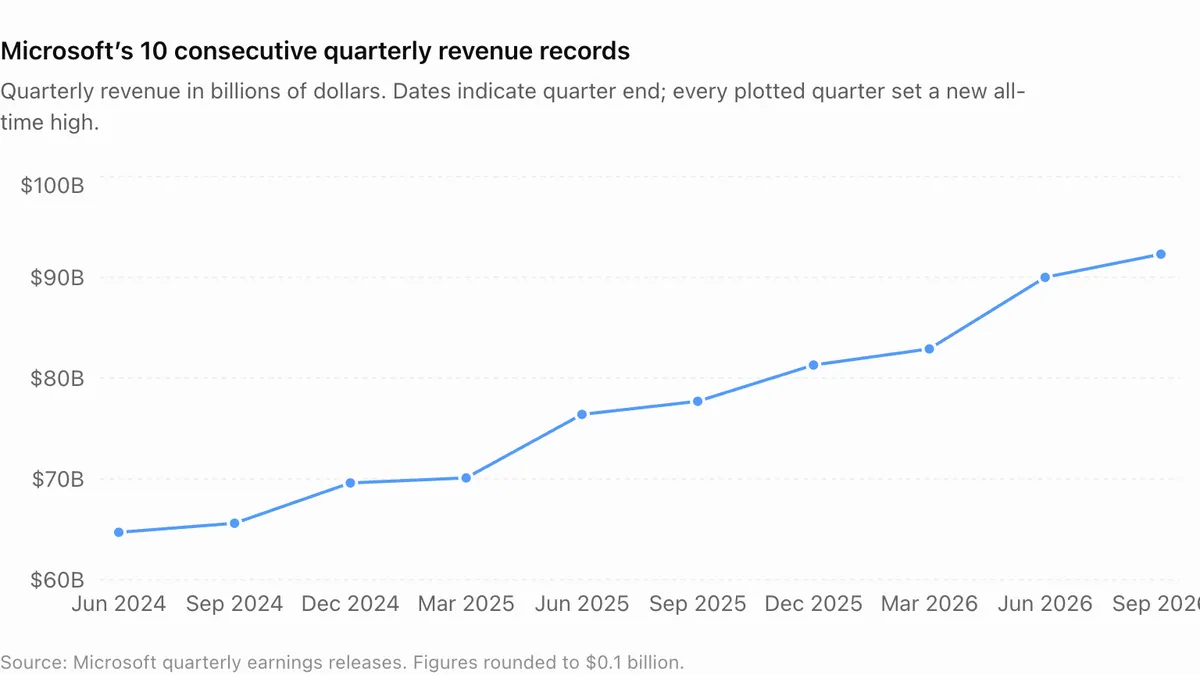
Microsoft says customers are now contractually committed to $677 billion of future commercial revenue, up 73% in a year (Microsoft IR). Its fiscal Q1 2027 revenue was $92.3B, up 19%. TechCrunch counts this as the 10th record quarter in a row. Azure grew 48% to $33.2B. A large share of the revenue depends on OpenAI, and spending is rising quickly: capex including finance leases reached $45.2B in the quarter. Microsoft expects about $170B for calendar 2027 (Motley Fool transcript).
What changed and event timeline
OpenAI partnership restructured
Microsoft stopped paying OpenAI a share of revenue. It kept Azure priority and a non-exclusive model licence through 2032. OpenAI had earlier contracted to buy an extra $250B of Azure services ().
Fiscal Q3 FY26 sets the baseline
Revenue was $82.89B, up about 18%. Azure grew 39% in constant currency, beating Microsoft's 37–38% guidance ().
Fiscal Q1 FY27 ends
This is the first quarter reported under the two new segments, "Agents and Infra" and "Devices and Consumer." Microsoft restated earlier periods to match ().
Results beat expectations
Revenue was $92.3B, against roughly $90.7B expected. Non-GAAP EPS was $4.89, against about $4.73 expected (;). After-hours gains were reported at about 2.7% to 4% ().
Capex guidance raised
On the earnings call, CFO Amy Hood said some third-party capacity deliveries slipped out of Q1. She guided to more than $50B of capex in Q2 and about $170B in calendar 2027 ().
Capabilities and access
No new model was announced.
Read the full section
No new model was announced. The figures describe adoption and capacity:
- Copilot: daily active users up nearly 50% from the prior quarter, and eight times as many customers with 50,000+ seats as a year earlier. About 90% of queries ran in Auto mode, which picks the model for each query (transcript).
- Capacity: 24 new datacenters on five continents this quarter. Azure is guided to 49–50% constant-currency growth in Q2 (transcript).
- Anthropic: TechCrunch reports that it also runs on Azure (TechCrunch).
Technical analysis for researchers and developers
- Cash spent on property and equipment was $39.4B, up 103% (more than double $19.4B a year earlier). Headlines use one or the other.
- About 75% of capex went to short-lived assets such as CPUs and GPUs.
- Microsoft recorded a $207M OpenAI-related gain this quarter, against a $3.1B loss a year earlier.
Read the full section
- Two different capex figures. Cash spent on property and equipment was $39.4B, up 103% (more than double $19.4B a year earlier). Adding $7.4B of finance leases gives $45.2B, up about 30% (Investing.com; WindowsForum). Headlines use one or the other.
- Asset mix. About 75% of capex went to short-lived assets such as CPUs and GPUs. That shortens depreciation timelines (Investing.com).
- OpenAI accounting. Microsoft recorded a $207M OpenAI-related gain this quarter, against a $3.1B loss a year earlier. That swing explains why GAAP net income rose 32% while non-GAAP net income rose 18% (Microsoft IR).
- Margin. Microsoft Cloud gross margin fell to 66% because more of the sales mix came from Azure (transcript).
Claims and evidence
- Revenue, net income, cloud and RPO: $92.3B revenue, $36.6B net income, $63.9B Microsoft Cloud and $677B RPO all come from the company release (Microsoft IR).
- "10 record quarters in a row": this is TechCrunch's own count. No other reviewed source confirms it (TechCrunch).
- OpenAI's share of revenue (conflicting): TechCrunch cites about $10B in OpenAI revenue. Another call summary says 11% of total revenue, about $10B (transcript).
Read the full section
- Revenue, net income, cloud and RPO: $92.3B revenue, $36.6B net income, $63.9B Microsoft Cloud and $677B RPO all come from the company release (Microsoft IR). Wire coverage repeats the same numbers (CNBC).
- "10 record quarters in a row": this is TechCrunch's own count. No other reviewed source confirms it (TechCrunch).
- OpenAI's share of revenue (conflicting): TechCrunch cites about $10B in OpenAI revenue. The transcript summary says OpenAI was 11% of Microsoft Cloud revenue, which works out to about $7B. Another call summary says 11% of total revenue, about $10B (transcript).
- Bad data in one write-up: tech-insider.org gives Microsoft Cloud as $49.1B, which conflicts with the release. Its free-cash-flow figure of $18.6B is unconfirmed elsewhere.
Context and prior work
Fiscal Q3 FY26 Azure growth was 39% in constant currency (investingLive), so 48% is a clear acceleration. Investing.com calls it Azure's strongest growth in five quarters (Investing.com). The April 2026 OpenAI restructuring turned what had been a revenue-share arrangement into mostly a customer relationship. That helps explain how OpenAI shows up in both RPO and Azure revenue.
Limitations, safety and contested findings
- Whichever OpenAI share is right, one customer accounts for a large slice of AI revenue.
- Windows OEM and devices revenue fell 22%. WindowsForum cautions against blaming a specific Windows release or hardware cycle (WindowsForum).
- Delayed third-party capacity shows that supply, not demand, is limiting growth (transcript).
Read the full section
- Customer concentration. Whichever OpenAI share is right, one customer accounts for a large slice of AI revenue.
- Weak consumer side. Windows OEM and devices revenue fell 22%. WindowsForum cautions against blaming a specific Windows release or hardware cycle (WindowsForum).
- Supply risk. Delayed third-party capacity shows that supply, not demand, is limiting growth (transcript).
- Unproven returns. Strong sales show demand but do not by themselves prove a return on the AI infrastructure spending (WindowsForum).
Business and practitioner implications
- Expect Azure GPU capacity to stay tight through the first half of calendar 2027, since Microsoft is pushing spending into the second half.
- Microsoft says it will stay free-cash-flow positive in FY27 and keep the option to raise outside funding (transcript).
- With about 90% of queries in Auto mode, Microsoft, not the buyer, increasingly chooses which model answers.
Read the full section
- Tight capacity. Expect Azure GPU capacity to stay tight through the first half of calendar 2027, since Microsoft is pushing spending into the second half. Plan for multiple regions or multiple clouds where you can.
- Cash flow. Microsoft says it will stay free-cash-flow positive in FY27 and keep the option to raise outside funding (transcript).
- Copilot routing. With about 90% of queries in Auto mode, Microsoft, not the buyer, increasingly chooses which model answers. Enterprise buyers should track which models handle their workloads and at what cost.
- Reading the numbers. Compare capex like for like (cash spending versus including leases), and use non-GAAP figures for operating trends.
The source trail.
Sources (10)
Microsoft hits 10 quarters of record-breaking revenue in a row
Article text retrieved; extracted text may omit tables or interactive elements.
techcrunch.comMicrosoft Quarterly Profit Soars as Cloud Growth Accelerates
Related coverage; assess separately
wsj.com