
AgentsAutonomy & tool use
Supabase raises $150M, buys Turso and launches OrioleDB beta and Multigres alpha as AI agents create most new databases
Supabase raised $150M, is acquiring SQLite rewrite Turso, and is reworking its Postgres platform for coding agents and AI tools, which now create about 70% of its new databases. The changes include declarative schemas, Docker-free local development, the OrioleDB storage engine and the Multigres cluster manager.
From the Latent Space podcast episode of October 26, 2026 and cited sources: Supabase raised $150M led by GIC, with CapitalG participating, four months after a $500M Series F at a $10.5B valuation. [3] [4] [5]
SOURCES[3] PR Newswire: $150M and Turso prnewswire.com[4] TechCrunch: Supabase hits $10B techcrunch.com[5] Turso: joining Supabase turso.tech
 AT Pulse research deskPublished · Updated · 5 min read · AI-assisted analysis
AI-assisted, not human-edited. Methodology Corrections Who owns this site
- What happened
- Supabase raised $150M led by GIC, with CapitalG participating, four months after a $500M Series F at a $10.5B valuation. [3] [4] [5]
- Original source
- Latent Space podcast episode, independent perspective
- Brief by
- AT Pulse research desk AI-assisted; publisher and contact on the desk page
- When
- October 26, 2026 podcast episode published
- Covered
- Oct 29 edition
- Evidence
- 10 sources across 8 sites; transcript sourced
RisingHow it’s measured
YouTube video · 2.7K views · 31 likes
Reach blends public engagement (views, likes, comments, shares, stars) from the platforms where the story or its original source lives: YouTube, Hacker News, GitHub, Substack and similar. A video and the article written from its transcript share one score, taken from the video. Platforms with no data are left out rather than counted as zero, and the age of a story never lowers its score.
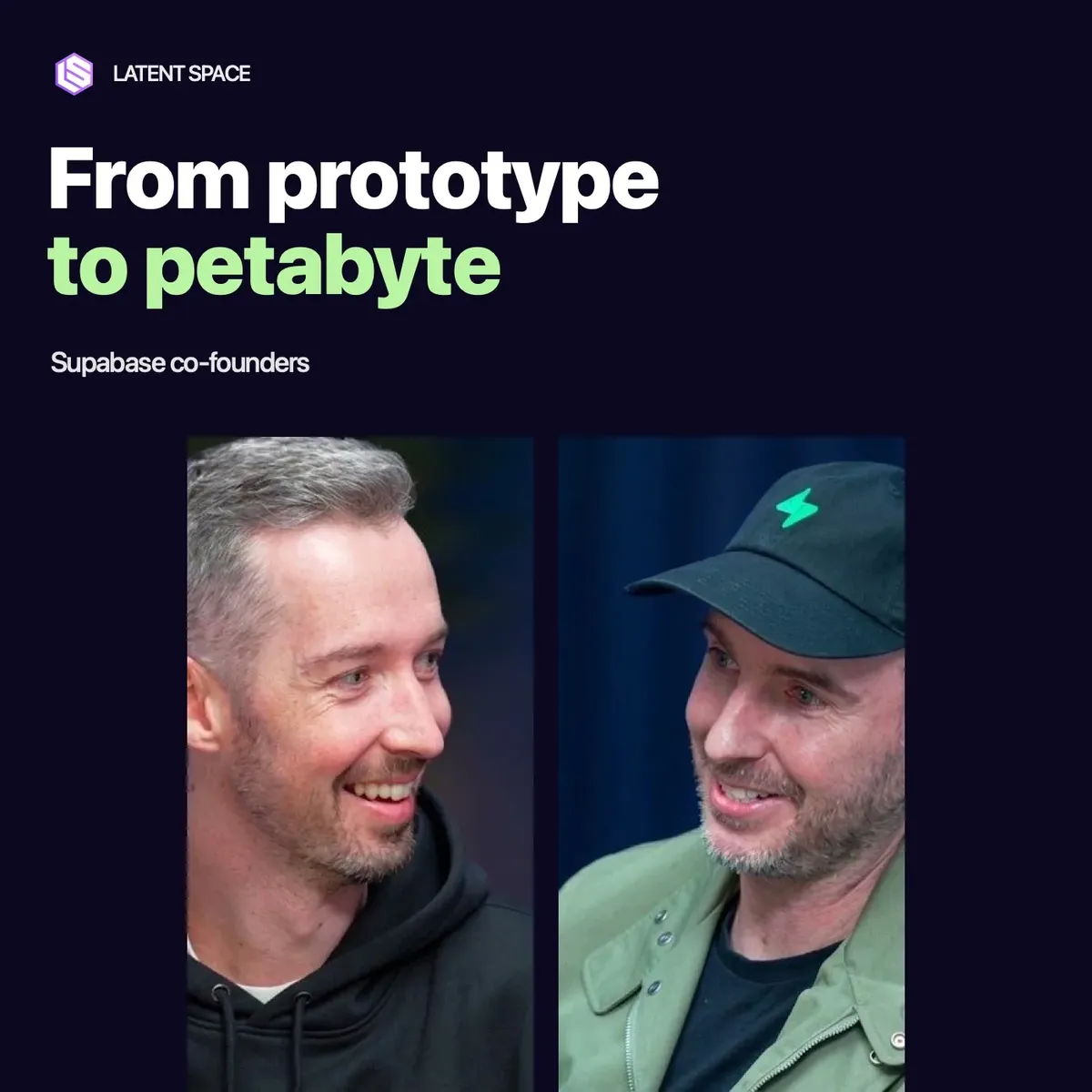
Supabase raised $150M led by GIC, with CapitalG participating, four months after a $500M Series F at a $10.5B valuation. It is acquiring Turso, and Turso's founder becomes Head of Agentic Services. The company says agents and AI tools create about 70% of its new databases, up from over 60% in June. [3] [4] [5]
Declarative Schemas 2.0 stores a database's full structure in files tracked in Git. An agent can read one schema instead of working through hundreds of migration files. The pg-delta library generates the migrations and works with any Postgres. Supabase also added local development without Docker and Compute, which runs long-running services next to the database. [1] [8]
OrioleDB is now in public beta on every plan. It replaces Postgres's default heap storage through the table access method interface and keeps old row versions in an undo log to avoid vacuum-related bloat. It reached about 1.8x throughput on a TPC-C-derived workload with data larger than memory. Supabase ran that test on its own benchmark site, dbarena, and no third party has reproduced it. [7] [1]
The planned path starts small and grows. Turso, a from-scratch SQLite rewrite that adds concurrent writes and keeps its write-ahead log on S3, would underpin a small instance type. Apps would then move to full Postgres and on to Multigres, a cluster manager now in private alpha that confirms writes only after a quorum of replicas agrees. [5] [6] [9] [1]
agents and AI tools already create most new Supabase databases, and declarative schemas and MCP confirmation prompts are available now. Implication: backends are being redesigned around what agents can read and change safely.
Read the full assessment
The new storage and scaling layers are still in beta or alpha.
Executive brief
About 70% of new Supabase databases are now created by agents or other AI tools, according to Supabase. That figure was over 60% in June. The Latent Space episode was recorded around the company's Select conference. In it, Supabase's founders describe a rebuild aimed at agents: local development without Docker, Git-native declarative schemas, co-located compute, a new storage engine (OrioleDB), a new cluster manager (Multigres), and the purchase of Turso, a company building on SQLite, so that very small databases can scale up to Postgres. The host, swyx, says on air that Supabase was his first angel investment and is now Latent Space's first sponsor (transcript 00:00:35–00:01:37).
What changed and event timeline
$500M Series F
Led by GIC at $10.5B post-money. TechCrunch reports nearly 10M developers and more than 600% annual growth in new databases. Multigres was introduced in the same period ().
Select keynote and Turso deal
$150M led by GIC, with CapitalG participating. Supabase is acquiring Turso and says it adds about 4M databases a month. Turso founder Glauber Costa becomes Head of Agentic Services (;).
Scaling stack announced
Multigres opens in private alpha and dbarena, a public benchmarking site, launches ().
Podcast published
The founders talk about announcements "tomorrow", which suggests the episode was recorded before Oct 2 and released weeks later ().
OrioleDB public beta post
Benchmark details and limitations published; available on every plan ().
Capabilities and access
- Declarative Schemas 2.0, which uses the pg-delta library to generate migrations. Supabase Compute for long-running services next to the database (daily.dev recap).
- Operate: MCP elicitations, which ask for confirmation before destructive actions. New data pipeline destinations (BigQuery, ClickHouse, DuckLake, Snowflake) (same recap).
- Scale: OrioleDB in public beta on every plan; Multigres open source, but invite-only and not for production on Supabase (changelog).
Read the full section
- Build: local development without Docker; Declarative Schemas 2.0, which uses the pg-delta library to generate migrations; Supabase Compute for long-running services next to the database (daily.dev recap).
- Operate: MCP elicitations, which ask for confirmation before destructive actions; health advisors; new data pipeline destinations (BigQuery, ClickHouse, DuckLake, Snowflake) (same recap).
- Scale: OrioleDB in public beta on every plan; Multigres open source, but invite-only and not for production on Supabase (changelog).
- Mentioned only in the interview: "Supabase Spark", a small instance type built on Turso, and "Control Tower" for managing fleets of databases (transcript 00:15:52, 00:40:10).
Technical analysis for researchers and developers
- Declarative schemas: An agent that wants to know a table's shape currently has to read through hundreds of migration files or start a database and run them.
- OrioleDB: plugs in through Postgres's table access method interface.
- Multigres: treats high availability as a consensus problem built on Postgres synchronous replication.
Read the full section
- Declarative schemas: An agent that wants to know a table's shape currently has to read through hundreds of migration files or start a database and run them. A single declarative schema file replaces that. pg-delta works with any Postgres (transcript 00:59:14–01:00:26).
- OrioleDB: plugs in through Postgres's table access method interface. It keeps old row versions in an undo log instead of leaving dead rows in the table, uses 64-bit transaction IDs, and stores rows inside the primary-key index (Supabase).
- Multigres: treats high availability as a consensus problem built on Postgres synchronous replication. A write is acknowledged only once a quorum agrees it is durable (Supabase).
- Turso: a from-scratch, open-source rewrite of SQLite that supports concurrent writes. It runs without local disks, with its write-ahead log on S3 (Turso).
- Reproducibility: dbarena publishes its methods and raw results.
Claims and evidence
- Agent-created databases (about 70%) and 4M databases a month: company figures; no independent audit found (PR Newswire).
- OrioleDB speed: the interview says "1.5 to 2 times faster" (transcript 00:07:56). It ran on Supabase's own dbarena, and no third-party replication was found.
- Multigres reliability: the claims that every existing Postgres operator can lose data under some conditions, and that 1,000 sequential failovers lost no data, come only from the interview (transcript 00:09:27–00:10:02).
Read the full section
- Agent-created databases (about 70%) and 4M databases a month: company figures; no independent audit found (PR Newswire).
- OrioleDB speed: the interview says "1.5 to 2 times faster" (transcript 00:07:56). The published benchmark is narrower: about 1.8x transactions per minute (113,850 tpm) on a TPC-C-derived workload, on a 32-vCPU instance with data larger than memory (Supabase). It ran on Supabase's own dbarena, and no third-party replication was found.
- Multigres reliability: the claims that every existing Postgres operator can lose data under some conditions, and that 1,000 sequential failovers lost no data, come only from the interview (transcript 00:09:27–00:10:02). No independent corroboration was found.
- Apache 2 license covering a purchased patent for OrioleDB: stated only in the interview.
Context and prior work
- Supabase began with the tagline "real-time Postgres" and switched to "open source Firebase alternative" around its first Hacker News launch (transcript 00:23:08–00:23:50).
- Multigres comes from the creator of Vitess, the MySQL sharding system. This time the team is putting full query compatibility first, before sharding.
- The founders credit years of community content and open source for AI models recommending Supabase. swyx's tracker of AI-engine recommendations (AEO) ranks it the frontier models' first choice for an integrated backend (transcript 00:33:47–00:35:17).
Read the full section
- Supabase began with the tagline "real-time Postgres" and switched to "open source Firebase alternative" around its first Hacker News launch (transcript 00:23:08–00:23:50).
- Multigres comes from the creator of Vitess, the MySQL sharding system. This time the team is putting full query compatibility first, before sharding.
- The founders credit years of community content and open source for AI models recommending Supabase. swyx's tracker of AI-engine recommendations (AEO) ranks it the frontier models' first choice for an integrated backend (transcript 00:33:47–00:35:17).
Limitations, safety and contested findings
- OrioleDB beta: no point-in-time recovery, no
CLUSTERorVACUUM FULL, experimental support for non-B-tree indexes such as pgvector HNSW, and no production SLA (Supabase). - Multigres: sharding is not released yet (transcript 00:11:23).
- Agent safety: early coding agents disabled row-level security (RLS) and stored image data in Postgres.
Read the full section
- OrioleDB beta: no point-in-time recovery, no
CLUSTERorVACUUM FULL, experimental support for non-B-tree indexes such as pgvector HNSW, and no production SLA (Supabase). - Multigres: sharding is not released yet (transcript 00:11:23).
- Agent safety: early coding agents disabled row-level security (RLS) and stored image data in Postgres. The founders say Lovable's agent skills addressed this first, and that newer models make these mistakes less often (transcript 00:46:46–00:47:17).
- Valuation: reported figures for the October round differ (Pomegra).
Business and practitioner implications
- Scale to zero, then grow: the plan is to start an app on a cheap Turso database, move it to Postgres, then to Multigres, with zero-downtime migration as a stated requirement.
- Distribution through AI labs: the founders call partnering with frontier labs their top priority, and CapitalG's investment gives them a route to Google Cloud for more compute capacity (transcript 00:26:32–00:26:59).
- Enterprise sales: new executive-level champions are appearing, for example product chiefs building internal tools with Lovable and Supabase.
Read the full section
- Scale to zero, then grow: the plan is to start an app on a cheap Turso database, move it to Postgres, then to Multigres, with zero-downtime migration as a stated requirement.
- Distribution through AI labs: the founders call partnering with frontier labs their top priority, and CapitalG's investment gives them a route to Google Cloud for more compute capacity (transcript 00:26:32–00:26:59).
- Enterprise sales: new executive-level champions are appearing, for example product chiefs building internal tools with Lovable and Supabase. The company sells through product signals such as customers hitting limits or errors, and measures outreach against a control group of customers who don't respond (transcript 00:42:01–00:46:08).
- For teams: declarative schemas and MCP confirmation prompts are useful now. OrioleDB and Multigres should stay out of critical workloads until they leave beta and alpha.
The source trail.
Sources (10)
Why Agents Love Supabase
Transcript retrieved via published_transcript; language en. Timestamped text, not direct audiovisual review. Source: https://rss.beehiiv.com/podcasts/transcriptions/01a183f0-c56d-72a4-9e07-fb3d07bab761.vtt. Automatic captions/transcription may contain errors.
latent.spaceTranscript: Why Agents Love Supabase
published_transcript
rss.beehiiv.com