
ModelsArchitectures & capability
Simon Willison builds 'Quick Study' browser painting tool from a single Claude Opus 5.5 prompt
Simon Willison used a single prompt to Claude Opus 5.5 at High effort to generate Quick Study, a dependency-free browser tool that repaints photos with simulated brushstrokes in seconds, echoing a 1998 SIGGRAPH painterly rendering technique.
From the Simon Willison article of October 23, 2026 and cited sources: One prompt to Opus 5.5 at its High effort setting produced Quick Study as a self-contained canvas artifact. [1] [7]
SOURCES[1] Quick Study — Simon Willison simonwillison.net[7] Quick Study tool tools.simonwillison.net
 AT Pulse research deskPublished · Updated · 4 min read · AI-assisted analysis
AI-assisted, not human-edited. Methodology Corrections Who owns this site
- What happened
- One prompt to Opus 5.5 at its High effort setting produced Quick Study as a self-contained canvas artifact. [1] [7]
- Original source
- Simon Willison article, independent perspective
- Brief by
- AT Pulse research desk AI-assisted; publisher and contact on the desk page
- When
- October 23, 2026 article published
- Covered
- Oct 24 edition
- Evidence
- 10 sources across 9 sites
- 1Quick Study — Simon Willisonsimonwillison.net
- 2Hertzmann, Painterly Rendering (NYU)mrl.cs.nyu.edu
- 3SIGGRAPH History Archive entryhistory.siggraph.org
- 4Pelican watercolor — Simon Willisonsimonwillison.net
- 5VentureBeat: Anthropic releases Claude Opus 5.5venturebeat.com
- 69to5Mac: Opus 5.59to5mac.com
Reach: not measured yet
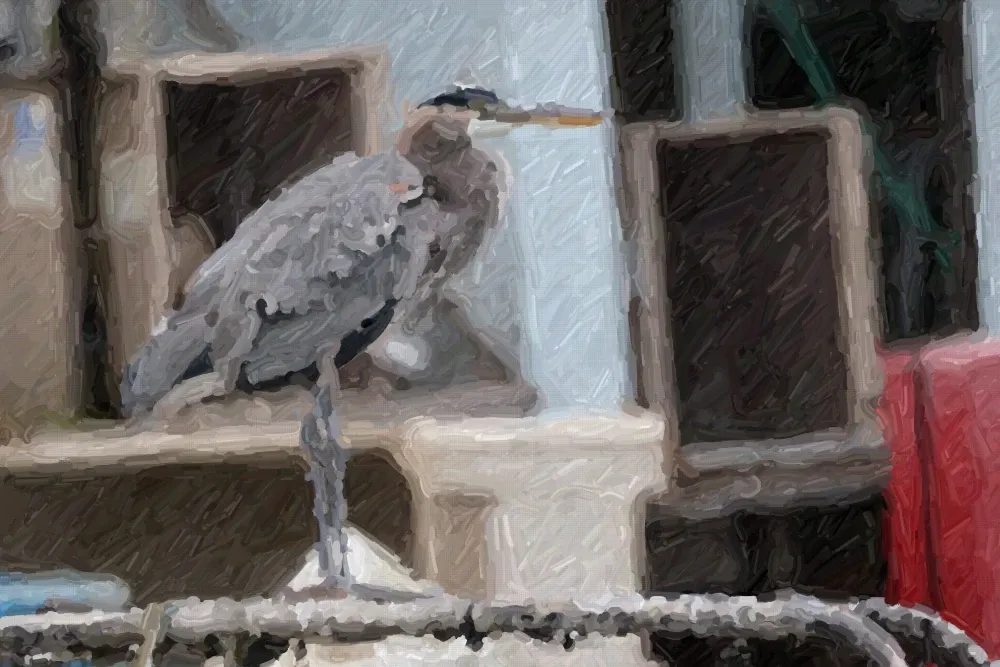
One prompt to Opus 5.5 at its High effort setting produced Quick Study as a self-contained canvas artifact. It uses Sobel edge detection and no external libraries apart from Google Fonts. Users load a photo and watch it painted stroke by stroke in Oil, Watercolor or Pointillist style, with adjustable detail and duration. [1] [7]
The coarse-to-fine painting approach closely tracks Aaron Hertzmann's 1998 SIGGRAPH method. That method layers progressively smaller brushes whose curved strokes follow image gradients, and it is still taught as a course assignment. The post doesn't say whether the resemblance was intended, so the model most likely reproduced known prior art rather than inventing something new. [1] [2] [3] [8]
Small creative-coding builds like this, and Willison's earlier p5.js watercolor pelican made with Claude Fable 5, are becoming informal ways to probe models. A related example is Artificial Analysis's Javascript Painter microeval. A single published prompt shows the task can be done, but says nothing about how reliably a model does it. [1] [4] [9]
one prompt yielded a working, shareable graphics tool built on established research. Implication, still untested: cheaper prototyping for demos, teaching and internal tools. Reliability across runs, models and effort levels has not been measured.
Executive brief
Simon Willison asked Claude Opus 5.5, with its "High" effort setting, for one thing: a browser tool that repaints any photo with a simulated paintbrush in a few seconds. The result, "Quick Study," came back as one self-contained artifact. It uses Sobel edge detection and has no external libraries beyond Google Fonts (Willison). The coarse-to-fine painting approach closely follows a SIGGRAPH 1998 technique, though the post doesn't say whether that was deliberate (Hertzmann). The tool is a small but concrete example of what one prompt can now produce. No independent coverage or evaluation of the tool turned up.
What changed and event timeline
The painterly algorithm is published
Aaron Hertzmann's SIGGRAPH paper paints an image in layers with progressively smaller brushes. Its curved strokes follow the image gradients, which is the conceptual ancestor of tools like Quick Study ().
Fable watercolor experiment
Willison prompted Claude Fable 5 at its Max reasoning setting to draw a watercolor pelican on a bicycle with p5.js. The result had adjustable washes, bleed and splatter ().
Opus 5.5 ships
Anthropic launched Opus 5.5 as the first model in the 5.5 family. It's priced at $4/$20 per million input/output tokens and has an effort parameter that controls how deeply it reasons (;).
Haiku 5.5 follows
Willison's blog lists a Claude Haiku 5.5 post on this date, which extends the 5.5 family ().
Quick Study published
One prompt to Opus 5.5 High produced a canvas painter that runs in a few seconds and uses Sobel edges. It is posted as Willison's 81st "tools" entry (;).
Capabilities and access
- Model: Claude Opus 5.5 at "High" effort, run as a Claude artifact (Willison).
- Tool features: You can load a photo by file, drag-and-drop or paste.
- Access: The tool is free in a browser. Opus 5.5 is available through Anthropic's API and through AWS, Google Cloud and Microsoft (VentureBeat).
Read the full section
- Model: Claude Opus 5.5 at "High" effort, run as a Claude artifact (Willison).
- Tool features: You can load a photo by file, drag-and-drop or paste. You then watch it painted stroke by stroke, coarse brushes first and fine ones last. Options include three styles (Oil, Watercolor, Pointillist), a Loose/Balanced/Fine detail setting and an adjustable duration, with 4 seconds shown (tool page).
- Access: The tool is free in a browser. Opus 5.5 is available through Anthropic's API and through AWS, Google Cloud and Microsoft (VentureBeat).
Technical analysis for researchers and developers
- Pipeline: Sobel filtering estimates how fast brightness changes across the photo. The tool page shows the coarse-to-fine order, but the post documents only "Sobel."
- Dependencies: Plain canvas with no p5.js. The earlier Fable piece relied on p5.js (Willison).
- Reproducibility: The prompt is published, but this is a single run with no seed or transcript and no comparison against other models or effort levels.
Read the full section
- Pipeline: Sobel filtering estimates how fast brightness changes across the photo. That lets strokes be oriented along edges and sized by detail, much like Hertzmann's gradient-aligned, multi-size layering (Hertzmann). The tool page shows the coarse-to-fine order, but the post documents only "Sobel."
- Dependencies: Plain canvas with no p5.js. The earlier Fable piece relied on p5.js (Willison).
- Reproducibility: The prompt is published, but this is a single run with no seed or transcript and no comparison against other models or effort levels. It shows that the task can be done, not how reliably a model does it.
Claims and evidence
- The tool paints within seconds using Sobel edge detection and no libraries: this is the author's own description, and the tool is publicly runnable (Willison).
- Opus 5.5 beats Fable 5.1 on agentic coding (Terminal-Bench 4.0: 66.4% vs 55.8%): these figures come from Anthropic, and VentureBeat notes no independent same-harness comparison exists (VentureBeat).
- About 40% lower cost per workload than Opus 5: an Anthropic claim based on the model using fewer tokens (VentureBeat).
Read the full section
- The tool paints within seconds using Sobel edge detection and no libraries: this is the author's own description, and the tool is publicly runnable (Willison).
- Opus 5.5 beats Fable 5.1 on agentic coding (Terminal-Bench 4.0: 66.4% vs 55.8%): these figures come from Anthropic, and VentureBeat notes no independent same-harness comparison exists (VentureBeat).
- About 40% lower cost per workload than Opus 5: an Anthropic claim based on the model using fewer tokens (VentureBeat).
Context and prior work
- Painterly rendering is a mature field of graphics research. Hertzmann's 1998 method is still used as a course assignment (Waterloo CS798).
- Creative coding is turning into an informal benchmark. Claude Opus 5 is among the models tested (Artificial Analysis).
- Willison's small "vibe-coded" tools, such as the earlier watercolor pelican, work as informal model probes (Willison).
Read the full section
- Painterly rendering is a mature field of graphics research. Hertzmann's 1998 method is still used as a course assignment (Waterloo CS798).
- Creative coding is turning into an informal benchmark. Artificial Analysis runs a "Javascript Painter" microeval that asks models to paint with p5.brush; Claude Opus 5 is among the models tested (Artificial Analysis).
- Willison's small "vibe-coded" tools, such as the earlier watercolor pelican, work as informal model probes (Willison).
Limitations, safety and contested findings
- The evidence is one prompt and one output, curated by the author. Failed attempts, if any, aren't shown.
- The model likely reproduced a known algorithm rather than inventing one, which is useful but not novel.
- One third-party guide says that at higher effort, the Opus 5.5 system card notes a tendency to make more changes than a task requires (OrcaRouter).
Read the full section
- The evidence is one prompt and one output, curated by the author. Failed attempts, if any, aren't shown.
- The model likely reproduced a known algorithm rather than inventing one, which is useful but not novel.
- One third-party guide says that at higher effort, the Opus 5.5 system card notes a tendency to make more changes than a task requires (OrcaRouter). This hasn't been checked against the system card itself.
- No independent corroboration of the tool exists beyond Willison's own pages.
Business and practitioner implications
- Prototyping cost: classic graphics techniques can be turned into shareable, dependency-free web tools from a single prompt, which helps with demos, internal tools and teaching.
- Effort tuning: effort settings matter, and higher effort costs more tokens.
- Domain knowledge: knowing the prior art, such as Hertzmann's method, helps you judge and steer outputs like this.
Read the full section
- Prototyping cost: classic graphics techniques can be turned into shareable, dependency-free web tools from a single prompt, which helps with demos, internal tools and teaching.
- Effort tuning: effort settings matter, and higher effort costs more tokens. Teams should benchmark effort levels on their own tasks rather than rely on vendor figures (VentureBeat).
- Domain knowledge: knowing the prior art, such as Hertzmann's method, helps you judge and steer outputs like this.