
ResearchPapers, evidence & method
Simon Willison flags a pelican-on-a-bicycle cameo in De Staat's 'FREEDOM' music video
Simon Willison pointed readers to the 00:44 mark of De Staat's FREEDOM video. The moment appears to show the bicycling pelican from his informal AI-model test, in a song the Dutch band says is about artificial intelligence.
From the Simon Willison article of October 22, 2026 and cited sources: Willison linked the official FREEDOM video and highlighted a moment at about 00:44–00:45. [1] [2] [7]
SOURCES[1] Simon Willison: DE STAAT – FREEDOM (Official Music Video) simonwillison.net[2] Spotted a familiar creature at 00:45s in this new music… x.com[7] Fake it or Leave it | AI Studio fakeitorleaveit.com
 AT Pulse research deskPublished · Updated · 5 min read · AI-assisted analysis
AI-assisted, not human-edited. Methodology Corrections Who owns this site
- What happened
- Willison linked the official FREEDOM video and highlighted a moment at about 00:44–00:45. [1] [2] [7]
- Original source
- Simon Willison article, independent perspective
- Brief by
- AT Pulse research desk AI-assisted; publisher and contact on the desk page
- When
- October 22, 2026 article published
- Covered
- Oct 23 edition
- Evidence
- 9 sources across 7 sites
- 1Simon Willison: DE STAAT – FREEDOM (Official Music Video)simonwillison.net
- 2Spotted a familiar creature at 00:45s in this new music…x.com
- 3Linked video: DE STAAT - FREEDOM (Official Music Video)youtube.com
- 4Simon Willison: The last six months in LLMs, illustrated…simonwillison.net
- 5Shazam: FREEDOM – De Staatshazam.com
- 6Rock Sound: De Staat 'DE STAAT' track by trackrocksound.tv
RisingHow it’s measured
YouTube video · 17.3K views · 1.3K likes
Reach blends public engagement (views, likes, comments, shares, stars) from the platforms where the story or its original source lives: YouTube, Hacker News, GitHub, Substack and similar. A video and the article written from its transcript share one score, taken from the video. Platforms with no data are left out rather than counted as zero, and the age of a story never lowers its score.
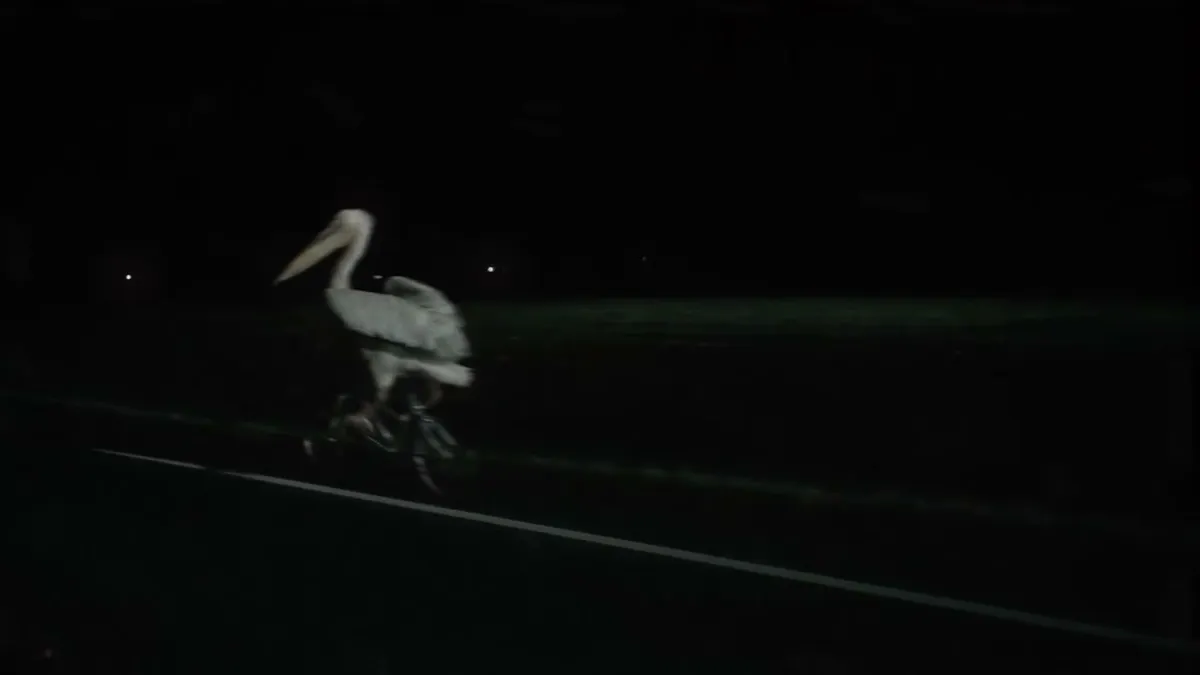
Willison linked the official FREEDOM video and highlighted a moment at about 00:44–00:45. His blog post does not say what appears on screen. His pelican-riding-a-bicycle tag and his X post about a 'familiar creature' suggest it is the pelican from his test. He credits the visual effects to Matties Grooten of the AI studio Fake it or Leave it, which offers face swaps, inpainting, generative video and lip-sync. [1] [2] [7]
The band describes FREEDOM as a song about AI. It plays on 'free' meaning either liberated or expendable. The lyrics come back to the theme of not being able to tell real from artificial, and the flagged moment comes right after the line asking whether the listener has heard the name. [6] [3]
The original test asks a text model to write SVG code for a pelican riding a bicycle. A pelican in a VFX-produced video therefore tells us nothing about any model's score. It does show how a popular test prompt can spread into wider culture, which may make it less useful for comparing models over time. [4] [9]
What the sources show: a well-known informal AI test now turns up in mainstream creative work. What it could mean: popular test prompts may lose value as they spread into culture and possibly training data, so evaluators should rotate them.
Executive brief
A pelican riding a bicycle, the subject of Simon Willison's informal test for AI models, seems to show up in a commercial rock video. On 22 October 2026 Willison called the FREEDOM video by Dutch band De Staat "a first for me" and pointed readers to 00:44. His post does not say what is on screen. Its tag ("pelican-riding-a-bicycle") and his X post about a "familiar creature" at 00:45 point to the pelican. The visual effects are credited to Matties Grooten of the AI studio Fake it or Leave it. No independent coverage confirms the shot or how it was made.
What changed and event timeline
The pelican test reaches the big labs
Willison said the "SVG of a pelican riding a bicycle" prompt began as a joke and turned out to be useful. Google then showed its own pelican during the I/O keynote ().
FREEDOM is released
The track came out on the album DE STAAT through V2 Records Benelux. Torre Florim wrote it and sings lead ().
The band says the song is about AI
In a track-by-track piece, De Staat said "free" can mean liberated or expendable, which it compares to the choice AI presents ().
Willison flags 00:44
His link post sends readers to the timestamp and credits the VFX to Matties Grooten and Fake it or Leave it ().
Capabilities and access
- The official video is public on YouTube. Its upload date is not documented in the reviewed sources.
- Fake it or Leave it, run by brothers Cas and Matties Grooten, offers face swaps, AI clean-up and inpainting, generative video, AI motion capture and lip-sync.
- No model, tool or version is named for the 00:44 shot or anywhere else in the video.
Read the full section
- The official video is public on YouTube. Its upload date is not documented in the reviewed sources.
- Fake it or Leave it, run by brothers Cas and Matties Grooten, offers face swaps, AI clean-up and inpainting, generative video, AI motion capture and lip-sync.
- No model, tool or version is named for the 00:44 shot or anywhere else in the video.
Technical analysis for researchers and developers
- The original test asks a text model to write SVG code, not to make pixels.
- A pelican in a music video comes from a different kind of pipeline (VFX or generative video), so it says nothing about any model's score on the test.
- Nothing about how the shot was made is published: no prompts, models or compositing steps. It cannot be reproduced.
Read the full section
- The original test asks a text model to write SVG code, not to make pixels. Willison says SVG comments show what the model was trying to draw (Willison).
- A pelican in a music video comes from a different kind of pipeline (VFX or generative video), so it says nothing about any model's score on the test.
- Nothing about how the shot was made is published: no prompts, models or compositing steps. It cannot be reproduced.
- This shows a broader risk for informal benchmarks. Once a test prompt becomes a cultural meme, it can turn up in training data and creative work. Willison raised the same worry when labs started showing pelicans themselves.
Claims and evidence
- The pelican appears at about 00:44–00:45. This is inferred from the blog's tag and the X post (blog, X). No other source confirms it.
- Fake it or Leave it did the VFX. The studio's site lists "The King | De Staat" (2026) in its portfolio but does not list FREEDOM.
- The shot was made with generative AI. No source says this. It is an inference from the studio's services, not a documented fact.
Read the full section
- The pelican appears at about 00:44–00:45. This is inferred from the blog's tag and the X post (blog, X). No other source confirms it.
- Fake it or Leave it did the VFX. This credit comes from Willison. The studio's site lists "The King | De Staat" (2026) in its portfolio but does not list FREEDOM.
- The shot was made with generative AI. No source says this. It is an inference from the studio's services, not a documented fact.
- The song is about AI. This comes from the band itself (Rock Sound).
Context and prior work
- De Staat formed in Nijmegen in 2006 and is known for concept videos.
- Willison's pelican tag has about 150 posts, many of them tracking model launches, most recently Claude Haiku 5.5 (tag page).
- The lyrics, from auto-captions that may contain errors, return to AI themes: "Even I can't tell the difference" (00:34), "It sounds a lot like you" (01:10), "Nothing is real" (01:25) and "Your hands off the wheel" (03:16).
Read the full section
- De Staat formed in Nijmegen in 2006 and is known for concept videos. "Witch Doctor" won Best Concept at the 2016 Berlin Music Video Awards (Wikipedia).
- Willison's pelican tag has about 150 posts, many of them tracking model launches, most recently Claude Haiku 5.5 (tag page).
- The lyrics, from auto-captions that may contain errors, return to AI themes: "Even I can't tell the difference" (00:34), "It sounds a lot like you" (01:10), "Nothing is real" (01:25) and "Your hands off the wheel" (03:16).
- The flagged moment falls next to "Have you heard the name?" (00:41).
Limitations, safety and contested findings
- No independent outlet has reported on the pelican shot. The only sources are Willison's blog and his X post.
- The captions are automatic and cut off in places (for example "practic" at 01:40). They describe the audio only, not what is on screen.
- Neither the band nor the studio has said whether the pelican was a deliberate nod to Willison or a coincidence.
Read the full section
- No independent outlet has reported on the pelican shot. The only sources are Willison's blog and his X post.
- The captions are automatic and cut off in places (for example "practic" at 01:40). They describe the audio only, not what is on screen.
- Neither the band nor the studio has said whether the pelican was a deliberate nod to Willison or a coincidence.
- No conflicting accounts were found.
Business and practitioner implications
- For creative studios: AI-VFX shops like Fake it or Leave it now work on mainstream music videos.
- For evaluators: a famous test prompt may now be over-represented in training data and culture.
- For marketers: references to AI community in-jokes can spread quickly through practitioner networks. This video was flagged within hours of Willison's post.
Read the full section
- For creative studios: AI-VFX shops like Fake it or Leave it now work on mainstream music videos. Crediting the tools and methods would help audiences and rights holders understand the work.
- For evaluators: a famous test prompt may now be over-represented in training data and culture. Rotate or hide test prompts before trusting pelican results on new models.
- For marketers: references to AI community in-jokes can spread quickly through practitioner networks. This video was flagged within hours of Willison's post.
- For anyone citing the story: treat it as a cultural signal, not a benchmark result.
The source trail.
Sources (9)
Simon Willison: DE STAAT – FREEDOM (Official Music Video)
simonwillison.netSpotted a familiar creature at 00:45s in this new music video for FREEDOM by De Staad https://t.co/AEIsAkro77 https://t.co/voZuAsGX17
Related coverage; assess separately
x.comLinked video: DE STAAT - FREEDOM (Official Music Video)
linked video auto captions
www.youtube.com