
InfrastructureCompute, chips & cloud
Western Digital says an 8-second AI video clip left 130 times its size in server-side data
Western Digital measured an 8-second, 3.97MB AI video clip leaving more than 500MB of logs, cached context, intermediate renders, backups and safety records. Its broader case is that inference keeps producing data that must be kept, so storage becomes a growing AI cost.
From the MIT Technology Review · AI article of October 22, 2026 and cited sources: In Western Digital's own test, one short AI-generated video left more than 500MB of data on the servers, about 130 times the file the user got back. [1]
SOURCES[1] AI’s hidden storage bill: What inference leaves behind technologyreview.com
 AT Pulse research deskPublished · Updated · 5 min read · AI-assisted analysis
AI-assisted, not human-edited. Methodology Corrections Who owns this site
- What happened
- In Western Digital's own test, one short AI-generated video left more than 500MB of data on the servers, about 130 times the file the user got back. [1]
- Original source
- MIT Technology Review · AI article, independent perspective
- Brief by
- AT Pulse research desk AI-assisted; publisher and contact on the desk page
- When
- October 22, 2026 article published
- Covered
- Oct 22 edition
- Evidence
- 9 sources across 9 sites
- 1AI’s hidden storage bill: What inference leaves behindtechnologyreview.com
- 2Soaring Inference AI Demand Triggers Severe Nearline HDD…mail.iconnect007.com
- 3The next big shifts in AI workloads and hyperscaler…karriere.mckinsey.de
- 4Introducing NVIDIA BlueField-4-Powered CMX Context Memory…developer.nvidia.com
- 5AI drives enterprise storage demand as data piles up…itbrief.co.uk
- 6The Next AI Challenge: Managing Data at Scale (WD blog)blog.westerndigital.com
QuietHow it’s measured
Hacker News · 1 like
Reach blends public engagement (views, likes, comments, shares, stars) from the platforms where the story or its original source lives: YouTube, Hacker News, GitHub, Substack and similar. A video and the article written from its transcript share one score, taken from the video. Platforms with no data are left out rather than counted as zero, and the age of a story never lowers its score.
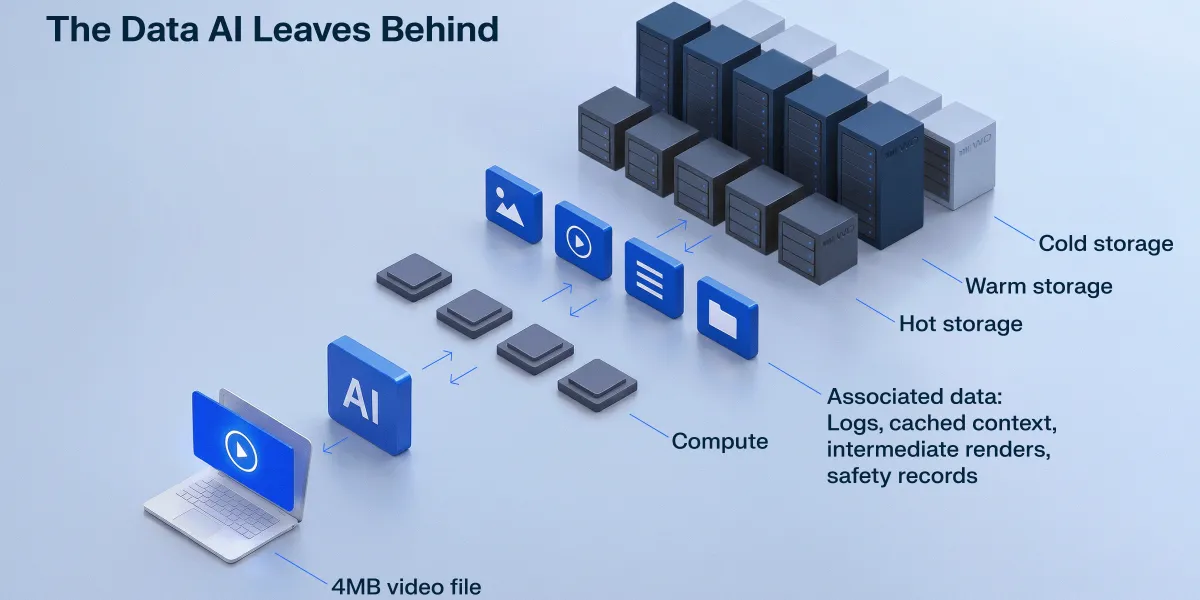
In Western Digital's own test, one short AI-generated video left more than 500MB of data on the servers, about 130 times the file the user got back. The figure comes from the storage vendor's sponsored article, which publishes no method and names no model, serving stack or retention settings. It should be read as an example, not a benchmark. [1]
Nearline hard drives are in short supply. TrendForce reports lead times have grown from weeks to more than 52 weeks. Western Digital has raised HDD prices, and recertified drives roughly doubled in price per terabyte. TrendForce also expects cloud providers to turn to high-capacity QLC SSDs, which it says use less power. [2] [9]
Inference creates two kinds of storage load. NVIDIA's CMX platform puts short-lived KV cache on a dedicated fast-flash tier and moves inactive context, query history and logs to object and file storage. Western Digital's 130x figure mostly covers the second kind: data that lasts and costs less to store. [4] [1]
nearline drives take 52-plus weeks to arrive, and NVIDIA built a separate tier for inference context. Implication: teams should track stored bytes per request alongside GPU-hours, set retention rules on purpose and order capacity early.
Read the full assessment
Retained safety records also bring compliance duties.
Sources are gathered; writing the dossier now.
Executive brief
The most striking figure is Western Digital's own measurement: an 8-second AI video clip sent to the user as a 3.97MB 720p file left more than 500MB of data behind on the servers, about 130 times the output size. That data included logs, cached context, intermediate renders, backups and safety records. No one has checked this figure independently, and the article is sponsored content by WD (Western Digital), a storage vendor, not written by MIT Technology Review's editors. Its main argument holds up better than that number does. Inference keeps producing data that must be kept, nearline hard drives are in short supply, and storage is becoming a cost line in AI budgets that grows over time.
What changed and event timeline
Nearline HDD shortage flagged
The analyst firm TrendForce reported that lead times for nearline hard drives had grown from weeks to more than 52 weeks. It blamed demand from AI inference and said high-capacity QLC SSDs were set for a breakout in 2026.
McKinsey projects inference overtaking training
Inference power demand is forecast to grow 35% a year (20.9 to 93.3 GW) and training 22% a year (23.1 to 62.2 GW) from 2025 to 2030.
NVIDIA adds a storage tier for inference context
NVIDIA introduced CMX, a flash storage tier powered by its BlueField-4 chip and dedicated to the KV cache (the stored attention state a model reuses across turns). Logs and inactive context move down to object and file storage.
WD-commissioned IDC survey released
IDC surveyed 763 decision-makers in seven countries. 94.7% said they stored more data because of AI, and 61% reported AI-driven data growth of 25% or more.
More detail
WD sponsored piece runs in MIT Technology Review
It introduces the 130x video-footprint claim and argues for tiered, HDD-heavy capacity planning.
Capabilities and access
This is not a model release, so there is no model version to report. The sponsored piece does not name the video model, the serving stack or the retention settings behind its 8-second-clip measurement. The IDC white paper is titled "Built for Scale: The Enduring Role of HDDs in the AI Era" (Doc. #US54789026, September 2026) and was commissioned by WD.
Technical analysis for researchers and developers
- What makes up the leftover data. WD lists logs, cached context, intermediate renders, backups and safety records.
- Two kinds of storage pressure. NVIDIA's CMX design separates short-lived KV cache that needs fast flash from durable artifacts that can live in object storage: inactive multi-turn state, query history and logs.
- WD's blog says 96% of respondents expect to need faster archive retrieval for inference and RAG.
Read the full section
- What makes up the leftover data. WD lists logs, cached context, intermediate renders, backups and safety records. It gives no breakdown by category, retention period or deduplication, so the 130x ratio cannot be reproduced.
- Two kinds of storage pressure. NVIDIA's CMX design separates short-lived KV cache that needs fast flash from durable artifacts that can live in object storage: inactive multi-turn state, query history and logs. WD's figure mostly concerns the second, cheaper-to-store kind.
- Reuse. WD's blog says 96% of respondents expect to need faster archive retrieval for inference and RAG. If that holds, "cold" storage tiers will face read loads as well as capacity demands. WD blog
Claims and evidence
- 130x back-end footprint. This comes only from WD's internal measurement, with no published method. Source
- WD says inference will be more than 40% of total data center demand by 2030. The discrepancy is unresolved.
- Coverage of the survey includes no outside commentary.
Read the full section
- 130x back-end footprint. This comes only from WD's internal measurement, with no published method. Source
- Inference share of demand. WD says inference will be more than 40% of total data center demand by 2030. McKinsey's own text says "roughly 30 to 40 percent", even though its GW figures (93.3 of 219 GW) work out to about 43%. The discrepancy is unresolved.
- Survey statistics. These come from a vendor-commissioned IDC survey. Coverage of the survey includes no outside commentary.
- HDD supply strain. This is supported separately by TrendForce.
Context and prior work
- Until now, AI infrastructure spending has centered on GPUs.
- NVIDIA's addition of a dedicated tier for inference context shows that the platform vendor also treats inference state as a separate storage problem. NVIDIA
- Equity analysts have also described inference as a lasting source of storage demand. Nasdaq/Zacks
Read the full section
- Until now, AI infrastructure spending has centered on GPUs. WD's CEO Irving Tan presents the shift as moving from a compute story to a data story. IT Brief UK
- NVIDIA's addition of a dedicated tier for inference context shows that the platform vendor also treats inference state as a separate storage problem. NVIDIA
- Equity analysts have also described inference as a lasting source of storage demand. Nasdaq/Zacks
Limitations, safety and contested findings
- WD's piece argues HDDs win on cost per TB.
- Hard drive prices are rising. WD has raised prices across its HDD range, and recertified drives went from about $12–16/TB to $24–31/TB. CO/AI
- The piece counts safety records as part of the retained data, so retention decisions also involve compliance and privacy, not just cost.
Read the full section
- WD's piece argues HDDs win on cost per TB. TrendForce instead reports that the shortage is pushing cloud providers toward QLC SSDs, which it says are about 30% more power-efficient than nearline HDDs. TrendForce
- Hard drive prices are rising. WD has raised prices across its HDD range, and recertified drives went from about $12–16/TB to $24–31/TB. CO/AI
- The piece counts safety records as part of the retained data, so retention decisions also involve compliance and privacy, not just cost.
Business and practitioner implications
- Track stored bytes per generation and per query alongside GPU-hours.
- Measure your own leftover data per request. Vendor ratios depend heavily on configuration.
- Nearline lead times of 52+ weeks mean capacity has to be ordered well ahead of need. TrendForce
Read the full section
- Budget storage per request. Track stored bytes per generation and per query alongside GPU-hours. WD's three budgeting questions (who sets retention, whether procurement follows the real data lifecycle, how cost scales if usage doubles) are a reasonable starting audit.
- Instrument before you trust ratios. Measure your own leftover data per request. Vendor ratios depend heavily on configuration.
- Procurement risk. Nearline lead times of 52+ weeks mean capacity has to be ordered well ahead of need. TrendForce
- Separate the tiers. Hot KV cache and durable logs and archives should be designed and costed separately. NVIDIA
The source trail.
Sources (9)
AI’s hidden storage bill: What inference leaves behind
Article text retrieved; extracted text may omit tables or interactive elements.
technologyreview.com